How Electrical Energy Works: Mastering Fundamental Electronics Part 09
A phone charger marked 20W tells you how quickly it can transfer energy under certain conditions. It does not tell you how much energy reaches a phone during an hour, a day, or a full charge. For that, rate must be combined with time.
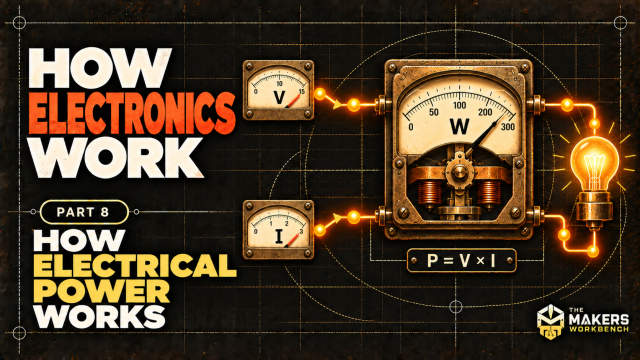
Electrical energy is the amount transferred or converted. A source can deliver it, a battery can make some available from chemical storage, and a load can convert it into light, heat, motion, sound, or computation. How Electrical Power Works introduced the rate. This article follows that rate through time and sorts out joules, watt-hours, kilowatt-hours, and ampere-hours.
The distinction between rate and amount appears on labels and bills everywhere. A battery is rated in milliampere-hours or watt-hours, a utility bills in kilowatt-hours, and a capacitor stores a number of joules that can be calculated from its capacitance and voltage. Each of these is a measure of energy, or in the case of ampere-hours something closely related, and confusing them with power gives wrong estimates of battery life, running cost, and storage.
The sections that follow define the joule and show how voltage connects energy to charge. They then build the watt-hour and kilowatt-hour from power and time, explain why an ampere-hour rating is not an energy rating on its own, and work through a battery runtime and a running-cost example. The article ends with how capacitors, inductors, and batteries store energy and how conversion losses reduce what reaches the load. It builds on the earlier articles on voltage, current, and power.
Energy as an Amount
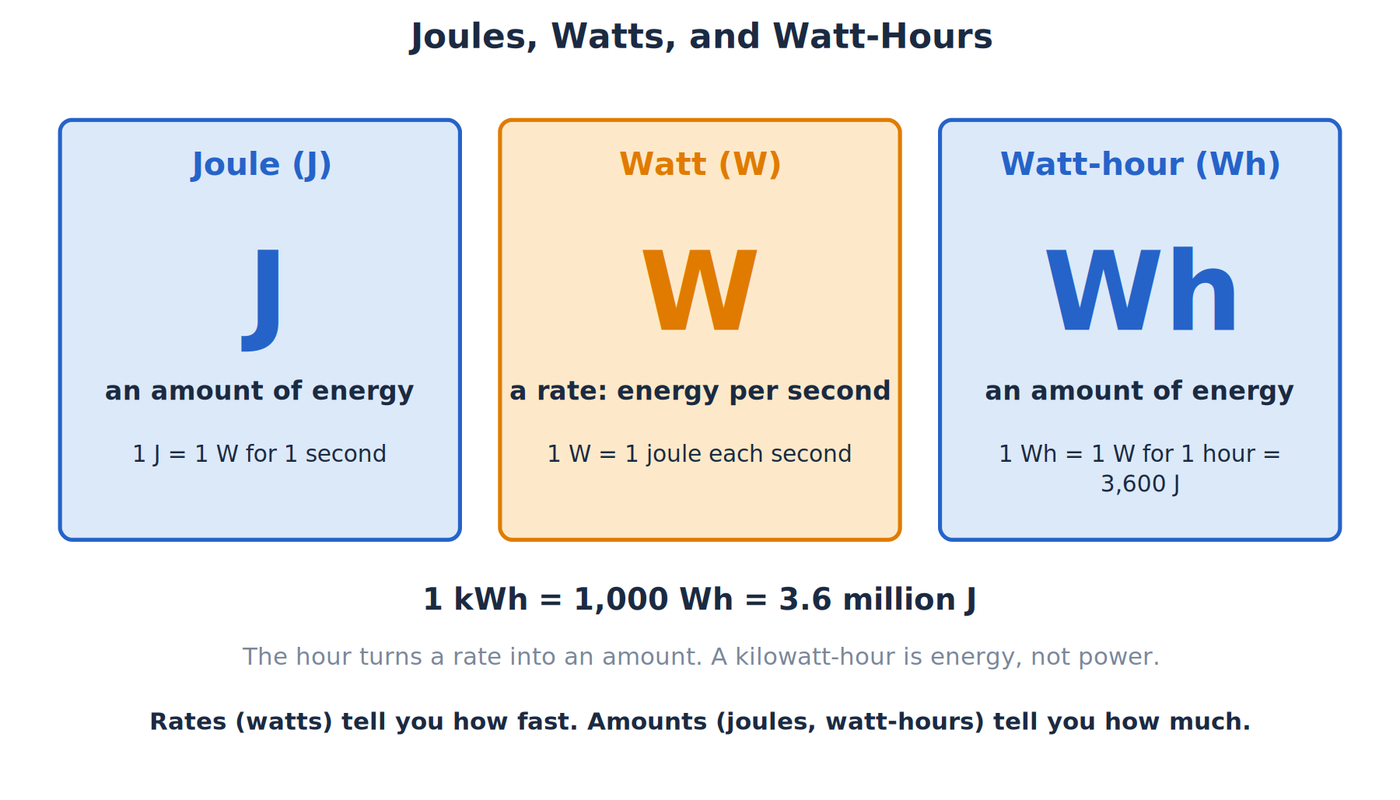
Energy is the capacity to do work or produce change. The SI unit is the joule (J). One joule is the energy transferred by one watt operating for one second:
1J = 1W·s
That distinction is the foundation of the article. A watt is a rate. A joule is an amount. Asking how many watts a battery “contains” is like asking how many miles per hour are stored in a fuel tank. The rate and the total are related, but they are not interchangeable.
Electrical systems do not destroy energy. They convert it. A lamp converts electrical energy into light and heat. A motor converts it into motion, sound, and heat. Everyday speech says a device “uses” energy, but the energy has changed form.
Energy per Charge
Voltage tells us how much energy is transferred per unit charge. One volt equals one joule per coulomb. If charge q moves through a potential difference V, the transferred energy is:
E = qV
A coulomb (C) is a quantity of electric charge. If 2 C moves through a 5V potential difference:
E = 2 C × 5J/C = 10J
The coulombs cancel, leaving joules. This does not mean voltage alone tells us total energy. We also need to know how much charge moved.
The equation connects two familiar ideas. Higher voltage means more energy transferred for each coulomb. More charge passing through the same voltage means more total energy.
Power Accumulated over Time
Power is the rate at which energy moves. If power stays constant:
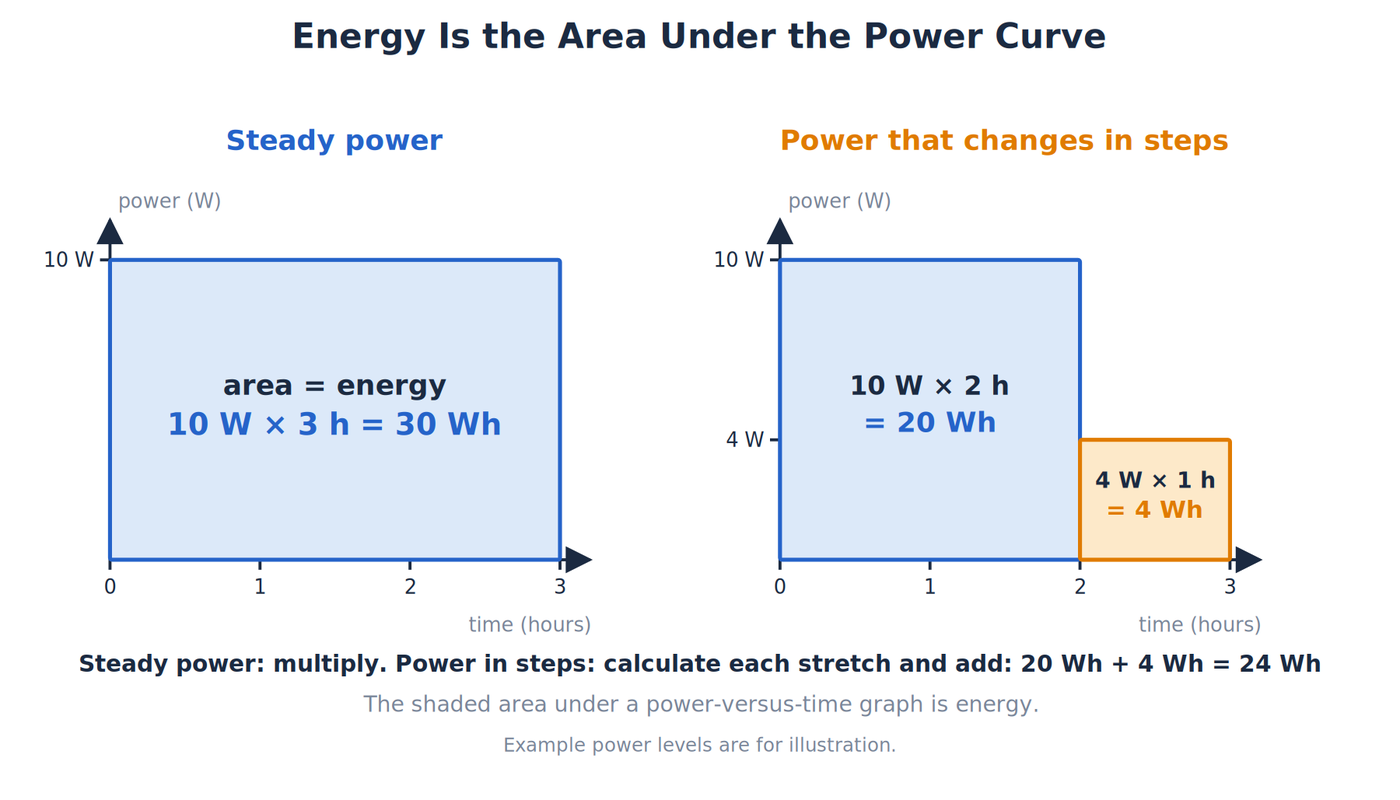
E = P × t
A 10W device running for 3 hours transfers:
E = 10W × 3 h = 30Wh
In joules, 3 hours is 10,800 seconds:
E = 10J/s × 10,800 s = 108,000J = 108kJ
If power changes, energy is the area under a power-versus-time graph. Engineers write that as E = ∫P(t)dt. The integral symbol means adding many tiny slices of power multiplied by time. You do not need calculus for a device whose power draw is steady, or steady in stretches; calculate each interval and add the results.
Two relationships now cover most calculations. Voltage is energy per charge, so charge moved through a voltage gives energy. Power is energy per time, so power multiplied by operating time also gives energy. The practical units for the second relationship come next.
Watt-Hours and Kilowatt-Hours
The watt-hour (Wh) is a practical energy unit. It is power multiplied by time:
1Wh = 1W × 1 h = 3,600J
A kilowatt-hour (kWh) is 1,000Wh:
1kWh = 3.6 million J
Despite the word “watt,” a kilowatt-hour is energy. The hour is what turns a power rate into an amount. The unit is the same whether it describes a small device scaled up over a long run or the reading on a household electric meter. Electric utilities bill customers in kilowatt-hours, and the next subsection shows the arithmetic.
Estimating Energy Cost
The cost of running a device is its energy in kilowatt-hours multiplied by the price per kilowatt-hour. Prices vary by location, utility, and time of day, so the examples use an assumed rate of $0.17 per kWh. Replace it with the rate on your own bill.
A 100W device that runs for 8 hours uses 100W × 8 h = 800Wh = 0.8kWh. At $0.17 per kWh that costs 0.8 × $0.17 ≈ $0.14. A small 10W device left on for a full year (8,760 hours) uses 10W × 8,760 h = 87.6kWh, which costs about 87.6 × $0.17 ≈ $14.89. Small loads that never switch off can add up to more than a larger load used briefly.
Other Energy Units
Other fields use their own energy units, and each converts to joules.
| Unit | Equals | Where it appears |
|---|---|---|
| Kilowatt-hour (kWh) | 3,600,000J | Electric bills |
| Food Calorie (kilocalorie) | 4,184J | Food labels |
| BTU | about 1,055J | Heating and cooling equipment |
| Electron-volt (eV) | about 1.6 × 10⁻¹⁹ J | Semiconductor and particle physics |
A Small Device over One Day
Suppose a sensor node draws a steady 0.50W. Over 24 hours:
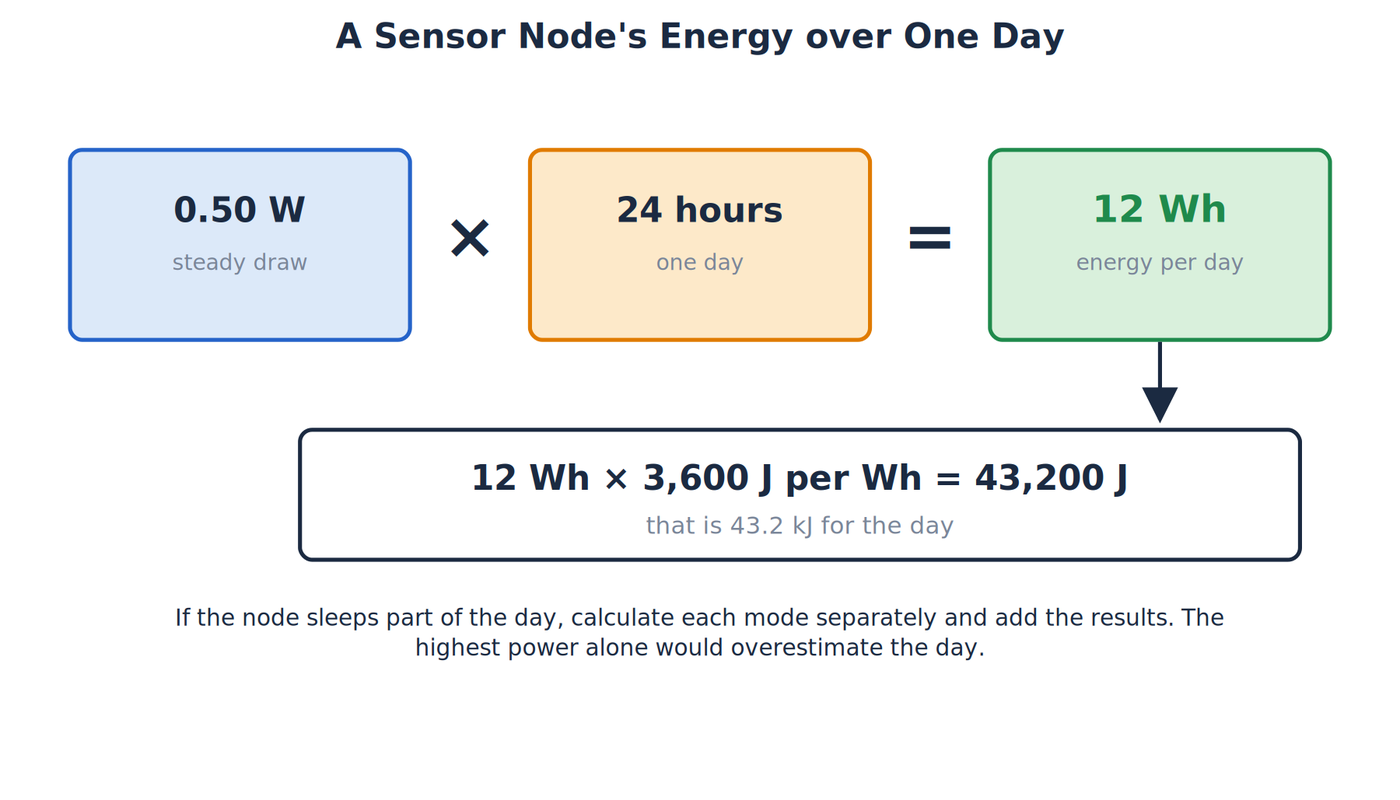
E = 0.50W × 24 h = 12Wh
In joules:
12Wh × 3,600J/Wh = 43,200J = 43.2kJ
If the device sleeps part of the day and wakes briefly, calculate the energy for each mode and add the results. Using only the highest power would overestimate daily energy, while using only the sleep power would underestimate it.
Ampere-Hours versus Energy
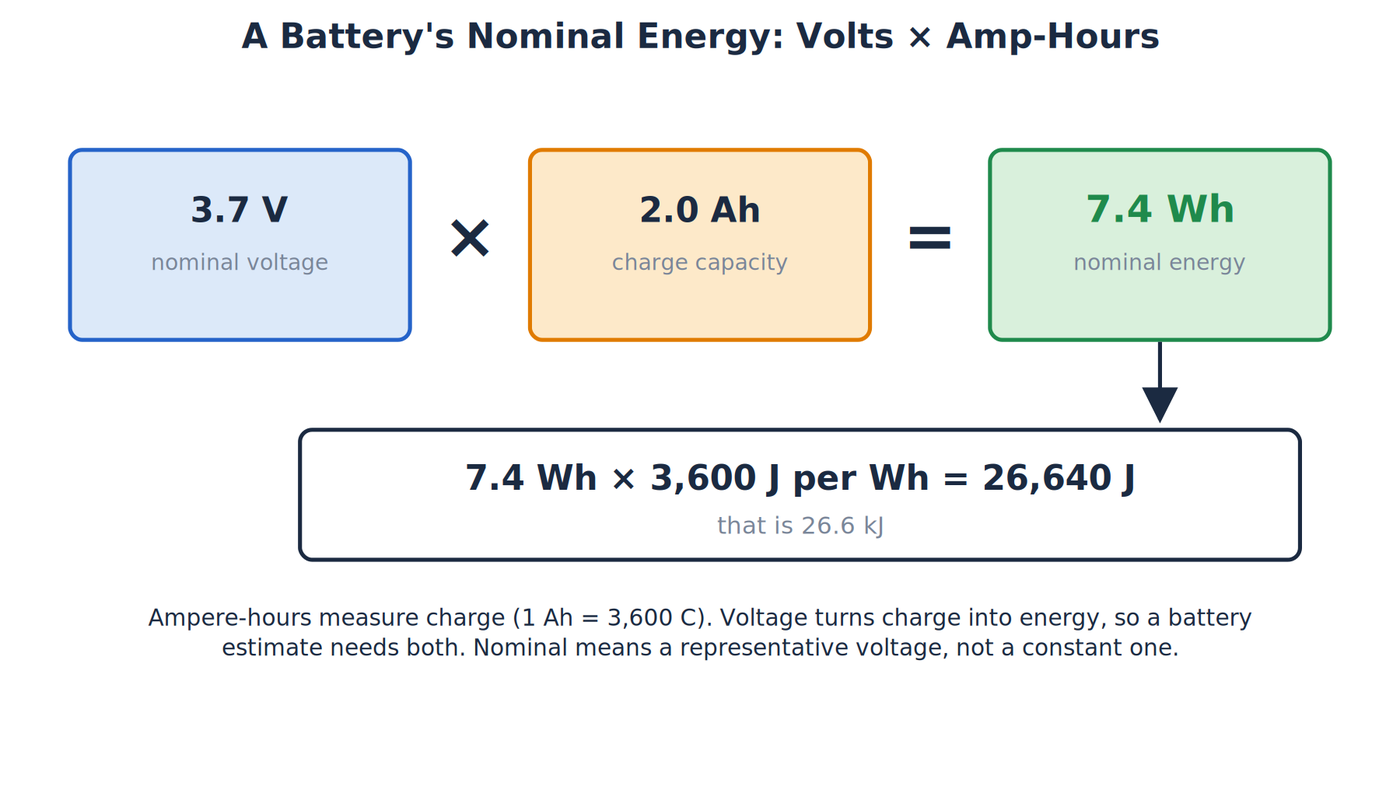
Battery labels often show ampere-hours (Ah) or milliampere-hours (mAh). Ampere-hours measure charge, not energy:
1Ah = 3,600 C
You need voltage to estimate energy. A common nominal lithium-ion cell label might state 3.7V and 2.0Ah. “Nominal” means a representative operating voltage, not a constant voltage throughout discharge. Its rough nominal energy is:
E ≈ Vnominal × capacity
E ≈ 3.7V × 2.0Ah = 7.4Wh
That is about:
7.4Wh × 3,600J/Wh = 26,640J = 26.6kJ
The 3.7V, 2.0Ah numbers illustrate the method, not a promise for every cell. Check the label or datasheet of the cell you actually have before doing this math for real.
Real usable energy depends on discharge current, cutoff voltage, temperature, age, cell protection, and the manufacturer’s test method. A converter between the battery and load also loses energy. Two batteries with the same 2Ah rating can hold different nominal energy if their voltages differ.
Worked Example: Battery Runtime
Runtime is the usable energy divided by the power the load draws. Suppose a 3.7V, 2.0Ah battery (7.4Wh nominal) powers a 5V load that draws 0.50A through a boost converter with 85 percent efficiency.
Load power = 5V × 0.50A = 2.5W
Input power = 2.5W / 0.85 ≈ 2.94W
Runtime = 7.4Wh / 2.94W ≈ 2.5 h
The check agrees: 2.5W for 2.5 h is about 6.3Wh delivered, which is 85 percent of 7.4Wh. If only 90 percent of the nominal energy is usable before the protection circuit shuts the battery off, the runtime drops to 6.66Wh / 2.94W ≈ 2.3 h. Dividing the 2.0Ah rating by the 0.50A load current would predict 4 hours, which is wrong because the battery and the load run at different voltages. Convert to energy first.
Storage, Transfer, and Conversion Losses
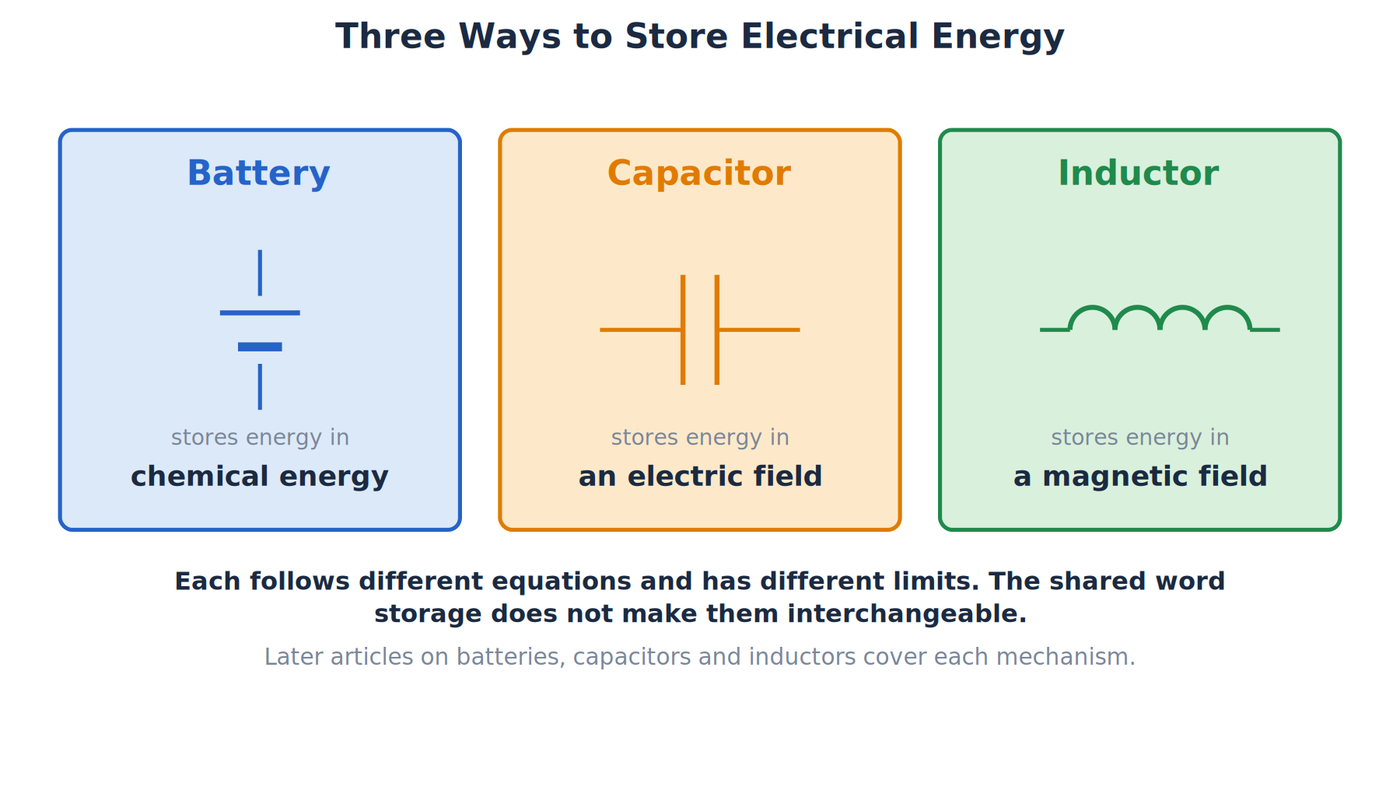
Batteries store chemically available energy. Capacitors store energy in an electric field, and inductors (coils of wire) store energy in a magnetic field. Each mechanism follows different equations and has different limits. The shared word “storage” does not make the devices interchangeable.
A capacitor stores energy according to its capacitance, C, in farads, and the voltage across it:
E = ½ C V²
A 1,000µF capacitor charged to 5V holds E = 0.5 × 0.001 F × (5V)² = 0.0125J, or 12.5mJ. That is about 3.5 millionths of a watt-hour, roughly two million times less than the 7.4Wh battery above. A capacitor releases its energy quickly and returns it nearly completely, so it suits smoothing, short bursts, and timing, and the battery suits long runtimes.
An inductor stores energy according to its inductance, L, in henries, and the current through it:
E = ½ L I²
A 10mH inductor carrying 1A holds E = 0.5 × 0.010 H × (1A)² = 5mJ. The energy is tied to the current, so the inductor gives it back as the current falls, which is the behavior switching power supplies use.
Efficiency compares useful output energy with input energy over the same interval:
η = Eout / Ein
If a nominally 10Wh source delivers 8Wh to a load before the system reaches its cutoff, the system’s delivery efficiency under those conditions is 80 percent. The other 2Wh is not missing. It may become heat in the battery, converter, wiring, and load-support electronics, remain inaccessible below the cutoff, or be consumed by standby circuits.
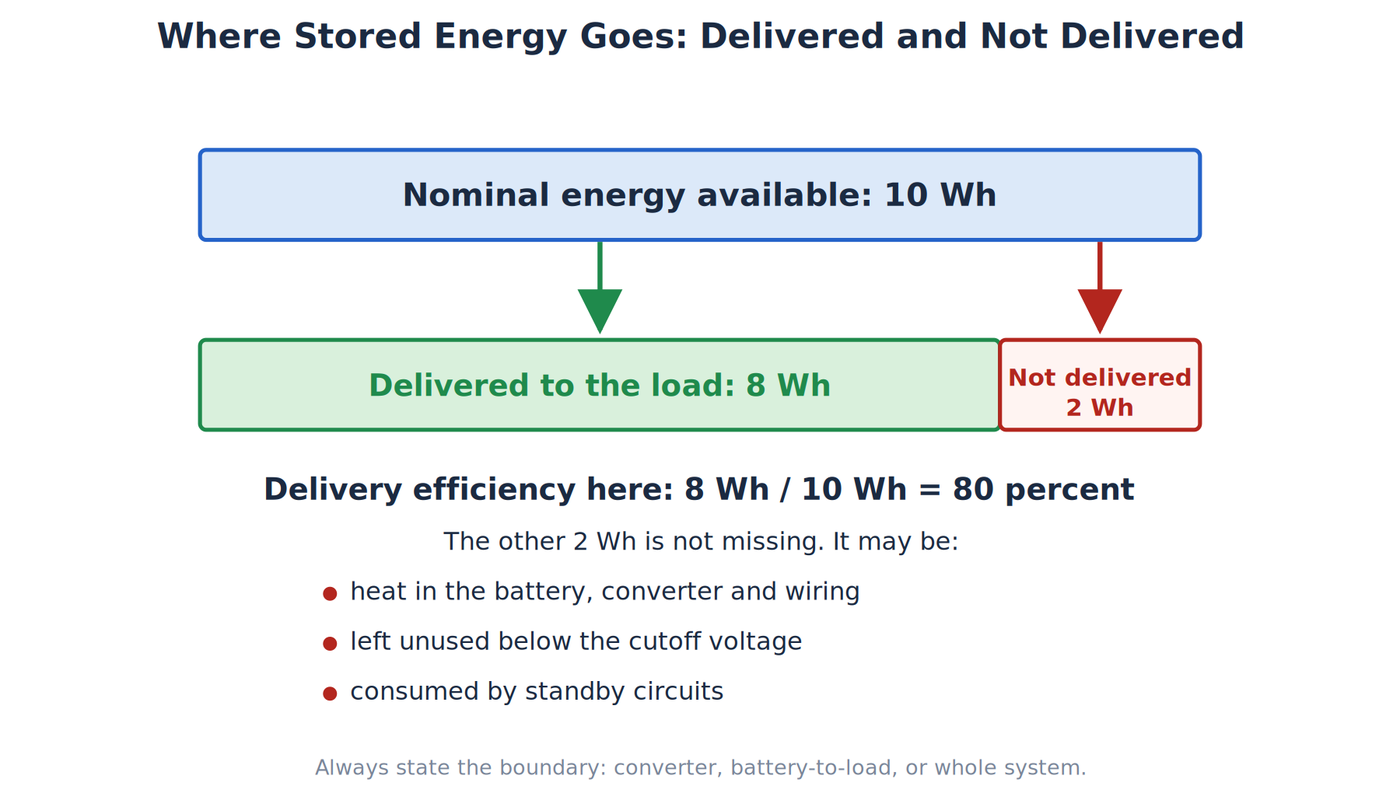
Be specific about the boundary. Converter efficiency, battery-to-load efficiency, and whole-system efficiency are different measurements. A percentage without a stated input, output, load, and condition is not very useful.
A Short History of the Units
The joule is named for James Prescott Joule (1818–1889), an English physicist from a family of brewers in Salford. In 1840 and 1841 he measured the heat produced in a wire carrying current and showed that it grows with the square of the current and with the resistance, which is the I²R relationship used in the article on power. In the 1840s he also stirred water with a paddle wheel driven by falling weights and measured the small rise in water temperature. The results showed that a fixed amount of mechanical work always produces the same amount of heat, a quantity called the mechanical equivalent of heat. Modern measurements put it near 4.18 joules per calorie. These experiments helped establish that heat and mechanical work are both forms of energy, and that energy is conserved when it changes form.
In 1882, C. William Siemens suggested naming the unit of energy after Joule, in the same speech to the British Association for the Advancement of Science in which he proposed the watt. The joule was adopted at the Second International Electrical Congress in 1889, the year Joule died, and its modern definition, one kilogram meter squared per second squared, was fixed in the 1940s and written into the SI in 1960. Because one watt is one joule per second, the two names appear together throughout electrical work.
The watt-hour and kilowatt-hour came later and for practical reasons. As electric utilities began selling electricity in the late nineteenth century, they needed a unit that matched what a meter could add up over time, and power multiplied by hours served that purpose. Both are still defined through the joule: one watt-hour is 3,600 joules.
Common Misconceptions
- “Watts and watt-hours are the same.” Watts are a rate; watt-hours are an amount of energy.
- “A larger Ah number always means more energy.” Voltage must also be included.
- “A 7.4Wh battery always delivers 7.4Wh.” That nominal estimate depends on test conditions and system limits.
- “Voltage tells runtime.” Runtime also depends on capacity, load power, conversion losses, and cutoff behavior.
- “Used energy disappears.” It is converted into other forms, including unwanted heat.
Related Articles
- How Electrical Power Works explains the watts that accumulate into watt-hours.
- Later articles on batteries, capacitors, and inductors examine their different storage mechanisms.
Wrapping Up
Electrical energy is an amount transferred or converted. E = qV connects energy with charge and voltage, while E = Pt connects it with power and time. Joules and watt-hours both measure energy, with 1Wh equal to 3,600J. Ampere-hours measure charge, so a battery estimate needs voltage: Wh ≈ V × Ah. Real delivered energy also depends on efficiency, cutoff, temperature, load, and aging. State the boundary and the conditions with every capacity claim. The word “ground” appears in nearly every circuit and means different things in different places, which is the subject of How Electrical Ground Works.
Hack The World and Make Awesome.