
The Makers Workbench is back.
For some readers, that statement probably does not mean much yet. For others who have followed my projects, articles, videos, forum posts, or various adventures through the maker community over the years, you know that The Makers Workbench has technically "returned" more than once.
This time feels different.
To explain why, I need to go back nearly two decades, to a very different Internet, a very different maker community, and a time when building your own 3D printer meant sourcing threaded rod, stepper motors, electronics, and a pile of hardware before spending weeks trying to convince the whole contraption to move in the right direction.
Where The Makers Workbench Started
I founded The Makers Workbench in 2008, and TheMakersWorkbench.com first went live in 2009. Its beginnings were tied closely to two technologies that would ultimately help reshape the DIY electronics and maker communities: RepRap and Arduino.
I had joined the RepRap project because I wanted to build a RepRap Darwin, one of the earliest open-source self-replicating 3D printer designs. At some point during that journey, Bre Pettis convinced me that building a McWire RepStrap would be the fastest pathway toward eventually building my first Darwin. It wasn't, and anyone who experimented with RepStraps during those early years probably understands exactly what I mean.
Still, struggling through that McWire build was one of those experiences that completely changed the direction of my life. I was learning about stepper motors, motor controllers, mechanics, firmware, electronics, CNC concepts, fabrication, and eventually extrusion systems.
At roughly the same time, I had begun experimenting with a relatively new development platform called Arduino. Back then Arduino was nowhere near the ecosystem it is today. You could not browse thousands of compatible development boards, sensor modules, shields, and accessories on Amazon and have everything sitting on your doorstep two days later. The ecosystem was still forming, and the people building hardware, software, documentation, and projects around it were helping define what modern hobby electronics would eventually become.
I already had some experience producing technical content. One of my day jobs at the time involved heading up the content and hardware review program for a PC modding website called The Best Case Scenario. By then, I had written around 100 PC hardware reviews and a few dozen other articles.
So I did what I already knew how to do. I started documenting what I was learning. I wrote articles, posted build logs on forums and wikis, documented hardware, and shared projects while talking about the problems I encountered trying to make these new technologies work.
That content quickly caught the attention of a relatively new electronics hardware company called Seeed Studio. Seeed offered to send me one of its new Arduino-compatible boards along with a handful of sensors and electronic components so I could experiment with them, write about them, and build some projects.
I was already running a successful content program for someone else's website, so a fairly obvious thought occurred to me: why not build my own? That was how TheMakersWorkbench.com was born.
Building the Workbench
I built the website myself and started publishing. There were articles about Arduino, reviews of the Seeed Studio hardware, electronics projects, RepRap experiments, 3D printer development, tutorials, and whatever else happened to be occupying my workbench at the time.
Things moved surprisingly quickly. My content caught the attention of Arduino itself and SparkFun Electronics, among others. Before long, companies were sending me development boards, modules, sensors, passive components, tools, and other hardware to experiment with. For the first time, I had enough equipment to build the kinds of projects I had been imagining.
I continued working on 3D printer hardware and prototypes. I created documentation and wiki articles for RepRap.org, published related material on The Makers Workbench, and contributed content to other websites and communities.
The maker community was smaller then, a lot smaller. IRC channels, forums, mailing lists, Skype calls, blogs, and wikis were where much of the discussion happened. If you were involved in open-source hardware, DIY electronics, or early desktop 3D printing, there was a decent chance you would eventually find yourself talking directly with many of the people helping create the industry.
I somehow found myself having conversations in IRC rooms and Skype calls with people such as Jeri Ellsworth, bunnie Huang, Josef Prusa, Bre Pettis, Zach "Hoeken" Smith, and others who were building some incredibly interesting things.
Then there was Forrest Mims. Yes, that Forrest Mims. I had grown up with his electronics books and one of the RadioShack springboard electronics kits. Long before Arduino existed, those books and kits were some of the things that taught an entire generation that electronics did not have to remain hidden inside mysterious black boxes. You could build this stuff yourself.
Years later, I had recreated and posted several projects based on his Engineer's Notebook material and that old springboard kit. Somehow, those projects caught his attention. Having someone whose books helped shape my childhood interest in electronics notice something I built was surreal.
For a while, the entire experience felt surreal. I was building things I had dreamed about building. I was communicating with people I admired. Companies were sending hardware to my little electronics lab. People were reading my articles. Hackaday covered several of my projects. Traffic to The Makers Workbench kept increasing. I was living my dream.
Then, in 2012, everything changed.
The Fire
Around the same time that I finally completed my first RepRap Mendel 3D printer, my home burned to the ground.
I wasn't there when it happened. I was eating dinner at my grandmother's house. A neighbor saw my house on fire, called the fire department, and then drove down the road to my grandmother's house to tell me. The fire department eventually determined that the fire was caused by a direct lightning strike.
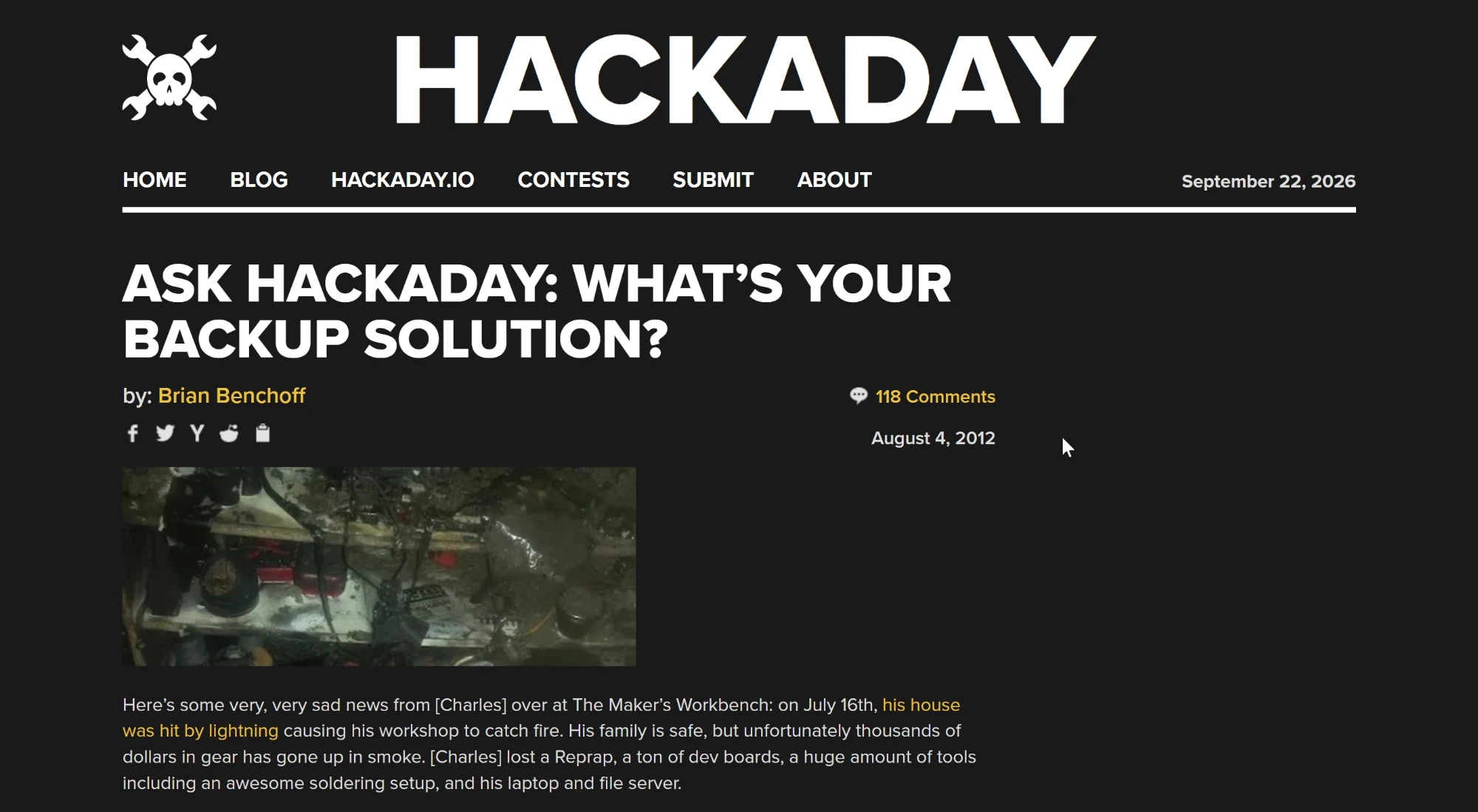
I lost essentially everything. My electronics lab was gone. My computers and hardware were gone. My camera equipment was gone. Projects were gone. Tools were gone. Childhood memories and keepsakes were gone. Everything I had accumulated over the years was suddenly reduced to what I happened to have with me when I left the house that day, which was the clothes I was wearing and my laptop, which happened to be inside my backpack. That was about it.
I had homeowners insurance, but the experience taught me some very painful lessons about insurance. The company you choose matters. Documentation matters. Photographs matter. Receipts matter. Knowing exactly what your policy covers before you need it matters.
I will leave most of that story for another day, but after everything was settled and the insurance company paid what it was going to pay, I had roughly $11,000 left to rebuild my entire life. Not my lab. My life. Furniture, clothes, household items, computers, tools, electronics, appliances, and everything else a person normally accumulates over many years.
I moved into a temporary rental and struggled to even furnish it comfortably. Fortunately, some of the companies and people I had met through the PC hardware and DIY electronics communities stepped in. Several PC hardware companies helped me gather enough parts to build another computer, and friends in the electronics industry helped me establish a small lab again.
Hackaday covered the fire and what had happened to me. This was before modern crowdfunding became commonplace, so there was no massive campaign or anything like that, nor did I expect one.
Then another company reached out. At the time, LulzBot was still a relatively small 3D printing company. They had seen the Hackaday article and offered me one of their new AO-100 MendelMax-based 3D printers. They also wanted to work with me, with the printer appearing in reviews, projects, and the live broadcasts I was doing through Livestream.
That machine got me back into 3D printing. More importantly, it helped get me building again.
Building a Maker Community
A few months after the fire, some friends and I started a local maker club. That club eventually partnered with another local geek-focused organization, and together we helped establish a makerspace in Augusta, Georgia. At the same time, I continued maintaining TheMakersWorkbench.com.
Then life became extremely busy. Some of those same friends and I founded a startup that developed automation electronics for haunted-house attractions. Around the same period, I began writing for element14, covering its Design Challenge programs, Raspberry Pi, electronics, and related technologies.
I was helping with the makerspace. I was working at the startup. I was writing for element14. I was still working my normal web-development job. And somewhere in between all of that, I was supposed to keep The Makers Workbench running.
Something had to give, and unfortunately, TMWB was usually the thing that got pushed down the list. I still posted occasionally, but updates became sporadic.
The startup did well, but I eventually left for personal reasons. Around that time another major shift was taking place online: YouTube was becoming increasingly important for makers and DIY content creators. So I started The Makers Workbench YouTube channel. I was still contributing to element14 and working as a web developer during the day, but I started producing videos while bringing the website back to life.
The channel grew. It became monetized. For a while I was publishing new videos every week while also producing articles and projects for the website. Things were moving again.
Then one morning I woke up and discovered that I could not log into YouTube. I tried loading TheMakersWorkbench.com. It would not load either. Then I discovered I had also lost access to Facebook. I had been hacked.
Losing The Makers Workbench
Fortunately, I regained control of YouTube and Facebook within a few days. The website was a different story. It was gone. The attacker had deleted everything.
Worse, I had made one of those mistakes that sounds ridiculous after you have already experienced the consequences. I wasn't paying my hosting provider for proper backups. I had local copies of some of the content on my file server, but nowhere near everything. I estimate that I recovered roughly one twentieth of the content I had accumulated.
Years of work disappeared: articles, tutorials, project documentation, images, build logs, reviews. Everything that had slowly turned The Makers Workbench into a library of my work was suddenly mostly gone.
That was probably the beginning of the longest decline in TMWB's history. I rebuilt the website, but I was disheartened. The motivation was gone.
There is a considerable amount of work involved in producing a good technical project article. You build the project, troubleshoot it, photograph it, document the process, create diagrams when necessary, write the article, edit it, format everything, and publish it. It can mean spending hours building something and then spending several more hours documenting what you just built. When you have watched years of that work disappear in seconds, convincing yourself to start over is difficult.
So for the next couple of years, the site received relatively few updates.
Another Attempt
Eventually something clicked again. I started looking at projects online. Then I found myself ordering parts. Boxes began showing up. The soldering iron came back out. The cameras came back out. Suddenly, The Makers Workbench was active again.
That run lasted around 18 months. Then life found another way to interfere.
My wallet was either lost or stolen. I never recovered it, which meant replacing all of my credit cards. At almost the same time, I lost my job, started working for another company, dealt with problems at home, and eventually stopped contributing regularly to element14. There was a lot happening at once.
When I replaced my credit cards, I forgot one particular recurring payment: the web host. The payment failed, and the hosting account was eventually deleted. Once again, I lost The Makers Workbench.
This time I recovered fewer than 30 articles. I was devastated, again. I did not even attempt another rebuild for about a year, and when I finally started rebuilding, I never really regained the enthusiasm I had during those early years.
I worked on the site occasionally between then and now, but life continued moving, and The Makers Workbench remained one of those projects that I always planned to finish "soon." Soon kept getting pushed further away.
Losing the Lab Again
During this period, I also moved. I went from a large home with a full woodworking shop and a dedicated electronics laboratory to a smaller house with a detached two-car garage that offered roughly half the workshop space I previously had and no room for a proper electronics lab.
A lot of my electronics equipment went into a gated storage facility. That included lab equipment, electronics hardware, soldering equipment, oscilloscopes, tools, and even a pick-and-place machine.
Then thieves broke into the storage complex. Six units were hit. Mine was one of them. Almost all of my electronics equipment was stolen. For the second time in my life, I had lost nearly an entire electronics laboratory.
The police were unable to do much. I had also been paying for insurance through the storage facility every month. When I attempted to make a claim, I learned another painful lesson about insurance: without receipts, photographs, serial numbers, and sufficient proof that every specific item had actually been inside the unit, the coverage was effectively useless for much of what I had lost.
I argued. I fought it. I spoke with an attorney. Eventually, I was told that pursuing it in court was unlikely to get me anywhere. So I gave up, again.
Walking Away From Electronics
That brings the story much closer to the present. I wrote a few articles during the years that followed, but The Makers Workbench never completely recovered.
Eventually I fell into a pretty bad depression for about six months. There were several reasons for it, but losing my electronics lab again absolutely contributed. I had spent years accumulating that equipment. Some of it had already been replacement equipment for what I lost in the fire. Now it was gone too.
For a while, I wanted absolutely nothing to do with DIY electronics. I unsubscribed from the electronics and maker channels I watched on YouTube. I stopped browsing electronics websites. I stopped looking at new development boards. I stopped searching for projects. I stopped paying attention to a world that had been part of my life for nearly two decades.
Then, eventually, I started climbing out of that hole. And as has happened more than once in the history of The Makers Workbench, something small got me tinkering again. I found a Raspberry Pi 4B, an old Seeed Studio Arduino-compatible board, and a handful of components from old projects that had somehow survived because they were sitting in a closet instead of the storage unit.
So I plugged them in. I tinkered. I started paying attention again. And eventually I started rebuilding TheMakersWorkbench.com.
Then I had to move again. This time I moved somewhere with no garage at all and very little room for hobbies. Which brings us to today.
Why The Makers Workbench Is Returning Now
Over the last month or so, I realized something. Right now, I do not have the shop I used to have. I do not have an electronics laboratory. I do not have rows of development boards, bins full of components, oscilloscopes sitting on a bench, or a workshop full of fabrication equipment.
But what I do have is time, and maybe that makes this the perfect opportunity to finally rebuild The Makers Workbench into the website I always wanted it to become. Instead of waiting until everything is perfect, I decided to put the site back online.
So here it is. The Makers Workbench is back.
The site is not perfect. There are things I want to improve. There is old content I want to restore where possible. There are categories I want to expand. There are features I want to build. But this version is already much closer to the website I always imagined The Makers Workbench becoming. Most importantly, it is online, and I am writing again.
What Comes Next
My goal is to publish one to three new posts every week on TheMakersWorkbench.com. Those posts will cover the subjects that have always formed the heart of TMWB: Arduino, Raspberry Pi, embedded development, DIY electronics, microcontrollers, development boards, sensors, tools, 3D printing, fabrication, software, open-source hardware, maker projects, tutorials, reviews, and whatever other technologies happen to find their way onto my workbench.
Some of the content will be aimed at beginners. Some of it will go much deeper.
I also plan to return to producing videos for The Makers Workbench YouTube channel. There are nearly two decades of new tools, platforms, technologies, and ideas that I want to explore. A lot has changed since I first started experimenting with Arduino and RepRap. The maker world I stepped into in 2008 barely resembles the one that exists today.
Arduino has grown into an enormous hardware and software ecosystem. Raspberry Pi did not even exist when I started TMWB. Affordable desktop 3D printers went from machines we were trying to build out of threaded rod and printed parts to products you can unpack, calibrate, and have producing excellent prints within minutes. ESP32-class microcontrollers provide processing power and connectivity we could only dream of having so cheaply back then. Affordable logic analyzers, USB oscilloscopes, software-defined radios, FPGA development boards, RISC-V hardware, AI tools, inexpensive PCB manufacturing, desktop CNC equipment, laser cutters, and countless other technologies have opened possibilities that would have seemed incredible when The Makers Workbench began.
I want TMWB to explore that world.
I Want Your Input
I also want readers to help shape where The Makers Workbench goes next.
If there is a project you want to see built, tell me. If there is a development board you want explored, tell me. If there is a tutorial that would make something easier to understand, let me know. If you are fighting with a piece of hardware and cannot find good documentation, that may be exactly the kind of article I should write.
Follow The Makers Workbench on social media and leave your ideas, suggestions, questions, and feedback. One thing I learned during the earliest years of TMWB is that some of the best projects begin with someone asking, "I wonder if you could..."
Rebuilding the Workbench, Literally
There is also one fairly substantial challenge ahead. I need to rebuild the actual workbench. At the moment, my electronics lab is essentially starting from zero. I need everything from basic soldering supplies and hand tools to modern development boards, sensors, components, test equipment, and laboratory hardware.
That eventually means rebuilding a proper selection of microcontrollers and development platforms, stocking common passive and active components, replacing soldering and rework supplies, and acquiring equipment such as oscilloscopes, logic analyzers, multimeters, bench power supplies, programmers, debuggers, measurement equipment, prototyping tools, and all the other things required to properly develop, test, and document electronics projects.
So I also want to extend an invitation to manufacturers, retailers, distributors, and other companies within the maker and electronics industries. If you would like to work with The Makers Workbench, I would love to hear from you.
There are a number of ways we can collaborate. Products can be featured in hands-on reviews, technical articles, tutorials, projects, videos, development guides, comparisons, and social media content. Hardware supplied for projects can also continue appearing in future content when it makes sense, rather than disappearing after a single review.
The goal is not simply to rebuild a collection of equipment. It is to rebuild a working lab that produces useful technical content.
Supporting The Makers Workbench
Readers who want to directly support the rebuilding of The Makers Workbench can also help. I am setting up several ways to do that.
Direct donations can be made through Stripe or Buy Me a Coffee, and I am working on bringing the TMWB Patreon back online with useful perks for supporters. I am also working on a The Makers Workbench Discord server, where readers, makers, electronics enthusiasts, programmers, engineers, and anyone else interested in building things can hang out, share projects, ask questions, and talk shop.
Any support helps, whether that means donating, sharing an article, subscribing on YouTube, following TMWB on social media, commenting on a post, or simply coming back to read the next article.
Almost Twenty Years at the Workbench
When I look back at this story as a whole, it is difficult not to notice a pattern. The Makers Workbench has been knocked down a lot. A lightning strike destroyed my first lab and nearly everything I owned. A hacker destroyed most of the original website. A missed hosting payment destroyed most of the rebuilt website. Thieves emptied the electronics lab I had spent years rebuilding.
There were career changes, startups, moves, personal problems, lost motivation, depression, and more than a few moments where walking away permanently would have been easier. And yet, somehow, I keep coming back to it.
Maybe that is because The Makers Workbench was never really just a website. It was where I documented the things I was learning. It was where I shared the things I was building. It introduced me to people I never imagined I would meet. It helped turn childhood curiosity about electronics into projects, friendships, opportunities, jobs, and experiences that shaped a huge portion of my adult life. It gave me a reason to keep asking how things worked and what I could build with them.
That is worth rebuilding.
We are approaching 20 years since The Makers Workbench began, and I would like to think that its most interesting years are still ahead of it. There is a lot of work to do. There is a website to rebuild. There is a lab to rebuild. There are projects to design. There are articles to write. There are videos to make. And there are an incredible number of new things I want to learn.
So to everyone who encouraged me over the years not to give up on The Makers Workbench, thank you. To everyone who visited the old site, watched a video, commented on a project, shared an article, sent me hardware, worked with me, taught me something, or simply followed along, thank you.
And to anyone discovering The Makers Workbench for the first time: welcome. The Makers Workbench is open again.
Let's build something.