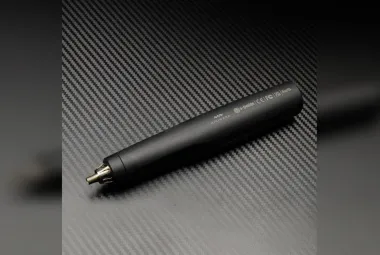
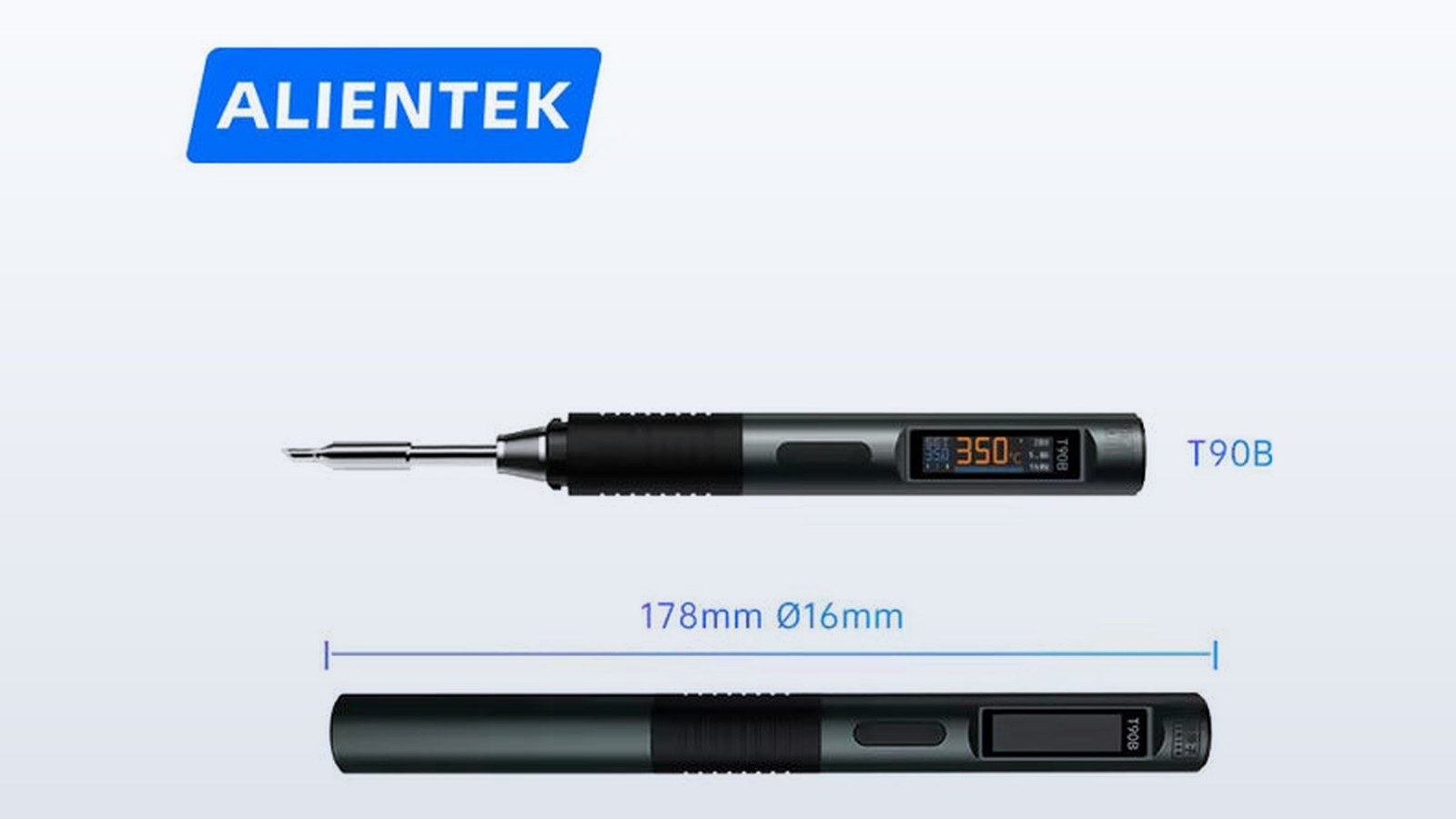
The ALIENTEK T90B is the highest-output model in the T90 series of USB-C soldering irons, and Switch Science began selling it on September 10, 2025. It pairs a T245 cartridge with a heating range of about 18 to 140 W, which puts it well above the fine-tipped T90A and a notch above the T90C. TMWB hasn't used it, so the details below come from Switch Science's product page, the press release carried by ZDNET Japan, and ALIENTEK's English page. The series overview covers the shared features, and the T90A and T90C each have their own articles.
What are the T90B's specifications?
Switch Science's listing gives the T90B an input of DC 9 to 28 V, a temperature range of 80 to 450°C, and heating of about 18 to 140 W. The tip is the T245, listed at 2.1 ohms, and the seller's figure for melting solder is about 3.5 seconds at 140 W. The handle is 178 mm long and 16 mm in diameter at 55 g, the same as its siblings. PID control (a method that holds a setpoint by reacting to how far and how fast the temperature drifts) is listed at plus or minus 2 percent stability, and the three presets default to 200°C, 350°C, and 450°C.
Power comes in through USB Type-C with PD 3.1 and QC 3.0. PD is USB Power Delivery, the negotiation a charger and a device run to agree on a voltage and a wattage, and QC 3.0 is Quick Charge 3.0, a separate method that does the same job. The press release says the iron recognizes the maximum output of the adapter and adjusts its heating power automatically. Protection features include motion idle shutoff, tip resistance protection, and short protection, though the delay and thresholds aren't printed.
Why does a 140 W ceiling matter?
Heating power is the rate at which the heater can push energy into the tip, and a joint that sinks heat quickly needs a heater that keeps up. Think of a large connector shell soldered into a board with a ground plane, which is a wide sheet of copper that carries heat away from the pad. A small iron lays heat down more slowly than the copper pulls it off, so the tip temperature sags and the solder doesn't flow. A higher-wattage iron can replace the lost heat fast enough that the joint reaches temperature.
Seller figures show the effect across the series: about 2.5 seconds to melt solder at 65 W on the T90A, about 3.5 seconds at 140 W on the T90B, and about 5 seconds at 130 W on the T90C. The T90B's number is longer than the T90A's because it's moving more metal. The T245 cartridge is a mid-size tip with more mass, and the series description says it's meant for work with more thermal load than the fine T210 handles comfortably. Switch Science describes the T90B as compatible with T80P tips, which carry through to the T245 name, so tips sold under the older T80P designation fit it.
What does the charger have to do with it?
A USB-C iron can only use what the charger on the cable agrees to deliver. A 140 W heater can't draw 140 W from a 65 W charger, so the T90B's top end needs a source that can supply it. The iron's behavior when it's connected to a weaker charger is described in the release: it reads the adapter's maximum output and limits its own heating to match. That protects the charger from shutting down in the middle of a joint, but it also means the T90B on a small adapter heats like a smaller iron. The included cable is a 1.2 m USB-C cable rated to 140 W, so the cable at least isn't the limit. The T90B ships with the iron, a 245-KU tip, the cable, a manual, and a TH50 stand.
How does the T90B compare with the rest of the series?
The T90B tops the series on heating power, with 140 W against the T90C's 130 W and the T90A's 65 W. It carries the same handle size and weight as both. The T90C uses a larger T65 tip that has more metal but a slower seller-claimed melt time, which suggests that higher wattage and larger tip size aren't the same thing. In the wider market, Miniware's TS100-class irons, Pine64's Pinecil, and SEQURE irons were established USB-C irons by September 2025, and the T90 series enters the same category with three tip families on one handle design. The sources don't give watt figures for those earlier pens, so I'm not ranking them.
What does it cost, and is it available?
The September 10 press release priced the series at about $41 per iron, tax included. Switch Science's listing for the T90B (SKU 10678) currently shows about $42 tax included, and when I checked, it was out of stock with zero units. The difference between the two prices isn't explained in the sources, so I'm reporting both. Both prices are converted from Japanese yen, at roughly 147 yen to the dollar in September 2025 for the release price and roughly 158 yen to the dollar in early October 2026 for the current listing. Switch Science sells in Japan. Outside Japan, ALIENTEK's English page directs buyers to an AliExpress store and an Amazon listing, and no official global ship date or US price is printed.
Display, wording, and claims worth noting
The press release calls the display an OLED, while Switch Science's listing calls it a 0.99-inch IPS LCD color screen. Those are different panel technologies, and the sources don't reconcile them. The 3.5 second melt time is also the seller's figure, with no stated test piece. The company name on the press release is Guangzhou YuanziDianzi Electronic Technology Co., Ltd., while the English site's footer uses Guangzhou Xingyi Electronic Technology Co., Ltd. The brand on both is ALIENTEK.
What isn't in the announcement?
The announcement doesn't give a heat-recovery figure (how quickly the tip regains temperature after touching a large joint), idle-shutoff timing, or the exact tip-fault conditions, and it doesn't say how the T90B behaves on charger outputs below its ceiling in terms of actual watts. A downloadable "T90ABC Smart Soldering Iron" file on ALIENTEK's English page may answer some of that.