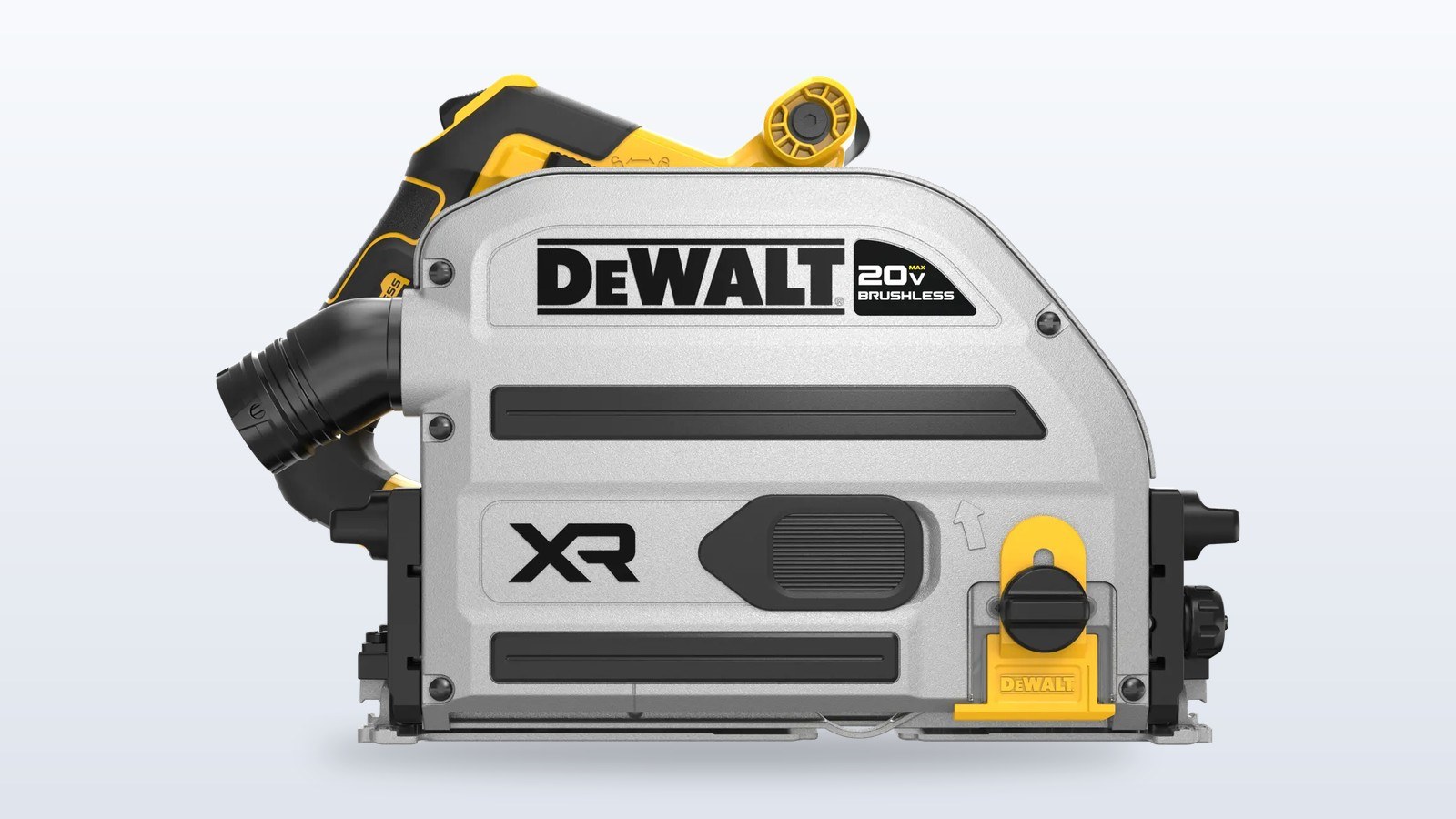
Breaking down plywood and ripping solid stock is a layout problem in a shop with no cabinet saw and no long outfeed, because the cut often has to start in the middle of a sheet and stay straight. On August 11, 2026, DeWalt added a 20V MAX XR 6-1/2 in. plunge track saw to a wider cordless carpentry release out of Towson, Maryland. DeWalt says every product in the release is available now wherever its tools are sold. TMWB hasn't used the saw, so the claims below are DeWalt's.
Festool, Makita, and Milwaukee already sold track saws, so this adds DeWalt's model to an established category. The bare tool is DCS525B.
What is a plunge track saw?
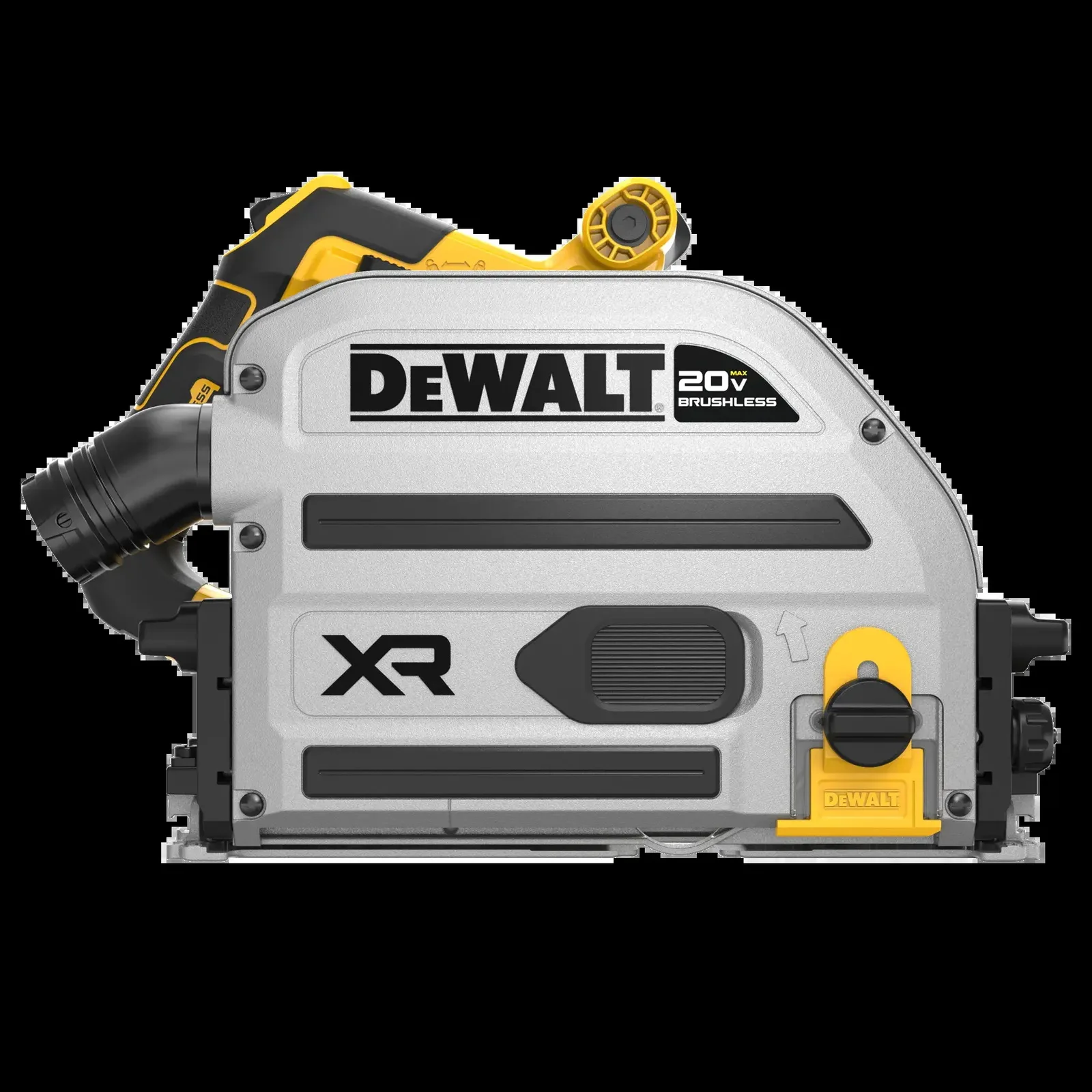
A plunge saw lowers the blade through the shoe. You set the shoe down with the blade clear, drop it to depth, and the cut can start in the middle of a sheet for a sink opening, a hatch, or a piece taken from the field. A track (a guide rail) is the straightedge the shoe follows, so the line is wherever you placed the rail.
The 6-1/2 in. figure is blade diameter, and the depth of cut is smaller because the arbor, shoe, and housing use part of the circle. DeWalt names two blades: the DWA261248TS, a 48-tooth fine-finish blade, and the DWA261224TS, a 24-tooth general-purpose blade. More teeth mean a smaller bite per tooth.
What's in each kit, and what does it cost?
The release prints no price for any configuration. DCS525B is the bare tool, DCS525ST is a track kit, and DCS525STWW1 is a fuller kit with an 8Ah 20V MAX XR battery, a charger, a track connecting rod, and two 30-inch tracks. DCS525ST isn't itemized. On the product page, a battery and charger for the bare tool are sold separately.
Two 30-inch tracks joined by a rod add up to about 60 inches before overlap, and the working length is shorter, which the release doesn't state. A full 8-foot sheet is longer than that, so a long rip needs more rail or a second setup.
What do the product page's numbers claim?
- Depth: up to 2-1/8 in. in solid hardwood, more than a 2x4 on edge (1-1/2 in.) and enough for 8/4 stock.
- Accuracy: within 1/32 in., with no test length given.
- Dust capture: up to 94 percent, with no vacuum, hose, or material named, so I wouldn't compare it with someone else's percentage.
- Runtime: up to 70 cuts or 280 linear feet ripping 3/4 in. MDF (fibers and resin pressed flat). That averages 4 feet per cut, but the battery behind the figure isn't named.
- Control: Wireless Tool Control signals a supported vacuum (sold separately). The motor is brushless with variable speed, but no RPM is printed.
The release also claims "more power with advanced control" against an unnamed leading competitor. A footnote ties top speed to a DCB2108 battery and "advanced control" to the kickback brake. Kickback is the blade grabbing and the saw lurching, and the brake shuts the saw off when it detects a pinch, stall, or bind. No stop time is given.
What did the rest of the August 11 release include?
The track saw shared its announcement with other cordless carpentry tools, and each had its own claims. The DCW211B is a 5 in. random-orbit sander and the DCW230B is a 6 in. model. Random orbit means the pad spins and also moves in a small circle so one grit doesn't cut a single groove. DeWalt says the 5 in. has the best control with the fastest material removal against the leading cordless 5 in. sander (unnamed), and runtime of up to 50 sq ft per charge on high, removing 3.8 g at 80 grit with a 3 kg bias on pine, using a DCB205 battery. Grit is abrasive coarseness, where a higher number is finer, and the release doesn't say whether the 3.8 g is a rate or a total. The 6 in. is claimed at up to 200 sq ft per charge on a DCB2108, without printing the grit, load, or wood, so the two area claims use different batteries and aren't comparable.
The DCN220B is described as the most compact 20-volt 16-gauge straight finish nailer by volume, with magazine and bare, at a printed width of 3.1 in. and up to five nails per second on a DCBP034. Gauge is thickness, with a higher number being thinner, so 16 gauge is the thicker finish nail used on trim. The DCN210B is the 18-gauge brad nailer, with a thinner nail and a small head, rated at up to five nails per second with no battery named and a height of 10.2 in. The release says that brad nailer was introduced earlier in 2026 without giving a date, and it also lists an oscillating tool, the DCS359.
How do the saw's numbers read?
The hardwood depth is stated as up to 2-1/8 in. Hardwood is often named in quarters, so an 8/4 board is nominal eight-quarter stock, about 2 in. before planing, and a dressed 2x4 on edge is 1-1/2 in. thick. The runtime claim is up to 70 cuts or 280 linear feet ripping 3/4 in. MDF, which is medium-density fiberboard, fibers and resin pressed flat with no long grain. Dividing 280 by 70 gives 4, so the figures agree as one total, though the page doesn't say each cut is 4 feet, and the battery behind the figure isn't named.
Who is the track saw for?
Anyone breaking down plywood and solid stock without a cabinet saw or outfeed table, since the guide travels with the work. No price is stated.
Sources and image credits
- DeWalt release via PR Newswire, August 11, 2026
- Product page, DCS525B
- Product images: DeWalt