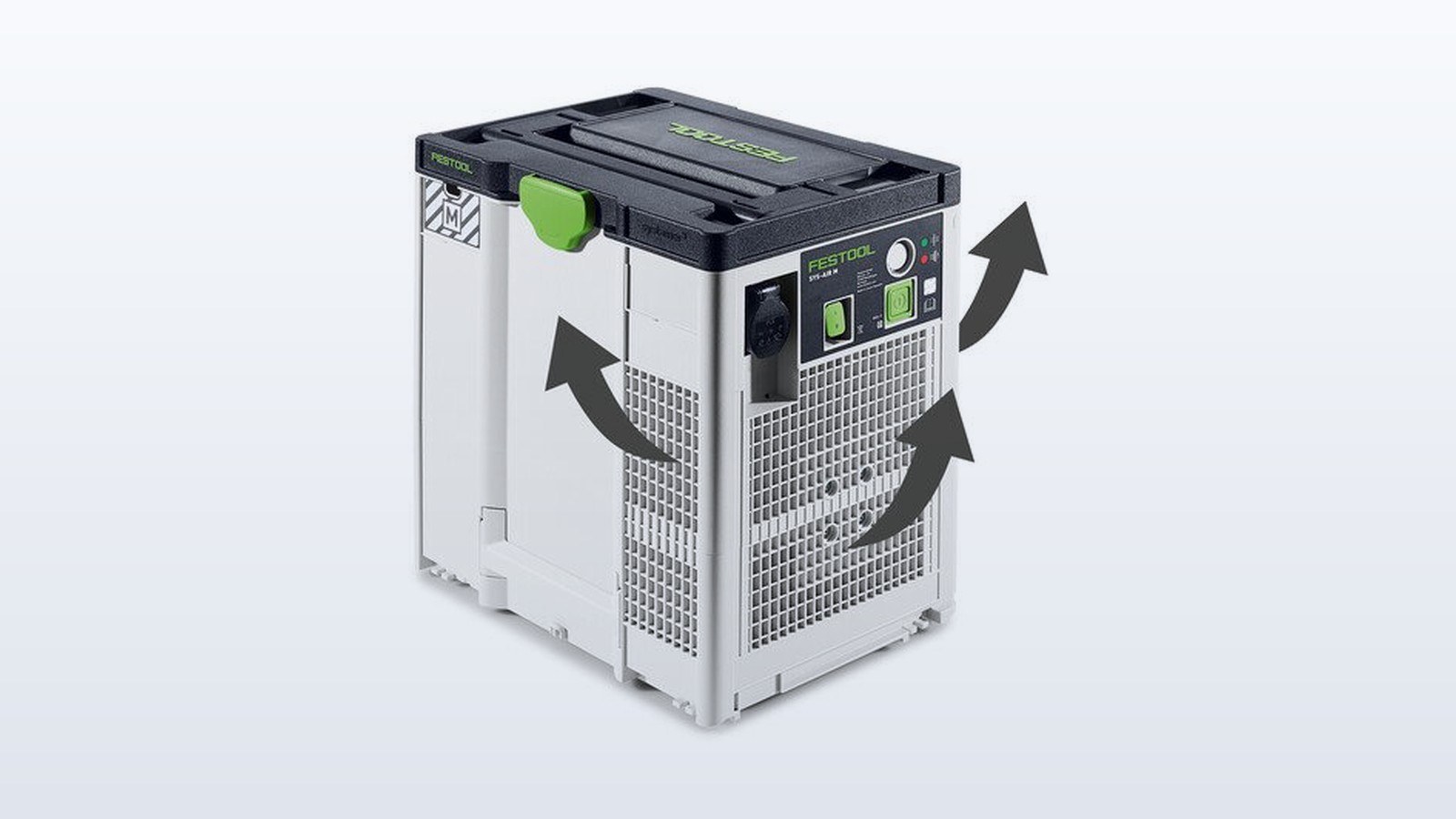
On February 12, 2025, Festool USA announced the SYS-AIR air filter and a Bluetooth generation of CT dust extractors, in a release carried by PR Newswire from Lebanon, Indiana. The machines were public and priced that day but weren't shipping yet, with shipping set to start March 26, 2025. TMWB hasn't tested any of them, so the filtration claims below are Festool's own.
Festool lists "from" prices, and a starting price is a floor, not a promise for every configuration:
- SYS-AIR Air Filter (item 57790): from $799
- SYS-AIR HEPA (item 57791): from $899
- Air-filter accessories: from $87
- CT 26 EI HEPA (item 577871): from $849
- CT 36 EI HEPA (item 577872): from $915
- CT 36 EI AC HEPA (item 577874): from $1,035
- CT 48 EI AC HEPA (item 577876): from $1,099
The same release also priced a few unrelated products, including the SYSLITE KAL C and KBS C work lights and a GRANAT abrasive Systainer³, which I'm leaving aside.
Why does a shop need a hose and a room filter?
A cut leaves two kinds of mess. The first is the stream you can aim a hose at. Chips and fine dust leave a saw, router, or sander through its port, and a dust extractor pulls that stream into a canister while the tool runs. The second kind is already loose. A blade throws dust sideways, a sanding pad lifts a cloud, and a cuff that doesn't quite seal leaks at the joint. Those particles never enter the hose. They hang in the light and then settle on the bench, the lumber rack, and whatever else shares the garage.
An air filter handles that cloud. A fan draws room air through filter media and sends it back out, cleaning what's already floating, which a hose can't do. Shops that have chased fine dust tend to end up wanting both, and Festool put an extractor and an air filter in the same announcement on the same ship date.
What is the SYS-AIR?
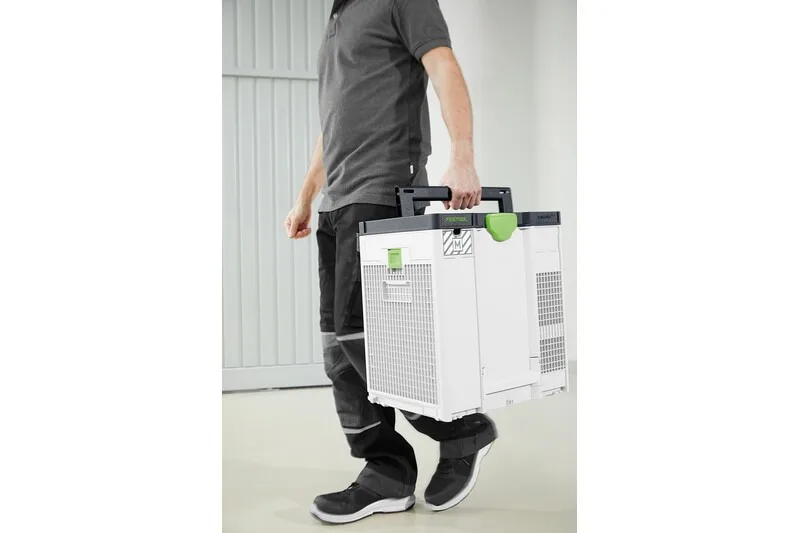
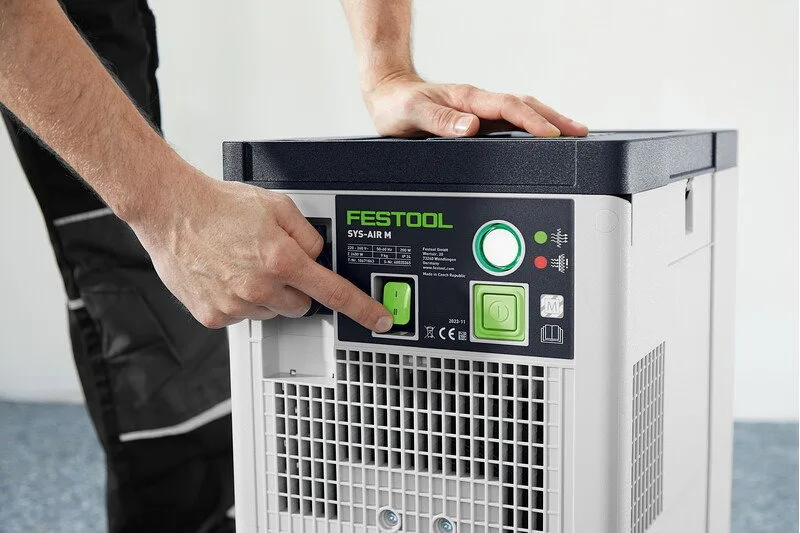
A Systainer is Festool's stackable jobsite box. The latches click box to box, so a tool, its accessories, and an extractor can travel as one column. The SYS-AIR puts the air filter in that same footprint, so it latches into a stack like any other Systainer. Festool also names two accessories: an air supply hose, and a ceiling bracket that lifts a small filter out of the walkway and into the band of air where fine dust circulates.
HEPA means high-efficiency particulate air, the fine filter stage specified for dust that stays airborne. Festool calls the SYS-AIR a two-stage filter, with a coarse layer ahead of a fine one so grit doesn't clog the fine media early, and claims "over 99.9% filtration." The release names no particle size, test standard, or lab behind that number, and the particle size is the part that matters most for the finest dust.
What's new on the CT extractors?
Bluetooth is standard on the CT 26, 36, and 48 EI. Auto-start can come from a Bluetooth Festool tool or from a CT FI remote, so the extractor comes on with the work and doesn't require a walk back to a switch with dusty gloves. The Festool Work app handles cleaning intervals and alerts, reminding the owner to service the filter or canister before suction falls off.
"AC" on the 36 and 48 marks automatic filter cleaning for high-volume fine dust. Fine dust blinds a filter while the bin still looks empty, so airflow drops and the room gets dusty again. The release names the feature but not the mechanism, whether it's a reverse air pulse, shaking, or something else. The numbers 26, 36, and 48 are canister liters, which come to roughly 6.9, 9.5, and 12.7 gallons (my conversion, not a Festool rating). The two 36-liter models differ by $120 at their starting prices, and that buys the automatic cleaning. The 48 AC sits $64 above the 36 AC.
What does Festool's wider launch look like?
The SYS-AIR and the CT EI extractors weren't the only products in the release, but they're the ones that fit together. Festool has long sold Systainer-based tools, so the air filter extends a system rather than starting a new one: the same latches, the same stacking footprint, and the same logic of a modular box that's carried as part of a column. The extractors extend another Festool habit, which is pairing a machine with an app and a remote so it behaves like part of the tool set. Bluetooth on the extractor and the CT FI remote are the connective tissue.
The pricing structure shows how Festool thinks about the customer. The cheapest item in the release is an $87 accessory, the SYS-AIR itself starts at $799, and the extractors climb from $849 to $1,099. Those are professional-tool prices, and the release leans on dust control as the reason to spend them.
What does the release say about where to buy?
The release prints starting prices and a ship date, March 26, 2025, and says nothing about a specific retailer. Festool's own product press index lists the same announcement. On February 12 the machines were public and priced but not shipping, so a buyer was looking at an announcement, a price list, and a wait of about six weeks.
Who are they for, and what's missing?
The SYS-AIR makes sense for a shop already stacking Systainers. The non-AC 26 and 36 suit work where the canister mostly swallows chips, such as solid-wood crosscuts, while the AC 36 and 48 are the models Festool points at fine dust from sanding. The EI line makes the most sense if you already run Bluetooth Festool tools.
The release prints no airflow figure (CFM) for the SYS-AIR or the CT models, and no horsepower. The 99.9 percent claim has no micron size behind it. Accessory details like hose length, diameter, and bracket size aren't given, and the release doesn't describe auto-start for a corded tool from another brand.
Sources and image credits
- Festool USA release via PR Newswire, February 12, 2025
- Festool USA product press index
- Product images: Festool USA