On July 8, 2025, Hakko posted a new-product notice on its English site under the headline "NEW STANDARD," announcing a new product released in the "evolved" FX-971 series. The release lists a family of soldering stations and handpieces built around the FX-971, a 100 W single-port station that replaces the long-running FX-951 role in Hakko's lineup. The series had been introduced earlier: Hakko's English news page dated February 17, 2023 first announced the FX-971 and the 200 W two-port FX-972, and the stations were shown at IPC APEX Expo 2023 in the United States. TMWB hasn't used these stations, so the details below come from Hakko's announcements and product page, plus retailer listings for pricing.
What does the FX-971 series include?
The July 8 release names the whole family. The FX-971 is a one-port station, the FX-972 is a two-port multi station, and the FX-973 is a three-port rework station. On the handpiece side, the list runs from the FX-9701 soldering iron through the FX-9702 (a nitrogen soldering iron) and FX-9703 (a micro iron) to the FX-9704 (a micro nitrogen iron). The FX-9705 is hot tweezers and the FX-9706 is micro hot tweezers. The FX-9707 is a heavy-duty iron and the FX-9708 is a heavy-duty nitrogen iron. The release also lists the FR-4103 desoldering tool. A port is a connection on the station for one handpiece, so a multi-port station can drive several tools at once. A nitrogen iron feeds a stream of nitrogen to the joint, which reduces oxidation while the solder flows.
Hakko's announcement frames the series as a response to changes in electronic components and soldering environments, and says the company has been "working closely with users to solve their problems" worldwide. The July 8 notice doesn't print specifications, a sales date, or pricing, so the technical detail below comes from the FX-971 product page.
What are the FX-971's features?
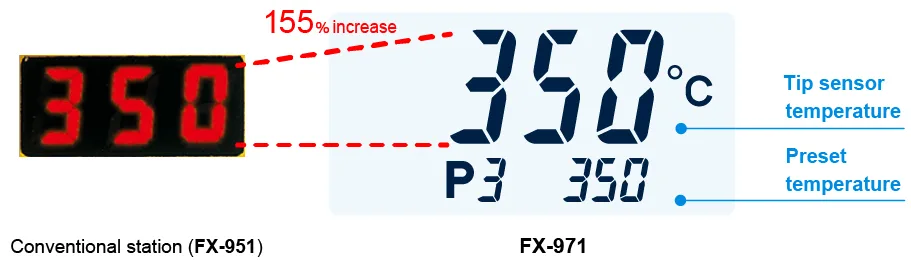
The product page describes 100 W of power in a compact body, with a self-standing iron holder that has a safe tip-replacement mechanism. The display shows the set temperature, the tip sensor temperature, and the stored presets, and it tilts for viewing, with a high-brightness panel and wide viewing angles. Hakko's product page includes a side-by-side of the older FX-951 display and the FX-971's larger readout, labeled "155% increase."
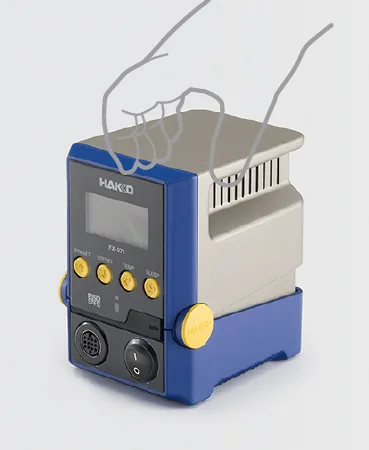
Operation uses four buttons. Hakko says the station has a patented composite tip with improved sensor sensitivity and stable temperature control. In a composite tip, the heater and the sensor are built into the tip cartridge itself, which keeps the temperature reading close to the point where solder is actually being melted.
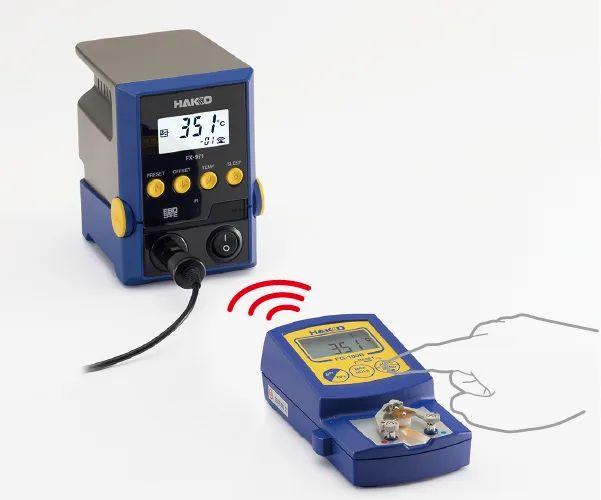
Auto-sleep and auto-shutoff work without needing the iron to sit in a holder base connection, which means the station can sense idleness on its own. The product page also lists infrared communication for automatic calibration against a thermometer (Hakko's FG-100B and FG-101B), and software compatibility that lets a PC connect for temperature management and history recording. Calibration is the process of comparing the temperature the station reports with a measured reference and correcting any difference, and a station that can do it over infrared saves the user from taking the tool apart. A US reseller listing says the station requires Hakko Control Software V3 or higher.
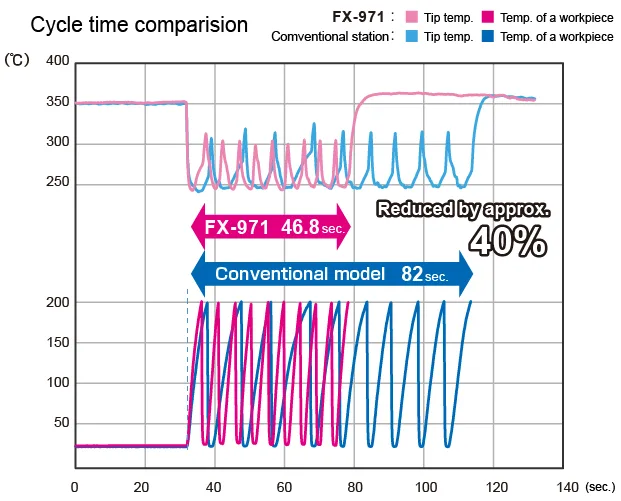
Tips named on the page are the T39-BCR1235, T39-JD16, T39-DR16, and T39-DS32, with N2 and micro irons optional. The station is lead-free solder compatible, ESD safe, and RoHS compliant. ESD is electrostatic discharge, the static spark that can damage sensitive parts, so ESD-safe means the tool is built to avoid creating or carrying it. The product page also cites an approximate 40 percent reduction in cycle time against previous models. Its graph defines the test: the time until solder on a workpiece reaches 200°C, measured at 10 points on a 0.6 mm wire on a 1.5 mm copper plate, at a 350°C setting with lead-free solder. In that test the FX-971 took 46.8 seconds against 82 seconds for a conventional model. Those are Hakko's own results.
What do the specifications say?
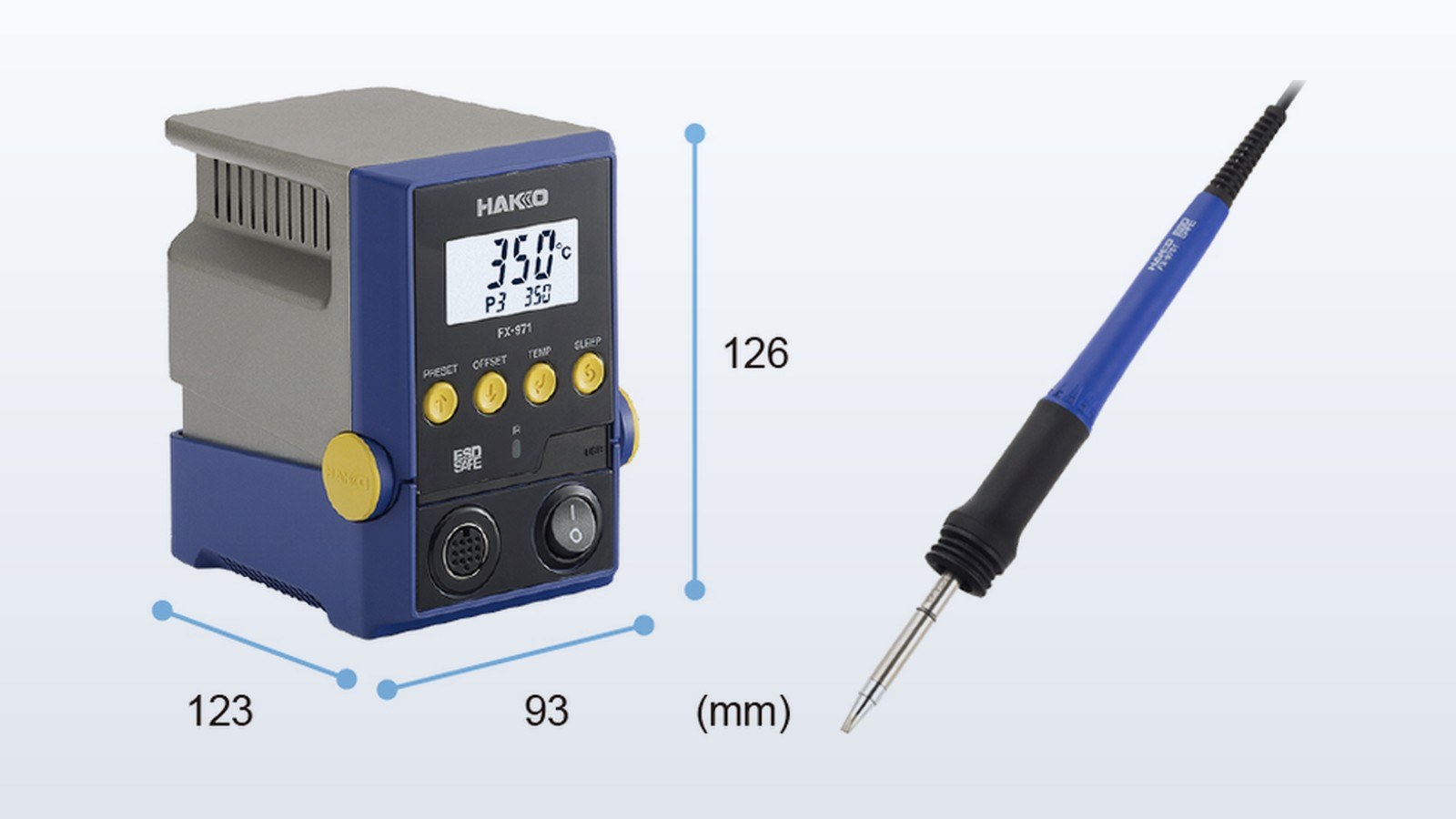
Reseller listings give a temperature range of 50 to 450°C (120 to 850°F), an output of 24 V, and outer dimensions of 93 mm wide, 126 mm high, and 123 mm deep (3.7 by 5 by 4.8 inches). Stability figures differ between sources, with one listing giving plus or minus 5°C and another citing tip temperature accuracy of plus or minus 3°C, so I'm not settling on one. Power draw is listed as 100 W on 120 V. The package listed at one US reseller includes the FX-9701 iron and a stand, and tips aren't included. The FX-971's part number in that listing is FX971-010.
How does it compare with what came before?
Retail and review sources describe the FX-971 as the new version of the FX-951, Hakko's earlier digital station, with the composite tip and the narrower accuracy as the headline improvements. Hakko's own pages don't print a point-by-point comparison, so I'm relaying that characterization as secondary. The more useful context is where the FX-971 sits in the market. A June 2026 buying guide lists the Hakko FX-888D class at about $130 as its best overall digital station and the Weller WE1010 at about $155 for professional use, while smart USB-C irons like Miniware's TS101 and Pine64's Pinecil sit far below that. The FX-971 is a professional-tier base, which is why it carries multi-port siblings and rework tools.
What do the extra handpiece types do?
Beyond the standard iron, the family covers jobs that a plain iron handles awkwardly. Hot tweezers (the FX-9705 and the micro FX-9706) have two heated tips that pinch a small part, so the part is heated from both sides at once and can be lifted off the board in one move. A micro iron (FX-9703, or FX-9704 with nitrogen) uses a finer tip for small surface-mount work. A heavy-duty iron (FX-9707, or FX-9708 with nitrogen) is built for large joints that pull heat away quickly. The FR-4103 is a desoldering tool, which removes solder instead of adding it. Hakko's notice lists all of them as part of one family, so a user can start with a single-port station and add handpieces as the work changes.
What does it cost, and where is it sold?
Hakko's announcements print no price. US retailer listings vary widely: one reseller lists the FX-971 at $449.97, while a European shop lists it at about $292 excluding VAT (converted from euros at early-October 2026 exchange rates), so I'd treat prices as shop-dependent until Hakko publishes a list price. American Hakko Products handles US sales, and the station is listed through US electronics distributors such as Digi-Key and Micro Center, with retailers listing a release date of November 5, 2025 in the US, which I couldn't confirm from Hakko directly.
What's still unknown?
The July 8 notice leaves out technical specifications, features, price, and the sales start date. Product-page claims such as the 40 percent cycle-time reduction aren't defined, the stability figure differs between sources, and the US availability date comes from retailers. Tips, handpieces, and holders may be sold separately depending on the package, so buyers need to check what's included before comparing prices.