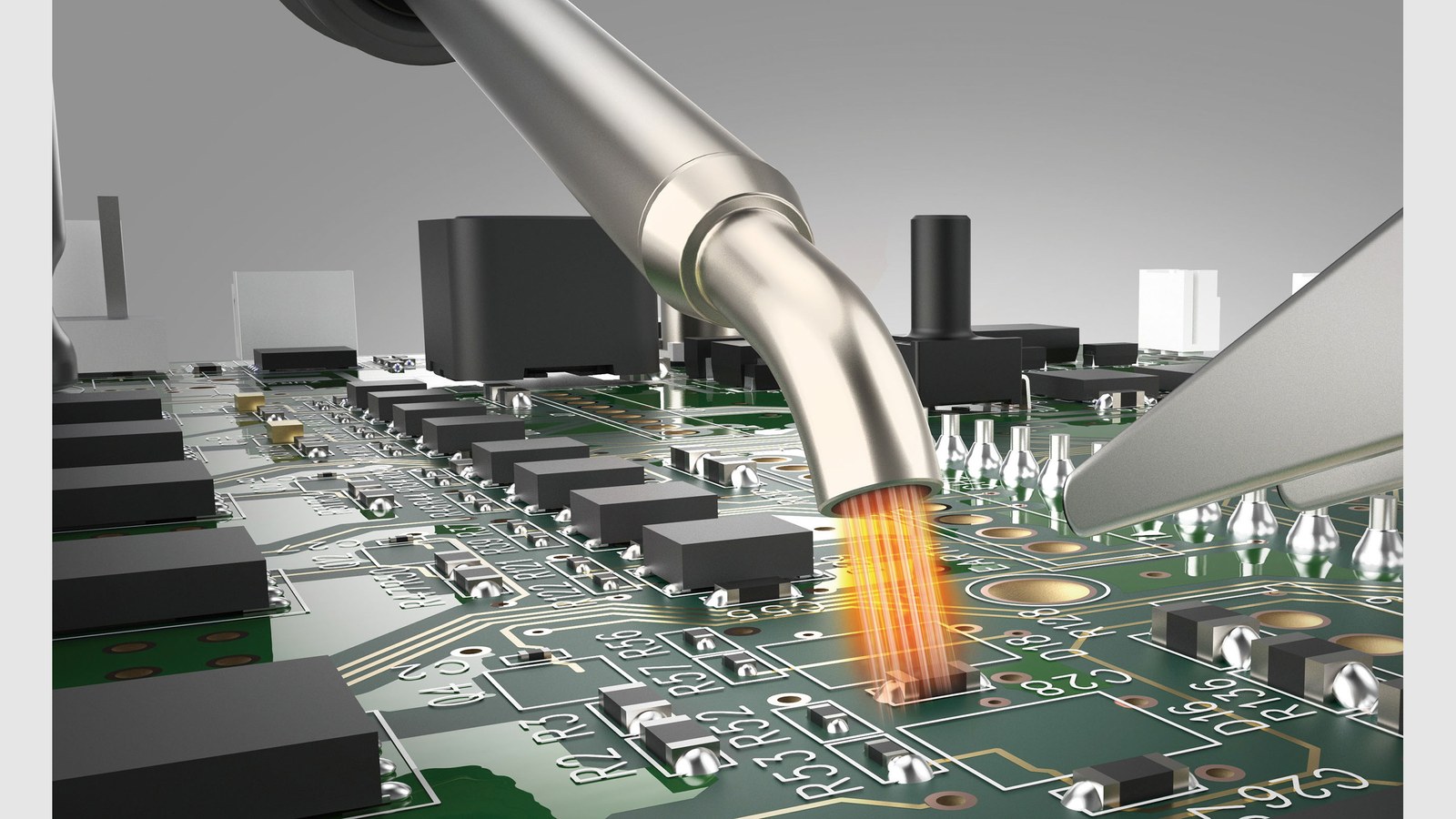
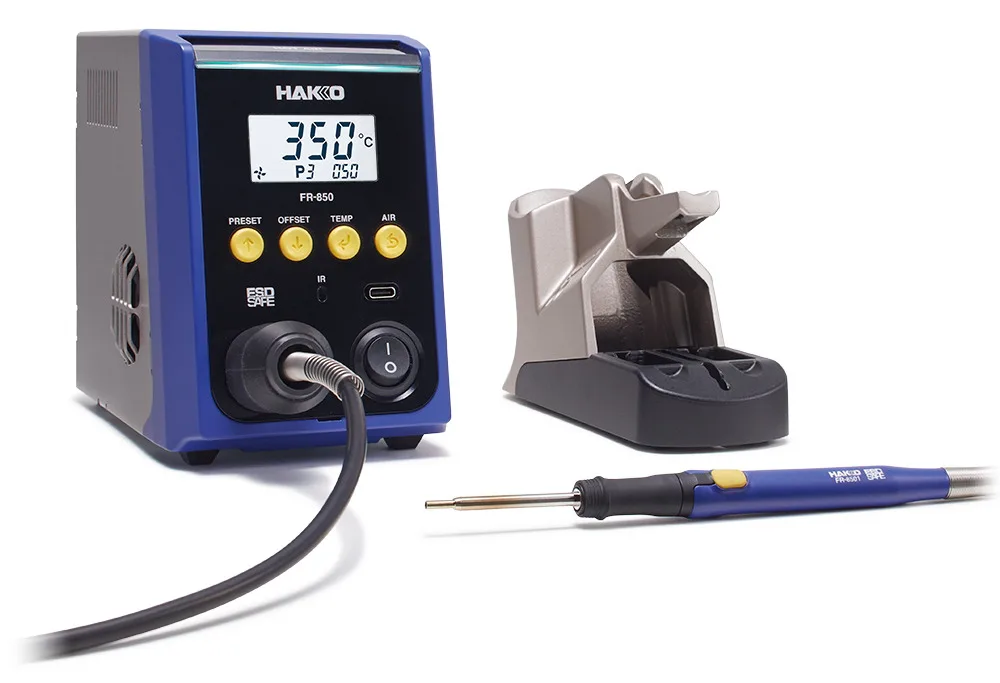
Hakko's Japan news page, dated May 30, 2025, gives the FR-850 a sale date of June 9, 2025. Hakko describes it as a micro hot-air station for dense surface-mount rework, with wide temperature settings and fine airflow for small parts on boards that sink a lot of heat, and says that kind of rework can leave surrounding parts unaffected. No price was announced. TMWB hasn't used this station, so the specifications below are Hakko's.
Why does airflow matter on a dense board?
A surface-mount device (SMD) sits on copper pads on the face of a board, with no leads through holes. A tiny chip, or a part with metal under its body, comes free only when the solder under the whole footprint is liquid. A soldering iron heats one pad through a tip, while hot air heats a whole group of connections as a stream. On a crowded board, that stream is the practical problem: too little heat and the part stays stuck, and too much moving air shoves the chip next to it off its pads.
A typical rework gun moves enough air to blow away an 0402, a very small chip, along with its neighbor. Hakko lists the FR-850's airflow at about 1.5 to 5 liters per minute, varying by nozzle, which is meant to heat one joint. A heat gun sized for shrink tubing, by comparison, throws a broad blast across a surface.
Thermal mass is the other half of the problem. A ground plane is a wide sheet of copper that carries heat away, so a small part sitting on one can stay solid while its neighbor on a thin trace is already liquid. Hakko pairs the fine airflow with a wide temperature range of 50 to 600°C and leaves the setpoint choice to the person at the bench. By May 2025 the market already offered benchtop hot-air stations from Hakko, Quick, and others with more airflow than this, as well as USB-C pen irons for single joints. The FR-850 is positioned for work under a microscope, nozzle close to one part.
What are the nozzle and stand details?
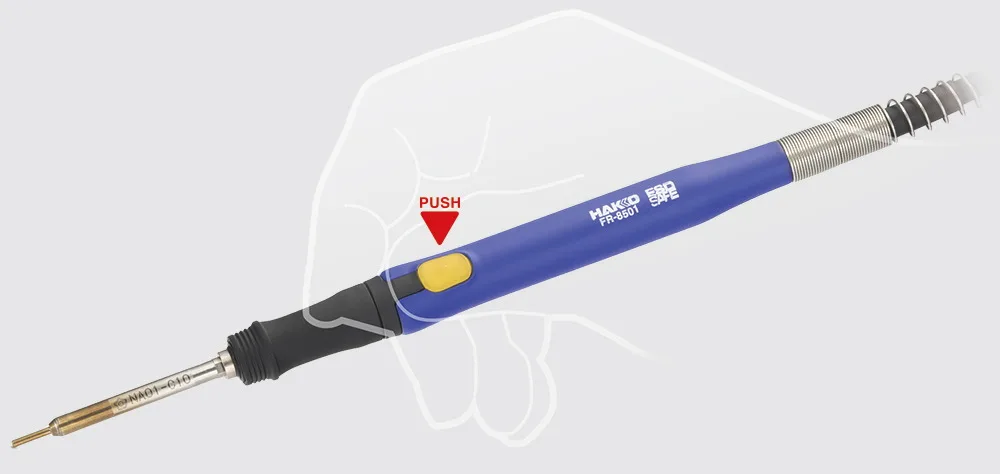
The handpiece uses cartridge nozzles, so the heater and nozzle travel together and a swap changes the air path. Hakko lists six nozzle types, straight and bent, with a tool-less swap. A bent nozzle lets the grip sit at an angle where it stays out of a microscope's light.
The stand stores up to four nozzles and accepts one-touch attach. Auto cooling runs when the handpiece is placed on the stand, and there's an auto shutoff, though the cooling time and shutoff delay aren't printed. An A1557 sensor measures hot-air temperature, infrared calibration works with Hakko's FG-100B and FG-101B instruments, and PC software handles temperature, calibration, and history. Hot air can be switched from a handpiece button or a wide top button.
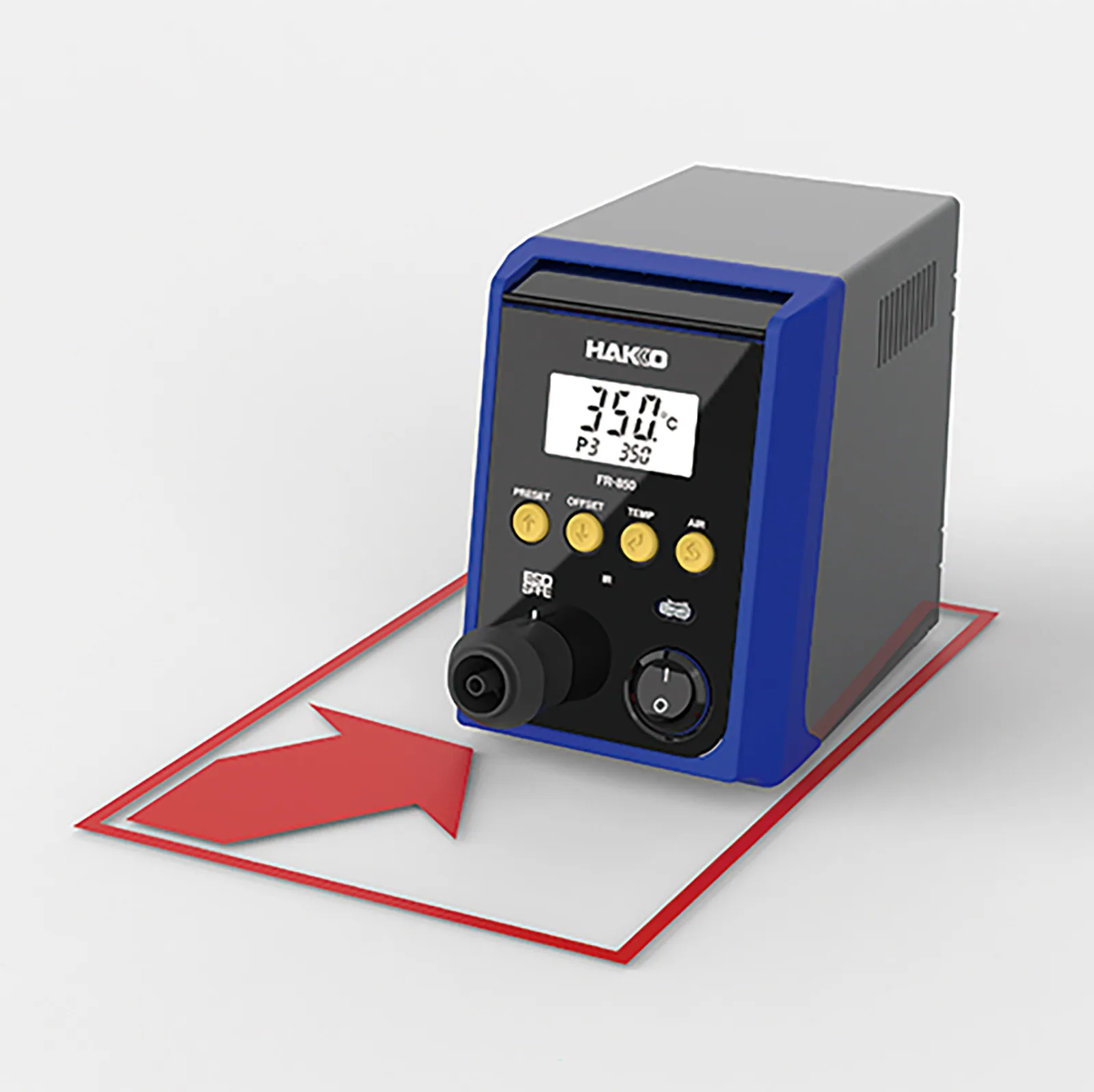
Hakko says the footprint is 55 percent smaller than conventional models, without naming the baseline. The station is 98 mm wide, 140 mm high, and 165 mm deep, and weighs 1.8 kg. The handpiece is 227 mm long and 70 g with the NA01-C20 nozzle fitted.
What are the electrical specifications?
Power is 112 W total, split between 7 W for the station and 105 W at 24 V for the handpiece's composite heater. Nozzle-to-ground resistance is under 2 ohms and potential is under 2 mV. That matters because the metal nozzle passes near pads that lead into a chip, and a static-sensitive part can be damaged by a voltage no one would feel. The cord is 1.2 m long.
Part numbers differ by market. FR850-81 is the Japan 100 V version, FR850-010 is the US 120 V listing, FR8501-81 is the handpiece, and NA01 is the nozzle family.
How does this fit Hakko's lineup?
Hakko is best known for its soldering irons and stations. The FR-850 is the micro entry in its hot-air range, with a small handpiece, a compact 98 mm wide station, and a modest airflow figure. Hakko's pages emphasize the footprint, which they call 55 percent smaller than conventional models, and the weight, with the station at 1.8 kg and the handpiece at 70 g. Those are the numbers of a tool meant to be carried between benches or kept beside a microscope, and not of a station built for production.
The calibration story reinforces that. The A1557 sensor and the infrared calibration with the FG-100B and FG-101B are the kinds of features a repair shop that cares about traceable temperatures would use, while the PC software for temperature history and calibration suggests Hakko expects technicians to log what they do.
What does it cost, and where can you get it?
Hakko's announcement doesn't state a price. The dated post is the Japan news item from May 30, 2025, which sets the sale date for June 9, and the longer description sits on Hakko's English product page, with the measurement table on the FR-850 spec page. The catalog lines I used don't add a price either, so a later shop price sits outside the announcement. Part numbers differ by market: FR850-81 is the Japan 100 V version and FR850-010 is the US 120 V listing. The nozzles are sold as the NA01 family, and the handpiece part is FR8501-81, so buyers shopping for replacement or extra nozzles will be ordering those separately.
Who is it for?
The stated job is board repair under a microscope, dense boards, and parts on a ground plane. A small shop that already owns a higher-airflow station plus a USB-C pen iron can slot the FR-850 into the close work: the pen for single pads, the larger station for big footprints, and this unit where that larger stream is too windy. Open questions remain on how 1.5 to 5 L/min behaves on a given connector, how long a heavy ground pad takes, and the price.
Sources and image credits
- Hakko Japan news, May 30, 2025
- Hakko FR-850 product page
- FR-850 spec page
- Product images: Hakko