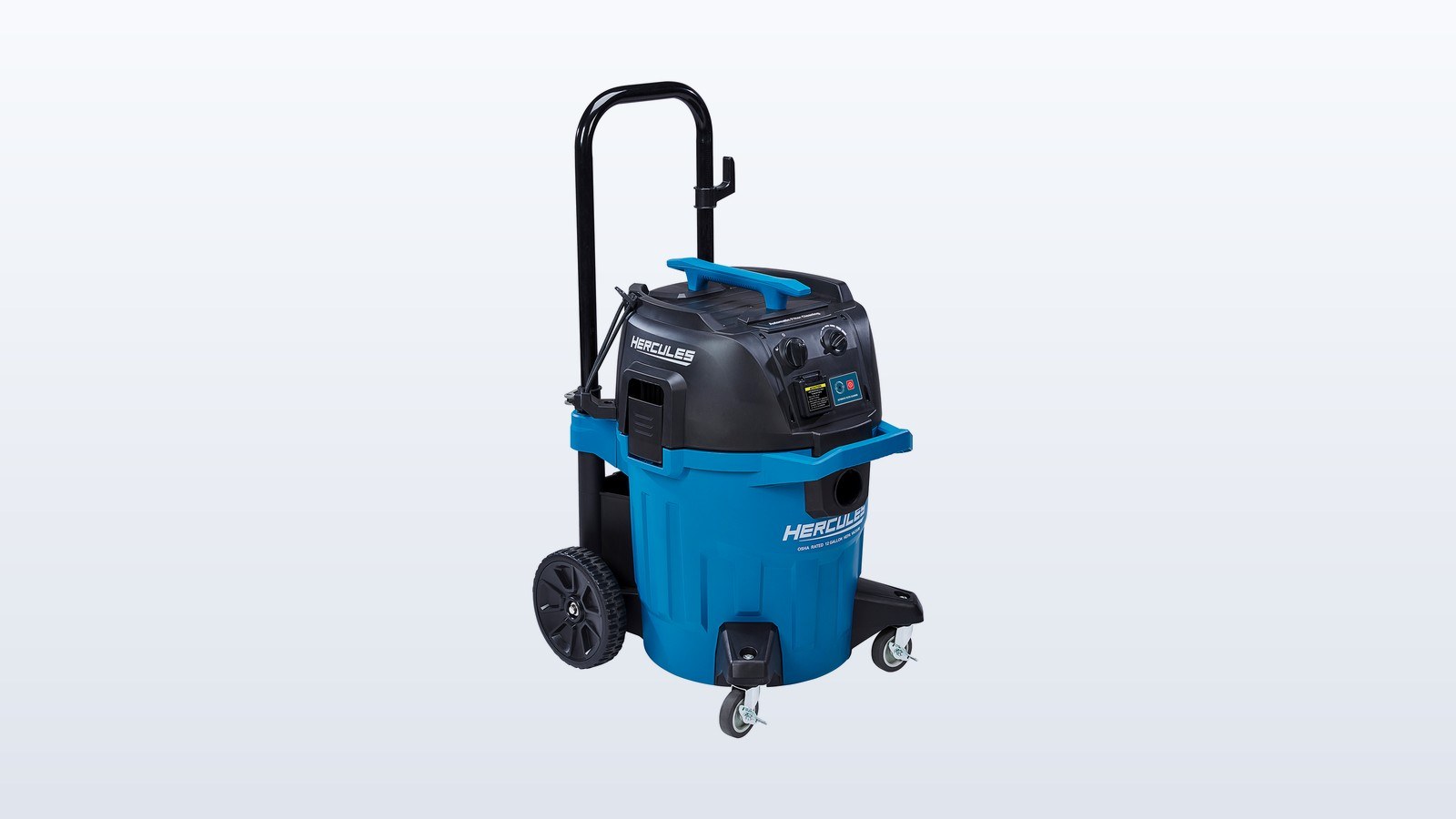
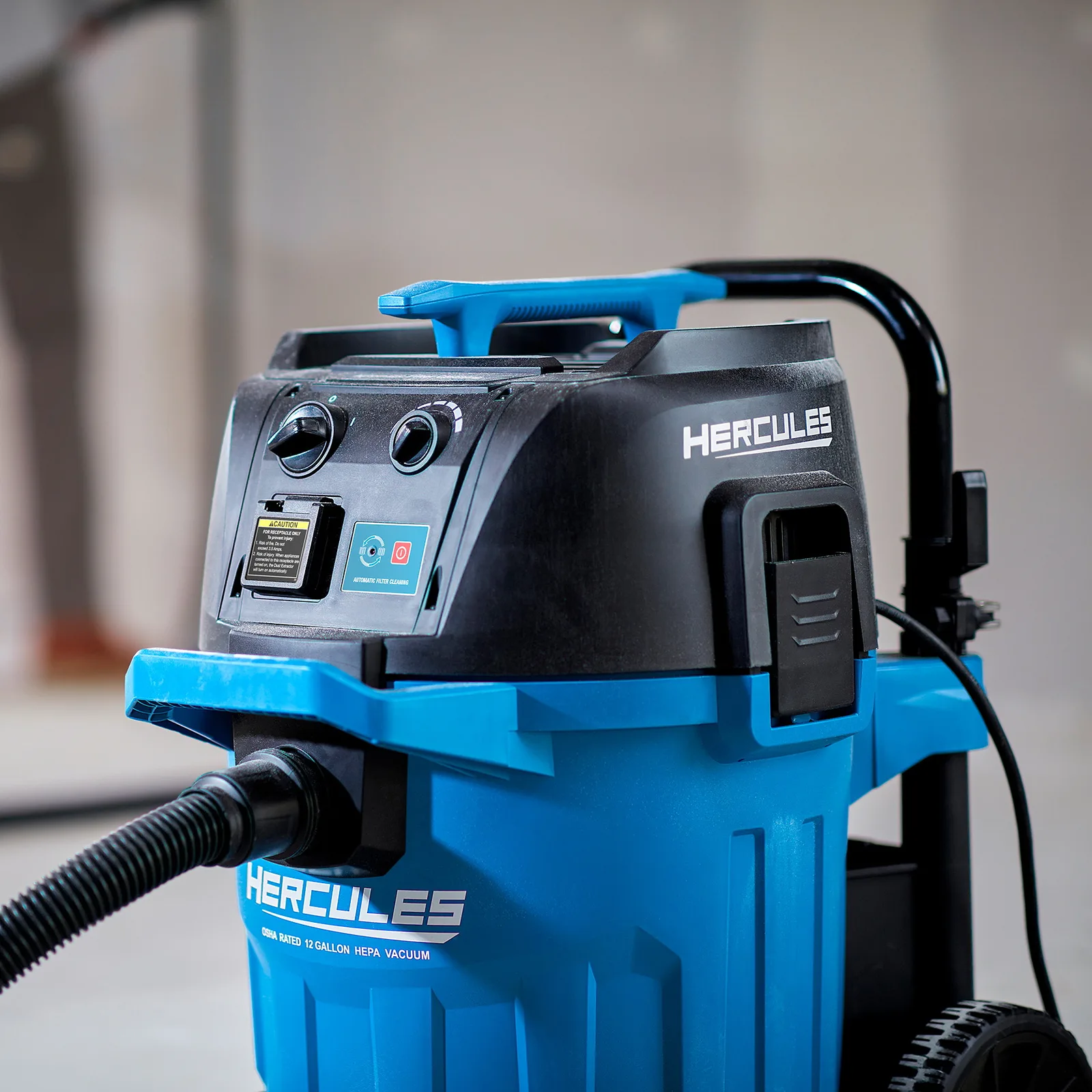
Harbor Freight added a 12-gallon dust extractor to its professional HERCULES line on October 17, 2024. It's item 58966, it's sold only at Harbor Freight, and the announcement doesn't print a price. The release points readers to the product page for the current figure. TMWB hasn't tested this machine, so everything below comes from Harbor Freight's own announcement.
A dust extractor is the shop vacuum's more deliberate cousin. A general wet/dry vacuum picks up screws, puddles, and whatever got swept into a corner. An extractor is built to stay connected to a sander, a track saw, or a router and keep fine dust out of the air while that tool runs. The HERCULES unit is aimed at that second job, and Harbor Freight describes it as OSHA-compliant. OSHA is the U.S. Occupational Safety and Health Administration, the federal agency that sets workplace safety rules. The release uses the phrase without naming a specific rule or certification number, so I'd read it as marketing language until the standard behind it is spelled out.
What does the filtration claim mean?
The headline feature is the filtering. Harbor Freight says the extractor uses dual self-cleaning HEPA filters that capture 99.9 percent of particles 0.3 microns and larger. HEPA stands for high-efficiency particulate air, and a micron is a millionth of a meter. A human hair is roughly 50 to 70 microns across, so 0.3 microns is far too small to see. Filters are usually tested at that size because it's the hardest one to catch: smaller particles get caught by diffusion and larger ones by direct impact, which leaves the middle size as the toughest case.
Fine dust loads a filter long before it fills a tank, so "self-cleaning" matters here. The first minutes of drywall or sanding work coat the surface of the filter, and that coating chokes airflow while the canister is still mostly empty. A self-cleaning system knocks or pulses the dust off the media so suction doesn't collapse partway through a job. Harbor Freight doesn't describe how its system does that or how often.
The canister holds 12 gallons, which is a volume and not a promise about how much dust fits before suction drops. The motor is listed at 6.5 peak horsepower with variable speed. Peak horsepower is measured at a brief moment, often startup, so it says little about continuous airflow. The release gives no cubic feet per minute, no water lift, and no decibel rating, and those three numbers are how people actually compare extractors.
How is it built to move and connect?
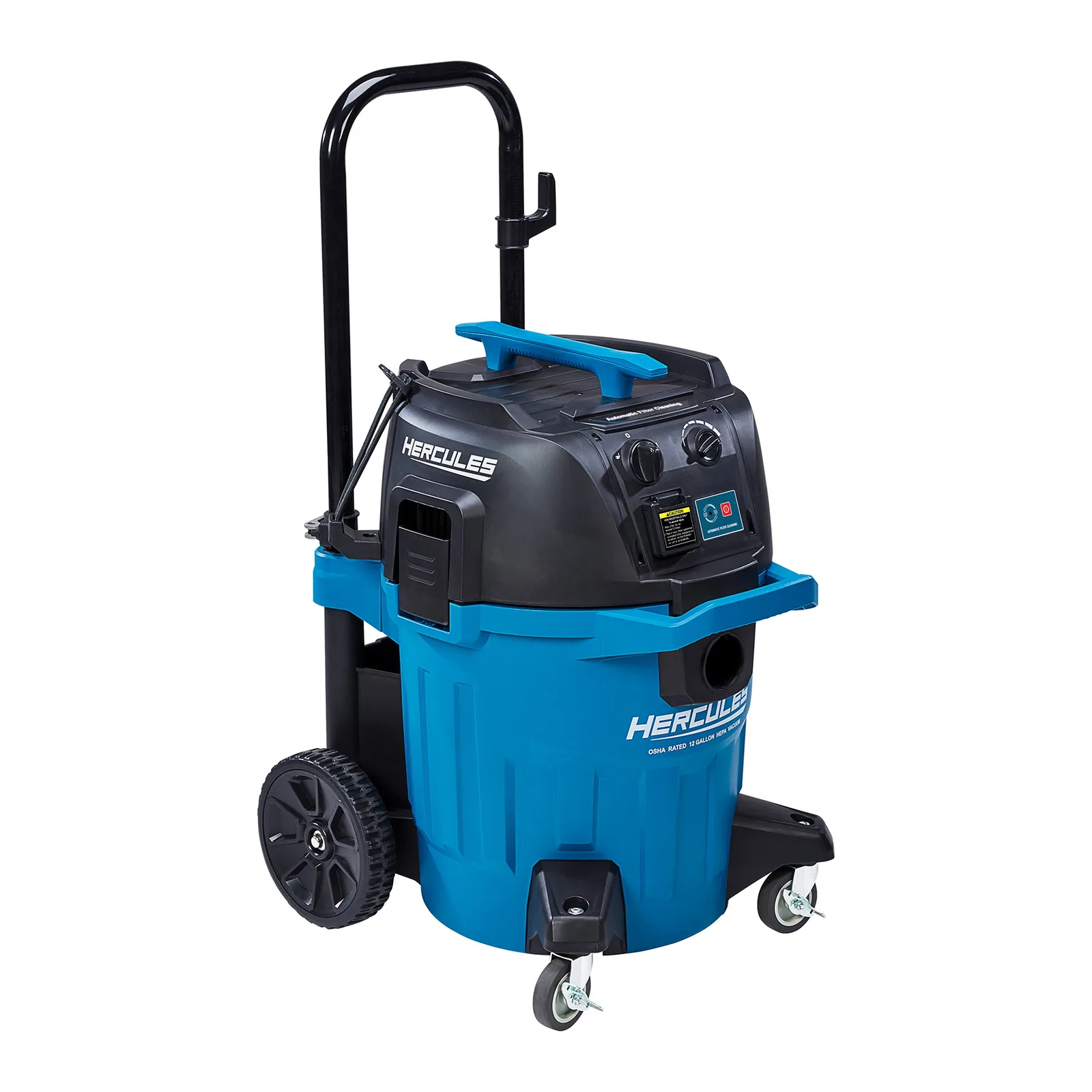
Portability gets a full paragraph in the release, which suits a machine meant to follow work around a garage or a small job. Harbor Freight lists a telescoping handle, wheels, and heavy-duty locking casters (the small swivel wheels, locked so the canister doesn't wander when the hose tugs). The cord is 24 feet and the hose is 17 feet. A swivel connector lets the hose turn without twisting the canister.
The hose is anti-static. Dust racing through plastic builds a charge, and an anti-static hose is meant to bleed it off so there's less chance of a spark at the tool or a shock at your wrist. The release doesn't say whether the hose is grounded through a wire in the cuff or through conductive plastic, and it doesn't give a diameter, which matters if you already own Festool, DeWalt, or shop-vacuum fittings.
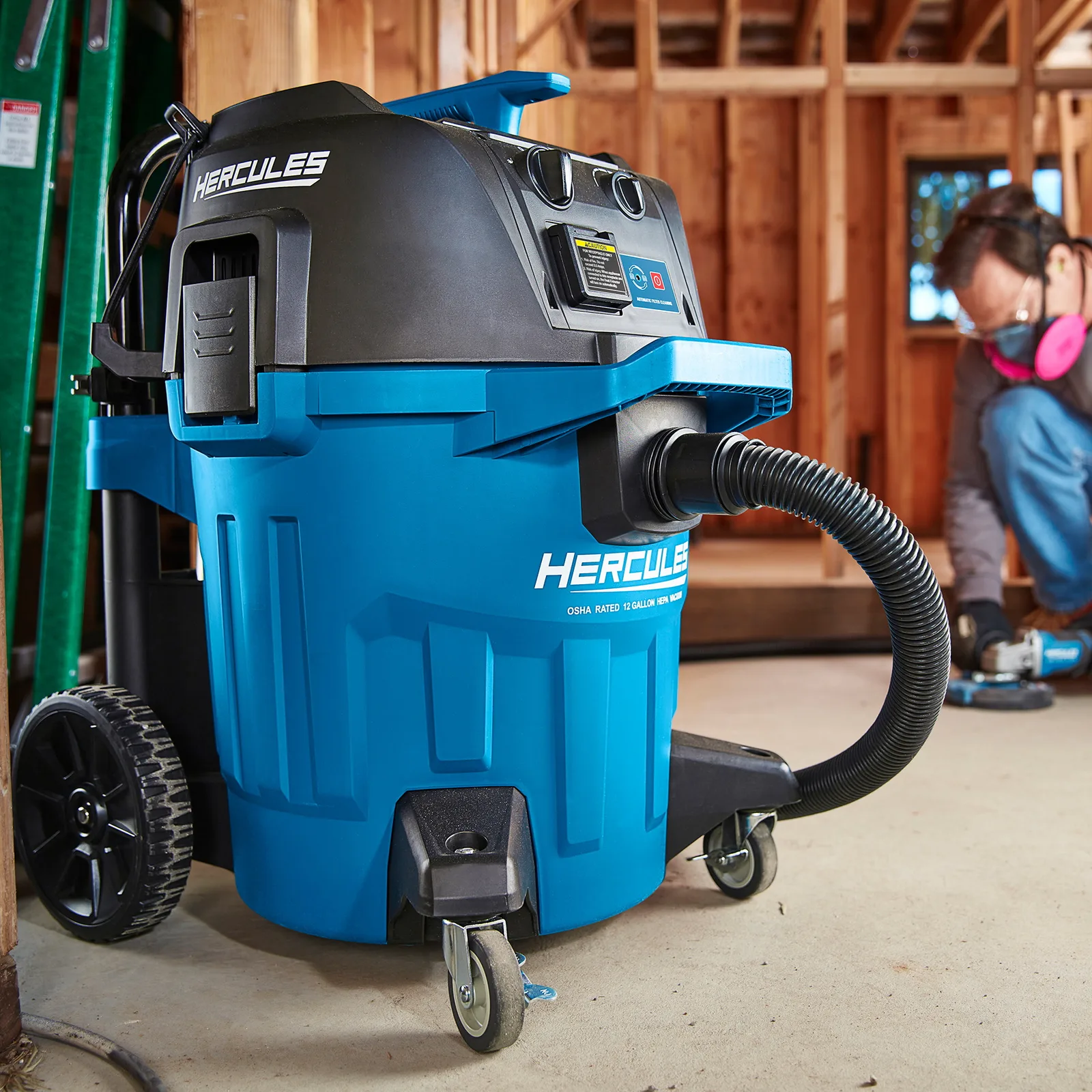
One feature handles the moment after a cut. Harbor Freight says a power-tool mode keeps pulling for 10 seconds after the connected tool turns off, clearing whatever is still sitting in the hose so the next cut doesn't blow a puff of dust back out of the port. That's the behavior people expect from an extractor with a tool-triggered outlet. The announcement doesn't say whether the extractor has onboard outlets, how many, or what they're rated for.
Where does it sit among other options?
Fine dust is the part of woodworking and drywall work that doesn't look dramatic and still causes the trouble. A table saw makes chips you can sweep. A random-orbit sander makes a cloud, and the cloud settles on the bench and in your lungs. Connecting the tool to an extractor doesn't make a shop clean by itself, but it moves the largest share of that dust into a canister.
By October 2024 a home shop already had plenty of ways to buy that idea. Festool's CLEANTEC extractors, DeWalt's steerable dust extractors, and jobsite vacuums from Ridgid and Bosch were all on the market, and they aren't interchangeable. Hose diameters differ, some auto-start when a plugged-in tool draws current, and some include HEPA while others sell it as a cartridge you add later. Harbor Freight didn't publish a comparison. What it published is a HERCULES-branded 12-gallon extractor with the feature list above.
HERCULES is Harbor Freight's professional power-tool brand, sold above the lower-priced Bauer and Warrior lines. An extractor is a different kind of product from a drill, because it has filters to replace and a motor that may run for many minutes at a stretch. The five-year warranty language common on HERCULES tools isn't repeated in this release, which says only that the extractor "offers exceptional value." Value is Harbor Freight's word, and no dollar figure sits beside it.
What can't you tell from the announcement?
Several gaps are large enough to matter before anyone treats this as a finished specification.
- Airflow. Without cubic feet per minute at the hose end, there's no way to know whether the machine keeps up with a 5-inch random-orbit sander, a track saw, or only a small detail sander.
- The filter claim. The release doesn't say whether the 99.9 percent figure is a rating for the filter media alone or a test of the whole machine with the hose attached. Those are different tests, and a leaky gasket can let dust past a very good filter.
- The OSHA wording. Compliance depends on the task. Wood dust, silica, and lead paint dust aren't governed by one sentence on a product page.
- Consumables and electrics. The release lists no replacement filter part number, no bag option, no noise level or weight, and no amp rating. A 6.5 peak-horsepower motor and a big saw on one household circuit is exactly the combination that trips breakers.
The extractor makes the most sense for a home shop or a one-person job that already makes fine dust: sanding, garage track-saw cuts, drywall, and the occasional concrete drilling. It's a weaker fit for anyone who needs a published airflow number for a safety plan.
Sources and image credits
- Harbor Freight newsroom, October 17, 2024
- 12 Gallon OSHA-Compliant Dust Extractor, item 58966
- Product images: Harbor Freight newsroom