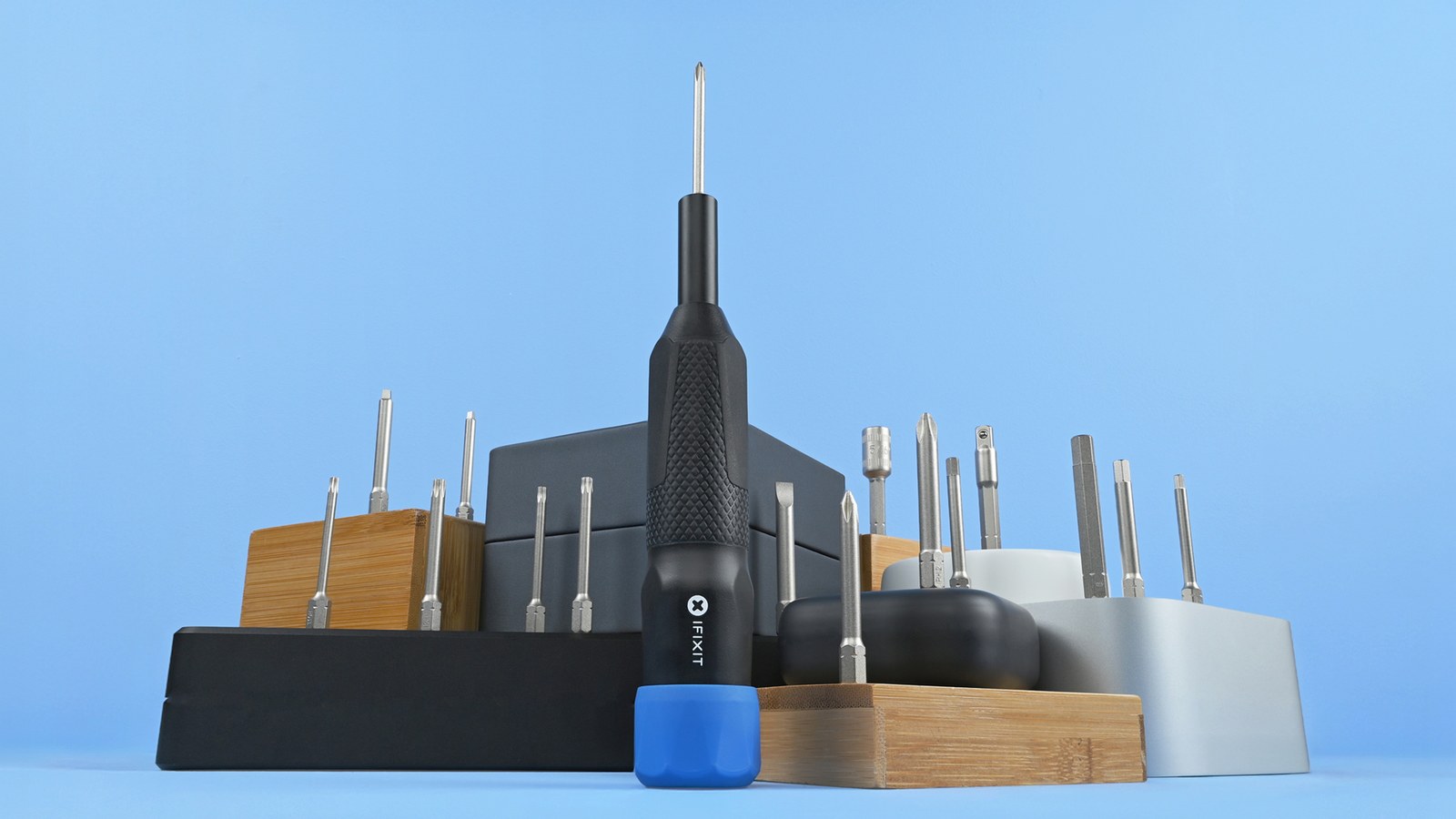
Spin the top of a driver with one finger and a loose screw walks in. Push that same top down and the cap stops turning free, so the handle and bit move together and the next turn can tighten. That motion is the center of the Megalodon Driver Kit, which iFixit described on July 1, 2026. The announcement presents it as available. It doesn't state a price or a part number. TMWB hasn't used it.
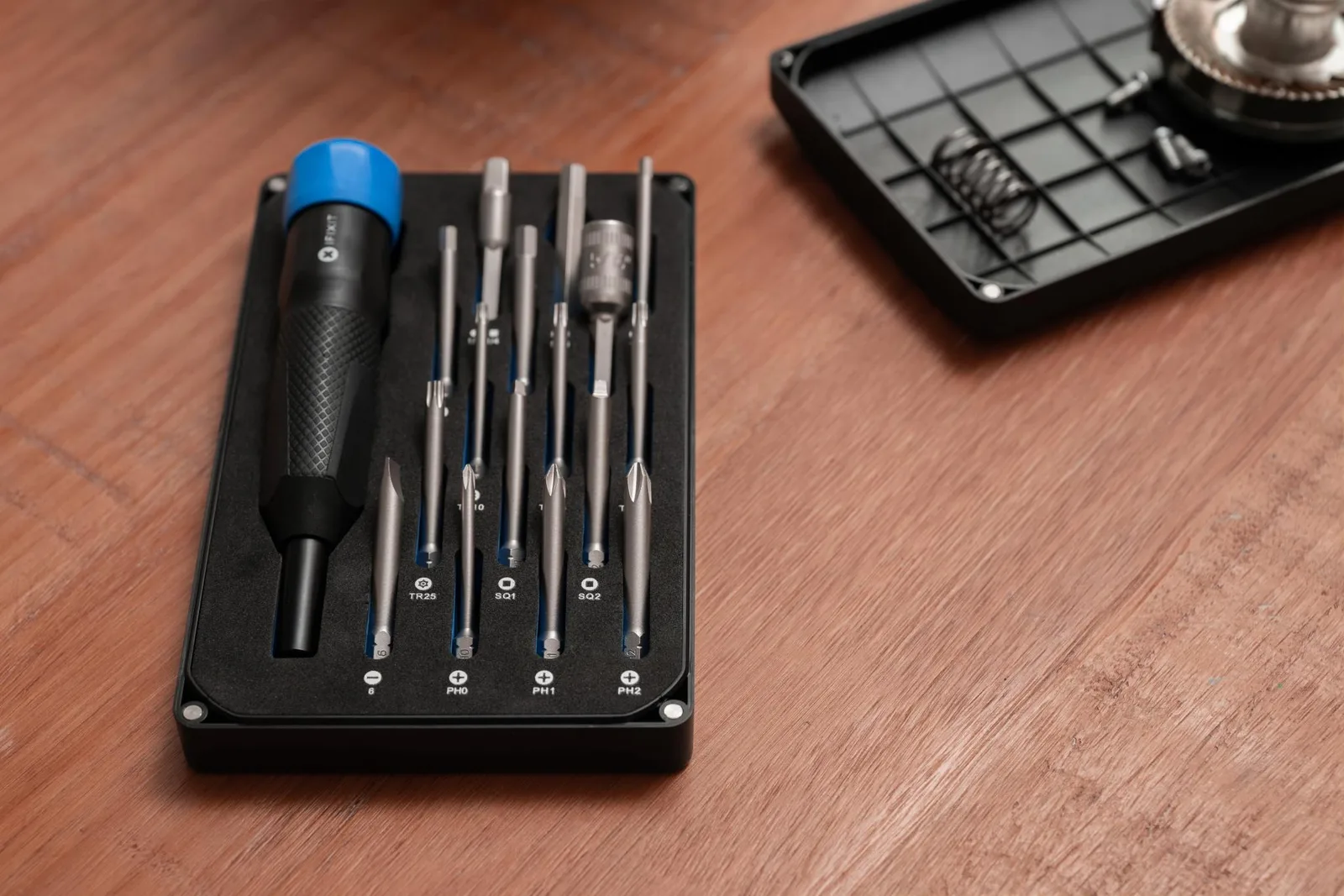
iFixit frames the kit as a home-repair driver. Product development lead Brett Hartt says the target is things in your house: a vacuum screw deep in a housing, a tight outlet terminal, a coffee maker, a rattling dishwasher, furniture, and small jobs inside a car. The case has the same size and shape as the Mako case, so the two share a drawer footprint, and a community latch frame designed for the Mako on Printables reportedly fits too.
What does the push-to-lock cap do?
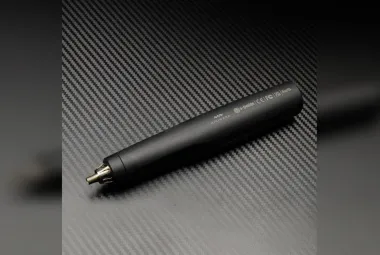
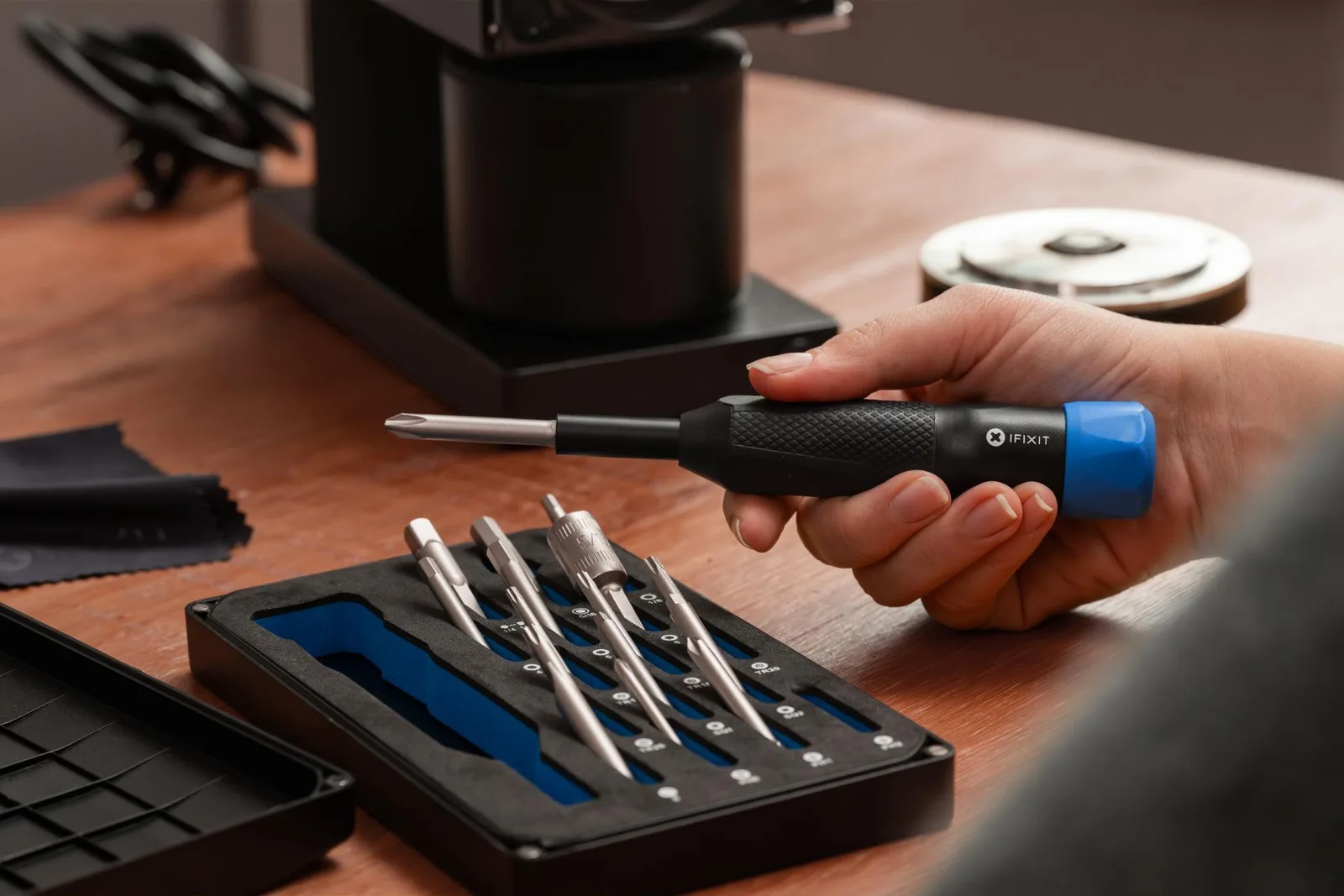
Free, the Swivel Grip Cap spins, so a fingertip can twirl a long screw in while the handle stays lined up and the bit stays square. Push the cap and it locks, and torque (the twist that turns a screw once the threads are engaged) then goes through the handle into the bit. Spin for speed, push down when you want to bear down.
Inside, the post describes a clutch. Lead developer Andrew Goldheart says the team started with smooth clutch liners, and Hartt wanted "infinite points of engagement" instead of a toothed ratchet, which only catches where a tooth meets a pawl. Smooth liners fell short, so the team added tiny lobes to help the clutch catch and line up. Goldheart says the feel couldn't be proved on a 3D-printed part, so the liners came from injection-mold tooling. iFixit mentions a torque rig and a cycle machine without printing results.
The post is explicit that the cap isn't a ratchet. There's no direction switch, and direction is just the way you twist the locked handle. A ratchet still suits a short swing against steady resistance, like a hose clamp in a corner.
Which 16 bits are in the case?
Sixteen extended-reach bits, each on a 2 in. shank:
- Phillips: 0, 1, and 2
- Flathead: one 6 mm
- Torx security: TR10, TR15, TR20, and TR25 (a six-lobe star with a hole for a pin in the middle, which a plain Torx bit won't seat in)
- Hex: 4, 5, and 6 mm, plus 1/8 in.
- Square (Robertson): 1 and 2
- One 5/16 in. nut driver, and one 1/4 in. socket adapter for turning a 1/4 in. drive socket you already own
Pentalobe (the five-lobe phone screw), tri-point, and Phillips #000 aren't included.
Why are the bits 2 in. long?
A standard 1 in. bit is enough when a screw head stands proud and too short when it sits in a well. A boss is a molded plastic tube around a screw hole, and the bit has to travel down it, or the driver body hits the rim first. Vacuum housings, coffee makers, and dishwasher panels are the examples. A longer bit flexes more, and the post prints no shank diameter or steel grade.
How did iFixit's team develop the clutch?
The post gives unusual detail on the engineering. Lead developer Andrew Goldheart says the team started with a smooth profile on the clutch liners, the pieces that grip when the cap is pressed. Product development lead Brett Hartt wanted "infinite points of engagement." A toothed ratchet catches only where a tooth meets a pawl and clicks between teeth, and Hartt describes one early prototype as feeling like biting a fork. Smooth liners avoided that crunch and still fell short, so the team added tiny lobes that help the clutch catch and line up. Goldheart says the feel couldn't be proved on a 3D-printed part, and the liners had to come from injection-mold tooling. The exploded view names a shaft clip, an inner housing, clutch liners, a quick-release spring, and the cap, and the post mentions a torque rig and a cycle machine without printing results.
What changed with the labels?
The kit trials new printed bit labels before a line-wide change. The coating is described as oil and solvent resistant, and a photo shows the holders with household solvents (the text doesn't name them). Hartt says the labeling took about as much work as anything else in the kit. On earlier foam holders, laser etching was what stayed readable after other printing wore off. The labels ship on this kit, and the wider change is described as later.
What came before the Megalodon?
The Megalodon isn't iFixit's first kit. On January 7, 2025, iFixit posted the Pro Tech Go toolkit, an earlier and different kit, and on January 22, 2025, a Mako buying-guide note mentioned a longer neck, which was a guide update. The July 1, 2026 claim is that the Megalodon case matches the Mako case in size and shape. The post places the Mako on gadgets, the Mahi on larger tech, and the Megalodon on household fasteners.
A comment the same day asked how the handle differs from the Narwhal. Elizabeth Chamberlain answered that both have the push-to-lock cap, and the Megalodon follows the Narwhal form factor. The Narwhal has a reversible shaft and a polymer core with a rubberized grip, while the Megalodon driver has an anodized aluminum handle and separate 2 in. bits in the case. Anodizing grows a thicker, harder oxide on aluminum that can hold color. She didn't rank them for strength.
Who is it for?
Furniture cam bolts, appliance covers, and small engines, along with electronics with matching tips. It doesn't publish a clutch torque limit.
Sources and image credits
- iFixit announcement, July 1, 2026
- Megalodon Driver Kit
- Mako latch frame on Printables
- Product images: iFixit