A nut sitting behind a bracket doesn't care how strong your pliers are if the head is too wide to reach it. Wire has the matching problem, since insulation has to come off to a set length and the copper has to stay round. On July 1, 2025, Knipex published its "new products summer 2025 FAQ" on its English blog, with the tools available from July 2025. No price was printed, and the FAQ says to ask a dealer.
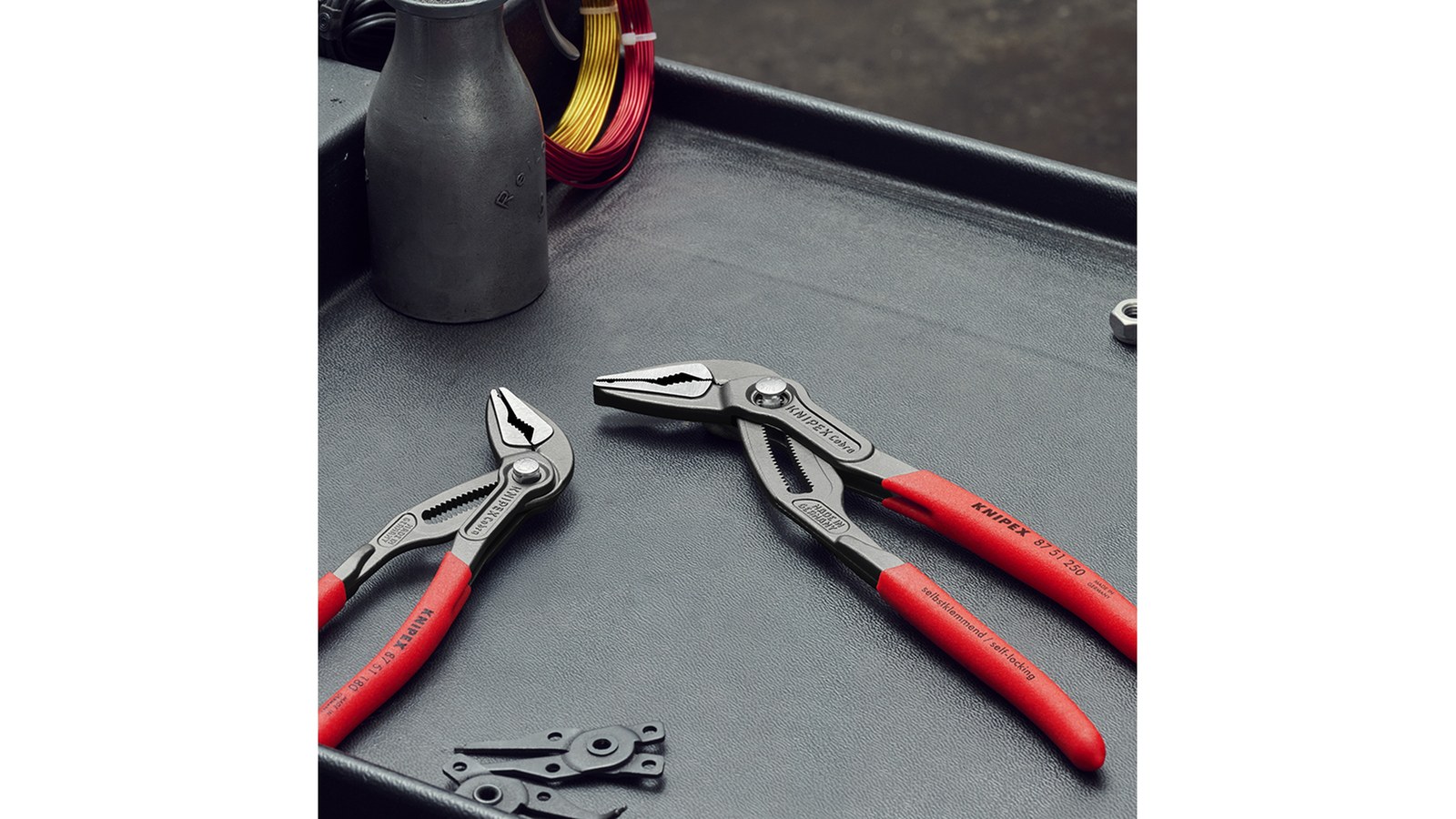
The post is a batch that also includes photovoltaic tools and a pipe cutter. I'm focusing on the two tools a general bench is likeliest to pick up: the Cobra ES extra-slim pliers and the EvoStrip stripper. TMWB hasn't used them.
What do the numbers mean?
| 87 51 180 | 87 51 250 | |
|---|---|---|
| Length | 180 mm (7.1 in.) | 250 mm (9.8 in.) |
| Adjustment positions | 18 | 25 |
| Maximum opening | 37 mm | 45 mm |
| Gripping capacity (bolt and hex) | 32 mm (1-1/4 in.) | 36 mm (1-3/8 in.) |
Positions are how many grooves the button can lock, and more grooves mean a better chance one puts the teeth on the flats. Maximum opening is how far the jaws spread, which has to be larger than the part so they can pass over it. Gripping capacity is the size they're rated to hold, with a hex measured across the flats. Length is leverage, so the longer tool squeezes harder but needs more swing room. Gripping force and jaw hardness aren't given.
How does the Cobra's adjustment work?
Water-pump pliers are a tongue-and-groove tool. The lower jaw carries a tongue, a rail cut with grooves, and the upper jaw locks into one groove, setting the opening. A wider groove reaches a larger nut or fitting, and the groove is chosen so the teeth land on the flats of a nut, because teeth that land on the corners slip and start rounding it. Changing grooves on a plain tongue-and-groove plier means opening the handles until the tongue can jump, while Cobra is Knipex's push-button version, where a button releases the joint and the jaw slides to the next groove. Extra-slim means the head and joint are narrowed to pass a bracket that blocks a full-width plier, though the FAQ gives no head thickness.
How is the EvoStrip rated?
Stripping means removing insulation without nicking the conductor. A nick is a cut in the copper or aluminum that reduces the area carrying current and is where a wire can break if the joint flexes later. Self-adjusting means the tool closes to the insulation diameter instead of the user choosing a notch. Knipex rates the EvoStrip (12 40 200) from 0.03 to 10 mm², and mm² is the area of the metal if the wire were cut straight across, not the outside diameter of the jacket. That range runs from a hair-thin signal strand to a heavy appliance conductor. The length stop allows 5 to 22 mm with the stop fitted and up to 25 mm with it removed. The same tool cuts copper and aluminum, with fine-stranded cable up to 10 mm² and solid cable up to 6 mm², since a solid conductor is stiffer in the blades than a bundle of the same area. The post doesn't rate the cutter for steel.
What are the other tools on the FAQ?
The ComStrip (12 62 180) strips solid, stranded, and fine-wire conductors from 0.2 to 6 mm², with a cutter to 2.5 mm² solid and 6 mm² fine-stranded. The ErgoStrip PV (16 95 03 SB) is for photovoltaic (solar) cable, covering round jackets of 8.0 to 13.0 mm and PV conductors of 4 and 6 mm². Knipex says a certified VDE version, the German electrical-safety mark for work near live parts, isn't currently planned. It's sold in an installation set (00 31 31 V01) with the PreciForce PV pliers (97 52 42) for MC4 and MC4 EVO 2 solar connectors. The MultiCrimp PV (97 33 03) crimps those connectors at 4 and 6 mm², wire-end ferrules (short metal tubes crimped over stranded wire) from 0.25 to 6 mm², and uninsulated connectors from 0.5 to 10 mm². Its releasable ratchet stays shut until crimp pressure is reached, and Knipex says it's factory calibrated.
How should the three Cobra numbers be read?
The FAQ prints three figures for each size, and they answer three different questions. The count of adjustment positions (18 on the 180 mm tool and 25 on the 250 mm tool) is how many grooves the button can lock, so more positions give a better chance one puts the teeth on the flats of a nut. The maximum opening (37 mm and 45 mm) is how far the jaws spread, which has to exceed the part so they can pass over it. The gripping capacity (32 mm and 36 mm, or 1-1/4 in. and 1-3/8 in.) is the size they're rated to hold, and for a hex it's measured across the flats, the number printed on a wrench for that nut. The 180 mm jaws open to 37 mm so they can come down over a 32 mm hex and then close until the teeth bear. Gripping force, jaw hardness, and handle torque aren't in the FAQ.
What do the availability notes say?
The announcement is a blog post on Knipex's English-language site, titled "KNIPEX new products summer 2025 FAQ" and dated on the page as "1, July 2025." It says the tools are available from July 2025 and prints no price, telling readers to ask a dealer. It also links a video at bit.ly/KNIPEXupdateSummer2025. The post is a batch: photovoltaic tools, a second stripper, and a pipe cutter share it, including the DPT50 pipe cutter for thicker-walled plastic pipe. This article stays with the pliers and the EvoStrip because they're the tools a general bench is likeliest to use first.
How do the Cobra ES and the EvoStrip fit Knipex's range?
The ES pliers are an addition to Knipex's existing Cobra water-pump pliers, offering two further sizes of the slim pattern, and the EvoStrip joins the ComStrip as a stripper. The post doesn't say one tool replaces the other. The ComStrip handles 0.2 to 6 mm², narrower than the EvoStrip's 0.03 to 10 mm², so the choice depends on the conductors involved.
Who are they for?
The 180 mm Cobra ES suits a 32 mm hex behind a bracket, the 250 mm a 36 mm hex with more reach. The EvoStrip suits anyone who wants the same bare length every time. Missing from the FAQ: price, head thickness, groove spacing, and gripping force.
Sources and image credits
- KNIPEX new products summer 2025 FAQ
- Summer 2025 video
- Product images: Knipex