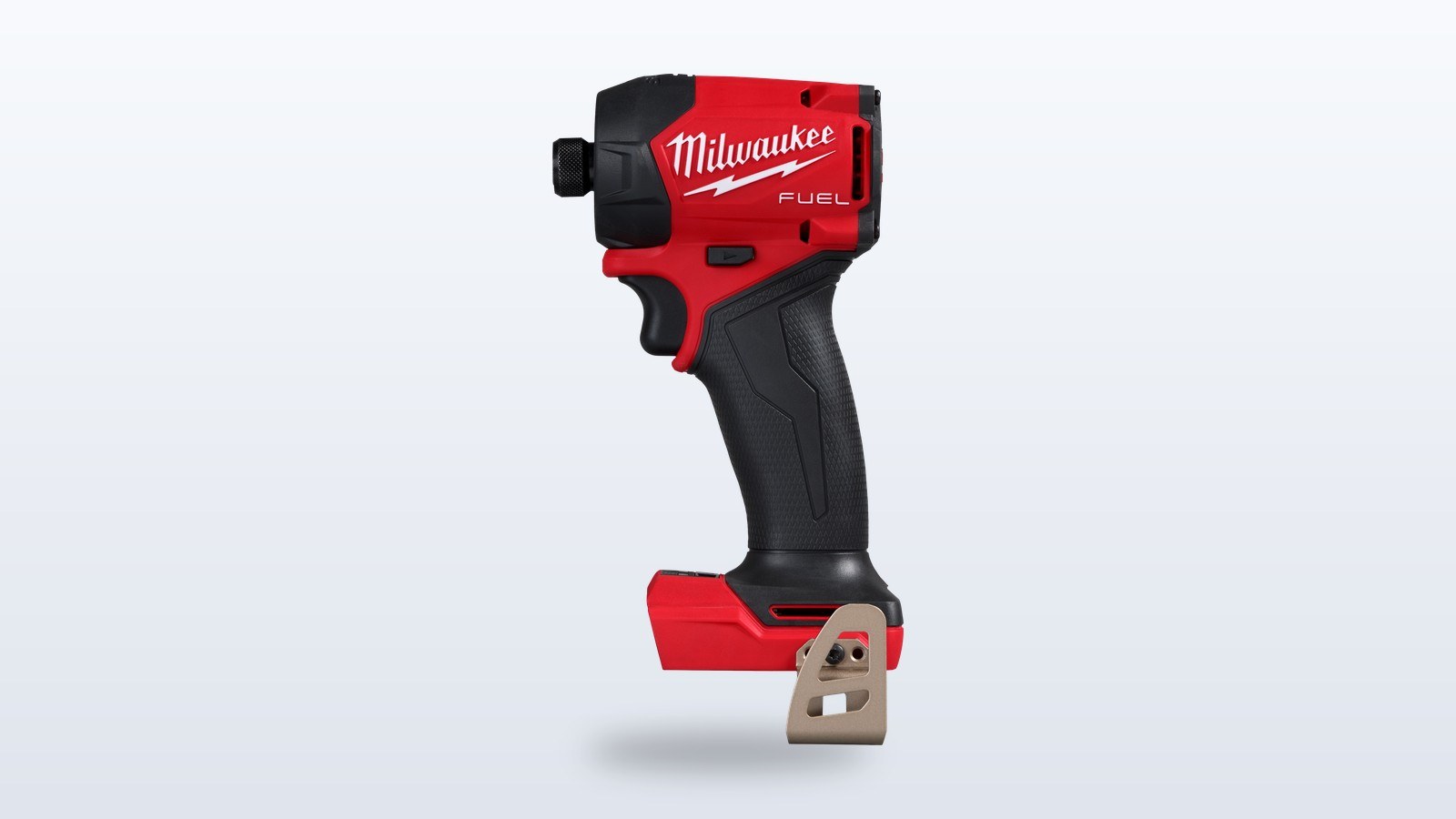
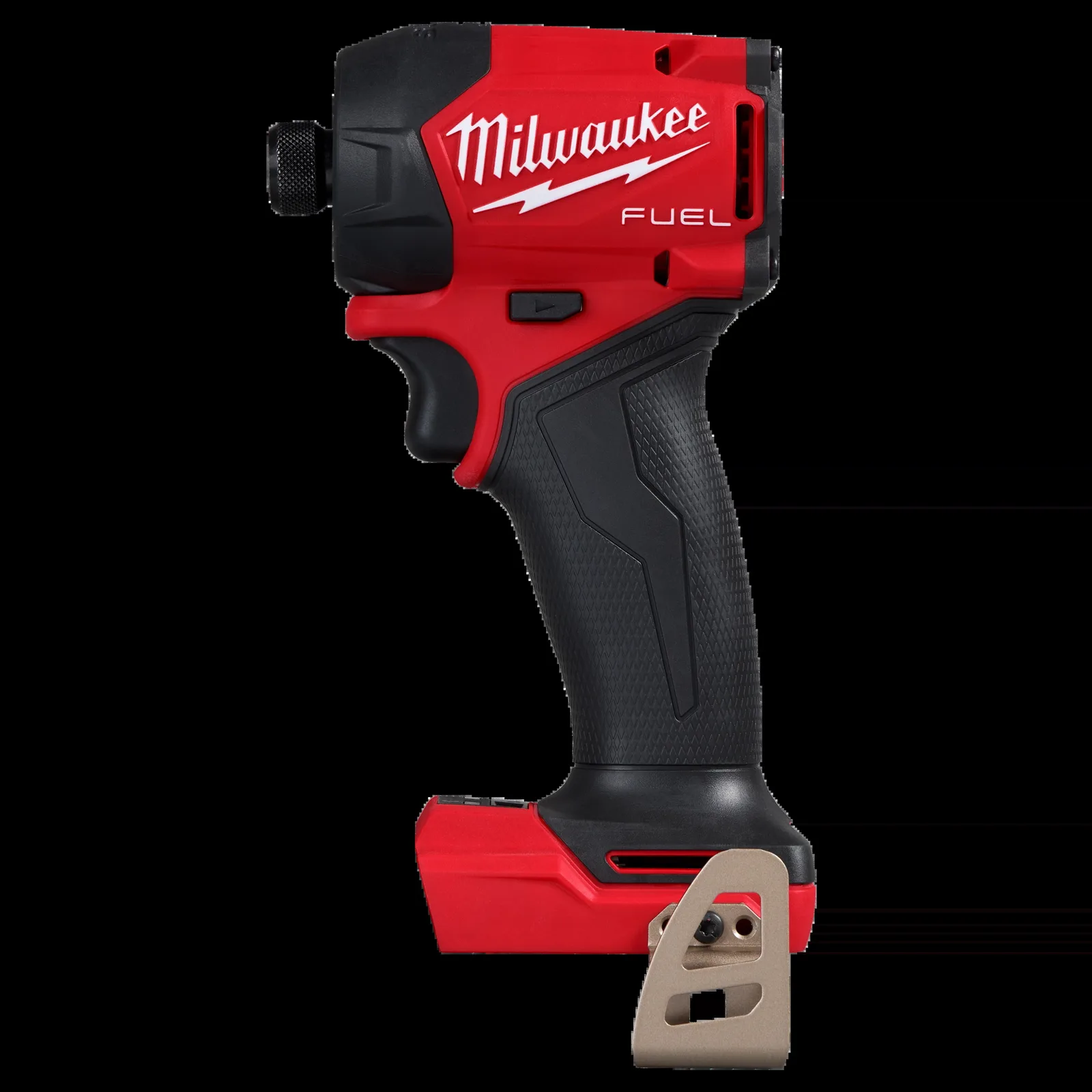
A finished room, an installed cabinet, or the inside of a van is a hard place to run a tool that rattles. On August 21, 2025, Milwaukee Tool described a second-generation tool for that work, the M18 FUEL SURGE 1/4 in. hex hydraulic driver. M18 is Milwaukee's 18-volt line, and FUEL is its name for this tier of cordless tools. The release presents it as a shipping tool. TMWB hasn't used it, so the claims below are Milwaukee's.
The bare tool is 2761-20 and the kit is 2761-22. The previous SURGE bare tool, 2760-20, is still listed separately.
Which tool is each "up to" claim measured against?
The three claims don't use the same baseline.
- Noise: up to 50 percent quieter than standard impact drivers. No decibel figure is printed.
- Vibration: up to 3 times less than standard impacts.
- Speed: up to 3 times faster driving than the first-generation SURGE. No screw size or material is named, so the test can't be rebuilt.
How big is it?
The press release lists 4.3 in. and 2.4 lbs without saying whether the weight includes a battery. The product page says 4.33 in. and 0.7 in. shorter than the previous generation. The older length isn't printed, so I haven't derived it. The product page also lists a Tri-LED work light (three diodes lighting the screw) and REDLINK PLUS thermal protection, which can step in before a long run overheats the motor or pack.
How does a hydraulic driver differ from an impact driver?
An impact driver is a motor, a hammer, and an anvil. The motor spins the hammer up a cam, the hammer springs forward and strikes the anvil, and the anvil turns the output, which on this tool is a 1/4 inch hex holder that takes screwdriver bits. Each strike twists the bit a small step, then the hammer resets, and the rapid sequence is the rattle you hear and the buzz you feel. A hydraulic driver still delivers pulses, but fluid spreads each blow over a little more time than metal striking metal, so the step is less of a sharp clang. That smoothing is why Milwaukee markets the category as quieter. The release says the FLUID-DRIVE powertrain was redesigned from the ground up, but it includes no cutaway, no fluid volume, and no parts list.
What do RPM, IPM, and torque measure?
A screw involves two separate motions. Rotational speed, 3,200 RPM here, is how fast the bit spins, and the release doesn't say whether that's no-load or under a screw. The pulse rate, 6,300 IPM, counts impacts per minute, so the hydraulic pulses are still counted as impacts. Torque is twisting force, and one inch-pound is one pound of force applied one inch from the screw's center, so 1,000 in-lbs is the fastening claim. The release prints no foot-pound conversion and no lug-nut figure, and it doesn't say what the three drive modes are, only that they exist so the tool can be turned down for a small screw.
What is the model history?
The new tool is ordered as 2761-20 (bare) and 2761-22 (kit), while the previous SURGE bare tool, 2760-20, remains listed separately and isn't restated in the release. The product page adds a Tri-LED work light (three diodes lighting the screw) and REDLINK PLUS thermal protection, Milwaukee's name for the electronics that can step in before a long run overheats the motor or pack. The press lines on speed, torque, noise, and size don't restate either one, and no temperature or lumen figure is printed.
How does it compare with the first generation?
Milwaukee's comparisons point at two different baselines, and that shapes how to read them. The "up to 3 times faster" driving claim is measured against the first-generation SURGE, while the noise and vibration claims are measured against standard impact drivers. So the update's headline over its predecessor is speed, and the quiet advantage is against the usual impact driver and not against the earlier SURGE. The bare tool for the earlier generation, 2760-20, remains listed separately, and the release doesn't restate its specifications. The shorter body is the other measurable change: the product page says 4.33 inches, which is 0.7 inches shorter than the previous generation, though the older length isn't printed.
What does the kit include?
REDLITHIUM is Milwaukee's name for its lithium-ion packs, and the kit's two M18 REDLITHIUM XC5.0 packs mean one can be on the tool while the other charges. The charger is multi-voltage, covering both the M18 line and Milwaukee's 12-volt M12 line, though the driver itself stays 18 volts. The kit adds a case and a belt clip. The kit sentence names the packs XC5.0 without printing amp-hours or a charge time.
Who is it aimed at?
The language of the release is about finished spaces. The driver is meant for screws in a finished room, an installed cabinet, or the inside of a van, where the rattle of a standard impact is the problem. The tool is also described as 1,000 in-lbs, which is a screw-driving figure and not a lug-nut figure, and the release gives no number for that heavier work.
What's in the kit, and why does the $199 line conflict?
Kit 2761-22 is $349 and includes the tool, two M18 REDLITHIUM XC5.0 packs, an M18 and M12 multi-voltage charger, a case, and a belt clip. The same press block prints a "Bare Tool" label above the line "Kit (2761-20) - $199." The label says bare tool, the line says kit, and the product page lists 2761-20 as the bare tool, so one of them is a misprint. I'm not guessing which. Warranty is 5 years on the tool and 3 years on the battery, with exclusions not printed.
Sources and image credits
- Milwaukee press release, August 21, 2025
- Product page, bare tool 2761-20
- Product images: Milwaukee Tool