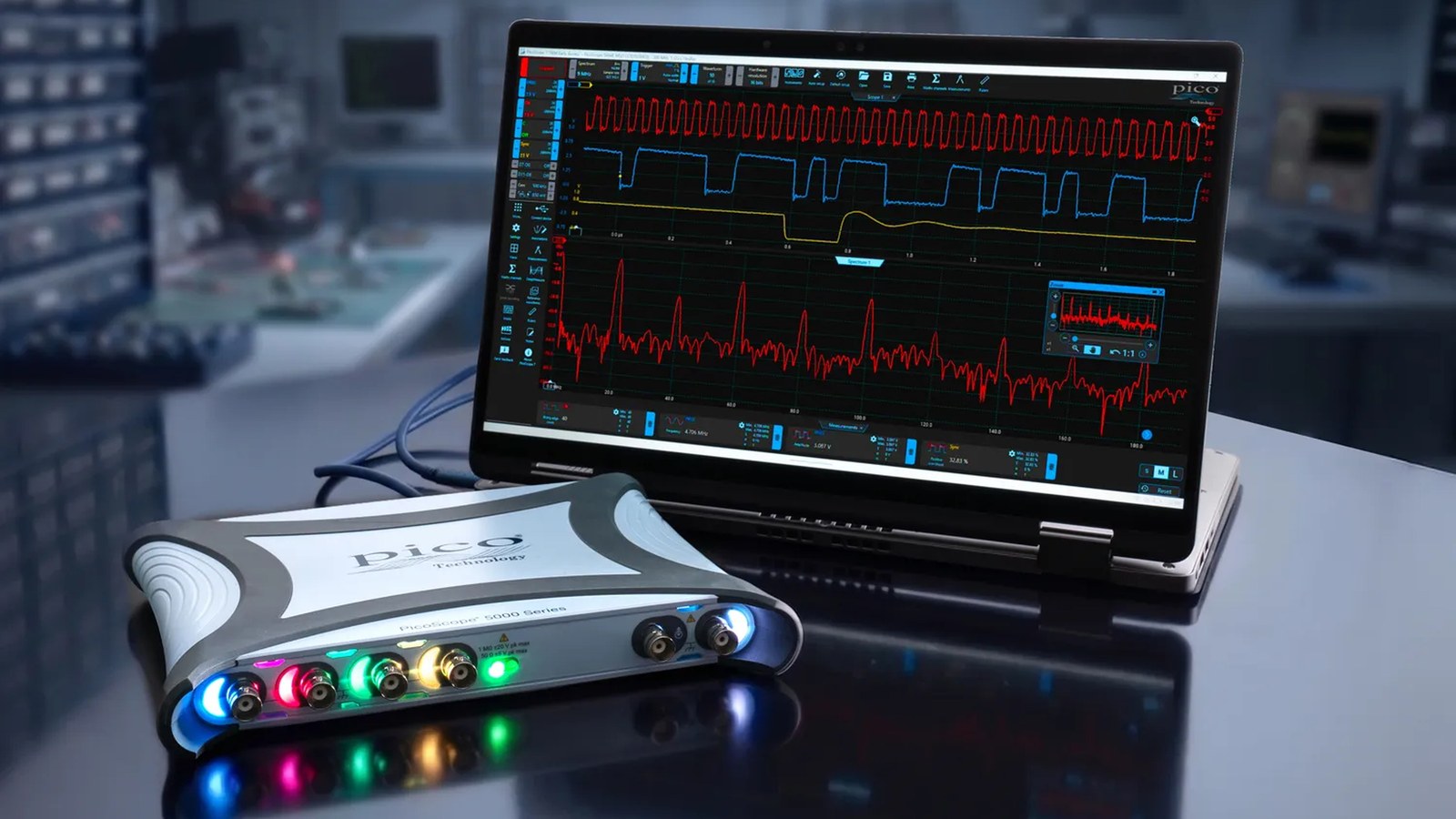
A 3.3 volt rail can look flat on a scope and still carry a few tens of microvolts of ripple. That's enough to nudge a sensor or sit under an audio circuit as hiss, and it's small enough to hide inside one step of a display that has only 256 vertical codes. On 28 May 2026, Pico Technology of St Neots published the PicoScope 5000E series, a four-channel USB oscilloscope family with 16-bit resolution on the analog channels.
Pico calls it the world's first 4-channel USB oscilloscope with 16-bit resolution on all four channels, which is Pico's claim and not an independent finding. The release doesn't state a price, and says the scopes were available that day through authorized distributors and picotech.com. TMWB hasn't tested one.

What is a USB oscilloscope?
A bench oscilloscope keeps the screen and knobs on the instrument. A USB oscilloscope puts the display and controls in software on a computer, so the box is only the analog front end and sampler. On the 5000E the data link is USB-C SuperSpeed, and a second 5 volt USB-C port can power the scope when the host port can't. The optional PS017 supply is 5 V at 3 A and isn't in the box.
Which model is which?
Standard models stay in 16-bit mode. Plus models, which Pico calls FlexRes, can run at 16-bit or 8-bit. Each comes as an MSO (mixed-signal oscilloscope, with digital logic inputs beside the analog channels).
- Standard: 5462E at 60 MHz, 5463E at 100 MHz, 5464E at 200 MHz, sampling up to 2.5 GS/s with 1 GS of capture memory.
- Plus: 5462E+ (60 MHz at 16-bit, 200 MHz at 8-bit), 5463E+ (100 and 350 MHz), and 5464E+ (200 and 500 MHz). In 8-bit mode they sample at 5 GS/s with 2 GS of memory, with timing resolution to 200 picoseconds.
Stay in 16-bit for ripple, audio, and sensors. When the edge is the question and the microvolts aren't, a Plus model's 8-bit mode gives more bandwidth.
What's in the 7-in-1 list?
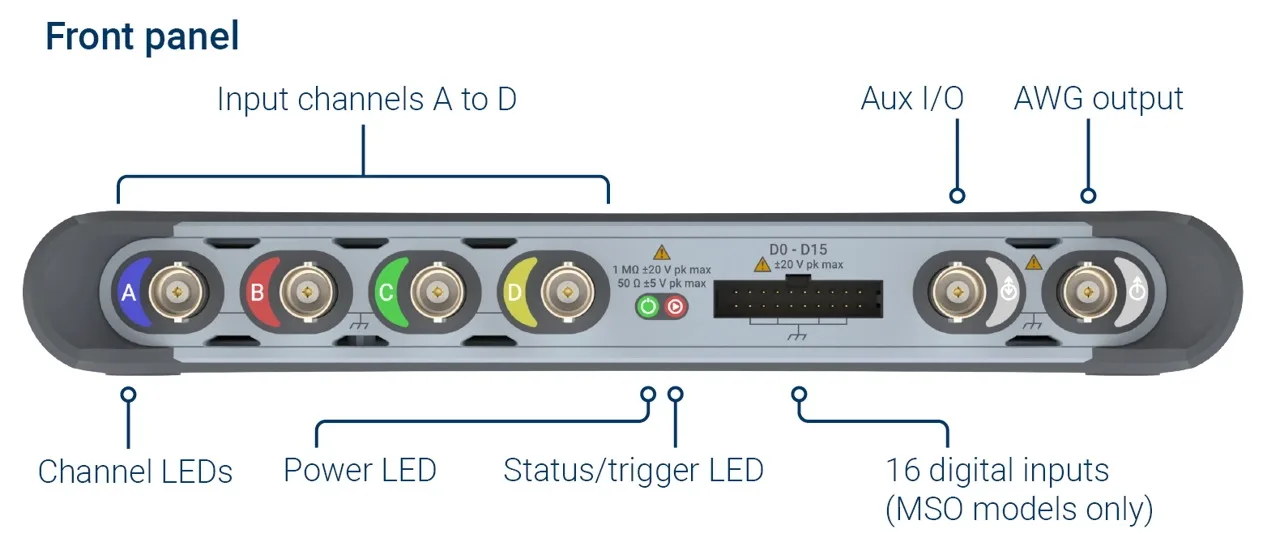
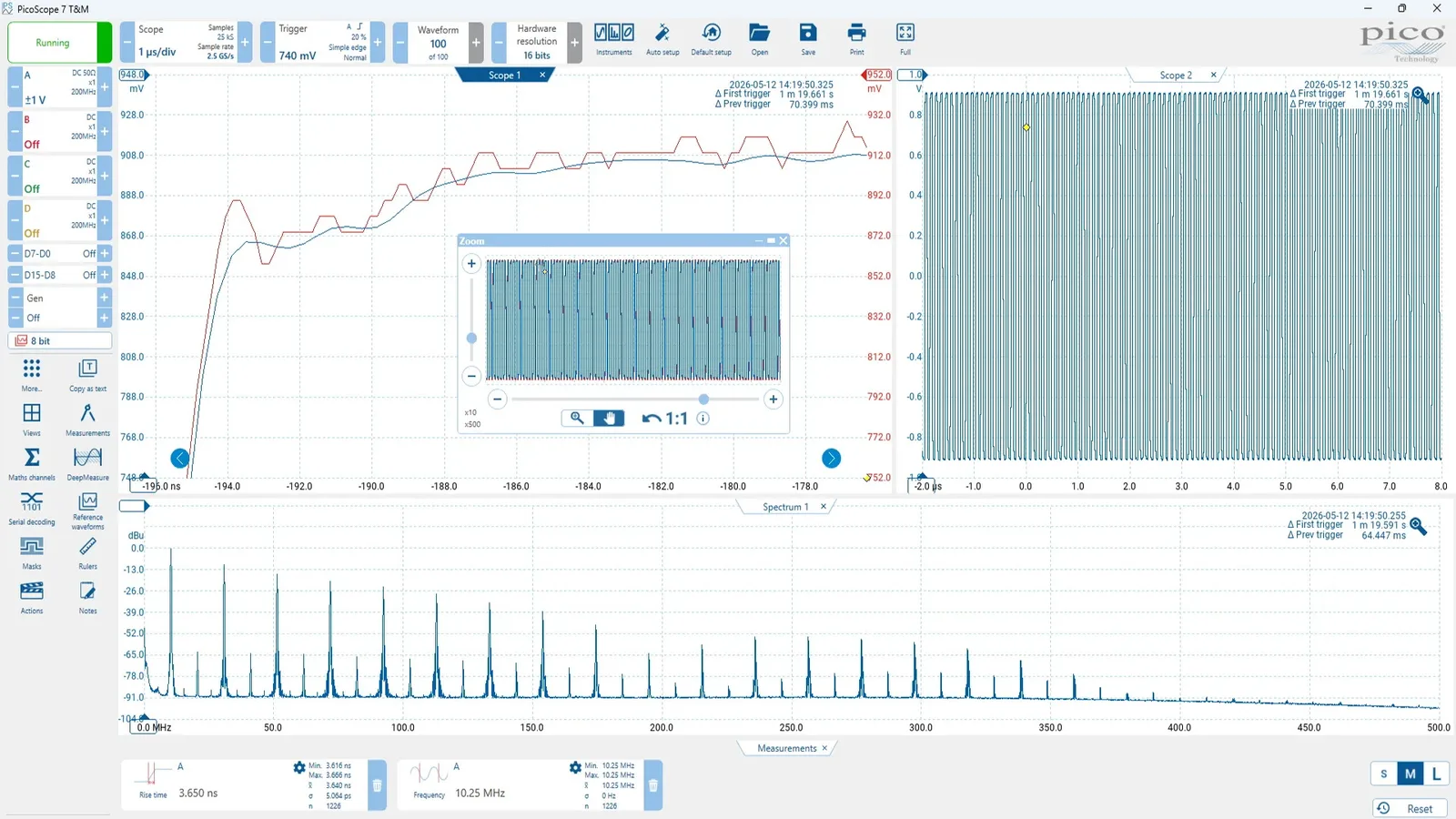
MSO models add 16 digital channels, and decoding can run across up to 20 analog and digital channels together. Pico's list is an oscilloscope, FFT spectrum analyzer, 200 MS/s 14-bit arbitrary waveform generator, function generator, frequency counter, protocol analyzer, and logic analyzer on MSO models. PicoScope 7 includes more than 40 serial decoders, with no license fee and lifetime updates, according to Pico.
How fast can it rearm?
HAL4 hardware acceleration enables persistence mode at up to 300,000 waveforms per second (older traces stay dimmer on screen so a rare glitch still leaves a mark). Rapid trigger mode is separate: up to 2 million waveforms per second, a buffer of the last 40,000 waveforms, and rearm under 700 nanoseconds.
For software streaming through PicoSDK, one section says over 300 MS/s, while a transfer table says up to 180 MS/s in 16-bit mode and 360 MS/s in 8-bit mode. Both are Pico's and they don't match, so a script that needs a ceiling should read both.
What do the noise and isolation figures mean?
An analog-to-digital converter turns a voltage into a whole number. An 8-bit converter has 256 codes, because 2 to the 8th power is 256, and a 16-bit converter has 65,536. Pico says 16-bit is 256 times the levels of 8-bit, so each step across the same voltage range is much smaller. Accuracy still depends on noise, the selected range, the probe, and how still the circuit is.
The product page qualifies the noise floor as 22 microvolts RMS at 20 MHz bandwidth on the ±5 mV and ±10 mV ranges. RMS collapses a varying voltage into one effective number, and the page ties that figure to the bandwidth and those two ranges: a wider bandwidth lets in more noise, and a taller range spreads the same codes across more volts, making each step coarser. The page also says over 73 dB of spurious-free dynamic range, which is how far the largest unwanted spike sits below a clean tone, and channel-to-channel isolation better than 500:1 typical, meaning a leaked copy is more than 500 times smaller than the original. "Typical" is Pico's word for a representative unit, not a guaranteed minimum.
What was the launch context?
The press text was embargoed until 11:00 British Summer Time on 28 May 2026, and Pico said the instruments were available that day through authorized distributors and picotech.com. Microwave Journal carried a same-day account. Pico still lists the earlier PicoScope 5000D separately, with flexible resolution from 8-bit to 16-bit, 60 to 200 MHz bandwidth, 1 GS/s sampling, and 128 to 512 MS of memory. The 5000E is a new series with different sample rates, memory depths, and model numbers.
What do the seven instruments do?
Pico's news index calls the series 7-in-1, and the list reads as an oscilloscope, a fast Fourier transform (FFT) spectrum analyzer, a 200 MS/s 14-bit arbitrary waveform generator, a function generator, a frequency counter, a protocol analyzer, and a logic analyzer on MSO models. An FFT plots signal size against frequency, an arbitrary waveform generator plays a shape the user defines, a function generator plays standard shapes, and a frequency counter reports how often a signal repeats. A protocol analyzer names the fields in a serial frame, and the logic analyzer is listed for MSO models only. Pico calls the 5000E the world's first 4-channel USB oscilloscope with 16-bit resolution on all four channels, which is Pico's claim and not an independent finding.
Where does the 5000D fit?
Pico still lists the 5000D separately, with 8-bit to 16-bit flexible resolution, 60 to 200 MHz, 1 GS/s sampling, and 128 to 512 MS of memory. The 5000E is a new series with different sample rates, memory depths, and models.
Sources and image credits
- PicoScope 5000E press release (PDF)
- PicoScope 5000E product page
- Pico news index
- Microwave Journal, 28 May 2026
- Product images: Pico Technology