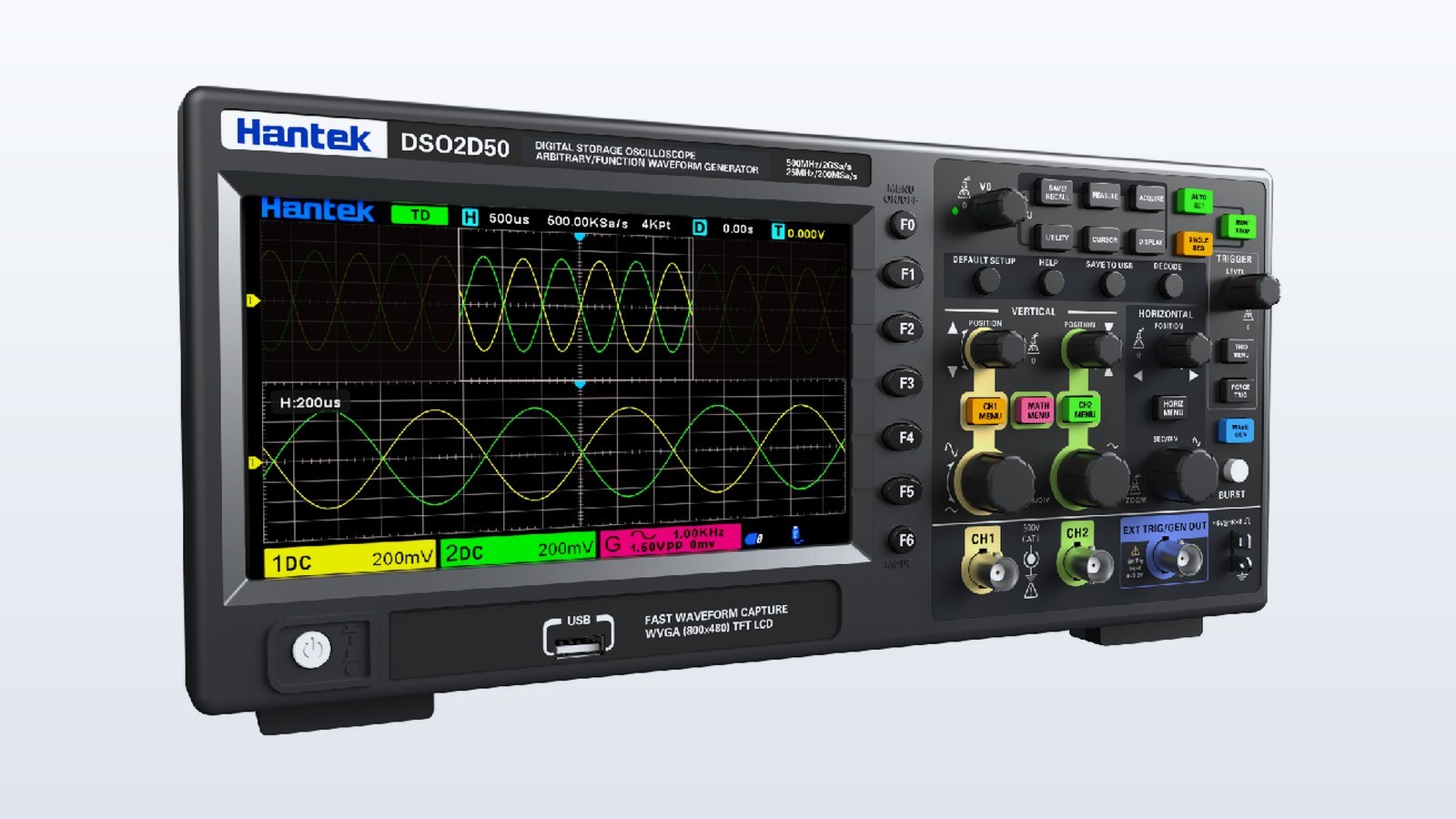
Two analog channels and a 500 MHz front end can show a very fast edge, and they can also run out of record in a hurry when memory is only tens of thousands of points. On July 9, 2025, Qingdao Hantek launched the upgraded DSO2D20 series, which it calls an upgrade of the earlier DSO2D10 in the DSO2000 family. The post doesn't give DSO2D10 specifications or any price. TMWB hasn't tested these scopes, so the figures below are Hantek's.
Which of the six models do you want?
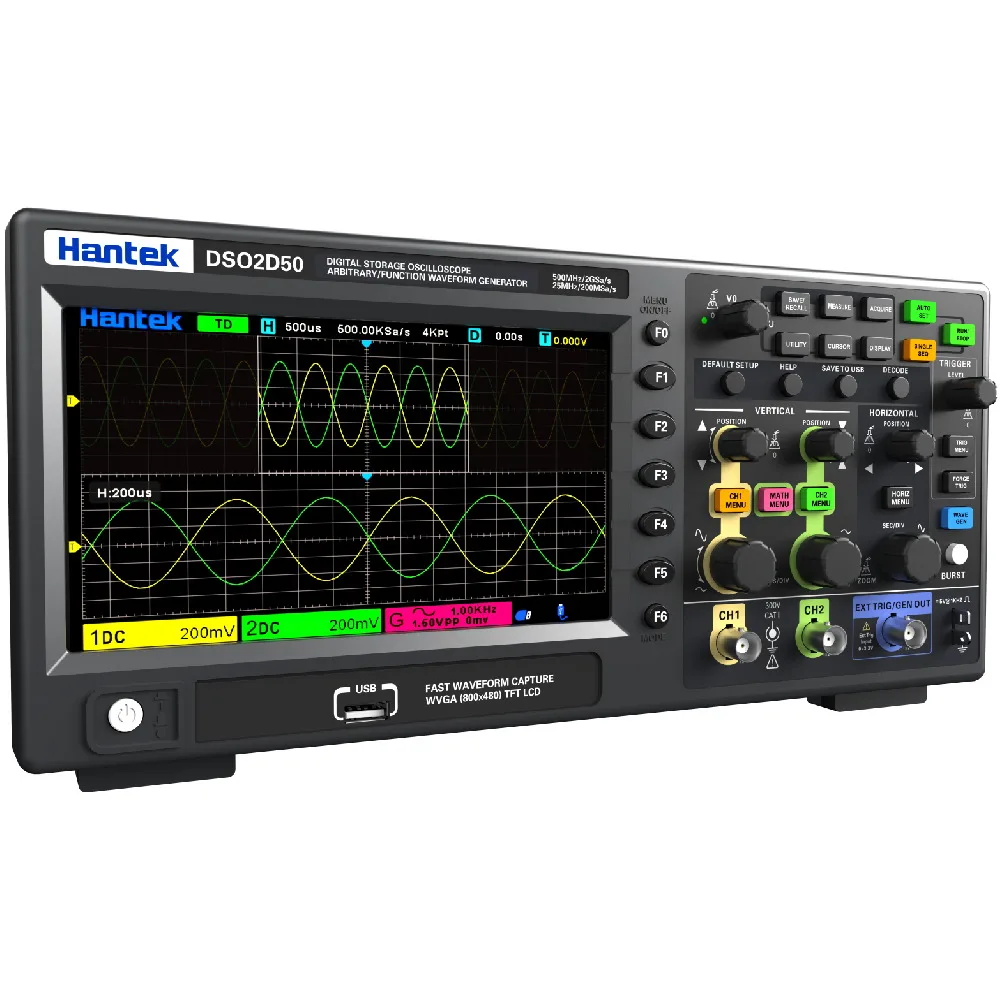
Every model has two analog channels, with bandwidths of 200, 350, or 500 MHz. The suffix tells you which: 20 is 200 MHz, 35 is 350 MHz, and 50 is 500 MHz. The letter is the other fork. The C models (DSO2C20, C35, C50) have no signal generator, while the D models (DSO2D20, D35, D50) include one generator channel. There's no four-channel model and no logic-analyzer pod. Bandwidth is the highest frequency the front end can pass with a usable amplitude.
What do sample rate and rise time mean?
Sampling is 2 GSa/s (2 billion samples per second) on one channel and 1 GSa/s with both on. At 2 GSa/s the samples sit 500 picoseconds apart (a picosecond is a trillionth of a second). Rise time is how fast the scope can follow an edge, listed at 1.75 ns or less at 200 MHz, 1 ns or less at 350 MHz, and 700 ps or less at 500 MHz. A slower rise time rounds off a fast edge, so the screen shows a ramp where the circuit had a step.
The inputs switch between 1 megohm and 50 ohms. One megohm is the high impedance a passive probe expects, while 50 ohms is the termination radio and fast digital lines expect. The launch material doesn't state a maximum input voltage, which matters most on the 50-ohm path, so check the manual.
How long is 80,000 points?
Memory is 80 kpts (thousand points) on one channel and 40 kpts with both on. Divide 80,000 by 2 billion samples per second and you get 40 microseconds. Using both channels halves the rate and memory together, so the window stays 40 μs.
That holds an edge or a short burst but only a thin slice of a serial packet. A slower timebase stretches the window by sampling more slowly, with fewer points on each fast edge. Memory doesn't grow to make room.
What can it decode and trigger on?
Five decoders are listed:
- UART: the asynchronous serial port, with no shared clock wire.
- IIC: another spelling of I2C, the two-wire clock-plus-data chip bus.
- SPI: a four-wire chip bus. Two analog channels can't show all four wires at once.
- CAN and LIN: vehicle buses.
Nine trigger types are listed: edge, pulse, video, slope, timeout, window, code, interval, and runt (a pulse that crosses one threshold but misses the next). The exact menu strings aren't printed.
What does the generator do?
The D models have one arbitrary waveform channel with five standard waveforms and a waveform editor. Maximum frequency, sample rate, and bit depth aren't given.
What triggers and measurements are listed?
Nine trigger types are listed: edge, pulse, video, slope, timeout, window, code, interval, and runt. In ordinary menus those mean a level crossing, a pulse width, a video line or frame, the steepness of an edge, a stretch of quiet, a band between two levels, a logic combination, the time between events, and a runt pulse that crosses one threshold and misses the next. The English wording of the last two is uneven in translation, and the news doesn't print the exact menu strings.
The scope lists 32 automatic measurements with statistics: current, average, maximum, minimum, and standard deviation. Current is the latest acquisition, and the other four accumulate across acquisitions. Standard deviation is the spread, so a noisy edge can hold a steady average and still show a wide spread. Two digital voltmeter readings report numeric voltages beside the waveform, and a hardware frequency counter is listed, without a digit count. Remote control uses SCPI, a text command set common on lab gear.
What math and acquisition modes are there?
Math covers add, subtract, multiply, divide, and an FFT, which turns a time record into signal size against frequency. Subtract lets two probes show a difference. An FFT of a 40 microsecond record is a short block for a low-frequency spectrum, because that's all the memory holds at full rate. Acquisition modes are normal, average, peak, and high-precision. Normal keeps each capture, average reduces random noise (and smooths away a one-off glitch), and peak keeps the high and low inside each time bucket so a narrow spike survives a slow timebase. The July 9 news states no bit depth for the converter, so the series shouldn't be called 12-bit or 8-bit, and it states no screen size or resolution.
How does it relate to earlier Hantek models?
Hantek calls the DSO2D20 an upgrade of the DSO2D10, within the older DSO2000 family. The July 9 material doesn't give DSO2D10 specifications, so I can't say how much changed. The news page is dated July 9, 2025, and the model list comes from the DSO2D20 product page.
What does it cost, and where can you get it?
The announcement doesn't state a price in any currency. The dated news post is Hantek's July 9, 2025 item, and the model list comes from the DSO2D20 series product page. The six-model split means pricing will differ between the C models without a generator and the D models with one, and bandwidth choices of 200, 350, and 500 MHz, but no figure is printed. Even the 500 MHz model has only two probe connections, so a signal that needs more than two channels is outside this series.
Who is it for?
It's a two-channel bench scope for someone who needs bandwidth more than a long record. The decoder list doesn't lengthen the 40 μs window, so it won't capture a full serial frame at full speed. Price and converter bit depth aren't published.
Sources and image credits
- Qingdao Hantek news, July 9, 2025
- DSO2D20 series product page
- Product images: Hantek