On November 4, 2024, Rigol Technologies announced its DHO/MHO5000 oscilloscopes and DG5000 Pro function generators in a single release out of Portland, Oregon. The instruments could be ordered that day and were due to start shipping in November, though Rigol printed no ship date and no dollar price. "Impressive price," "lower price," and "affordable price" are the company's phrases, and I'm not going to turn them into numbers.
TMWB hasn't tested any of this equipment, so the specifications below are Rigol's. It helps to think of a bench as two instruments facing each other: one that makes a voltage and one that records what a circuit did with it. This announcement covers both halves.
What are the DHO5000 and MHO5000 oscilloscopes?
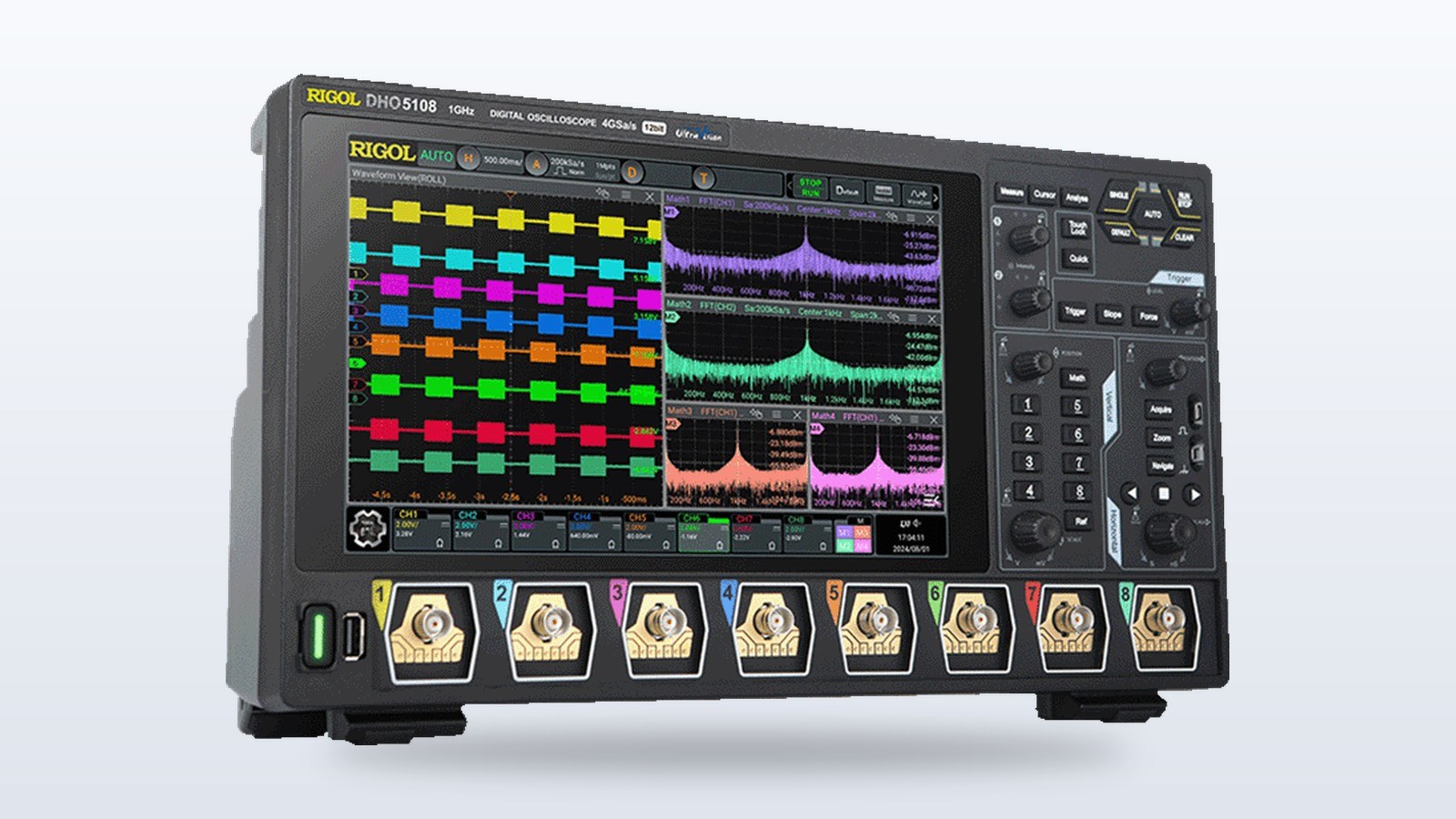
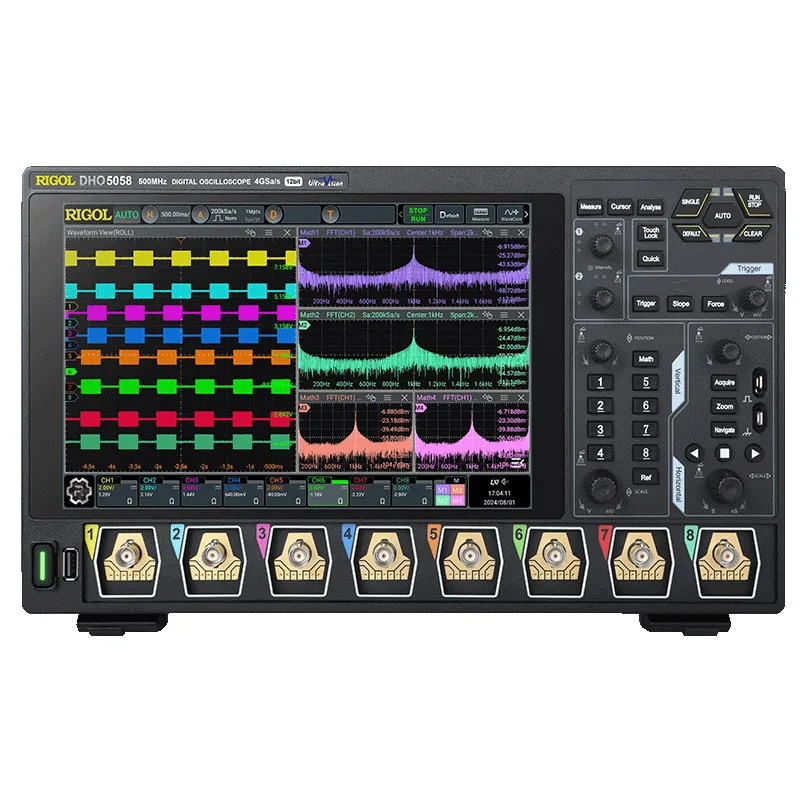
An oscilloscope draws voltage against time, with time running left to right and voltage running up and down. A probe connects one point on a board to one channel, and the channels share a timebase, so you can see which edge happened first. Rigol's DHO5000 models are digital oscilloscopes with 4 or 8 analog channels and 500 MHz or 1 GHz of bandwidth (a megahertz is a million cycles per second, a gigahertz a billion). Maximum real-time sampling is 4 GSa/s, meaning 4 billion samples a second. "Real-time" means the samples in one capture are taken in a single pass, in time order, which is how a one-off glitch gets caught. The 4-channel units deliver that rate on every channel, and the release doesn't state the rate for the 8-channel units.
The MHO5000 models are mixed-signal scopes. They pair 4 or 6 analog channels with 16 digital channels. An analog channel records the voltage itself, while a digital channel only reports whether a wire is above or below a threshold, the way a logic analyzer does. The 4-channel MHO5000 can also be ordered with an integrated function generator.
Every 5000 Series scope has 12-bit resolution, 500 Mpts of record length, and a 10.1-inch color touch screen. Rigol points to embedded debugging, power-supply testing, three-phase motor testing, and multichannel data acquisition (recording several signals over time for later study). Three-phase gear uses three alternating voltages offset in time, the way many motors run, so measuring voltage and current on each phase can use up a two-channel scope immediately.
What do the scope specs mean?
Bandwidth is how high in frequency the scope can see before its response rolls off. By convention that corner is where amplitude is about 3 dB down, which is roughly 70 percent of the true height. The release lists no probes, and a slow probe still shows a slow edge no matter how fast the scope is.
Sample rate is points per second, and you want several samples inside every cycle you care about. At 1 GHz bandwidth and 4 GSa/s, that works out to four samples per cycle, which is a simple illustration and not a Rigol specification. Twelve bits means 4,096 vertical levels, which is 16 times as many as an 8-bit scope's 256. That matters when a few millivolts of ripple sit on a larger supply rail, because an 8-bit converter can turn that ripple into a staircase. No effective number of bits (what's left after noise) is stated, so "12-bit" describes the converter width and not a measured accuracy.
Memory depth divided by sample rate gives capture time. 500 million points at 4 billion samples per second is 0.125 seconds. Rigol doesn't promise full memory and full rate together on every channel, but a long record lets a motor start-up sit in one capture while you zoom into edges inside it.
What are the DG5000 Pro generators?
A function generator makes a voltage on purpose, where a scope measures one that already exists. An arbitrary waveform generator plays back a stored shape, which could be a simple sine, a captured wave, or a string of uneven pulses. Rigol lists 16-bit vertical resolution (65,536 steps), up to 500 MHz output, 2.5 GSa/s, and a square-wave rise time of 0.8 ns, or 800 picoseconds (a picosecond is a trillionth of a second). Waveform length is up to 128 Mpts per channel, with 64 Mpts standard. There's a 10.1-inch touch screen of its own.
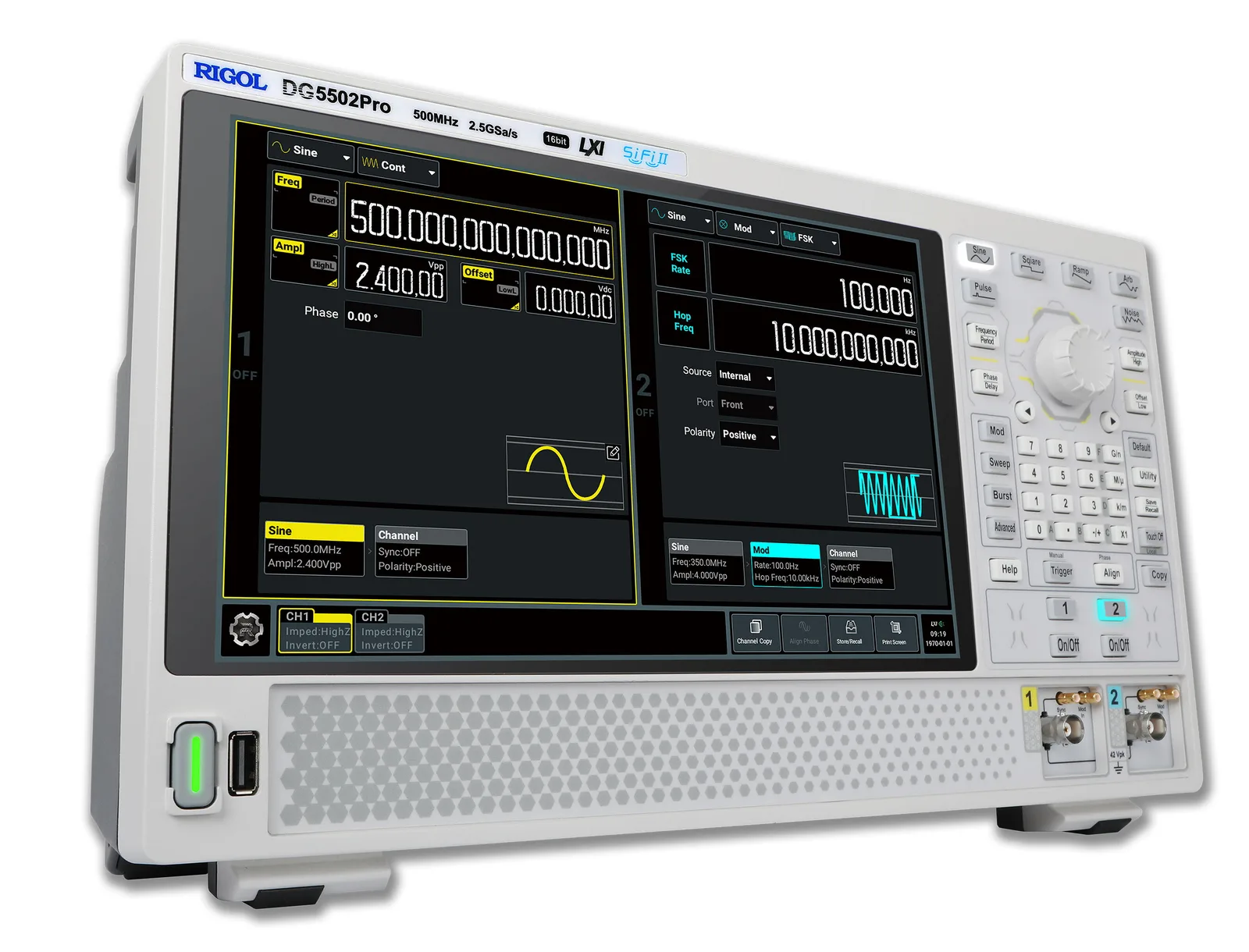
At 2.5 GSa/s, a 500 MHz sine gets only five samples per cycle, which is just the two headline numbers divided. Rigol also names multi-pulse output, analog and digital modulation, and IQ modulation. IQ stands for in-phase and quadrature: two carriers 90 degrees apart, each carrying information, which lets a radio-style signal hold more pattern than a single sine can. Symbol rates aren't given.
Sequence mode is an option carried over from the DG800/900 Pro generators. Instead of one looping buffer, it plays segments of a pattern, loops them up to 512 cycles, and adds repeat, wait, event, and jump steps, so the generator follows a list of moves between segments.
Ground isolation needs a battery-holder option. Rigol cites ground loops (current that flows because a cable shield and the building's safety earth both connect two instruments), damage from potential differences between instruments, and signal degradation from stray effects. Battery type, runtime, and isolation voltage aren't stated.
What's the picture for buyers?
Rigol addresses designers, engineers, researchers, and educators, and Spyros Lazaris, general manager of Rigol Technologies USA, called the launch an example of "performance and functionality-packed test equipment at an affordable price." A bench that debugs a power rail, a multi-phase motor, and a chip bus at the same time is the one these channel counts suit, and the generator side supplies the stimulus for the same work. The pairing is the news: a 12-bit scope and a 16-bit stimulus announced together, so the measuring end and the making end of a test arrive as a set.
The release leaves out catalog codes, prices, the 8-channel sample rate, how the 500 Mpts is divided across channels, and the frequency and bit depth of the optional generator inside the MHO5000. Nothing says that built-in generator matches the standalone DG5000 Pro.
Sources and image credits
- RIGOL press release, PR Newswire, November 4, 2024
- Rigol North America news post
- Product images: Rigol