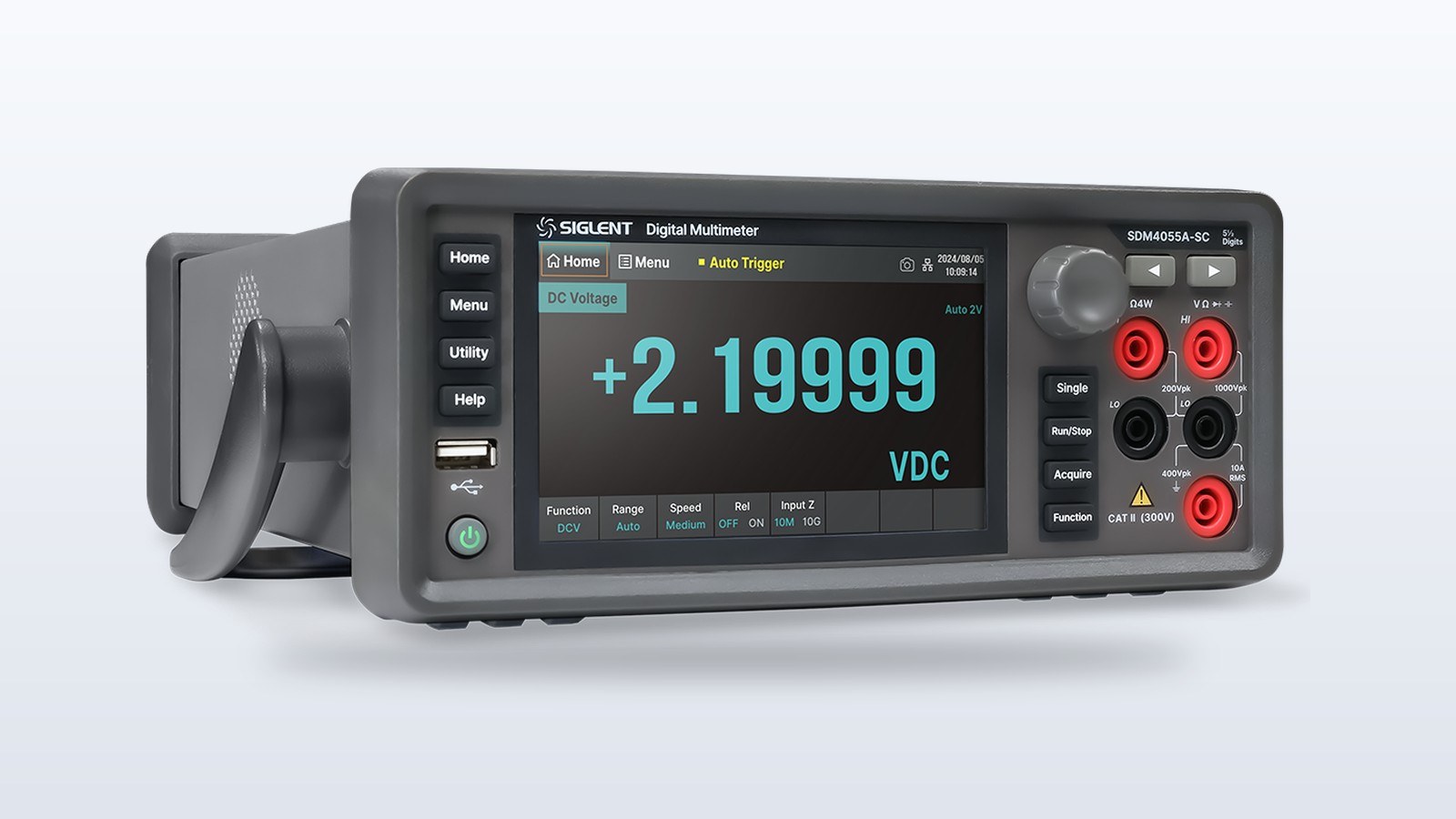
On April 16, 2025, Siglent launched the SDM4000A series of bench digital multimeters in 5.5-digit and 6.5-digit versions. The announcement leads with 2,200,000 counts, up to 50,000 readings per second, a minimum sampling interval of 20 μs, 11 measurement functions, and a touchscreen. A mirror of the same wording on another Siglent site repeats the April 16 date. The announcement doesn't print a price. TMWB hasn't used these meters, so the figures below are Siglent's and the context is mine.
Siglent frames the series for automated production lines, where the pace of a test station changes how many boards leave the line, and for catching subtle current changes alongside large voltage swings. A home bench can find uses for a bench meter too. The comparison that matters is a handheld that updates a few times a second at about four digits against a bench instrument that can read quickly and show far more resolution.
What is a count?
A digital multimeter measures a quantity and shows a number, and "digits" is shorthand for how many places that number can have. Siglent says the 5.5-digit meter is 220,000 counts and the 6.5-digit meter is 2,200,000. A count is one step the display can resolve on a given range, so more counts means a smaller step. A typical handheld has around 6,000 counts, and a 2,200,000-count meter can show a change that wouldn't move the last digit on the handheld at all.
The "half" digit is the leading place that doesn't run from 0 through 9. Siglent states a full-scale display from -2,199,999 to +2,199,999 for the 6.5-digit meter, which is why the first digit only reaches 2. Counts describe resolution, not accuracy. Accuracy is how close a reading is to the true value, usually written as a percent of reading plus a few counts, and it lives in a separate datasheet table. The launch post doesn't state one, and I'm not going to guess.
How fast does it read?
Reading rate is how many new numbers the meter reports each second. The SDM4055A, the 5.5-digit model, reaches up to 4,800 readings per second. The SDM4065A, the 6.5-digit model, reaches up to 50,000. One divided by 50,000 is 20 microseconds, so the minimum sampling interval and the top reading rate are the same pace stated two ways.
A handheld gives a few readings a second, which suits a battery or a steady rail. It's a poor match for inrush, the surge when a capacitor charges or a motor starts, or for a brief glitch in an otherwise calm signal, because a slow meter averages those events away. Thousands of readings per second give a spike somewhere to land. Both series offer fast, medium, and slow speeds, where fast is for transients and slow produces a quieter number.
What are power-line cycles?
On the SDM4065A, the sampling interval can be set from 0.001 to 1,000 PLC. One PLC is one cycle of the wall voltage, which is 1/60 of a second (about 16.7 ms) on 60 Hz mains and 20 ms on 50 Hz mains. Averaging over whole cycles cancels the hum that wiring and room fields induce, because a clean sine wave averaged over complete cycles comes to zero. A window shorter than one cycle doesn't get that benefit, and the hum shows up as wobble in the reading. At 60 Hz, 1,000 PLC is about 16.7 seconds of averaging, though that's my arithmetic and not a Siglent figure.
What else does the description cover?
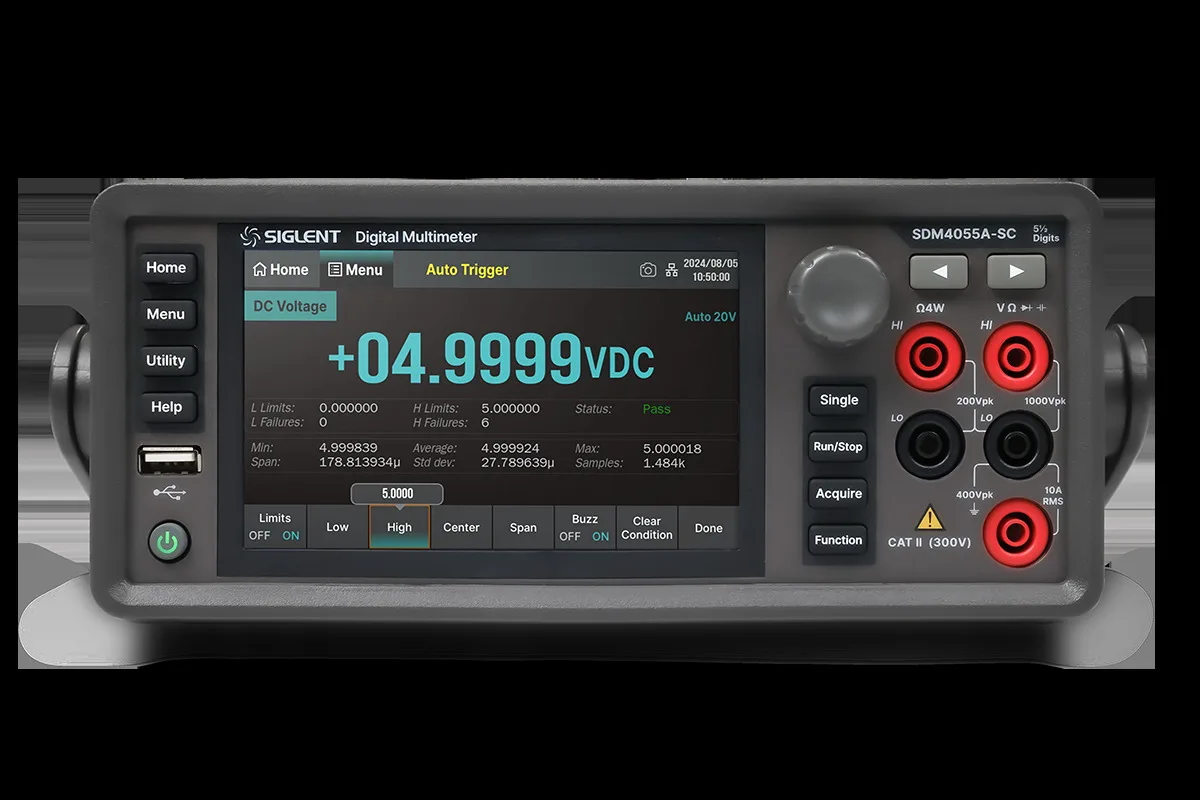
Siglent counts 11 measurement functions without naming them all. Math functions include statistics (maximum, minimum, average, peak to peak, standard deviation, and sample count), limit checks, dB, dBm, and relative values. The acquisition modes are continuous sampling and data logging, and the SDM4065A adds a digitizer mode for high-precision, low-frequency sampling that Siglent says suits audio. Half of 50,000 is 25,000, so that mode could in principle represent frequencies a bit under 25 kHz, which is a sampling-theory remark and not a Siglent claim.
Display options include numeric, histogram, trend, and bar chart. Connections are USB Host, USB Device, LAN, an optional USB-GPIB module (GPIB being the older instrument-rack bus), SCPI commands (the text commands scripts send to instruments), and a built-in web server.
How does it compare with earlier bench meters?
The announcement doesn't name an earlier model or give numbers for one, so I can't say how much of this is new. What the post does make clear is where Siglent is aiming: 2,200,000 counts at 50,000 readings per second is a combination that bench meters in the 6.5-digit class have often kept for pricier models. The standard comparison is with a handheld meter, which has perhaps 6,000 counts and a handful of readings per second. Moving from that to a bench meter is a jump of several hundred times in resolution and several thousand times in speed, and that gap is the entire argument for the series.
What does the announcement say about price and where to buy?
Siglent's announcement doesn't print a price, and I'm not borrowing a later catalog figure. The family is listed on Siglent's digital multimeter page, and the announcement leads with the headline figures of 2,200,000 counts, 50,000 readings per second, a 20 μs minimum sampling interval, 11 measurement functions, and a touchscreen. No distributor is named in the post.
Who is it aimed at?
Siglent lists automated test, power work, manufacturing and repair, telecommunications, networking, research, and education. The split inside the family is simple: the SDM4055A is the 5.5-digit meter at up to 4,800 readings per second, and the SDM4065A is the 6.5-digit meter at up to 50,000, with the PLC control. Missing from the post are price, an accuracy percentage, the list of 11 functions, and how fast, medium, and slow map to published reading rates.