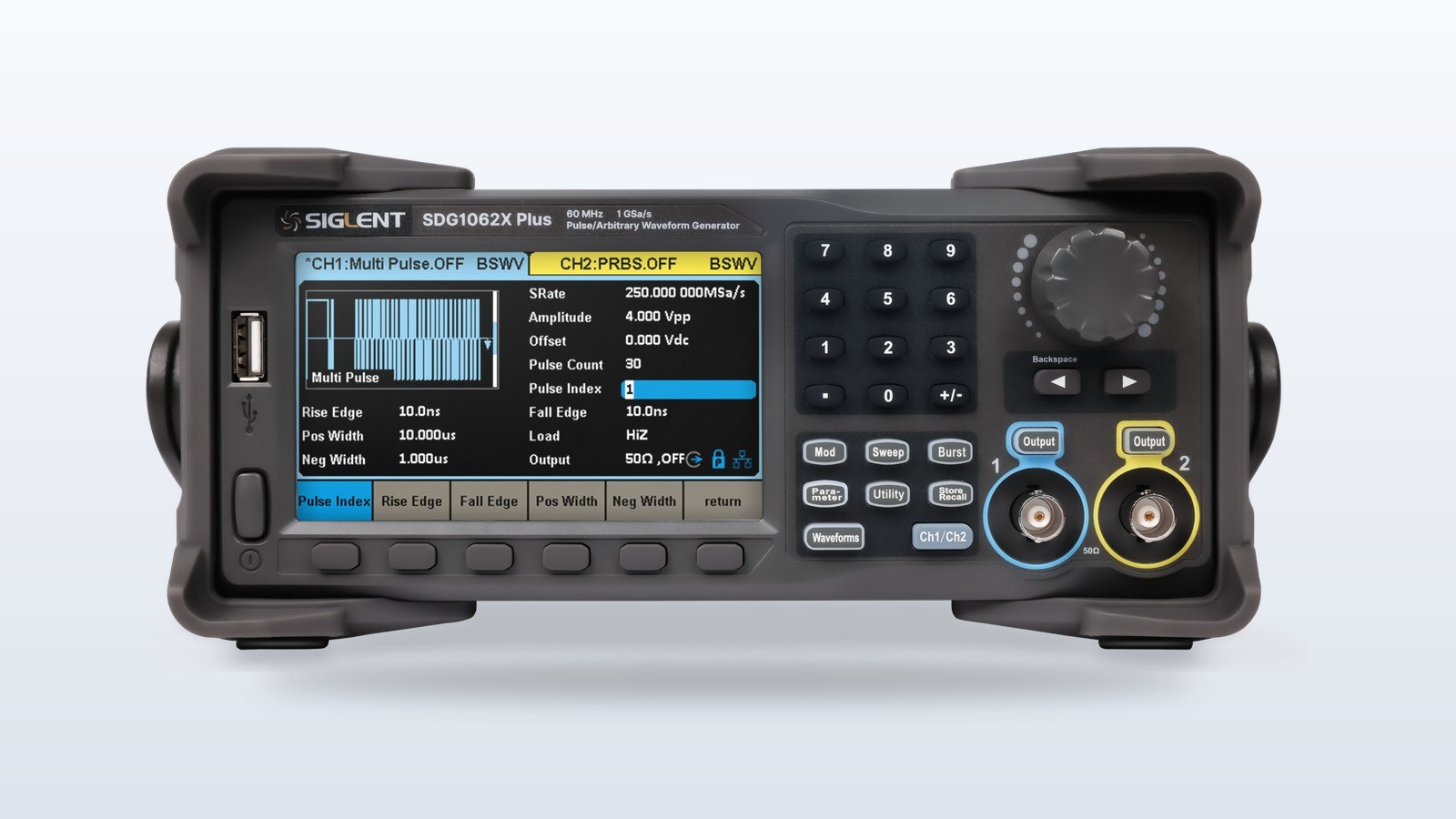
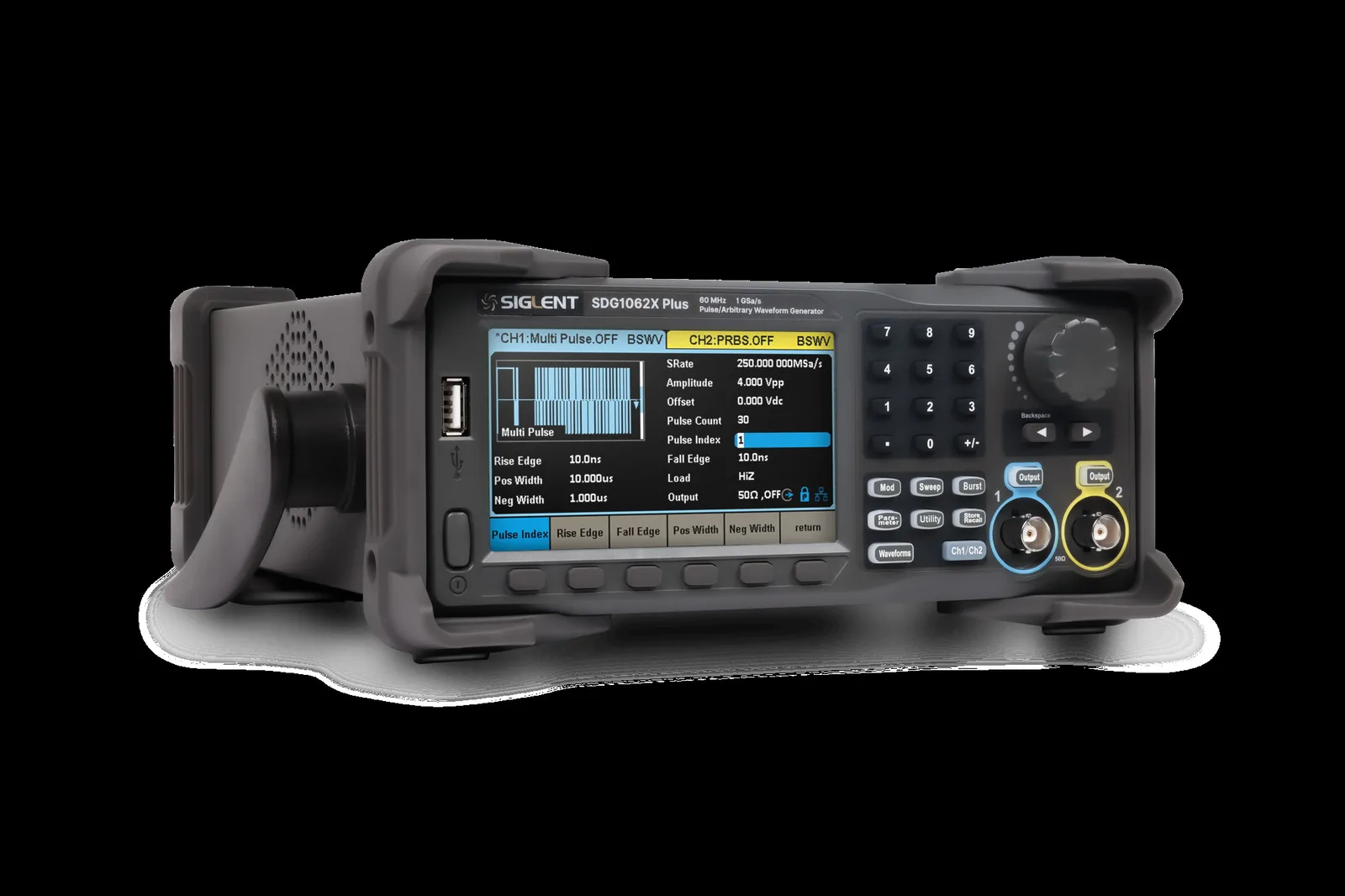
On November 12, 2024, Siglent released the SDG1000X Plus series of function and arbitrary waveform generators. They're dual-channel instruments with a maximum output frequency of 60 MHz, 16-bit vertical resolution, a 1 GSa/s sampling rate, and 8 Mpts of arbitrary waveform memory per channel. The product page lists a maximum amplitude of 20 Vpp, meaning volts peak to peak, the swing from the bottom of a wave to the top. Neither the announcement nor the product page prints a price, and TMWB hasn't tested the generator, so these are Siglent's specifications.
An oscilloscope measures a voltage that's already there and draws it against time. A function generator does the opposite: it makes a voltage on purpose and sends it into a circuit, which is how you exercise a filter, an amplifier, a sensor front end, or the gate of a power switch. The scope, if you own one, watches the result, and the SDG1000X Plus is the stimulus half of that pair. Siglent's own line is that the series "integrates many features that were previously available only in higher-end products," without naming those products.
Which models are in the series?
"Up to 60 MHz" is the top of the family and not a promise for every unit. The datasheet lists three two-channel models: the SDG1062X Plus at 60 MHz, the SDG1032X Plus at 30 MHz, and the SDG1022X Plus at 25 MHz. A megahertz is a million cycles per second, so even the entry model reaches into the radio and fast-logic range.
What do the headline numbers mean?
One GSa/s is a billion samples per second. On a generator that rate belongs to the DAC, the digital-to-analog converter, which turns stored numbers back into a voltage. Sixteen-bit vertical resolution means each sample can land on one of 65,536 steps, compared with 256 for an 8-bit generator, so a sine or a ramp comes out with much finer steps. The size of one step in volts still depends on the amplitude range, and the pages don't reduce it to a single figure.
Eight Mpts per channel is the arbitrary waveform length. Mpts means megapoints, millions of points, and at a billion samples a second that would last eight milliseconds if the whole memory played at full rate. Long memory matters when the shape is a serial pattern or a string of pulses rather than a few cycles of sine. The 20 Vpp maximum is listed for the series, but the pages don't say whether it's into an open circuit or a stated load. Generators usually deliver less into a 50-ohm input, so that detail is worth confirming in the datasheet.
The product page also lists a 4.3-inch display and 196 built-in arbitrary waveforms, a library to start from. Connections are USB Host (for a flash drive), USB Device using USBTMC (so a computer can control the instrument), and LAN using VXI-11, a network protocol older test software uses to find instruments. A built-in web server lets a browser on the same network change settings.
What is PRBS output?
Siglent says the generator offers PRBS from PRBS3 to PRBS32 at bit rates from 1 μbps to 40 Mbps. PRBS stands for pseudo-random binary sequence: bits that look random but come from a fixed recipe, so the pattern repeats and a receiver knows what should have arrived. The number is the order of the recipe, and in the common construction a pattern of order n repeats after 2^n minus 1 bits. PRBS3 is only 7 bits long, while PRBS32 runs for more than four billion bits before it loops.
Siglent says this suits link testing for Ethernet, USB, or HDMI, with TTL and LVCMOS logic levels and differential signals (two wires moving in opposite directions so shared noise can be rejected). The announcement doesn't call the generator a compliance tester and lists no certification masks, so the PRBS function is a test stimulus and not a certification tool.
Why mention power switches?
The post says multi-pulse output has rise and fall times as low as 10 ns (a nanosecond is a billionth of a second), with each pulse configurable. Siglent aims that at gate-drive and switching tests of MOSFETs and IGBTs, the transistors found in motor drives, inverters, and power supplies. It includes double-pulse testing, where a first pulse builds current in an inductive load and a second pulse is where the switching event gets examined for voltage collapse, current spikes, and gate ringing. No minimum pulse width or gate-drive voltage is given.
What else is on the feature list?
- Sweep: linear (equal time per hertz) and logarithmic (equal time per decade, how filter plots are usually drawn).
- Burst: N-cycle and gated, triggered internally, externally, or manually.
- Modulation: AM, DSB-AM, FM, PM, ASK, FSK, PSK, and PWM. The first four vary a carrier's height, sidebands, frequency, or phase. ASK, FSK, and PSK make the same changes in jumps, to spell digital symbols. PWM holds the period steady and changes the pulse width, which is how many motor drives and LED dimmers set an average level.
An external signal can also modulate the output, and Siglent says the list serves everything from audio work to wireless communication. Modulation depth, deviation, and the top modulating frequency aren't stated.
Who is it for?
Siglent points the series at communications equipment, serial-link patterns, semiconductor timing, biomedical waveform playback, and power-device switching. A real HDMI or multi-gigabit Ethernet compliance job needs different equipment than a PRBS output capped at 40 Mbps, even though Siglent names those interfaces. What's left out is price, differences between the three models beyond frequency, the load behind the 20 Vpp figure, the PRBS polynomials, and the modulation limits.