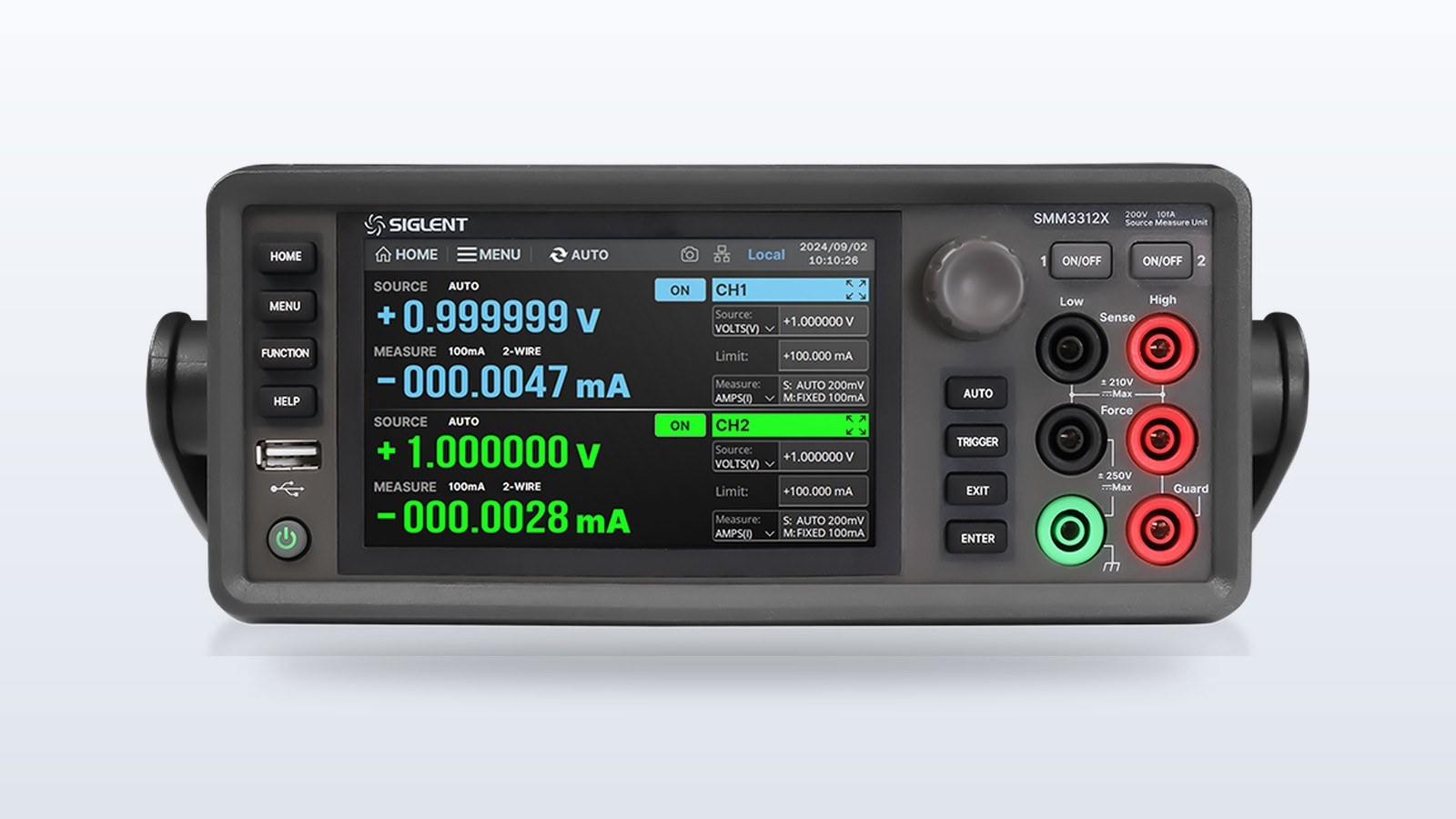
On February 27, 2026, Siglent released the SMM3000X series of source-measure units. The announcement describes a 6.5-digit instrument with output up to ±210 V DC, ±3.03 A DC, and ±10.5 A pulsed, programming and measurement resolution down to 10 fA and 100 nV, and acquisition up to 100,000 points per second. The product page states 31.8 W per channel. The SMM3311X is the single-channel model, and the SMM3312X has two channels, each with the same ratings.
Siglent doesn't print a U.S. list price. The same day, European distributor Batterfly listed the SMM3311X at about $5,500 and the SMM3312X at about $9,800 (converted from euros at the February 27, 2026 rate). Those are one distributor's prices, not Siglent's. TMWB hasn't used this instrument.
What is a source-measure unit?
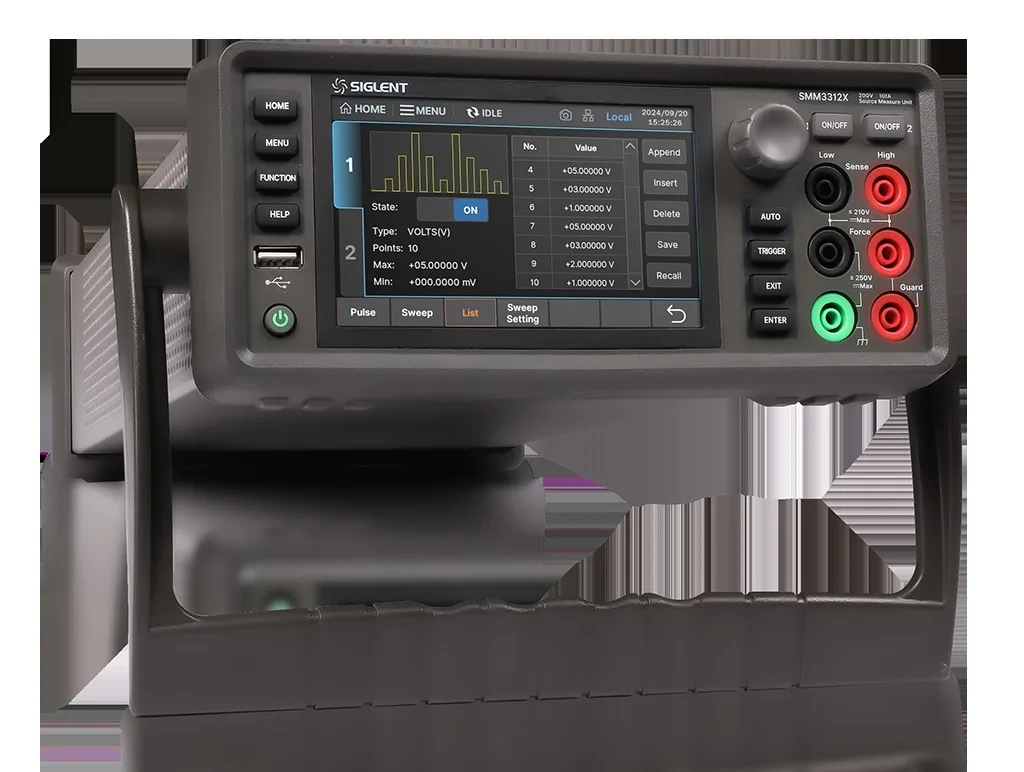
A source-measure unit (SMU) sets a stimulus and reads the response at the same time on the same terminals. A bench supply plus a separate meter splits that job across two boxes, two clocks, and extra lead drops. Siglent says the SMM3000X can act as a voltage source, current source, voltmeter, ammeter, and ohmmeter, with pulse and arbitrary waveform output (a stored shape of voltage or current).
It's a lab instrument for learning what a part does. A microcontroller or motor wants an ordinary bench supply instead.
What does 31.8 watts allow?
The ± marks mean positive or negative. Those maximums aren't a set you can use all at once: 210 V times 3.03 A is about 636 W, but the product page allows 31.8 W per channel. Dividing 31.8 W by 210 V gives about 0.15 A, and dividing it by 3.03 A gives about 10.5 V. Those are my arithmetic, not a published curve. Plus or minus 210 V is also high enough to hurt you, so treat the terminals as a hazardous supply.
Pulsed current is how it reaches ±10.5 A without living there. Minimum pulse width is 50 μs, since a short burst heats a part less than the same current held for seconds. Siglent names GaN (gallium nitride) and SiC (silicon carbide) switching-loss tests for it. Those wide-bandgap semiconductors can run hotter and switch faster than ordinary silicon, and switching loss is energy burned while a device is neither fully on nor fully off.
What is four-quadrant operation?
Voltage and current can each be positive or negative, giving four combinations. When their signs match, the instrument delivers power, which is sourcing. When they're opposite, power flows back in, which is sinking. A battery on charge, a lit solar cell, or a capacitor dumping its charge can need a sink, and this box can push current out or absorb it while measuring either way.
How small is 10 femtoamps?
A nanoamp is a billionth of an amp, a picoamp is a thousandth of that, and a femtoamp is a thousandth of a picoamp, so 10 fA is 0.00000000000001 A. A handheld meter reads that as zero. A nanovolt is a billionth of a volt, so 100 nV is 100 billionths of a volt.
Those are step sizes, not accuracy. Cables, guarding, vibration, and humidity can swamp a measurement that small, and the announcement doesn't print a percent-of-reading accuracy or describe the setup that realizes 10 fA. The display is 6.5 digits and 2,100,000 counts. Acquisition runs up to 100,000 points per second, one sample every 10 μs, with internal storage for up to 100k timestamped points, which fills in about a second at the fastest rate.
What are sweeps and list mode?
A sweep sets a start, a stop, and a step, and the instrument measures at each point. Linear steps are even, and logarithmic steps grow by a ratio, which suits a diode or transistor across many decades of current. A pulsed sweep avoids parking the part at high current between points, and the result is an I-V curve, current against voltage. List mode is a user-defined sequence timed down to 10 μs, with a measurement at each step. Graph, roll, and measure views show curves, a time roll, and statistics on the 5-inch capacitive touchscreen, and internal storage holds up to 100k timestamped points.
Why do two-wire and four-wire matter?
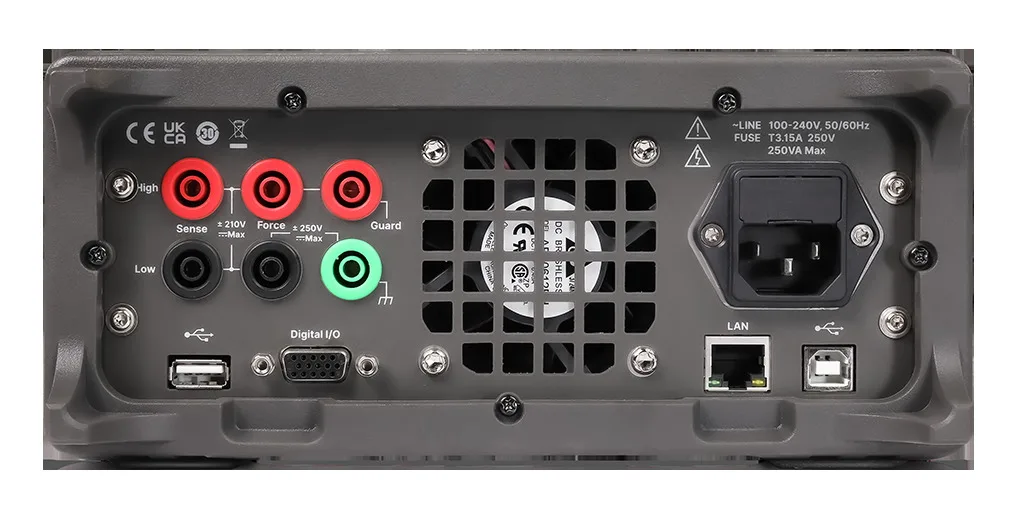
Two-wire measurement uses one pair of leads to force current and sense voltage, so lead resistance sits inside the reading. Leads of a few tenths of an ohm hardly matter on a large resistor, but they can dominate a 0.1-ohm shunt or the sag of a small cell. Four-wire (Kelvin) measurement uses separate force and sense leads. Force carries the current, and sense measures voltage while carrying almost no current, so the drop in the force leads is left out. The announcement doesn't describe the connector layout.
How do you connect to it?
The screen is a 5-inch capacitive touchscreen, meaning it senses a finger the way a phone does, with graph, roll, and measure views for curves, a time roll, and statistics. Remote control is over USB and LAN, using SCPI (Standard Commands for Programmable Instruments), and a built-in web server is listed too. Acquisition tops out at 100,000 points per second, which is one sourced-and-measured sample every 10 μs, and Siglent states that same 10 μs as the minimum trigger interval. At the fastest pace, the 100k-point internal storage fills in about a second.
What does it cost, and where can you buy it?
Siglent's announcement doesn't print a U.S. list price. The same day, European distributor Batterfly listed the SMM3311X at about $5,500 and the SMM3312X at about $9,800 in an introduction post, converted from euros at the February 27, 2026 rate. Those are one distributor's prices on the announcement day and not Siglent's U.S. price. The SMM3311X is the single-channel model and the SMM3312X is the dual-channel model, with the ratings per channel on both.
Who is it for?
Siglent names semiconductors, nonlinear devices, materials, diodes, transistors, optoelectronics, and newer batteries. A maker characterizing an LED, a diode, a sensor, or a small cell is who that list describes. Missing: a U.S. price, accuracy in percent, pulse duty cycle, and whether both channels of the dual unit can hit 31.8 W together.
Sources and image credits
- Siglent announcement, February 27, 2026
- SMM3000X product page
- Batterfly listing
- Product images: Siglent