Wera introduced its Click-Torque Lock range on May 19, 2025, according to the US page of its press releases. Two dates appear on Wera's materials, which is worth a mention. The English press PDF carries a header of "1/6/2025," which would read as 1 June if the day is written first, the way many European documents do. The US page and the file path both point to May 19, so that's the date I'm using, and Wera's availability line is simply "Now available in this range." No price is stated. TMWB hasn't handled these wrenches, so everything here comes from Wera's materials.
What is a click torque wrench?
A plain ratchet turns a fastener but doesn't say when a specified twist has been reached. Some bolts on machines and jigs carry a torque spec, meaning a stated amount of twist. Too little and the joint can loosen in service, and too much can stretch the bolt or crush a flange. Torque is that twist: force multiplied by the length of the arm it's applied along.
A click torque wrench lets the user hear and feel the spec. A value is set, and when the fastener reaches it the mechanism releases with a click and a break in the pull. Wera names that release Work-Stop-Click. Many click wrenches will keep applying torque if the pull continues past the click, though Wera's release doesn't describe what this range does, so stopping at the click is the ordinary practice.
What does the lock change?
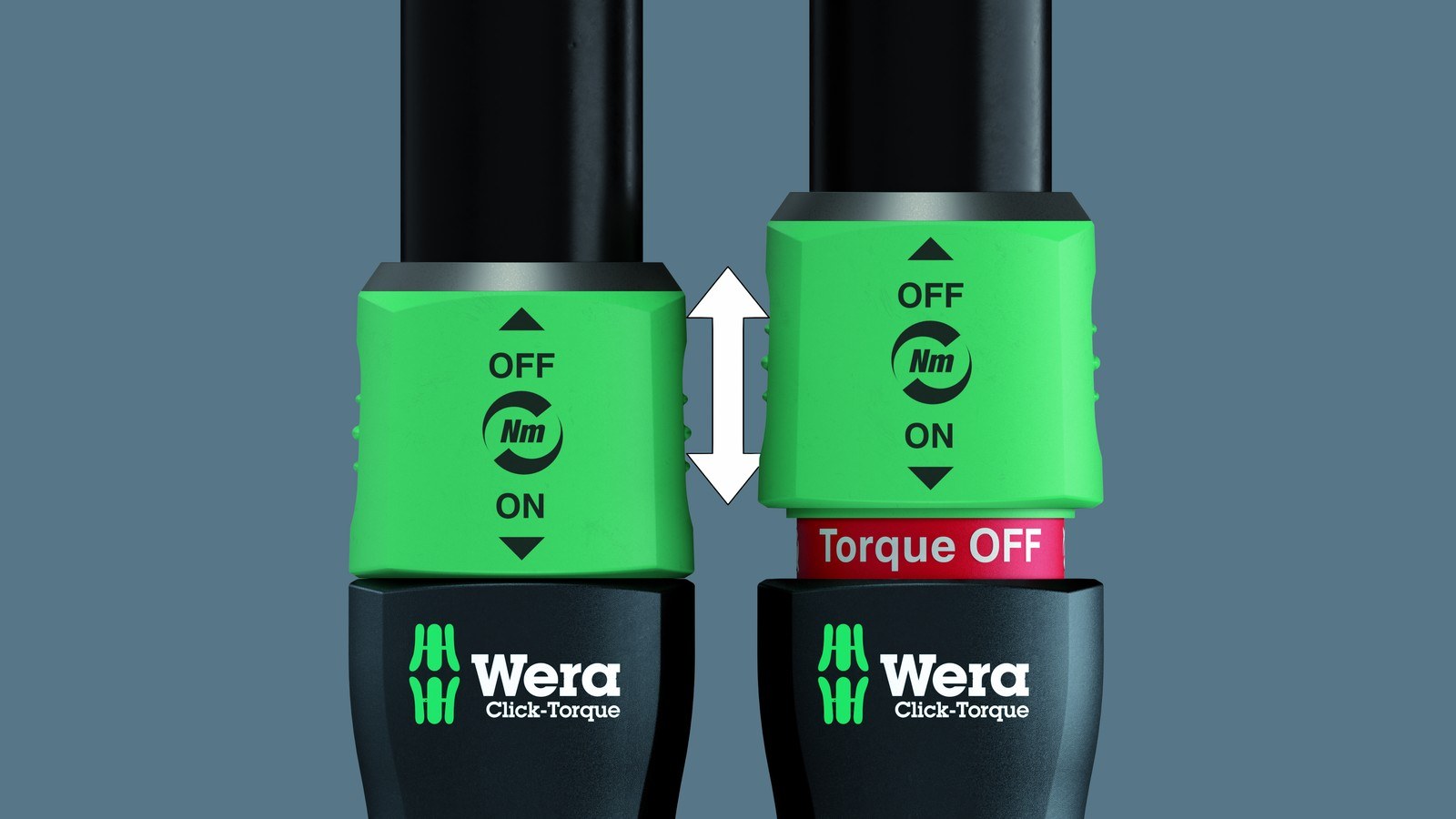
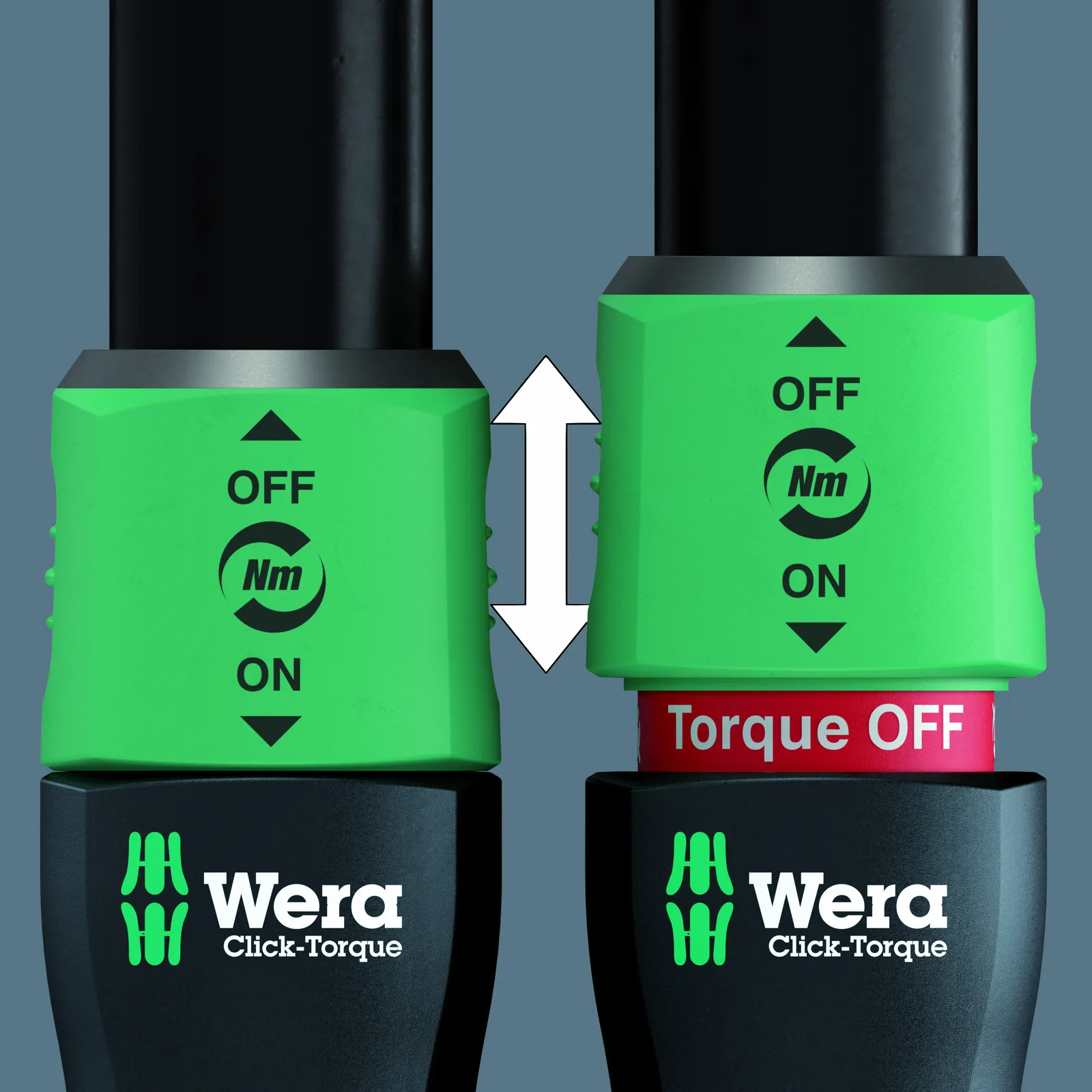
The new feature is a lock that disables the torque function, so the wrench can be used without torque as a plain ratchet. Earlier Click-Torque wrenches, in Wera's framing, didn't have that deactivation. A red "Torque OFF" band becomes visible when the function is off, which is a visual cue that the click mechanism is bypassed, so a pull with the band showing isn't a torque reading to record.
That matches how real jobs are structured. Take a jig or a machine with a mixed row of fasteners. One bolt has a published value, and the next only has to be snug. With the lock released, the wrench is a torque tool for the first and a ratchet for the second, without a tool change in between. The earlier models aren't named in the PDF, and it doesn't reprint their torque spans, so how this range compares with them can't be judged from the release.
How is the value set?
The value is set by turning the handle. Two scales are listed, Nm (newton-meters, force at a one-meter arm) or lbf ft (pound-force feet, force at a one-foot arm), plus a fine scale for in-between values. Wera also names Extra-Click, a click that sounds while the value is being set, giving feedback as the handle moves from one mark to the next. That's a different event from Work-Stop-Click, which happens at the fastener during use.
What do 45 teeth and 40 to 200 Nm mean?
The ratchet head has 45 teeth. A full circle is 360 degrees, and 360 divided by 45 is 8, so the handle needs to move only 8 degrees to catch the next tooth. That short stroke matters near a frame or a jig plate, where there's little room to swing. A coarser ratchet needs a longer arc. A small lever on the head switches between tightening and loosening.
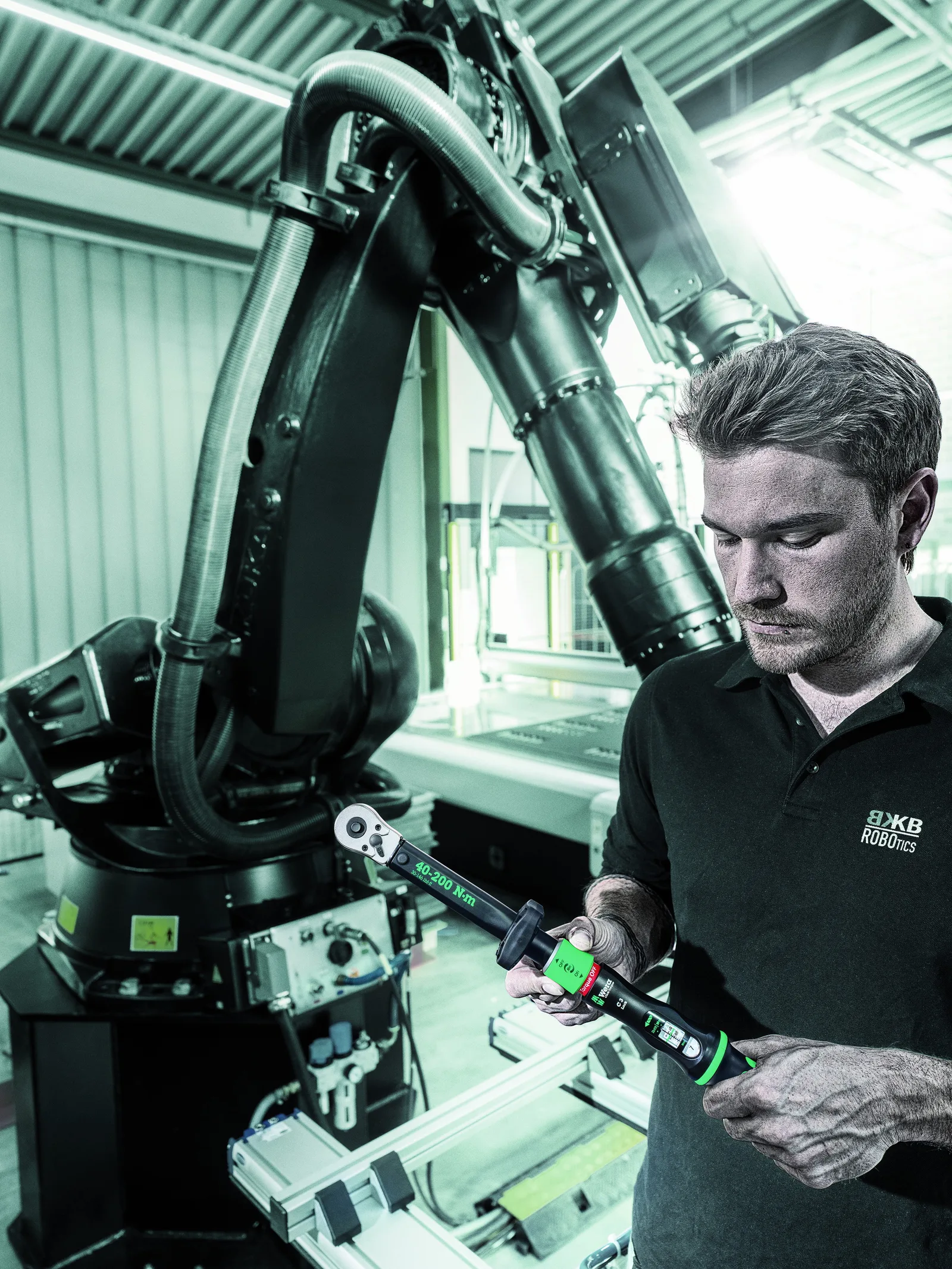
The press photo shows a scale marked 40 to 200 Nm. The text doesn't say that every wrench in the range uses that window, and it doesn't list SKUs or the full set of torque spans. Dividing by 1.356 converts the photographed endpoints to about 29.5 and 147.5 lbf ft.
Which versions does Wera offer?
There are clockwise versions, and R/L versions that apply torque in both directions, which matters for left-hand threads. The release doesn't explain how the direction lever behaves when the torque band is showing.
What does the release say about the intended use?
Wera's materials describe the range in terms of its two features, the switchable torque function and the fine-toothed ratchet, and they don't list specific applications beyond the general idea of tools used on machines, jigs, and equipment. That's an important limit on how far to read the announcement. The photo in the press material shows a technician using a click wrench next to an industrial robot arm, which hints at maintenance and assembly work in a factory, but the text doesn't make that claim.
The torque-off lock is the genuinely new idea. Torque wrenches are usually single-purpose tools. Wera's lock lets one tool do both jobs and bypasses the measuring mechanism when torque isn't needed, though the release doesn't make a calibration claim.
What's the difference between the two date printings?
The press PDF's "1/6/2025" header and the US page's May 19 date describe the same release as it appears on two Wera pages, and the file path for the PDF also carries 250519, which lines up with May 19, 2025. If the header is read in the day-month order common in Europe, it would mean 1 June 2025, a discrepancy I'm leaving as it appears.
What does the release say about price and availability?
Wera's availability line is the sentence "Now available in this range." That's all the release says about it. It doesn't name a ship week or a retailer, and no price appears on either the US page or the English PDF. The photographed 40 to 200 Nm scale is the only torque window shown, and the PDF text doesn't state the full torque spans or SKUs, so buyers have to check Wera's product pages for the exact torque range of the model they need.
What's missing?
The press materials leave out individual SKUs, the full torque spans, and a price. They don't say what the wrench does if the pull continues after Work-Stop-Click, and the earlier Click-Torque models' specifications aren't given for comparison. What Wera does state is a range of click torque wrenches, now available, with a torque function that switches off, a 45-tooth head, and a small direction lever.
Sources and image credits
- Wera press release, US page
- Press PDF
- Product images: Wera