

A red indicator LED can cost only a few cents, while an LED bulb can light a room from an ordinary household socket. Both descend from the same effect: charge carriers meeting inside a semiconductor and releasing energy as light.
That compact explanation hides nearly a century of work. Researchers first noticed light from crystals before electronics had a good theory for semiconductors. Engineers then learned to make infrared emitters, visible red indicators, brighter colors, and finally efficient blue devices. Blue completed the practical path to white solid-state lighting.
This article follows the LED from a glowing crystal observed in 1907 through infrared and red devices, the blue breakthrough, and the white lighting in use today.
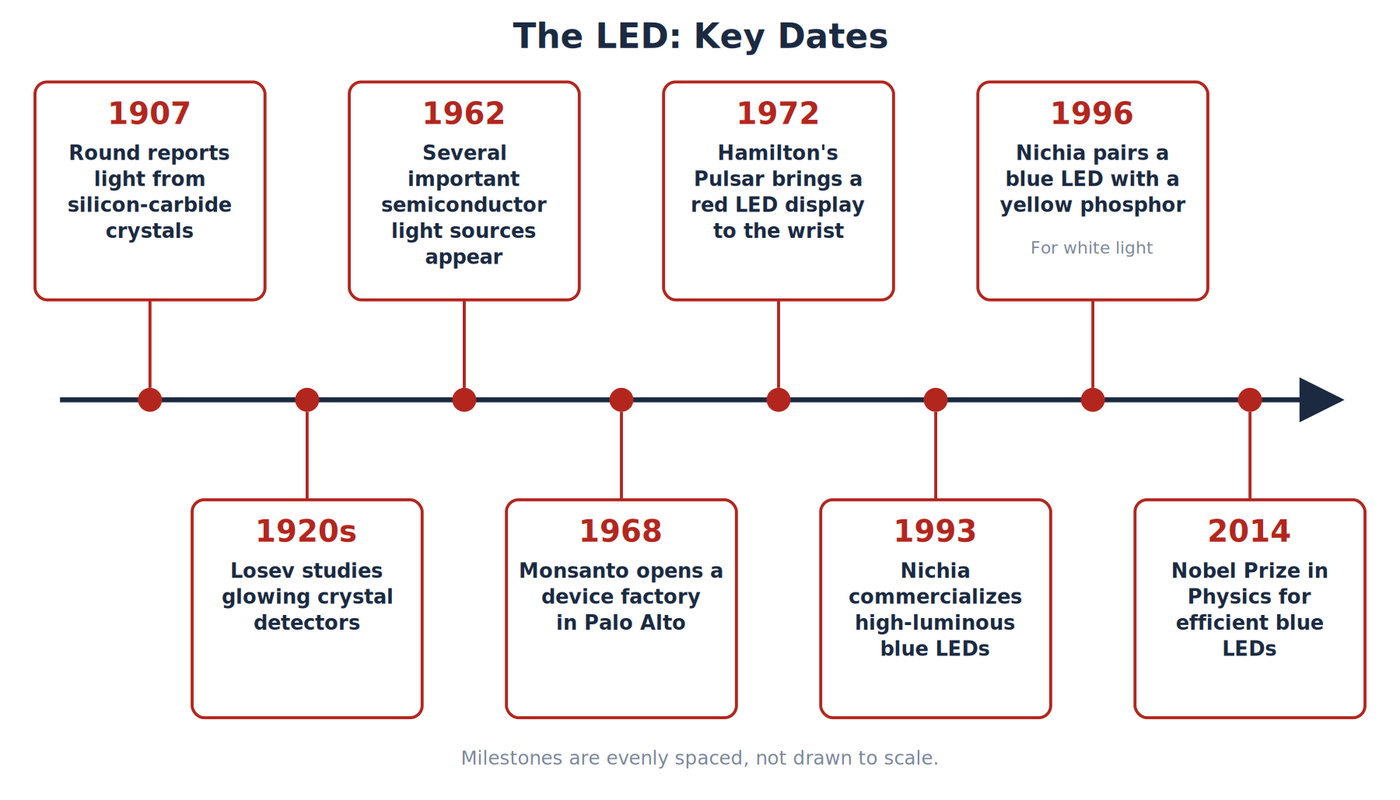
Key dates in the story of the LED. Credit: The Makers Workbench.
Light from a crystal
In 1907, Henry Joseph Round reported light from silicon-carbide crystals while experimenting with radio detectors. Silicon carbide is a semiconductor, a material whose ability to conduct electricity sits between that of a conductor and an insulator and can be controlled through composition and structure.
Round's observation was electroluminescence, light produced when electrical energy excites a material. It did not immediately create a useful lamp. The crystal contacts were difficult to control, the light was weak, and semiconductor physics was still developing.
Oleg Losev explored the same phenomenon in the 1920s, and a silicon-carbide light-emitting diode is credited to him in 1927. He published experiments on glowing crystal detectors and recognized that the emission was connected to the electrical behavior of the junction. His work is an important part of LED prehistory, but it did not lead to a practical commercial component at the time.
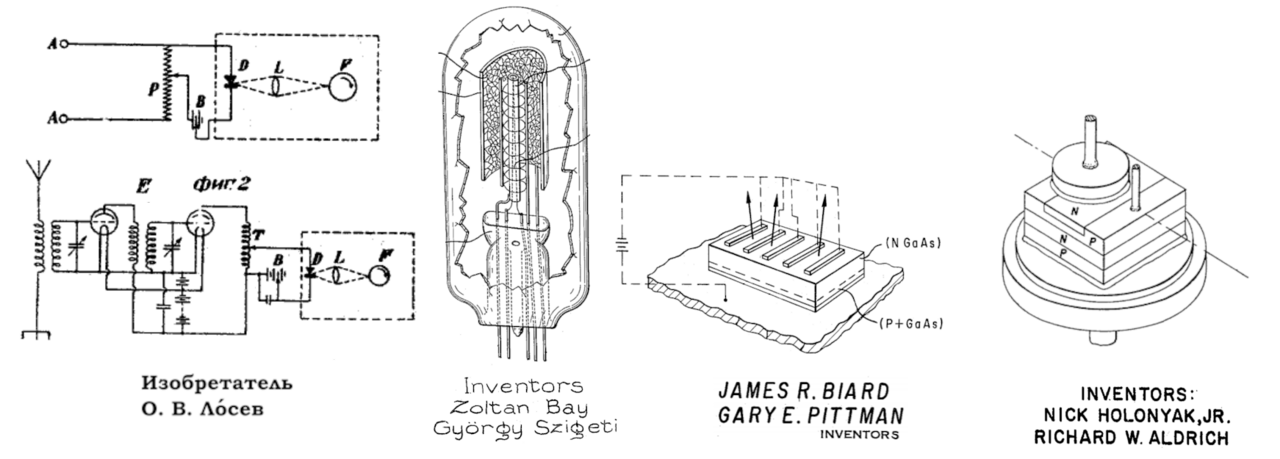
Four early drawings on one sheet, including work by Losev and by Biard and Pittman. Credit: Michael Weinold, CC BY 4.0, via Wikimedia Commons.
These early experiments established that a solid material could turn current directly into light. The missing pieces were a reliable semiconductor junction, suitable materials, and a manufacturing process that could reproduce the effect.
The junction that releases a photon
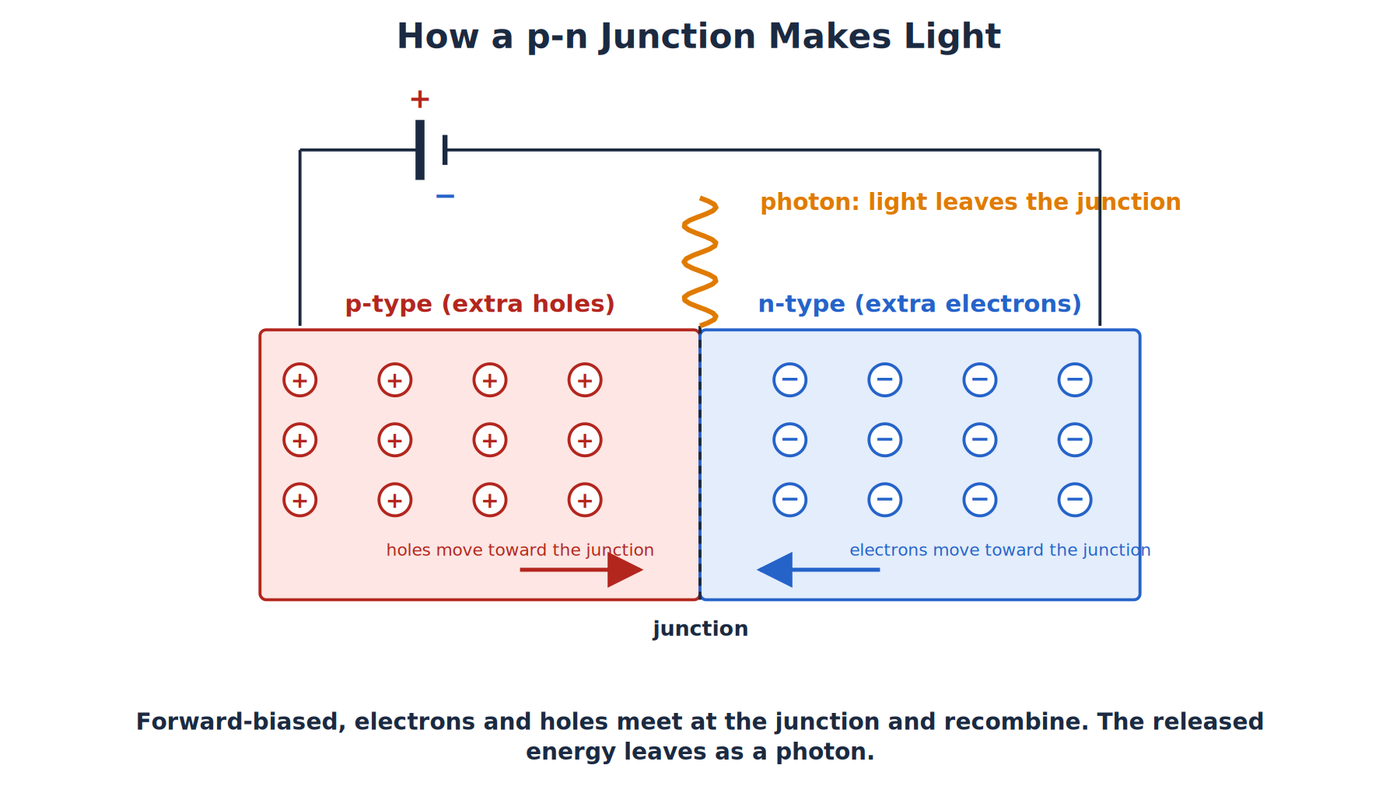
What happens inside an LED: electrons and holes meet at the junction and the released energy leaves as light. Credit: The Makers Workbench.
A modern light-emitting diode is a p-n junction. One side of the semiconductor is doped to contain an abundance of mobile electrons. The other is doped so that empty states called holes behave like positive charge carriers.
When the diode is forward biased, current flows across the junction. Electrons and holes recombine. In a suitable material, part of the released energy appears as photons, the individual packets of electromagnetic energy we perceive as light.
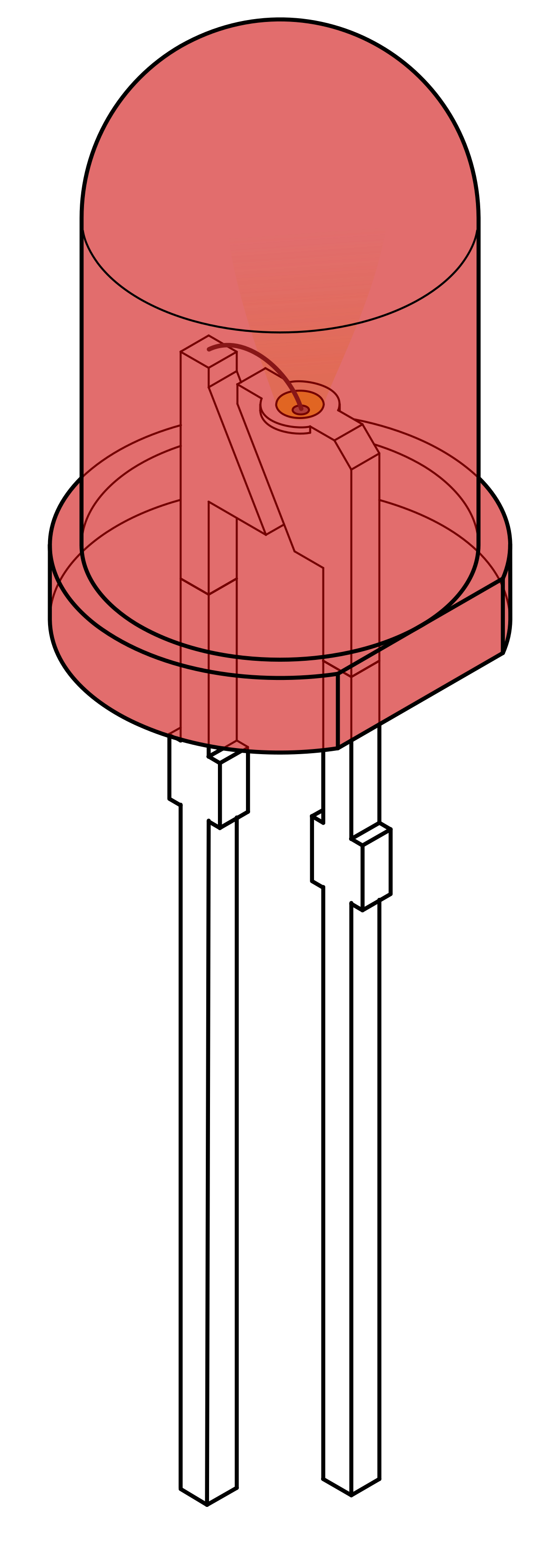
A cutaway of a 5mm red LED showing its internal structure. Credit: Inductiveload, public domain, via Wikimedia Commons.
The material's band gap helps determine the photon energy and therefore the color. Band gap is the energy separation electrons must cross between bound and conducting states in the semiconductor. A larger energy transition produces a higher-frequency, shorter-wavelength photon.
The familiar circuit symbol captures only the electrical direction. In a real LED, material composition, crystal defects, junction shape, package optics, and heat removal all affect how much useful light escapes.
The crowded year of 1962
Several important semiconductor light sources appeared around 1962, which makes “the first LED” a question that needs careful definitions.
At Texas Instruments, James Biard and Gary Pittman developed an infrared-emitting gallium-arsenide diode. Infrared light lies beyond the red end of human vision, so the device could emit even though a person could not see it glow. Their patent work and TI's commercial product establish a major step: a semiconductor light emitter that could be manufactured and sold.
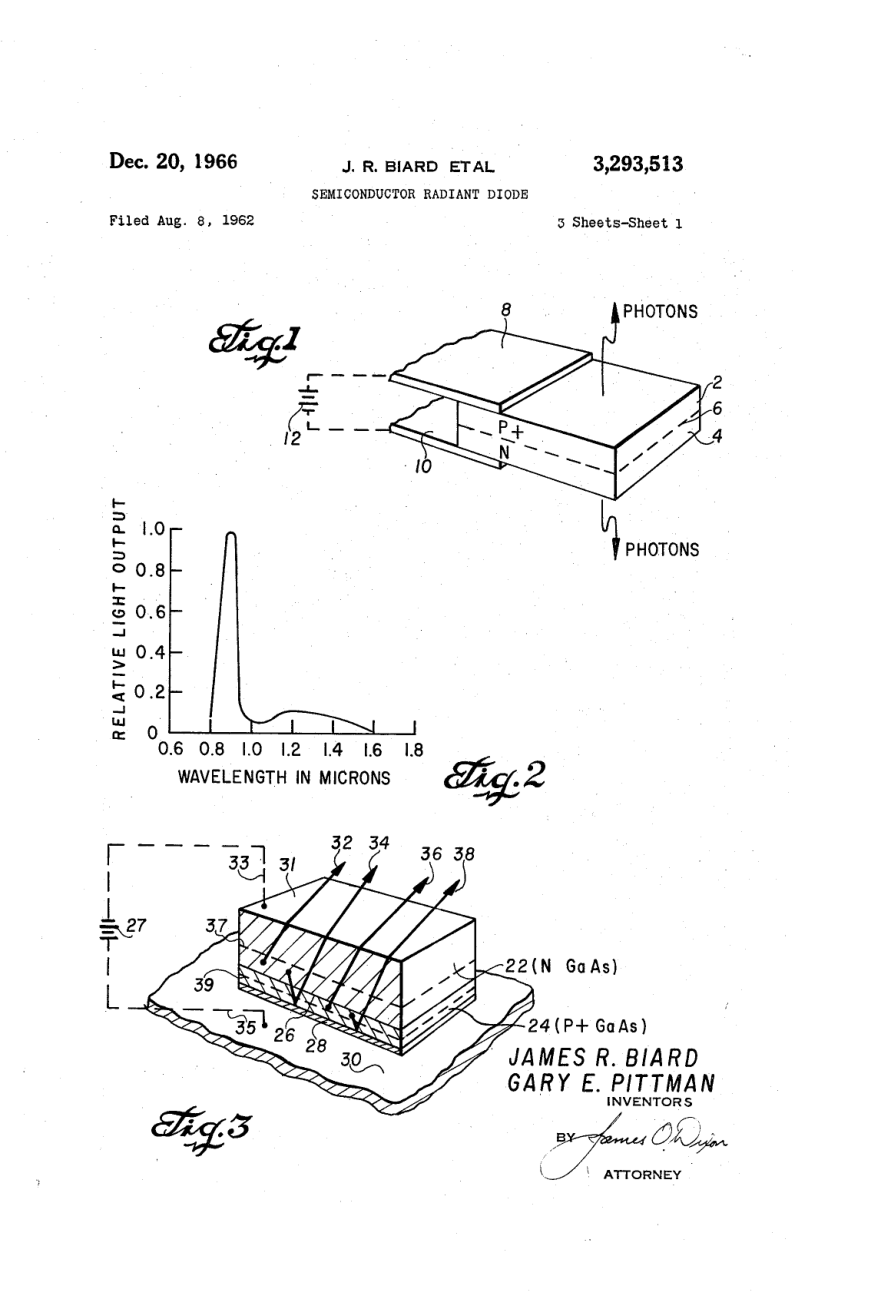
Sheet 1 of the Texas Instruments patent for a gallium-arsenide radiant diode. Credit: U.S. Patent 3,293,513, sheet 1. James R. Biard and Gary E. Pittman, Texas Instruments.
At General Electric, Nick Holonyak Jr. demonstrated a visible red gallium-arsenide-phosphide diode. This is the result most often associated with the first practical visible LED. At the same time, other laboratories were producing infrared emitters and semiconductor lasers.
A laser diode is related to an LED but operates differently. An LED emits spontaneous, relatively broad light. A laser uses stimulated emission and an optical cavity to produce more coherent light. Mixing those categories makes the 1962 record look simpler than it was.
The safe conclusion is a chain rather than a single finish line. Infrared devices became practical commercial emitters, and Holonyak's work established a visible red junction device. Both were necessary stages in the technology's development.
Red light becomes a product
Early visible LEDs were dim and expensive. Their strongest use was as an indicator, where a small point of colored light only had to show that power was on or a logic state had changed.
Monsanto became an important early producer of visible LEDs, while Hewlett-Packard developed displays that arranged small emitting segments into readable numbers and characters. Devices such as the MAN-1A helped LEDs move from isolated points of light into electronic readouts. By the 1970s, Monsanto and Hewlett-Packard had brought the unit cost of an LED below five cents.
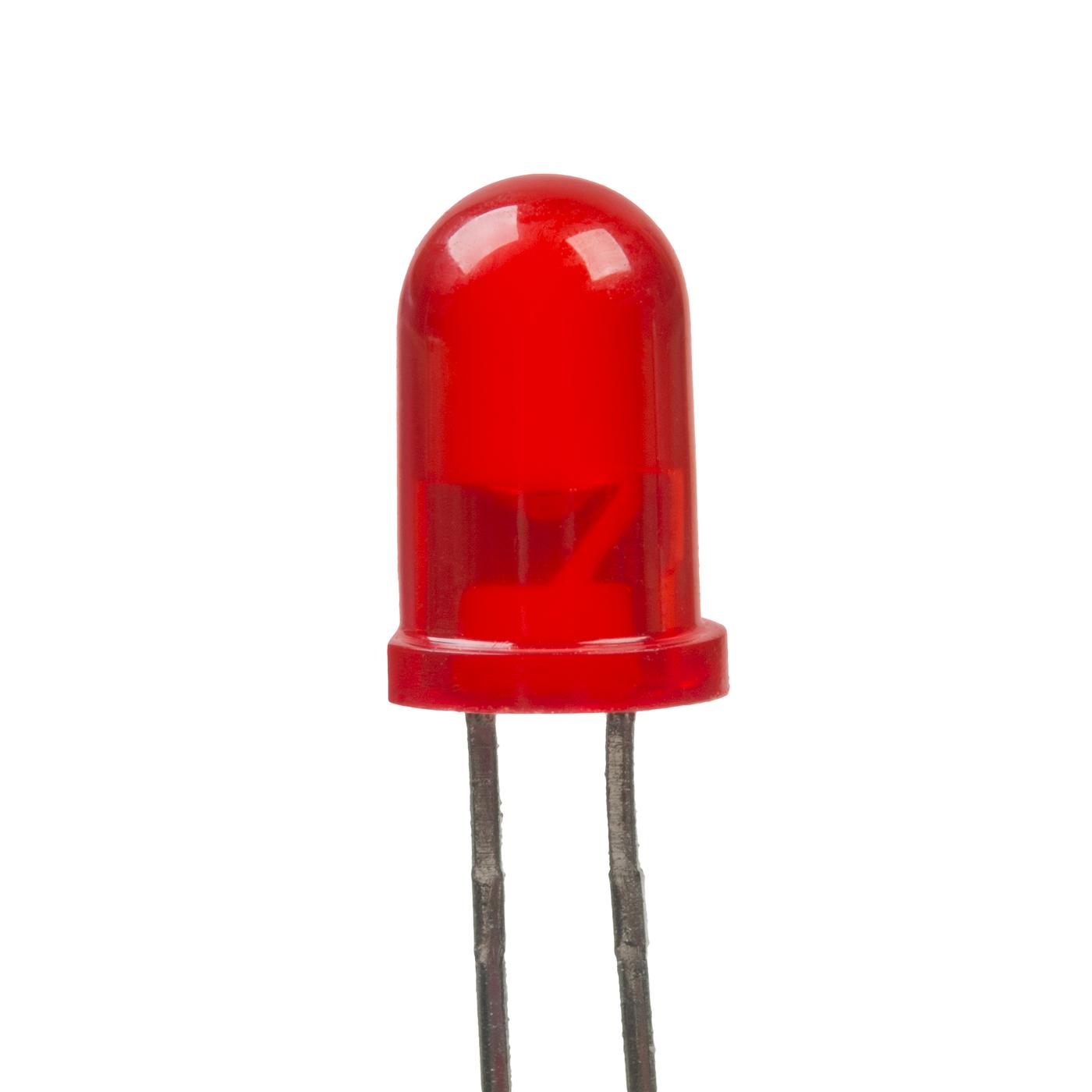
The part most of us know: a red through-hole indicator LED. Credit: Photo by Evan-Amos. Released to the public domain.
The MAN-1A used fourteen separate gallium-arsenide-phosphide chips, two for each segment. “MAN” stood for Monsanto alphanumeric, although a seven-bar display shows numerals much better than letters. Monsanto opened a device factory in Palo Alto in 1968 and became a major force in early optoelectronics.
The seven-segment display became one of the most recognizable forms. Seven bar-shaped LEDs can form the digits zero through nine. Calculators, instruments, clocks, and test equipment gained a bright display with no filament to burn out.
LED watches provided another memorable showcase. A user pressed a button to display the time because the early display consumed too much power to remain lit continuously. That limitation shows how far efficiency had to improve before LEDs could become general illumination.
Hamilton's Pulsar watch brought the glowing red display to the wrist in 1972. Calculators and watches created a large market for numeric modules through the late 1960s and mid-1970s. Companies including Monsanto, Hewlett-Packard, Litronix, Texas Instruments, Fairchild, Motorola, and National Semiconductor competed in the display business.
These products changed the public meaning of an LED. It was no longer just a laboratory junction or a panel indicator. It could communicate information directly. Later liquid-crystal displays used much less power for watches and calculators, but LEDs continued to improve and found other roles where brightness, color, speed, and ruggedness mattered more than minimum display power.
More colors and more brightness
Changing an LED's color requires changing the semiconductor material and its band gap. Engineers developed red, orange, yellow, and green devices through different compound semiconductors and fabrication methods. M. George Craford's work on gallium-arsenide-phosphide devices greatly improved brightness and helped add useful yellow emission.
For makers, the package evolved along with the material. The common 5-millimeter through-hole LED places a small semiconductor die in a clear or colored epoxy lens. Surface-mount LEDs shrink the package for automated assembly. RGB LEDs place red, green, and blue emitters together so their brightness can be mixed electronically. Chip-on-board modules mount many dies on one substrate, and filament-style lamps arrange strings of tiny emitters to resemble a glowing wire.
This variety creates an important practical warning. “An LED” is not a complete electrical specification. Forward voltage, rated current, thermal resistance, wavelength, viewing angle, and polarity still matter. A small indicator usually needs a current-limiting resistor. A high-power LED needs a regulated driver and a thermal path that keeps its junction temperature under control.
Infrared LEDs were not a dead end. They became the emitters in remote controls, optocouplers, and proximity sensors, uses that continue today. In the 2010s, LEDs that include a tiny control chip inside the same package, such as the WS2812B, which is often sold under the name NeoPixel, allowed a long strip of individually controllable colors to be driven from a single data pin.
The blue problem
Red LEDs arrived decades before efficient blue ones. Blue light requires a wider-band-gap material, and the material system that ultimately worked, gallium nitride, was exceptionally difficult to grow and dope into useful junctions.
Isamu Akasaki, Hiroshi Amano, and Shuji Nakamura helped overcome those barriers through work on high-quality gallium-nitride crystals, p-type layers, and bright blue devices. Their contributions made efficient blue LEDs practical in the 1990s.
Akasaki began sustained gallium-nitride work in the 1970s. At Nagoya University, he and Amano used a low-temperature aluminum-nitride buffer layer on sapphire to grow better material. They then demonstrated ways to produce p-type gallium nitride, the positively doped layer needed for an efficient junction.
Nakamura began blue-LED work at Nichia in 1988. His work included improved buffer growth and a thermal-annealing method that activated p-type material by removing the effect of hydrogen passivation. Nichia says it commercialized high-luminous blue LEDs in 1993. A 1994 indium-gallium-nitride structure cited in the Nobel background reached a reported quantum efficiency of 2.7 percent, meaning that a measurable share of the injected charge produced useful emitted photons.
Blue mattered for more than adding another indicator color. A blue LED can excite a phosphor, a material that absorbs some of the blue energy and re-emits it across a broader range of wavelengths. The mixture appears white. Other white systems combine multiple colors, but the blue-die-and-phosphor approach became central to modern LED lighting.
Nichia dates its combination of a blue LED with a yellow-emitting yttrium-aluminum-garnet phosphor to September 1996. That is a company historical claim, but it marks the practical formula that became familiar in white lamps: let some blue light pass through and convert the rest to longer wavelengths. The spectrum is not identical to sunlight or an incandescent filament, so phosphor composition and additional emitters are used to improve color quality.
Blue history also contains competing “first” claims. Cree's founders described early silicon-carbide products as the first commercially available blue LEDs. Nichia described its 1993 products as the first high-luminous blue LEDs. The Nobel recognized efficient nitride blue devices. Those statements refer to different materials and performance thresholds, so collapsing them into one winner would hide the engineering progress.
The 2014 Nobel Prize in Physics honored the invention of efficient blue light-emitting diodes. That award should not be mistaken for an origin date for the LED itself. It recognized the breakthrough that enabled bright, energy-efficient white light after earlier researchers and companies had already established infrared, red, and other visible devices.
From indicators to illumination
Once efficiency and manufacturing improved, LEDs spread through traffic signals, vehicle lighting, signs, displays, televisions, flashlights, phones, decorative strips, and household lamps. The shift was not only about lower electrical power. LEDs are small, switch quickly, tolerate vibration, and can be arranged into shapes that incandescent filaments and fluorescent tubes cannot easily match.
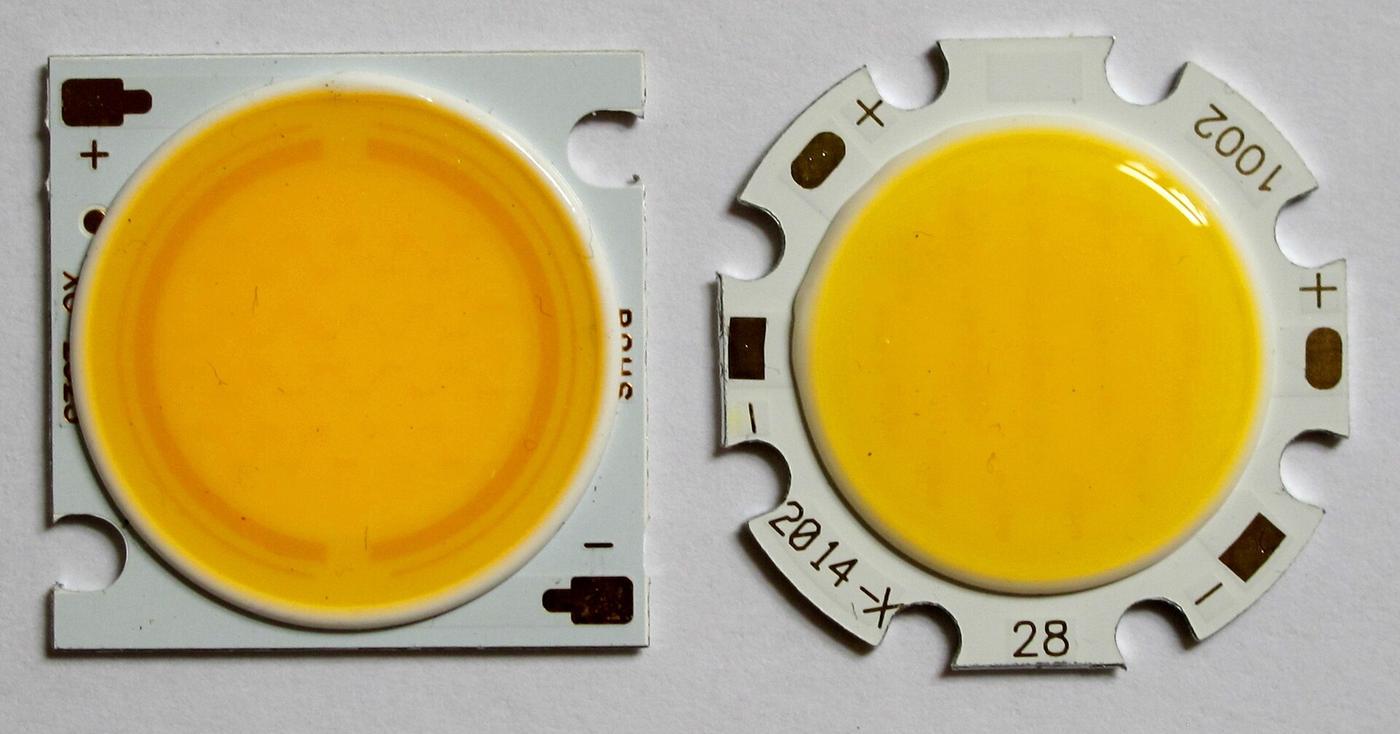
Two high-power chip-on-board LEDs. Credit: wdwd, CC BY-SA 4.0, via Wikimedia Commons.
Lighting is judged by efficacy, the amount of visible light produced for each watt of electrical power, measured in lumens per watt. A typical incandescent bulb produces roughly 10 to 17 lumens per watt, and a compact fluorescent lamp roughly 50 to 70. In 2009, Cree's XP-G LED reached 105 lumens per watt, and in 2010 Nichia's 19 series reached a typical 140. By 2011, some LED bulbs reached 150. The US Department of Energy created the L Prize in 2008 to encourage better LED lamps, and a Philips LED bulb won the first prize in August 2011.
There are tradeoffs. LED junctions produce heat even though the emitted beam feels cool compared with an incandescent lamp. Poor thermal design shortens life and shifts performance. White-light quality depends on the spectrum, phosphor, driver electronics, and optical design. Cheap lamps often fail in their power supplies rather than in the emitting dies.
Efficiency changed the scale of the opportunity. A red display only had to produce enough light to be read nearby. A replacement lamp must turn electrical power into a large amount of useful visible light while controlling heat, color, flicker, and cost. High-power packages, better heat sinking, phosphors, optics, and switching power supplies were as important to the lighting transition as the emitting junction itself.

An LED filament lamp up close. The photographer counted 28 chips under the yellow phosphor. Credit: wdwd, CC BY-SA 4.0, via Wikimedia Commons.
Automotive dashboards, phone keypads, and color-screen backlights provided intermediate mass markets. Cree's corporate history places gallium-nitride-on-silicon-carbide LEDs in a Volkswagen dashboard in 1996 and describes a handset ramp beginning around 2001. Lighting-class packages followed. These are company claims, but they show how blue LEDs moved through high-value applications before household bulbs became ordinary.
By October 2026, this history reached both ends of the price scale. A basic red indicator remained a few-cent component, while mass-market white bulbs sold for less than a dollar in some listings. Those figures are current snapshots and have not been adjusted for inflation. Even so, they show how an effect first seen in a laboratory crystal became an everyday manufactured part.
The LED was not one invention delivered in one year. Round and Losev saw the glow. Semiconductor physics explained it. Biard and Pittman helped make infrared emission commercial. Holonyak made visible red practical. Craford and others improved brightness and color. Akasaki, Amano, and Nakamura opened the efficient blue path that made white lighting possible.
An LED on a breadboard is simple to use because the materials science behind it, from the crystal growth to the doping and the phosphors, has already been done.