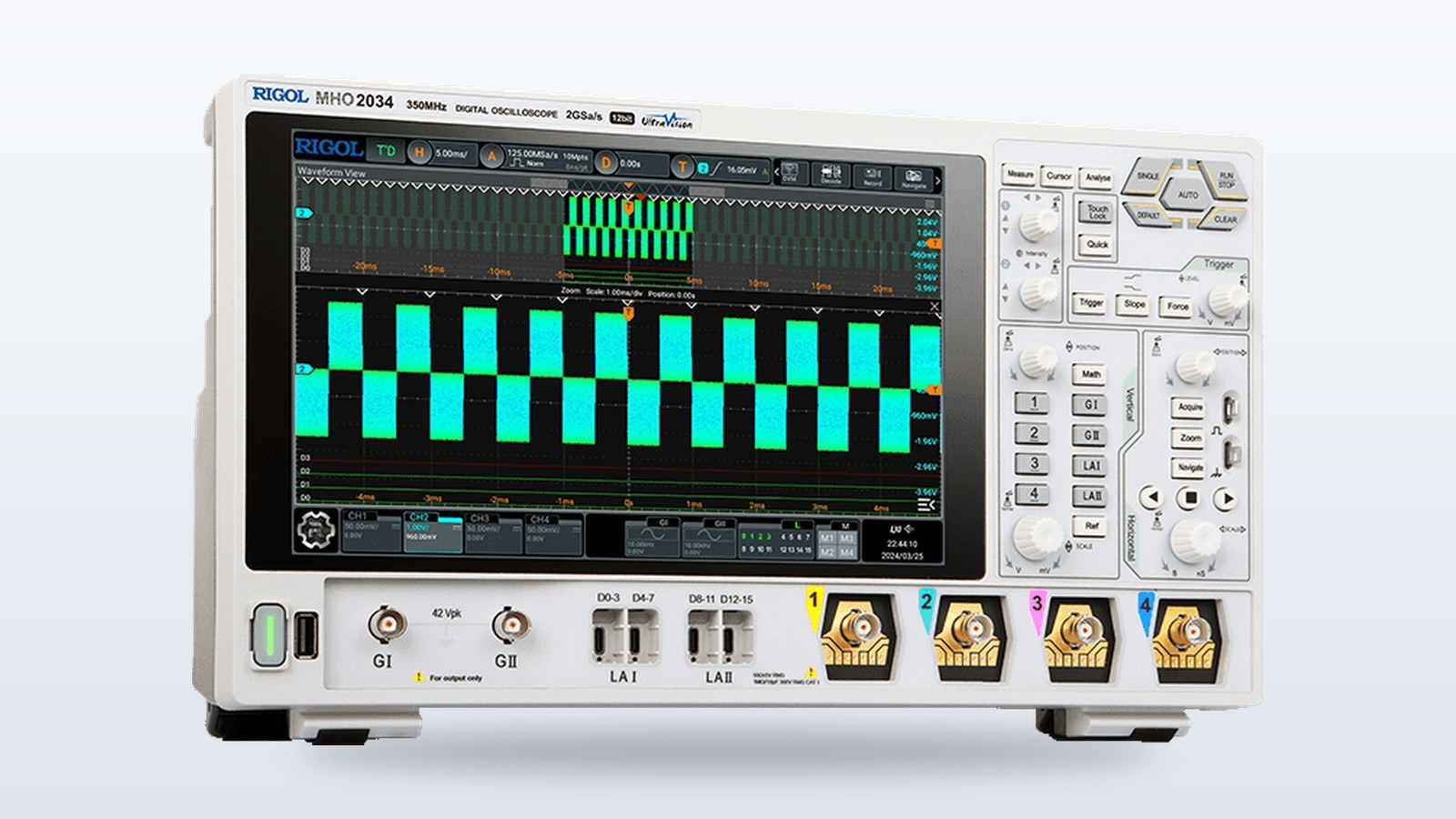
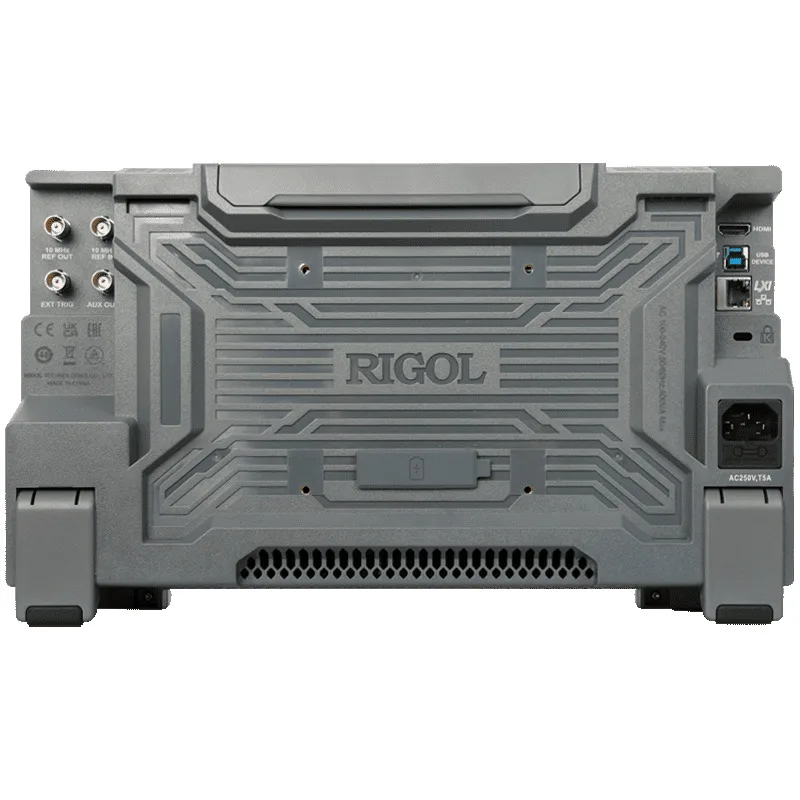
On May 8, 2025, Rigol introduced the MHO2000 series, 12-bit mixed-signal oscilloscopes with bandwidth up to 350 MHz. Rigol's release calls the series an economical, high-resolution instrument that combines protocol analyzer, logic analyzer, and signal generator functions. The same day, Saelig, Rigol's U.S. distributor, published its own introduction (carried by Microwave Journal) naming two models and filling in more figures. Neither announcement prints a price, and TMWB hasn't tested the scope, so these are the specifications as announced.
An oscilloscope draws voltage against time. "Mixed-signal" means digital lines are watched on the same timebase as the analog waveforms, and that combination is the reason this series exists.
What are the models and core specs?
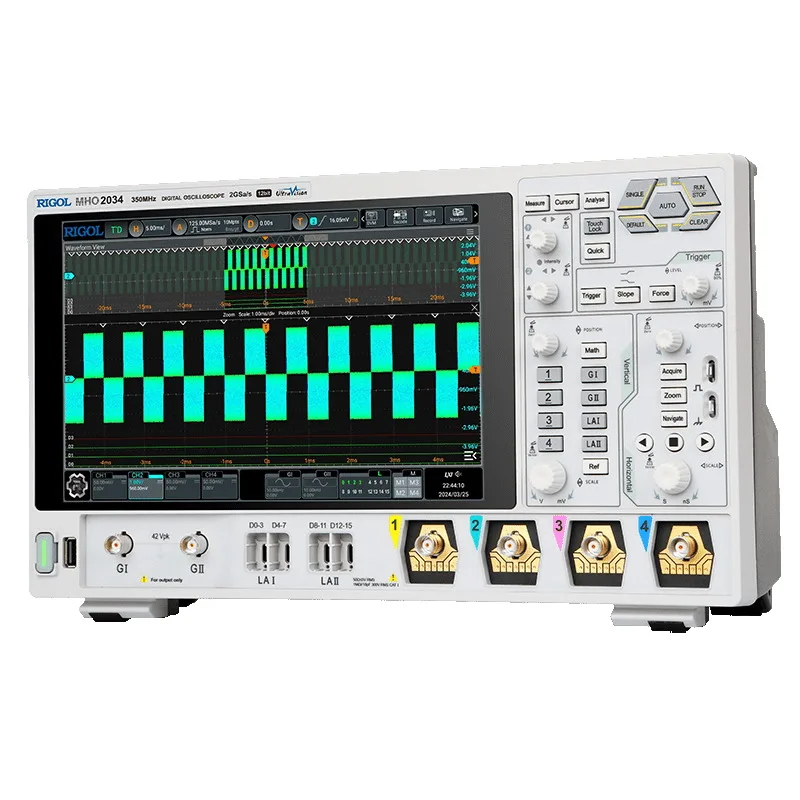
Saelig names the 200 MHz MHO2024 and the 350 MHz MHO2034, and says the series is built on the Centaurus platform, without explaining what that name covers. A megahertz is a million cycles per second. Bandwidth is the highest frequency the scope's front end can pass before its response rolls off, conventionally measured where amplitude is about 3 dB down, roughly 70 percent of true height. The release lists no probes, and a slow probe on a faster scope still shows a slow edge.
There are 4 analog channels and 16 digital channels, with the digital set used through an optional probe, so the probe shouldn't be assumed to be in the box. Resolution is 12 bits, or 4,096 vertical levels, which is 16 times as many as an 8-bit scope's 256. Saelig also says up to 16 bits in high-resolution mode. That kind of mode generally filters neighboring samples to show a finer number, usually at some cost in bandwidth, and Rigol's tradeoff isn't described.
Sampling is 2 GSa/s (2 billion samples per second) on all channels at 12 bits. "All channels" matters, because some scopes quote a headline rate with only one channel on and then split the converter across the rest. Rigol's highlights also describe the rate as real-time, meaning one capture is taken in a single pass in time order. Memory is up to 500 Mpts. At 2 GSa/s, that's a quarter of a second of capture, which is arithmetic and not a published record length. Waveform capture rate goes up to 1,000,000 waveforms per second, which matters because a fast sample rate can still miss a rare glitch if the scope is blind between captures, and a high capture rate shortens those gaps.
Saelig adds up to 41 automatic measurements, statistics, XY cursors, pass/fail testing with a hardware mask, a 6-digit frequency counter, and an integrated DVM (a digital voltmeter that shows a number beside the trace). A mask is a shape drawn around the expected waveform, and "hardware" in Saelig's wording means the test can keep pace with the fast capture rate.
What about the generator?
Rigol says the series integrates signal-generator functions, while Saelig says a 2-channel, 50 MHz arbitrary waveform generator is optional. An arbitrary waveform generator plays a stored shape, whether a plain sine, a square wave, or something captured elsewhere. "Integrates" doesn't mean every unit ships with it enabled, and the generator's bit depth and memory aren't given.
Why do 12 bits and 16 digital lines belong together?
Many boards are analog and digital at once. A microcontroller has a power rail that should stay quiet and a set of pins that talk to sensors and memory. The rail is an analog problem, with ripple and a dip when something transmits, and 12-bit steps keep a small wiggle from collapsing into one chunky stair. The pins are a logic problem: was a line high or low, and in what order did the edges arrive?
Two common chip-to-chip buses show up constantly in that kind of board. SPI uses a clock, two data wires, and a chip select, and I2C uses two shared wires, a clock and data. While those pins toggle, the supply rail can dip, and the useful picture is the dip and the bus traffic on the same screen. Rigol does call the instrument a protocol analyzer, but the summaries I've seen don't list which buses it decodes, so I won't promise SPI or I2C. That's a manual or option-sheet question.
Who is Saelig, and why does it matter here?
Saelig is a long-established U.S. distributor of Rigol instruments, and its introduction on May 8 carried more numbers than Rigol's own release. That's worth keeping in mind. The channel counts, the 2 GSa/s rate, the 500 Mpts memory, and the optional 50 MHz generator come from Saelig's text, while Rigol's page frames the instrument more broadly as an economical, high-resolution mixed-signal oscilloscope. The two sources agree where they overlap, and neither prints a price.
The announcements don't say which options come bundled, so a quote from the distributor is the way to find out exactly what a given configuration includes.
How do the bandwidth and sample rate relate?
The two bandwidths are two models, and the sample rate is shared. At 2 GSa/s on all channels, the faster 350 MHz model gets a bit under six samples per cycle at its top frequency, which is simple division and not a claim of flat response. The 200 MHz MHO2024 gets ten samples per cycle at its own corner, so the lower model has more samples per cycle of its highest frequency. Both are 12-bit instruments, and the release doesn't print probes or an effective number of bits, which is the depth that remains after noise is counted.
Where does it fit?
Rigol points the series at medical electronics, power supplies, electricity work, and automotive electronics, and calls it economical. A dedicated logic analyzer usually has more channels and deeper memory, so the MHO2000's 16 digital lines are best understood as a convenience beside the analog traces. Still unknown at announcement: the price, which buses are decoded, whether a given unit has the generator installed, how the 500 Mpts is shared when all four analog channels are active, and the ship date.
Sources and image credits
- Rigol MHO2000 release, May 8, 2025
- MHO2000 product page
- Saelig introduction via Microwave Journal
- Product images: Rigol