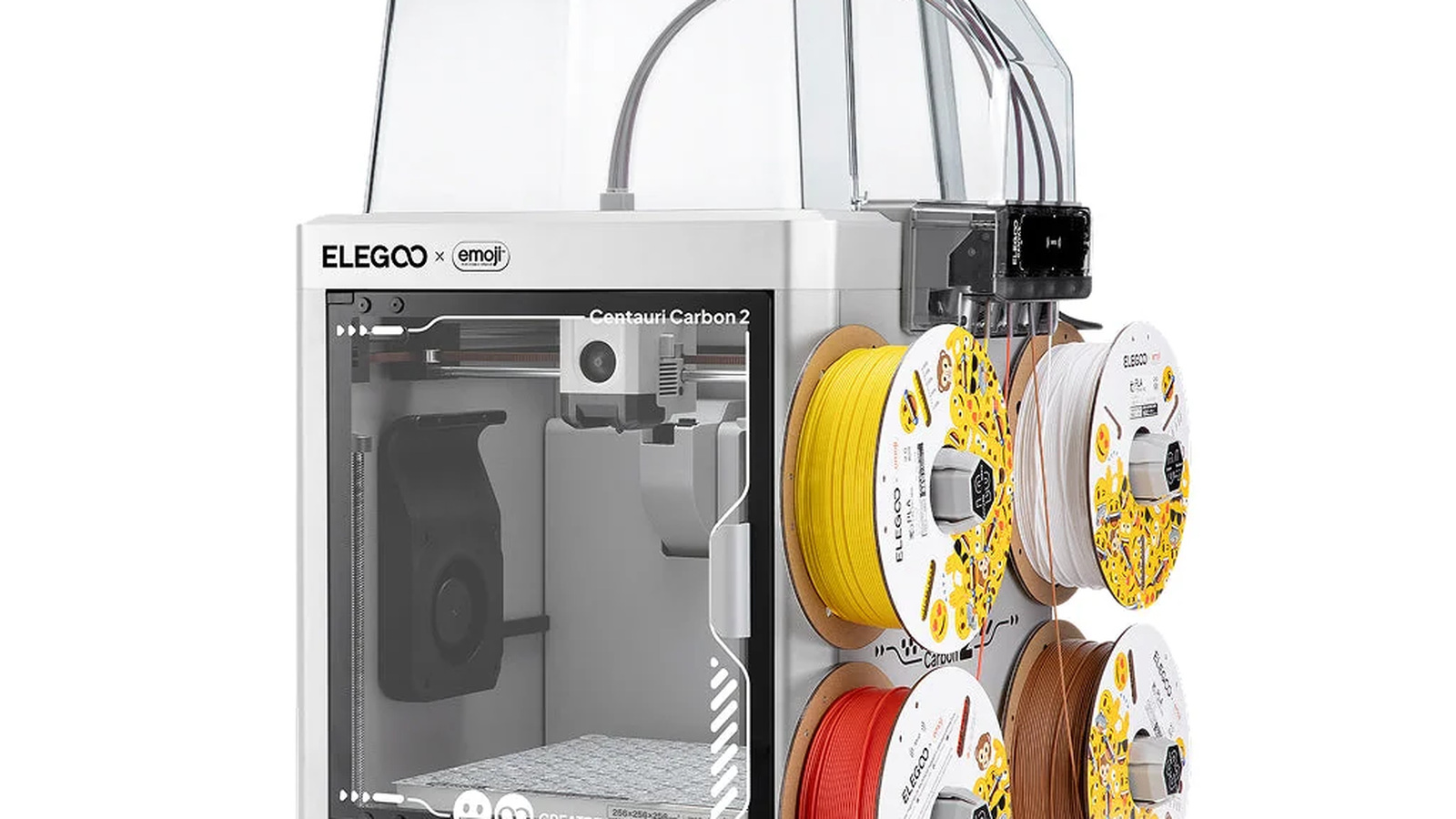
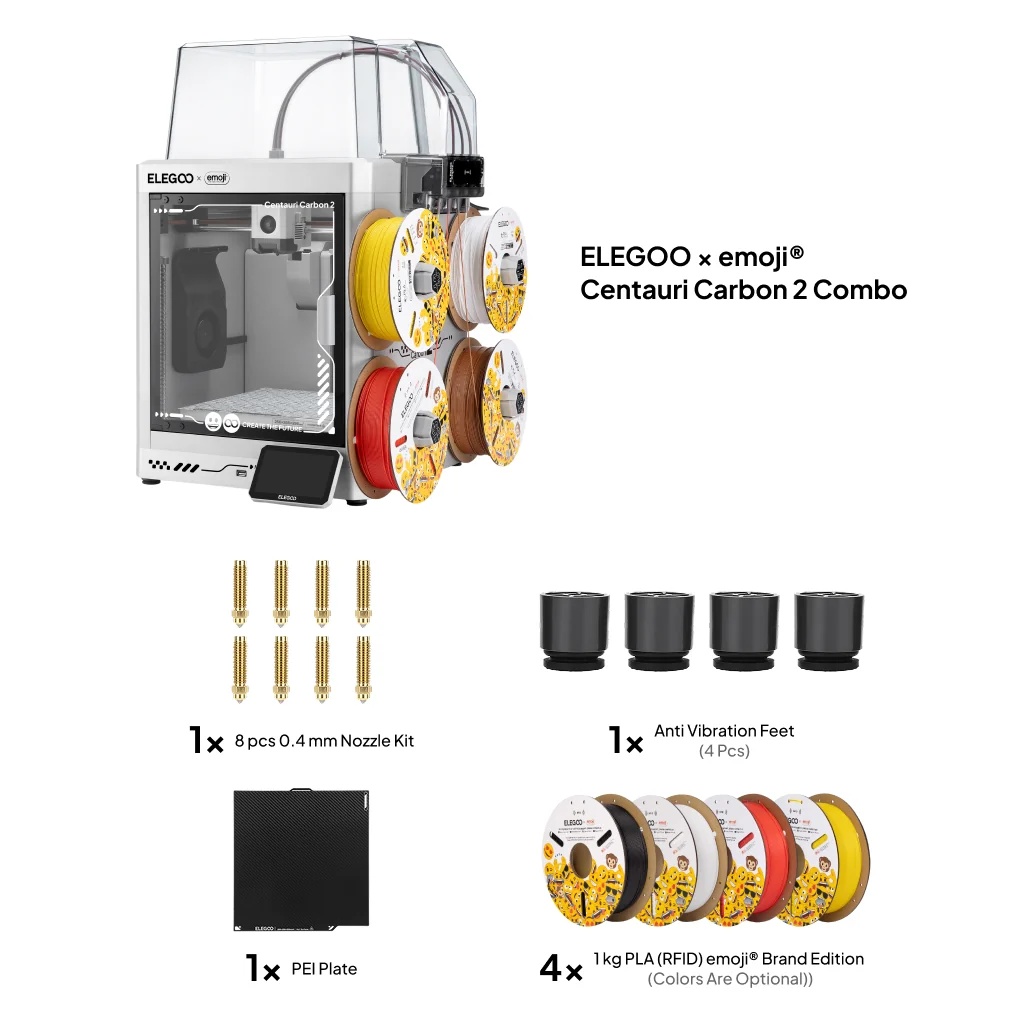
A 3D printer earns its place in a home workshop one ordinary job at a time. The impressive demo model may get attention, but the machine has to load cleanly, produce a dependable first layer, and finish a long part without turning the workbench into a troubleshooting station. Elegoo is approaching that practical test with the Centauri Carbon 2 Combo, an enclosed four-color CoreXY printer that aims to combine family-friendly setup with enough temperature range for reinforced materials.
The company announced the machine on 2026-01-26. Its main specifications include a 256 × 256 × 256 mm build volume, CANVAS four-color feeding, a 350 °C nozzle, full automatic calibration, a CoreXY motion system rated to 500 mm/s, 31 monitored sensor inputs, and a claimed operating level below 45 dB. Those figures describe the machine on paper. The more useful question is how the design changes a real project after the new-product excitement has passed.
TMWB has not tested the Centauri Carbon 2 Combo. Performance figures, availability, and reliability claims in this article come from Elegoo's announcement and product material. They should be treated as manufacturer claims until production hardware has been used over a meaningful run of prints.
What did Elegoo announce?
The Centauri Carbon 2 Combo is an enclosed four-color CoreXY printer that aims to combine family-friendly setup with enough temperature range for reinforced materials. That positioning matters because desktop printers are no longer separated only by speed and build volume. The current dividing lines are workflow, material control, and how much intervention a machine needs when a print changes color, nozzle, or polymer.
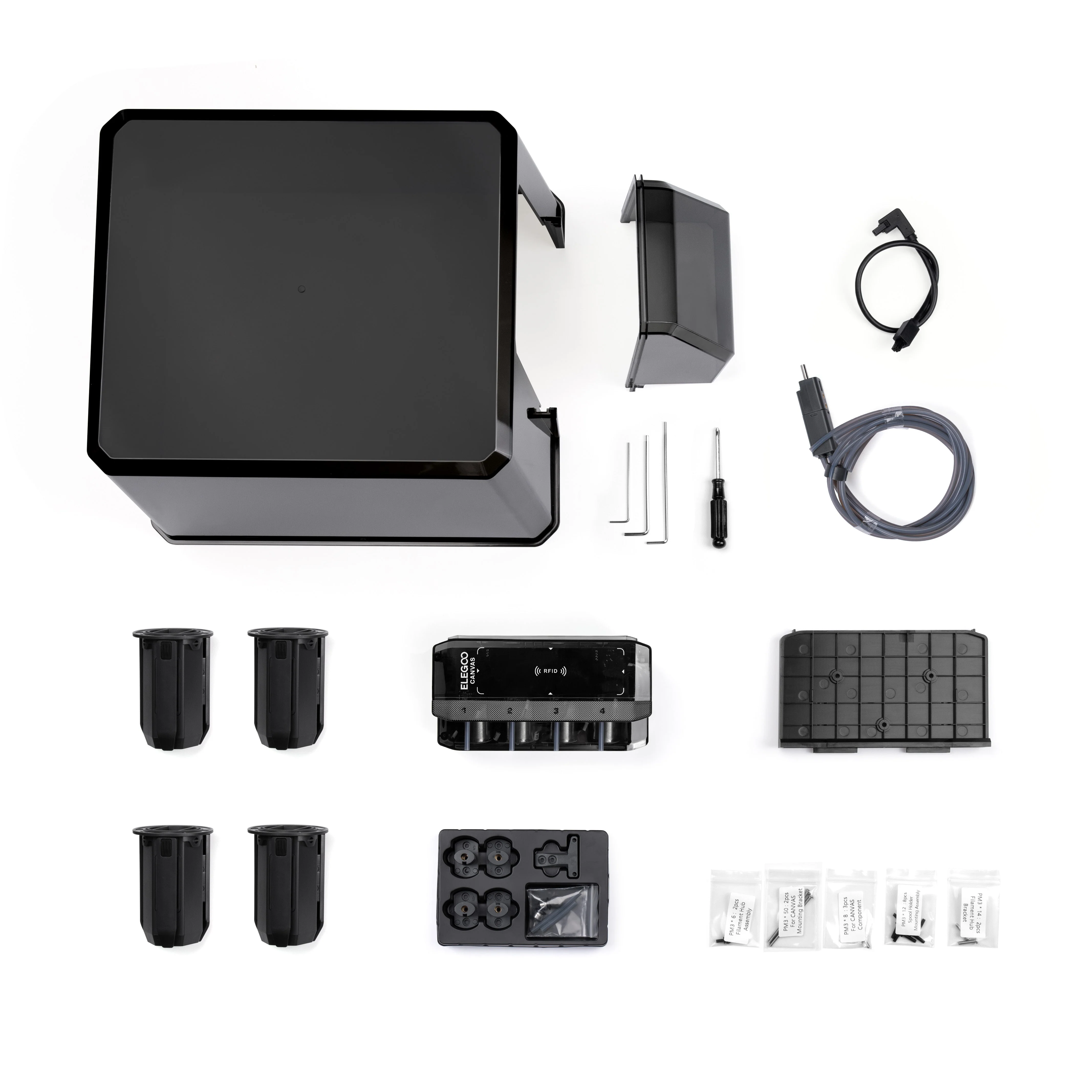
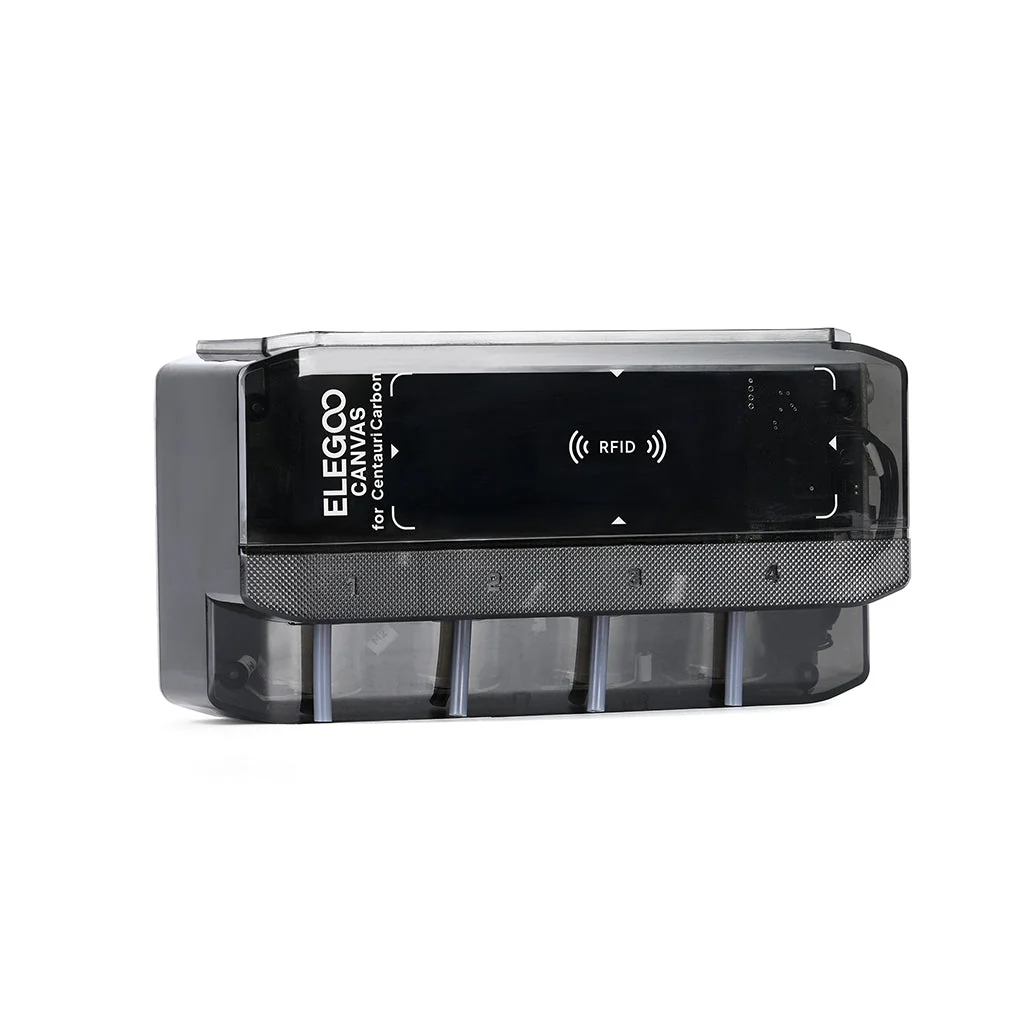
The headline hardware is CANVAS multicolor feeder. In plain English, CANVAS holds several spools, identifies supported Elegoo filament through RFID tags, and drives the selected strand toward the printer. RFID means radio-frequency identification, a small tag that can carry material and color information. That is the part of the announcement worth understanding before comparing price tags. A fast motion system saves minutes only when the material path, temperature control, and tool changes remain predictable.
Fused deposition modeling, usually shortened to FDM, builds a part by melting thermoplastic filament and placing it in thin paths. Each finished layer becomes the foundation for the next one. A modern printer can move quickly, but it still depends on the same physical chain: dry filament must reach a clean nozzle, the first layer must grip the plate, and every later layer must cool at a rate the material can tolerate.
How does the new system change printing?
The system includes auto refill for continuing onto another matching spool and tangle detection that can pause a job before a knot becomes an under-extruded section. A smart chamber grille changes ventilation behavior as material needs change.
Automation is useful when it removes a decision the machine can measure better than the operator. Bed probing is a good example. A sensor can sample many points on a build plate and create a mesh, which is a small height map used to keep the nozzle at a consistent distance from the surface. Input shaping is another example. It measures vibration and changes motor commands to reduce the ripples that appear after a fast direction change.
Neither feature repeals the underlying mechanics. A dirty plate can still defeat automatic leveling, wet filament can still pop and string, and a loose belt can still leave artifacts in a wall. The advantage is a shorter setup checklist and better information when something goes wrong.
The same rule applies to multicolor and multimaterial printing. Color is mostly a scheduling problem. The printer has to stop using one filament, put another material at the nozzle, and resume at the correct location. A shared nozzle usually unloads, reloads, and purges. A toolchanger parks one melt path and collects another. Dedicated tools can save material and time, although they add docks, offsets, and more nozzles to maintain.
What do the specifications mean at the workbench?
Build volume is the maximum rectangular space in which the nozzle can create a part. It is tempting to treat that number as usable capacity in every situation. Real projects leave room for a brim, purge structure, tool clearance, or multiple objects. A tall stated Z dimension also does not guarantee that a narrow tower will remain stable at maximum speed.
Temperature ratings need similar context. Nozzle temperature tells us whether the hotend can melt a material. It does not tell us whether a large part will stay flat. Bed heat helps the first layer, while chamber heat slows shrinkage across the entire model. An enclosure can contain drafts, but only an actively heated chamber deliberately controls the surrounding air.
Speed is the easiest figure to market and one of the hardest to compare. Maximum travel speed describes a brief motion limit. Actual print time also depends on acceleration, material flow, cooling, layer height, and how often the printer changes tools. A machine rated at 600 mm/s cannot maintain that number while drawing every corner of a small detailed model.
For a workshop, I would pay close attention to service access. Nozzles, cutters, feed gears, build surfaces, filters, and PTFE guide tubes are wear items. A clever system is easier to live with when those parts can be inspected and replaced without dismantling the printer around them.
What should buyers verify?
RFID convenience is strongest with tagged Elegoo spools, while ordinary third-party filament still needs manual profile choices. Four colors share one hotend, so transition waste remains part of the workflow. A 350 °C nozzle also does not guarantee that every high-temperature polymer will print well, because chamber temperature, drying, bed adhesion, and ventilation matter too.
Ventilation belongs on the same checklist as print quality. Melting plastic releases particles and volatile compounds, and the amount depends on the polymer, temperature, and additives. An enclosed printer and carbon filter can reduce what reaches the room, but they are not universal permission to print every material beside a desk. Follow the filament maker's safety data and exhaust demanding materials appropriately.
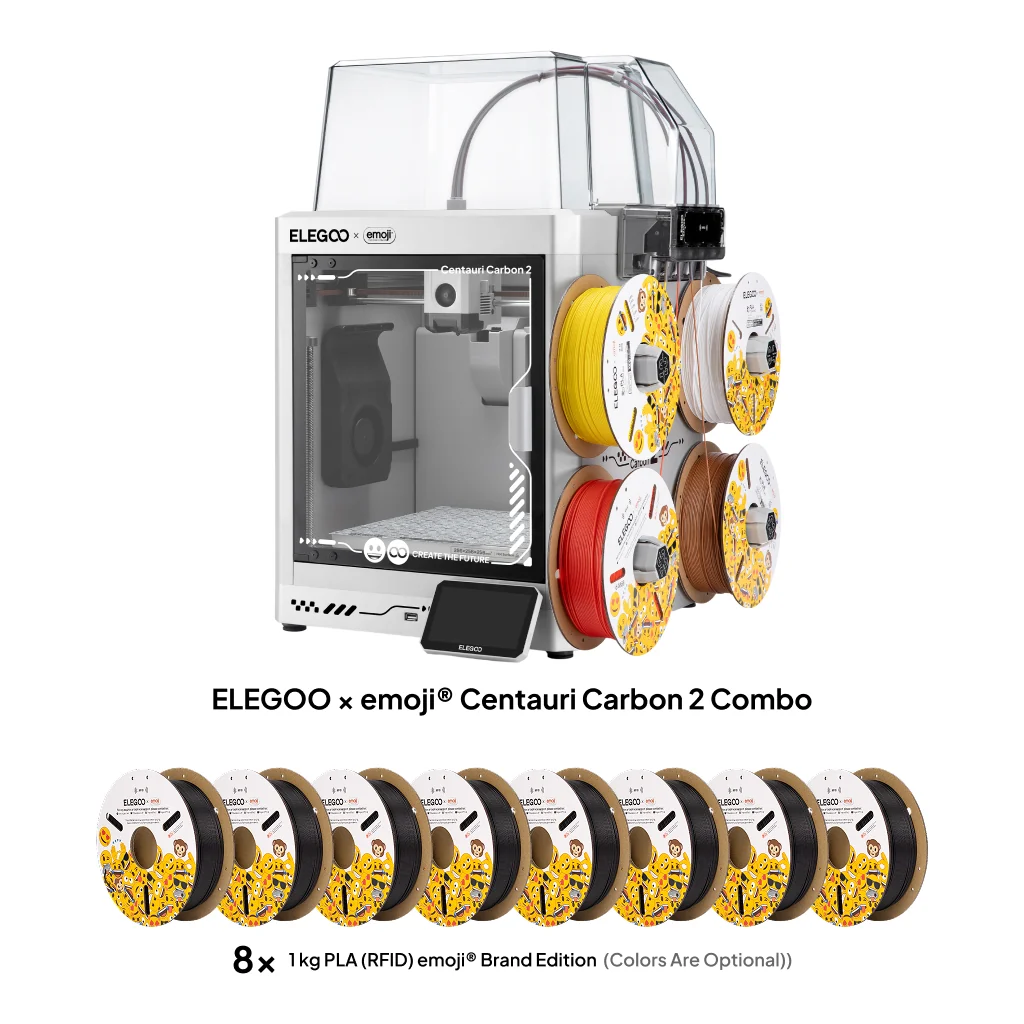
Availability and bundle names can also move after launch. A Combo may include a feeder that the base machine omits. An enclosure, camera, dryer, or hardened nozzle may be optional in one region and standard in another. Compare the exact box contents and replacement-part prices before treating an announcement price as the finished workshop cost.
Who is the Centauri Carbon 2 Combo for?
The clearest audience is makers who want one enclosed machine for colorful household projects and tougher functional parts, without moving into a large prosumer system. These users can connect the feature list to jobs they already do. That is a stronger reason to buy than a benchmark model or a maximum-speed claim.
New users should also think about the complete workflow. A printer needs a slicer, which is software that converts a three-dimensional model into layers and motion instructions. It needs dry material, a stable table, room for spool movement, and a safe plan for heat and fumes. Multicolor systems add spool storage and waste handling. Toolchangers add docking space and more consumable parts.
The Centauri Carbon 2 Combo is interesting because its design focuses on a specific source of friction rather than speed alone. If Elegoo delivers the claimed automation and repeatability in production machines, the benefit will show up in fewer interrupted jobs and less time spent preparing the printer. That is the standard that matters in a real home workshop.
Sources and image credits
- Elegoo announcement or official product page
- Product images: Elegoo official press, announcement, and product materials