
A street light comes on at dusk with nobody near a switch. Behind a small window in its fixture, a light-sensing part sits in a circuit and changes its resistance as the sky darkens, and the circuit does the rest. A part of this kind ships in hobby kits as a small disk with two leads and a zigzag track across its face. Its full name is a cadmium sulfide photocell, and most people call it an LDR, short for light-dependent resistor.
A photocell, as makers use the word, is a photoconductive cell: a part whose resistance falls as more light lands on it, in a circuit where current is already flowing. The word is looser than that definition. A 1963 Radio Shack catalog used it for selenium and silicon cells that generate their own current, for a cadmium sulfide power resistor, and for a small light-sensitive resistor that the page described as "similar to a photocell" [1]. This article follows the photoconductive kind, and it labels the other kinds when they appear.
The effect was measured in selenium bars in the 1870s, turned into a street-lamp control by 1931, reported in cadmium sulfide crystals in 1947, and sold across a counter for $1.97 in 1963. Today a hobby shop lists a similar part at $0.95 and states that it is not compliant with RoHS, the European Union's Restriction of Hazardous Substances rules [2]. The sections below follow that line from the first selenium experiments to the cadmium rules, and they separate the LDR from the three other ways light can act on a part.
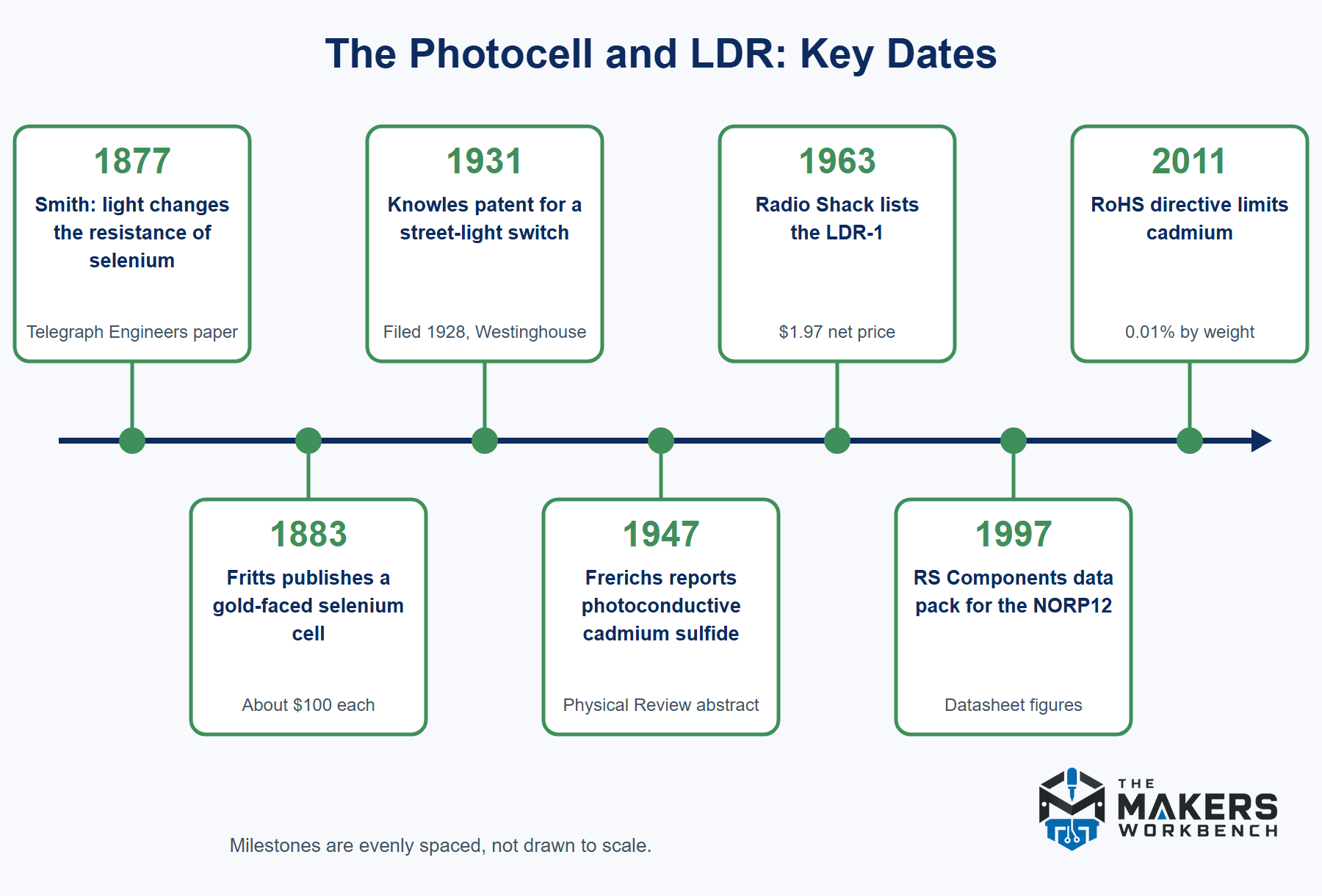
Key dates in the story of the photocell and LDR. Credit: The Makers Workbench.
Selenium Changes With Light
Selenium is a chemical element that can exist in several forms. In 1877 the English telegraph engineer Willoughby Smith read a paper to the Society of Telegraph Engineers in London, dated 28 November, on the electrical qualities of selenium and the effect of light on them [3]. Many accounts place his first observation in 1873. The 1877 paper is the detailed record, and it is the one used here.
Smith separated two forms of the element. Amorphous selenium, which has no crystal structure, he found to be a non-conductor of electricity. Crystalline selenium conducts. He tested seventeen crystalline bars, lettered A to R with J left out, hung in a wooden box, and he measured each bar's resistance, the opposition a material puts up to current, which is measured in ohms (Ω). His conclusion was that light alters the electrical properties of crystalline selenium, but not permanently. When the light was removed, the selenium slowly returned to its normal resistance [3].
Smith also compared light sources. Sunlight had more effect than gaslight, and during the lunar eclipse of 23 August, reflected sunlight lowered a bar's resistance by about 26 percent. He thought a prepared bar carrying a current could become a very sensitive photometer, an instrument that measures light [3].
A Royal Society paper by W. G. Adams and R. E. Day on the action of light on selenium had appeared in 1876, one year before Smith's reading. Charles Fritts later quoted three of their claims about selenium carrying a current and reported cells of his own that did not follow them [4]. The selenium results of the 1870s were therefore not settled facts. They were measurements that different experimenters read differently, and the next stage of the story was about making a cell that behaved the same way twice.
How a Photoconductive Cell Works
A photoconductive cell is a resistor whose value depends on the light on it. In the light its resistance is low, and in the dark it is high. It does not make electricity from light. A current has to flow through it already, and light changes how easily that current passes, which is how Smith's bars behaved under a battery. A 1997 data sheet for a cadmium sulfide cell states the rule in one sentence: the cell's resistance falls with increasing light intensity [5].
The hobby circuit built around that rule is a voltage divider, two resistors in series with the voltage at the point between them set by the ratio of the two values. The earlier articles How Electrical Resistance Works and How Ohm's Law Works cover the ideas behind it. Adafruit's product page wires one lead of the cell to 5V, the other lead to an analog input pin on a microcontroller, and a 10kΩ resistor from that pin to ground [6]. The pin voltage is:
Vpin = 5V × 10kΩ ÷ (RLDR + 10kΩ)
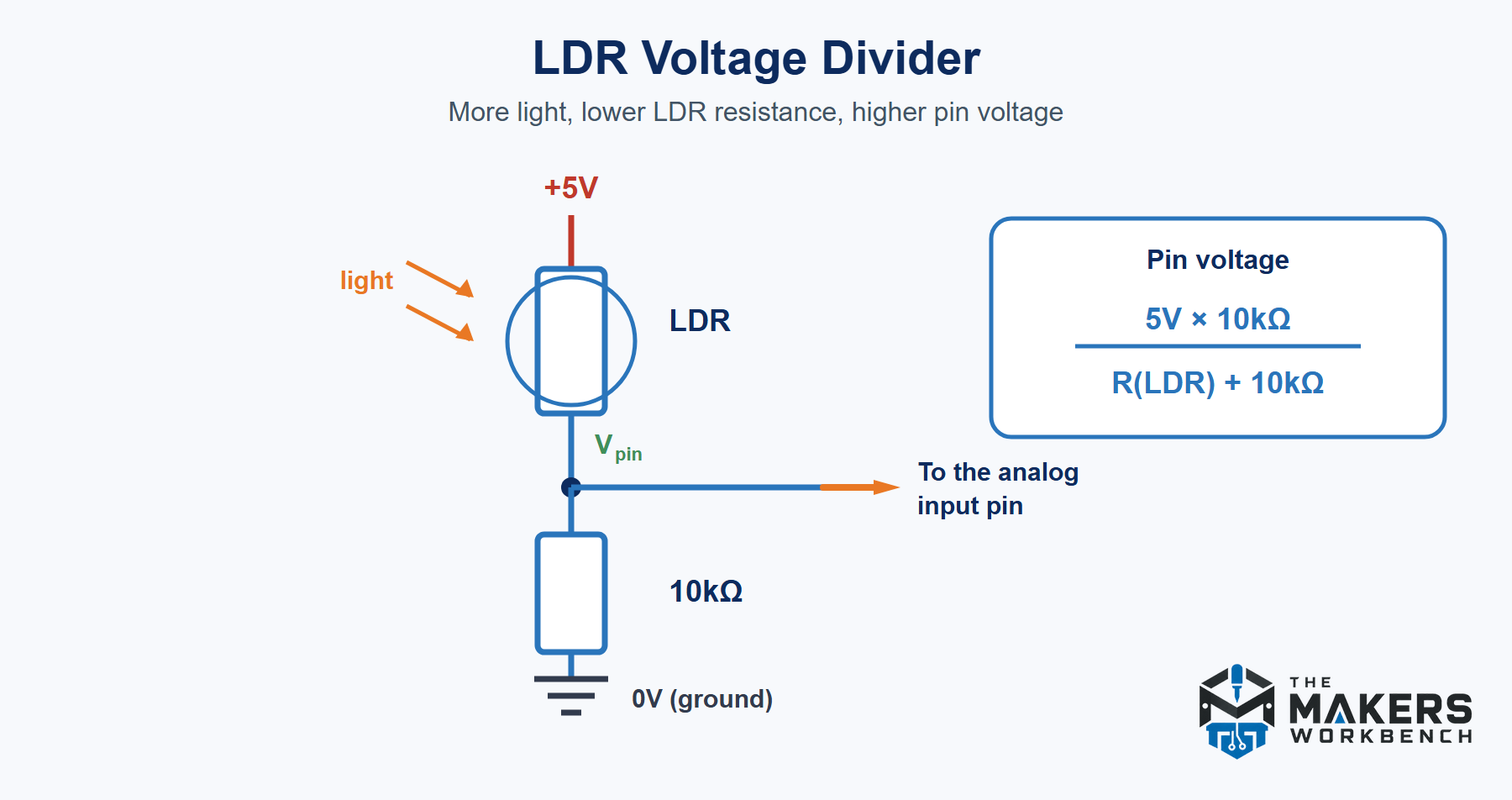
The usual hobby wiring for an LDR. Credit: The Makers Workbench.
The data sheet for the RS NORP12 cell gives resistances at three conditions, measured in lux, the unit of light falling on a surface, equal to one lumen per square meter. For scale, the sheet lists moonlight at 0.1 lux, a 60W bulb at a distance of 1 meter at about 50 lux, and bright sunlight at 30,000 lux [5]. Putting the NORP12 numbers through the divider formula gives the pin voltages in the table. The resistances are from the data sheet, the voltages are calculated here, and the 10kΩ value is the one on Adafruit's page.
| Light level | NORP12 resistance | Pin voltage |
|---|---|---|
| 1,000 lux | 400Ω typical | 4.8V |
| 10 lux | 9kΩ typical | 2.6V |
| Dark | 1.0MΩ minimum | 0.05V or less |
A microcontroller reads that voltage and decides whether it is bright or dark. The photocell never produces a voltage of its own, and that difference is what separates it from the next kind of cell in the story.
The Gold-Faced Cell
Charles E. Fritts of New York published a paper in the American Journal of Science in December 1883 on a new form of selenium cell [4]. His cells put a thin layer of selenium on a metal plate and covered it with a transparent layer of gold, so that light reached the selenium from the direction the current flowed. He priced finished cells for scientific research and technical uses at "ordinarily about $100 each," and he made them with resistances as low as 9Ω, though he generally used 500Ω to 5,000Ω.
Fritts measured how much the light mattered, as the ratio of a cell's dark resistance to its resistance in sunlight. He treated a cell built by Werner Siemens as the record to that date, with a dark resistance 14.8 times its sunlight resistance, from 10,070,000Ω in the dark to 680,000Ω in sunlight. His own brass cells showed ratios from about 7 to 1 up to 44 to 1. One cell went the other way, with resistance higher in the light and lower in the dark, which he called the first of its kind he knew [4].
His paper of September 1884, printed in Scientific American Supplement in June 1885, reported a larger ratio. Cell 137, powered by five Leclanché elements, had 108,000Ω in the dark and 320Ω in hazy sunlight, 337.5 times as conductive in the light. He found that the high ratio needed the current to enter at the gold face [7].
The same 1885 paper described a different effect. Fritts reported that his cells generated a current by simple exposure to light, at the junction between the gold and the selenium, with no chemical battery involved. He called an assembly of them a photo-electric dry pile, and he reported using the current for resistance measurements, telephony, and photometry [7]. That is a photovoltaic cell, a part that makes its own voltage from light. The 1883 resistance work and the 1885 generator are two separate experiments with two separate effects, and the word photocell has covered both ever since.
A Street Lamp Switch
The earliest practical use documented here is a street-lighting patent. Dewey D. Knowles of Westinghouse Electric filed US 1,788,111 on 22 August 1928, and it was granted on 6 January 1931 [8]. Its example cell is selenium in a light-tight box with a window. The cell has high resistance in the dark and lower resistance in daylight, and the current through it operates a contactor, a heavy-duty switch, that turns the street lamps on and off.
Light does not change in a clean step at dusk. Passing clouds make it dip and recover, and a contactor that follows every dip would chatter. Knowles added an auxiliary lamp inside the box, wired so that once the street lamps are off, the extra light on the cell holds the contactor through a brief dimming. Making a switch need a larger change to turn off than to turn on is called hysteresis, and the auxiliary lamp does that job here. The drawing plots light in foot-candles, a unit of about 10.8 lux, against time, with separate lines for the closing and opening of the contactor [8].
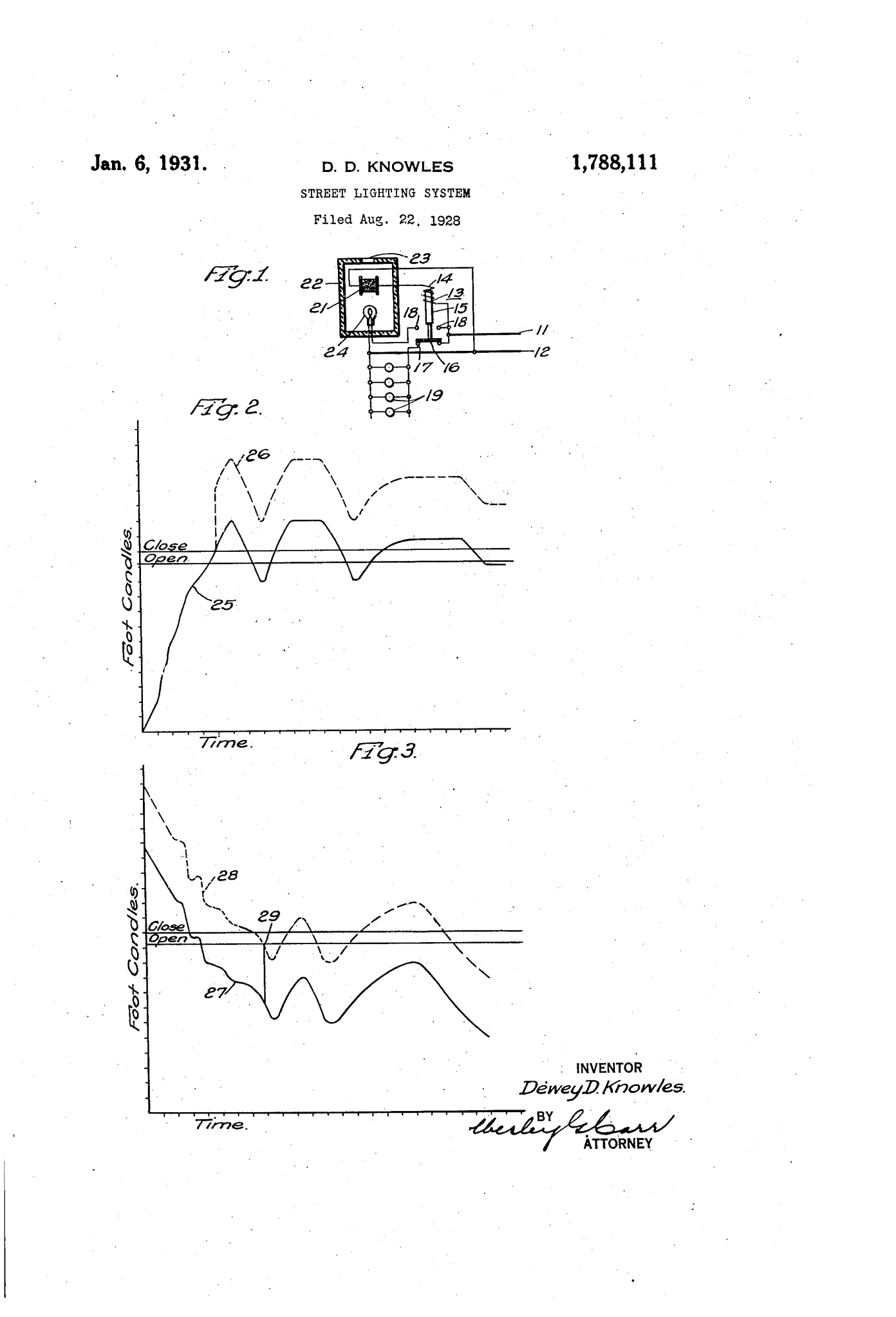
Drawing sheet from the Knowles street-lighting patent. Credit: US Patent 1,788,111, D. D. Knowles, "Street Lighting System," 6 January 1931. Public domain.
The patent shows the job that the photocell still does. Daylight in, lamps off. Darkness in, lamps on, with a margin so that a cloud does not flicker the lights.
Light That Makes Current
The photocell has relatives that behave differently, and a short sorting of them keeps the rest of the story clear. Light can act on a solid in four ways. It can change the resistance of a solid that already carries a current, which is the photoconductive cell. It can produce a voltage and a current on its own, which is the photovoltaic cell. It can knock electrons out of a surface into a vacuum or a gas, which is the photoemissive cell, better known as the phototube. And it can act at a barrier inside a semiconductor, which is a junction photodetector, the family that includes the photodiode and the phototransistor.
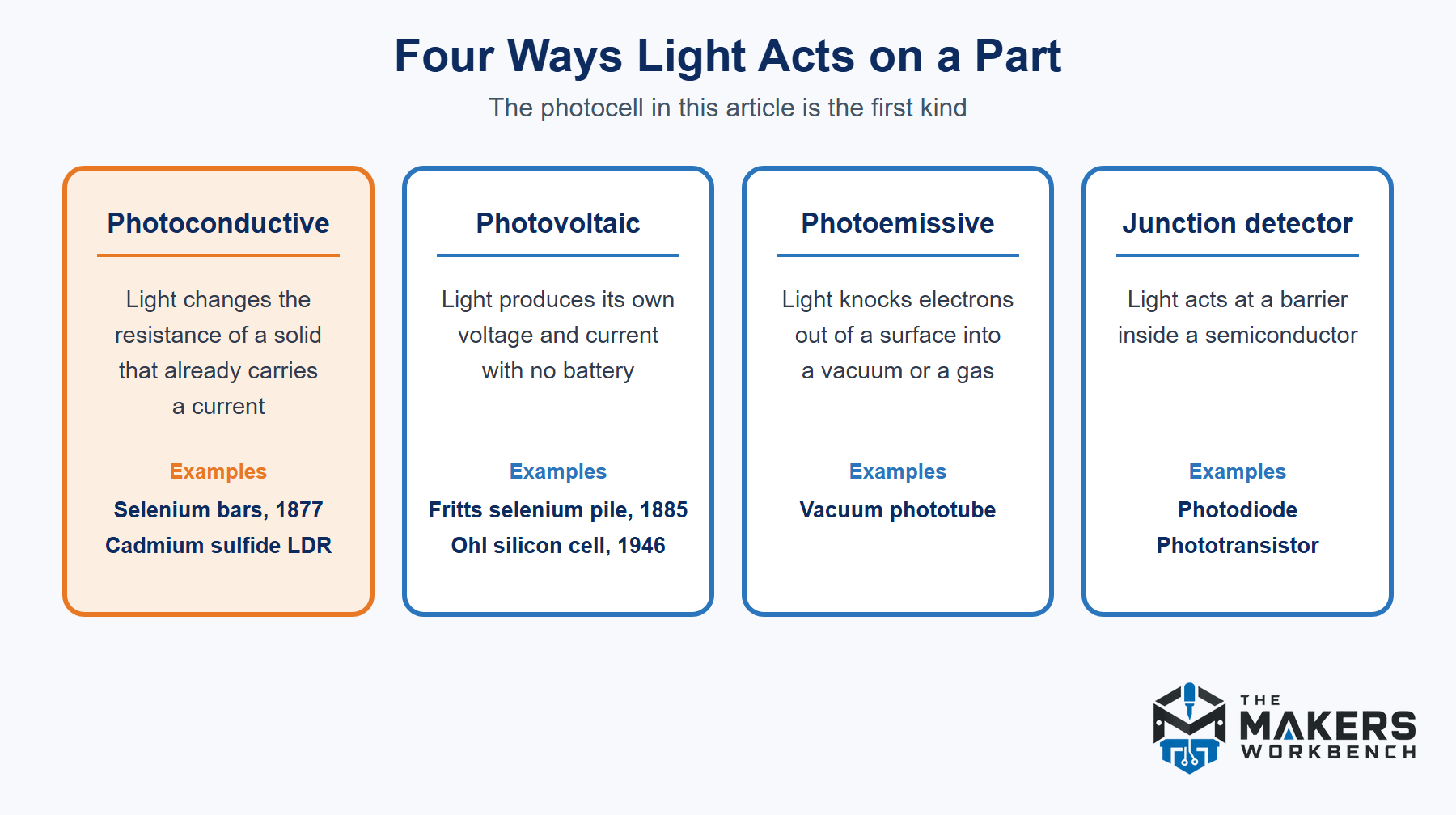
Four ways light acts on a part. Credit: The Makers Workbench.
Russell S. Ohl of Bell Telephone Laboratories showed two of those behaviors in one device. His patent, US 2,402,662, was filed on 27 May 1941 and granted on 25 June 1946, and it describes a light-sensitive cell made from fused silicon with a barrier between two zones of the material [9]. Light on the barrier produces a voltage, which the patent calls a photo-E.M.F. One figure shows the cell running a relay from sunlight with no battery, so that a beacon or an alarm operates when the sun is obscured. Switched onto a battery, the same cell works as a resistance, and the patent says the light is used merely to change the resistance in the circuit.
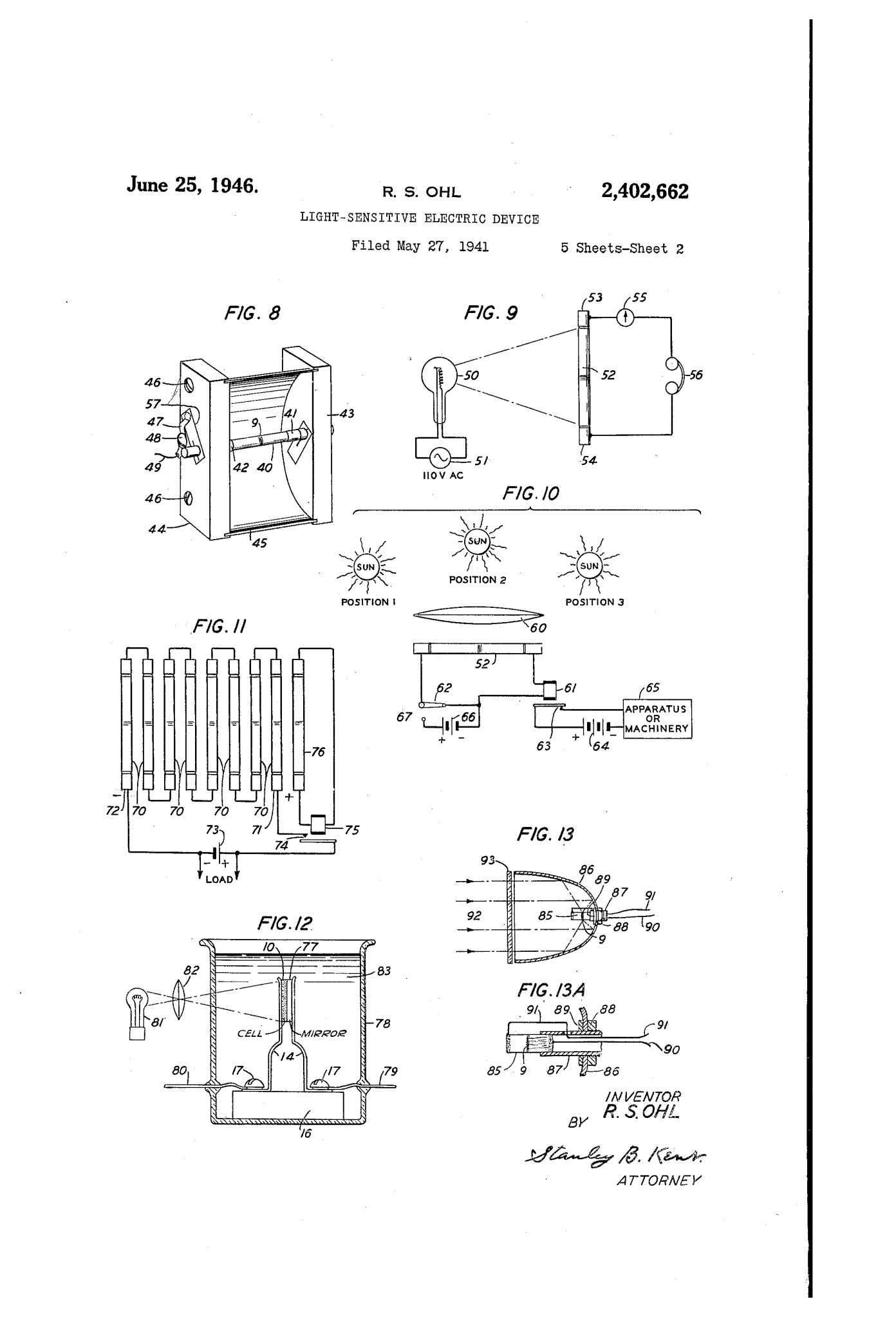
Sheet 2 of Russell Ohl's silicon light-sensitive cell patent. Credit: US Patent 2,402,662, R. S. Ohl, 25 June 1946. Public domain.
Ohl's patent also draws the line against the phototube. It contrasts the silicon cell with vacuum photoelectric cells, which brought insulation resistance difficulties and needed a battery in the uses he describes [9]. A phototube is a glass bulb with a light-sensitive surface inside it, and light on that surface frees electrons that a second electrode collects.
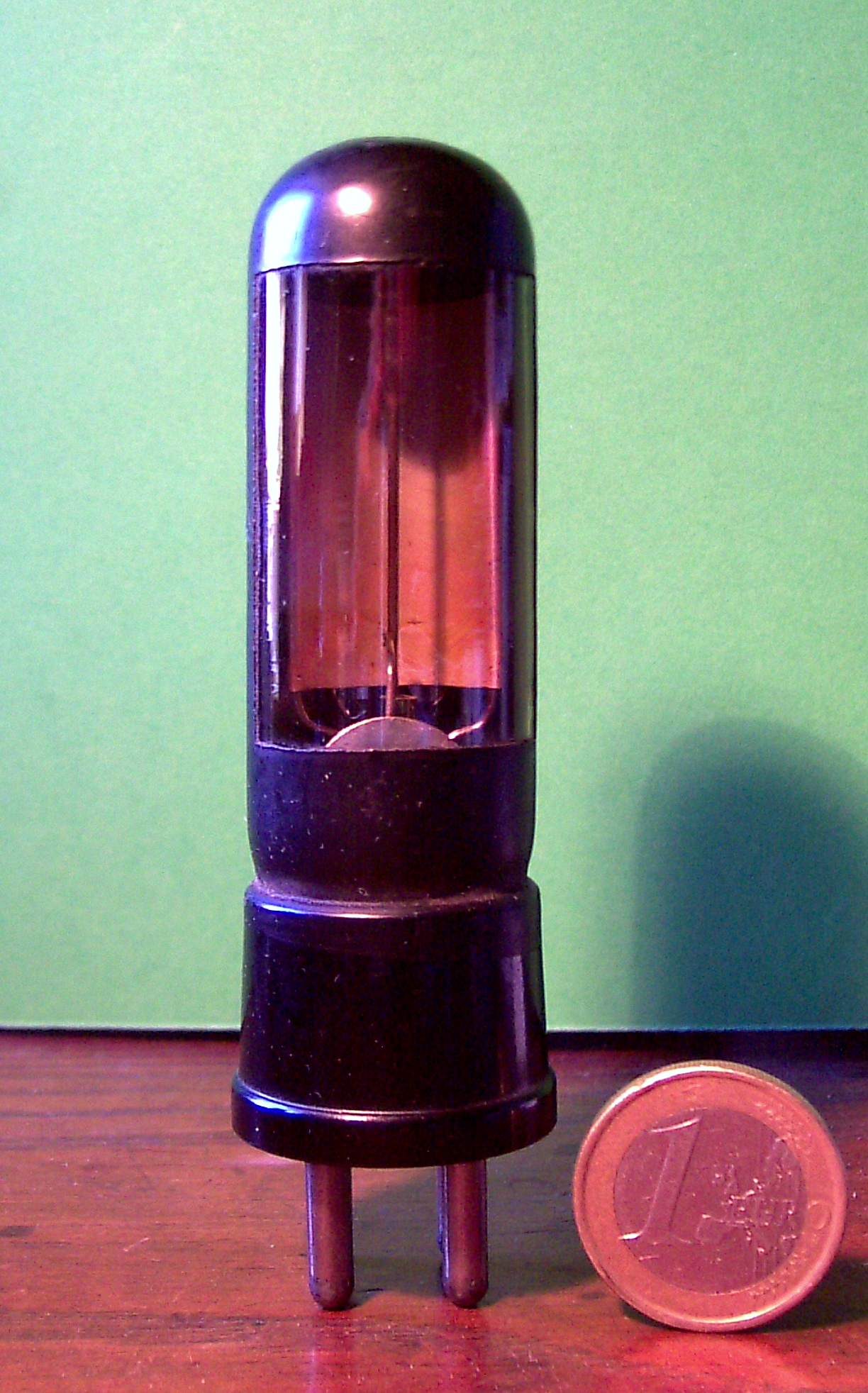
A phototube. The file title dates it to the 1940s, and no maker is named. Credit: Antonio Pedreira, released to the public domain, via Wikimedia Commons.
By 1946 selenium, silicon, and the vacuum phototube had each been put to work. The part that kit builders buy today is made from a different material.
Cadmium Sulfide
In 1947 Rudolf Frerichs of the Technical University in Berlin-Charlottenburg published an abstract in Physical Review on the photoconductivity of what he called incomplete phosphors [10]. He grew single crystals of cadmium sulfide, cadmium selenide, and cadmium telluride from cadmium vapor and a hydrogen compound of sulfur, selenium, or tellurium. A phosphor is a material that keeps glowing after light is removed. These crystals did not glow, but their photoconductivity was strongly developed, and the abstract reports it as a property of the photocells made from them. Cadmium sulfide is the material of the LDR that kit builders buy, and this abstract is the earliest account of its photoconductivity found in the sources used for this article.
By 1963 the part was in retail catalogs. The Radio Shack Catalog No. 124, with contents copyrighted in 1962, listed a small light-sensitive resistor called the LDR-1 at a net price of $1.97, with a kit of six at $10.00. The catalog text says the cell will drive a 6V relay from a 9V battery. A cadmium sulfide resistor in a plastic case, rated for 117V AC service, sold for $2.35 nearby. Next to them the catalog sold small photovoltaic cells, in selenium at $1.50 to $3.95 and in silicon at $2.25 [1]. A buyer in 1963 could pick a part that changed resistance with light or one that made current from light, and the catalog called both of them cells.
Reading the NORP12 Data Sheet
By the 1990s the part was documented well enough to read in numbers. RS Components published a data pack in 1997 for the NORP12 and the NSL19-M51, two cadmium sulfide photoconductive cells [5]. For the NORP12, the sheet gives a resistance of 400Ω typical at 1,000 lux and 9kΩ typical at 10 lux, and a dark resistance of 1.0MΩ minimum. The spectral response is similar to that of the human eye, which is why the cell suits jobs that depend on what a person would call bright or dark.
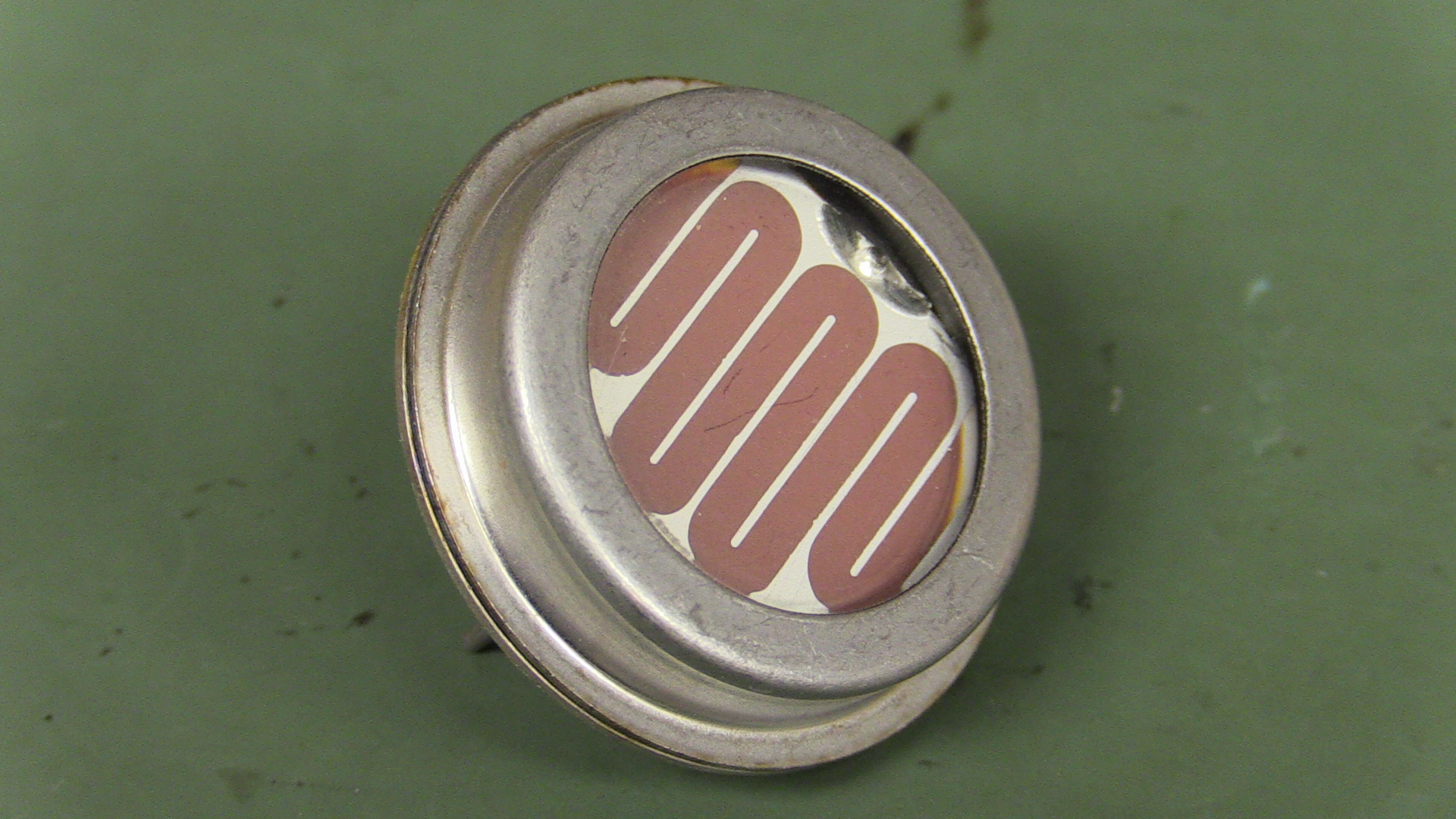
A large cadmium sulfide photocell taken from a street light, with the serpentine sensing track visible. Credit: Binarysequence, via Wikimedia Commons, CC BY-SA 4.0.
The NORP12 can also be treated as a resistor with limits. Its ratings are 320V peak AC or DC, 75mA, and 250mW at 30°C, over a temperature range from −60°C to +75°C. A small version, the NSL19-M51, is rated for 100V peak, 5mA, and 50mW at 25°C [5]. A two-terminal part that tolerates that much voltage needs little circuitry around it, which is part of why such a cell suited jobs like the street light. The sheet lists applications that include smoke detection, automatic lighting control, batch counting, and burglar alarms.
Two properties limit the part. It is slow, and it has a memory. The sheet defines rise time as the time for the resistance to fall from its dark value to within 10 percent of the lit value, and fall time as the time for it to climb back to 1,000 times the lit value. For the NORP12 at 2854K tungsten light, rise is 2.8 milliseconds at 1,000 lux and 18 milliseconds at 10 lux. Fall is 48 milliseconds at 1,000 lux and 120 milliseconds at 10 lux. The sheet also warns that the cells remember the lighting in which they were stored, and that storage in the light shortens the time they need to settle to a steady resistance [5]. Those times are fine for deciding whether it is dusk. They are too slow for a circuit that has to follow a light that changes quickly.
To recap: a photocell is a resistor that light controls, the effect was found in selenium in the 1870s, turned into a street-light switch by 1931, and moved to cadmium sulfide crystals by 1947. Photovoltaic cells, phototubes, and junction photodetectors are different parts that share the word. What remains is the reason this part has become a specialty item, and that reason is cadmium.
Cadmium and the Phototransistor
Directive 2011/65/EU, adopted on 8 June 2011 and published on 1 July 2011, restricts hazardous substances in electrical and electronic equipment sold in the European Union. Its Annex II limits cadmium to 0.01 percent by weight in any homogeneous material. The directive's own recital says the use of cadmium should be limited to cases where suitable alternatives do not exist [2].
The photocell was one of the places where alternatives were still missing. A Commission amendment, Directive 2012/51/EU, added a temporary exemption for cadmium in photoresistors used in analog optocouplers in professional audio equipment, and gave as its reason that substitution was still technically impracticable. An optocoupler passes a signal between two circuits with a light source and a light sensor, and the exemption expired on 31 December 2013 [11]. The exemption was narrow. It named professional audio optocouplers and did not cover night lights, toys, or kit parts.
That history is visible on a hobby shop's page today. Adafruit's CdS photocell listing, read on 22 November 2026, shows $0.95 each for one to nine, $0.86 each for ten to forty-nine, and $0.76 each at fifty or more. The page states that CdS photocells are not RoHS compliant and links to a phototransistor for a builder who needs a compliant part [6]. A phototransistor is a transistor whose current is controlled by light on its junction, the junction photodetector family from the sorting above.
The photocell is a resistor that light controls. Smith measured the effect in selenium in 1877, Knowles used it to switch street lamps in 1931, and cadmium sulfide carried it into hobby catalogs by 1963. It is still sold as a kit part and still suits the job of telling light from dark, within the limits of its speed and its cadmium content. Builders who need a RoHS-compliant part are pointed to the phototransistor.
References
- Radio Shack, Catalog No. 124 (1963), entire contents copyrighted 1962, archive.org. https://archive.org/details/radio_shack_catalog_124_1963 Accessed October 18, 2026.
- European Parliament and Council, "Directive 2011/65/EU of 8 June 2011 on the restriction of the use of certain hazardous substances in electrical and electronic equipment," Official Journal L 174, 1 July 2011, eur-lex.europa.eu. https://eur-lex.europa.eu/legal-content/EN/TXT/HTML/?uri=CELEX:32011L0065 Accessed October 18, 2026.
- Willoughby Smith, "Selenium: its electrical qualities, and the effect of light thereon," paper read before the Society of Telegraph Engineers, 28 November 1877, archive.org. https://archive.org/details/b22277687 Accessed October 18, 2026.
- Charles E. Fritts, "On a New Form of Selenium Cell, and some Electrical Discoveries made by its use," American Journal of Science, 3rd series, vol. 26, December 1883, pp. 465-472, ajsonline.org. https://ajsonline.org/article/65415-on-a-new-form-of-selenium-cell-and-some-electrical-discoveries-made-by-its-use.pdf Accessed October 18, 2026.
- RS Components, data pack for the NORP12 (stock no. 651-507) and NSL19-M51 cadmium sulphide photoconductive cells, 1997, rs-online.com. https://docs.rs-online.com/fb50/0900766b8001a9d6.pdf Accessed October 18, 2026.
- Adafruit Industries, "Photo cell (CdS photoresistor)," product 161, adafruit.com. https://www.adafruit.com/product/161 Accessed November 22, 2026.
- C. E. Fritts, "On the Fritts Selenium Cells and Batteries," read at the AAAS, Philadelphia, 5 September 1884, Scientific American Supplement No. 492, 6 June 1885, Project Gutenberg. https://www.gutenberg.org/files/12490/12490-0.txt Accessed October 18, 2026.
- Dewey D. Knowles, "Street-lighting system," US Patent 1,788,111, filed 22 August 1928, granted 6 January 1931, Westinghouse Electric, Google Patents. https://patents.google.com/patent/US1788111A/en Accessed October 18, 2026.
- Russell S. Ohl, "Light-sensitive electric device," US Patent 2,402,662, filed 27 May 1941, granted 25 June 1946, Bell Telephone Laboratories, Google Patents. https://patents.google.com/patent/US2402662A/en Accessed October 18, 2026.
- Rudolf Frerichs, "The Photo-Conductivity of 'Incomplete Phosphors,'" Physical Review 72, 594, 1 October 1947 (abstract), aps.org. https://journals.aps.org/pr/abstract/10.1103/PhysRev.72.594 Accessed October 18, 2026.
- European Commission, "Commission Delegated Directive 2012/51/EU of 10 October 2012," Official Journal L 348, 18 December 2012, eur-lex.europa.eu. https://eur-lex.europa.eu/legal-content/EN/TXT/HTML/?uri=CELEX:32012L0051 Accessed October 18, 2026.