
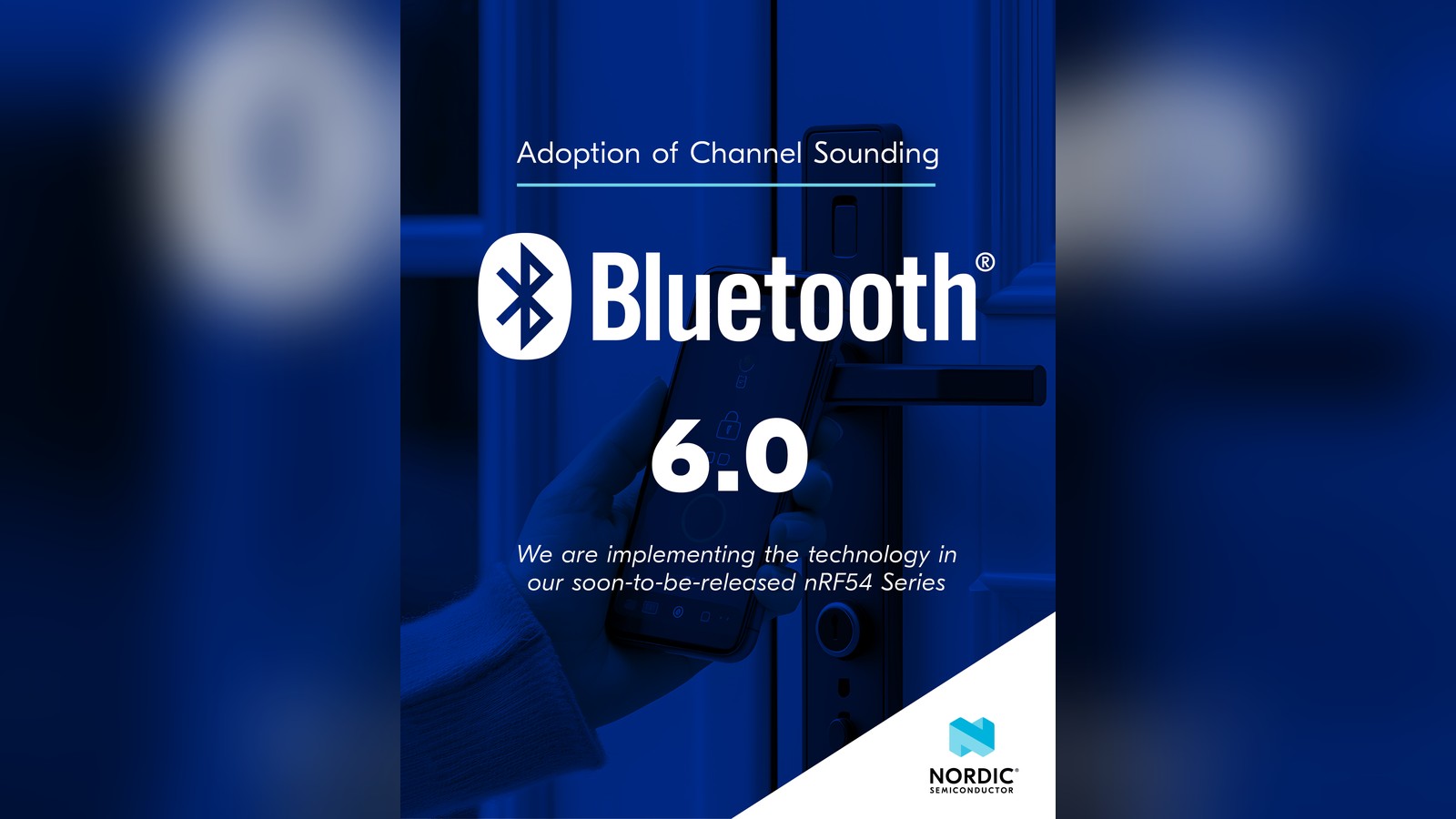
Nordic Semiconductor announced on September 3, 2024, that its nRF54L and nRF54H wireless chips would support Channel Sounding, a major ranging feature introduced with Bluetooth 6.0. The technology lets two Bluetooth Low Energy devices estimate the distance between them more accurately and securely than traditional signal-strength methods.
That improvement opens practical uses for smart locks, digital keys, item finders, appliances, and industrial presence detection. A device can ask not only whether another radio is nearby, but how far away it appears to be.
Nordic's announcement was a support commitment for forthcoming nRF54 products, not a promise that every application would immediately achieve a particular accuracy. The phone, accessory, software stack, antennas, and environment must all participate.
Why signal strength is a weak ruler
Many Bluetooth proximity systems estimate distance from received signal strength, or RSSI. In simple terms, a weaker signal is assumed to come from farther away.
The method is inexpensive because every receiver already reports signal level. It is also unreliable indoors. A body, wall, metal cabinet, antenna orientation, or reflection can change RSSI without changing the true distance. Two devices a meter apart may report very different values when one is in a pocket.
RSSI remains useful for broad categories such as near and far. It is a poor foundation for deciding that a key is definitely on one side of a locked door. Channel Sounding adds measurements designed specifically for ranging.
How Channel Sounding measures distance
Bluetooth Channel Sounding uses two complementary techniques. Phase-based ranging compares the phase of radio signals exchanged across multiple frequencies. Round-trip timing measures how long a signal exchange takes between devices.
Phase is the position within a repeating radio wave. Because phase changes predictably with distance, measurements across many channels can estimate separation while reducing ambiguity. The calculation must account for frequency, hardware delay, and reflections.
Round-trip timing provides another distance estimate based on propagation time. Radio waves travel close to the speed of light, so short ranges correspond to extremely small time intervals. Precise hardware timing is essential.
Using both approaches provides cross-checks and lets an implementation balance accuracy, complexity, energy, and security. The Bluetooth specification defines the procedures, but vendors still build the algorithms that turn measurements into useful distances.
Multipath is the central challenge
Indoor radio rarely travels along one clean line. Signals reflect from floors, walls, appliances, and people. The receiver sees several paths with different lengths, known as multipath.
Channel Sounding uses measurements across frequencies to help distinguish the direct path from reflections. It cannot make the environment disappear. Antenna placement, calibration, filtering, and scene geometry remain important.
For a smart lock, the hardest case may be a phone close to the door but on the wrong side. For an item finder, it may be a tag buried in a bag. For industrial safety, moving machinery and metal structures can create difficult reflections. Product testing must reproduce these cases rather than relying on an open tabletop.
Security is more than accuracy
A digital-key system must resist relay attacks. In a relay attack, an adversary forwards radio messages between a legitimate key and a lock, making distant devices appear connected.
Channel Sounding includes security mechanisms intended to make manipulated measurements harder. Randomized exchanges and protected procedures can help the devices verify that ranging data is fresh and internally consistent. Nordic highlighted resistance to tampering and man-in-the-middle attacks as a major use-case advantage.
No single radio feature secures an entire lock. Authentication, key storage, firmware updates, rate limits, physical design, and safe fallback behavior still matter. Ranging adds evidence about proximity; it should be one part of a layered access decision.
Single-antenna support lowers the hardware barrier
Nordic noted that Channel Sounding can work with a single antenna. That is important for small tags, key fobs, and wearables where additional antennas consume board area and complicate the enclosure.
Single antenna does not mean antenna design is unimportant. The antenna still needs a clear region, correct matching, and stable behavior near the battery and case. Products may use more elaborate antenna arrangements when they need direction information or stronger multipath performance.
The larger advantage is ecosystem scale. Bluetooth already appears in phones and battery accessories. Standardized ranging can reach high-volume products without requiring a separate ultra-wideband radio in every design. Ultra-wideband may still offer advantages in some precision applications, so the choice depends on required accuracy, phone support, energy, and cost.
What nRF54 support means for developers
Nordic named both nRF54L and nRF54H. The L family targets mainstream low-power products, while the H family offers more processing and interfaces for demanding systems. That coverage suggests Channel Sounding was intended as a family capability rather than a niche flagship feature.
Developers need compatible hardware on both ends, an SDK (a software development kit, the bundle of drivers, libraries, and example code a chipmaker provides for building firmware) with the relevant Bluetooth controller and host support, and a way to inspect ranging results. Application software must decide how many samples to collect, how to filter them, and what thresholds trigger an action.
Power budgeting deserves attention. A ranging exchange uses radio time and computation. A door lock that measures distance only after detecting an authenticated device may consume less energy than a tag that performs frequent ranging. Measure a complete usage pattern rather than extrapolating from sleep current.
Designs should also expose confidence information. A distance estimate without a quality score can encourage unsafe binary decisions. If measurements disagree or the radio channel is difficult, the product should request another sample, use a second sensor, or decline the action.
A foundation for better proximity products
Channel Sounding does not replace GPS (the satellite-based Global Positioning System), motion sensors, ultra-wideband, or direction finding. It fills a particular gap: standardized, secure short-range distance measurement in the enormous Bluetooth ecosystem.
For makers, the most interesting experiments will compare Channel Sounding against RSSI in real rooms. Test open space, pockets, walls, doors, moving people, and reflective surfaces. Plot raw distance and quality over time before building automation around a single threshold.
Nordic's commitment puts the nRF54 family near the front of that transition. Once compatible stacks and peer devices become available, familiar Bluetooth hardware could support projects that understand physical proximity with far more confidence than a conventional beacon.
Once this reaches hardware you can buy, I'd compare Channel Sounding against plain signal strength in real rooms, in pockets, and behind doors before trusting it for anything.
Sources and image credits
- Bluetooth 6.0 Channel Sounding supported by Nordic Semiconductor's upcoming nRF54 Series SoCs, Nordic Semiconductor, September 3, 2024.
- Official graphic from Nordic Semiconductor's announcement.
- Square and vertical crops are edited from the same source image.


