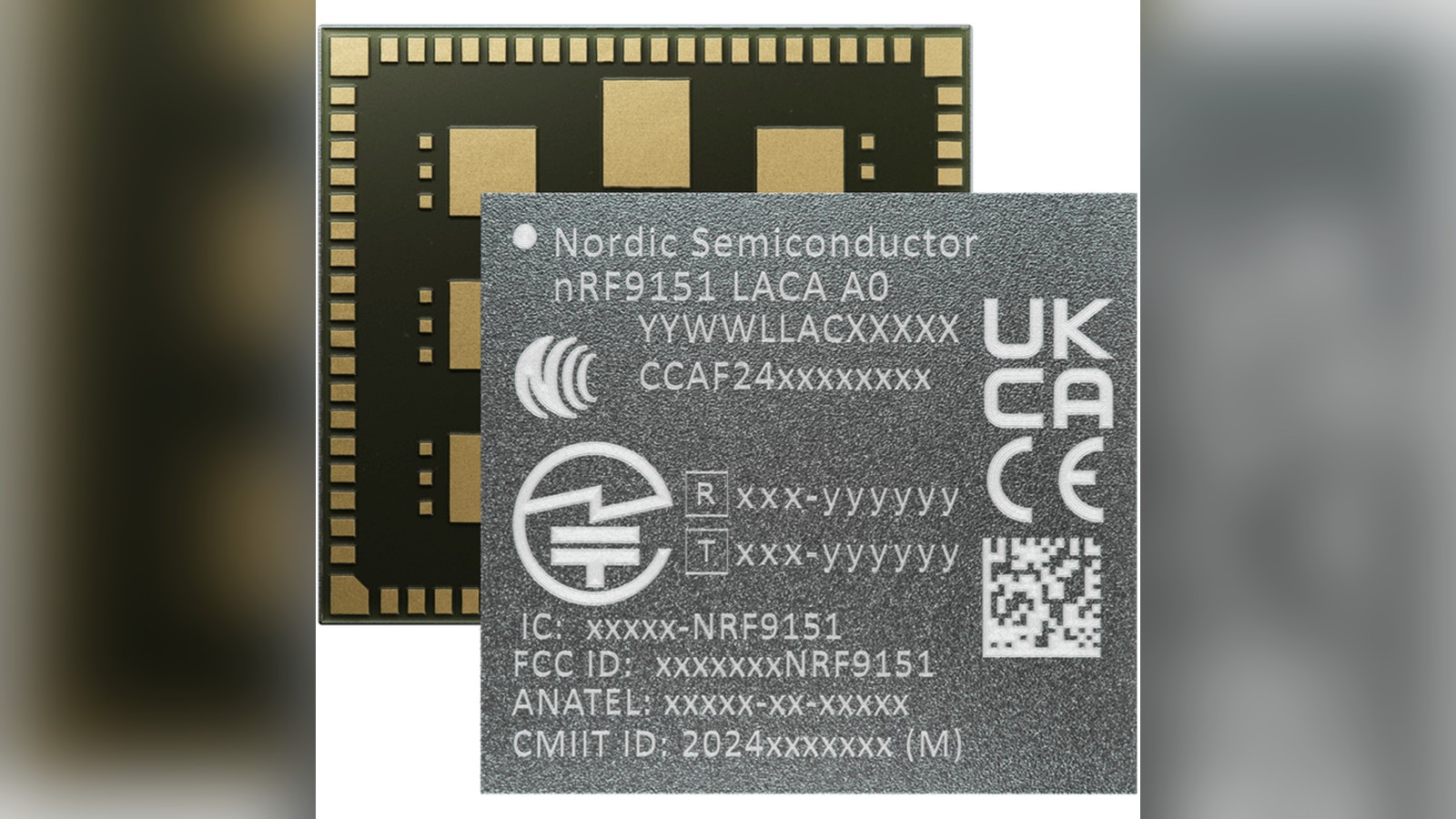
Nordic Semiconductor introduced the nRF9151 on February 21, 2024, as a smaller system-in-package for cellular Internet of Things products. The device combines LTE-M, NB-IoT, DECT NR+, positioning support, application processing, radio-frequency circuitry, and power management in a pre-certified package.
Nordic said the new package occupied 20 percent less area than earlier nRF91 devices. It also added a 20dBm transmit-power option alongside the usual 23dBm class. Those changes target a practical problem: cellular trackers and sensors need wide-area connectivity, but their batteries, enclosures, and antennas leave little room for waste.
At announcement, the nRF9151 was sampling to selected customers. Nordic advised developers to begin with the software-compatible nRF9161 development kit while waiting for dedicated hardware.
Why a system-in-package helps
A system-in-package, or SiP, places several necessary functions inside one qualified component. The nRF9151 includes the cellular modem, RF front end, power-management circuitry, and programmable processing needed for a self-contained connected device.
Building those blocks separately is possible, but cellular radios are unforgiving. The RF path, power supply, clocks, filtering, antenna match, software, and regulatory tests all interact. A pre-certified SiP gives a product team a validated starting point and can reduce, though not eliminate, the certification work for the finished device.
The 20 percent footprint reduction helps most in wearables, compact trackers, smart meters, and embedded sensors. It may create space for a larger battery or better antenna clearance rather than simply making the enclosure smaller. Antenna performance often improves when designers resist the temptation to fill every available millimeter with electronics.
LTE-M and NB-IoT serve different deployments
LTE-M and NB-IoT are low-power wide-area cellular technologies standardized by 3GPP. Both use operator networks, but their performance profiles differ.
LTE-M generally supports higher throughput, mobility, and lower latency. It is often suited to moving asset trackers, gateways, and devices that occasionally transfer more data. NB-IoT emphasizes deep coverage and small, infrequent messages for meters and fixed sensors. Actual service depends on the carrier and country, so a globally capable modem does not guarantee that every network enables every mode.
The nRF9151 also supports Global Navigation Satellite System reception for location. GNSS can provide accurate outdoor positions, but acquiring a fix costs time and energy. Products commonly combine it with cellular or cloud-assisted location methods and use full satellite positioning only when needed.
DECT NR+ adds a private-network option
DECT NR+ is a noncellular radio technology designed for large private IoT networks. It uses dedicated spectrum in supported regions and can form dense, scalable networks without routing every device through a public mobile operator.
That makes it interesting for factories, utilities, campuses, and agriculture. A deployment can control its own coverage and traffic while using the same Nordic package for application processing. DECT NR+ availability and spectrum rules vary, so developers must check regional requirements and the maturity of the network ecosystem.
Including LTE-M, NB-IoT, and DECT NR+ does not mean a device uses all three simultaneously. It gives manufacturers a common hardware platform that can be configured for different customers or locations. A shared design can reduce inventory and firmware fragmentation if the antenna and certification plan support the chosen bands.
Lower transmit power can reduce battery stress
The familiar cellular power class transmits at up to 23dBm, roughly 200 milliwatts of RF output. The added 20dBm class is roughly 100 milliwatts. The difference affects more than average energy use because the battery and power supply must tolerate transmit-current peaks.
A lower-power mode can ease voltage droop and allow smaller cells in products that have adequate network coverage. It is not free range. Reducing output power lowers the uplink link budget, so designers need field measurements in representative locations before selecting it.
Battery estimates should include network registration, retries, poor-signal operation, GNSS acquisition, sensor power, processor activity, and storage. The modem may sleep efficiently, yet a deployment with weak coverage can consume far more energy than a bench test near a tower.
Software compatibility reduces the transition cost
Nordic said the nRF9151 uses the same modem firmware and nRF Connect SDK (Nordic's software development kit, a bundle of drivers, libraries, and sample code) foundation as the nRF9161 and nRF9131. That let developers prototype before production samples arrived and reuse code across the family.
The nRF Connect SDK provides drivers, protocol integration, security components, examples, and the Zephyr real-time operating system foundation. Compatibility is still something to verify. Package pins, RF layout, power behavior, memory limits, and modem firmware versions can affect a migration even when application APIs remain familiar.
Nordic also tied the hardware to nRF Cloud services. Cloud assistance can shorten GNSS fixes, estimate position from cellular or Wi-Fi observations, manage devices, and support security services. Teams should calculate ongoing cloud and data costs and define what happens if a service is unavailable.
The design work the SiP does not remove
The package simplifies the hardest radio blocks, but it does not supply the complete product. Engineers still need an antenna, matching network, SIM or eSIM strategy (the physical or embedded chip that identifies a device to a cellular network), battery protection, enclosure, sensors, and a production test method.
The custom board should preserve test access for current measurement, modem recovery, and conducted RF checks where practical. Production fixtures may need to program credentials and verify connectivity without consuming excessive paid network time. Planning those steps on the development board is far easier than adding them after the first enclosure tooling is complete.
Carrier and regulatory approvals also deserve early attention. Pre-certification can reuse test evidence, but the final antenna, enclosure, and target markets determine the remaining work. Contact carriers and test laboratories before the enclosure design is locked.
For a first prototype, begin with a development kit and activate service from a supported provider. Measure registration time, signal quality, data transfer, and sleep current in the actual deployment area. Then repeat the tests at coverage boundaries and low battery voltage.
The nRF9151 announcement is notable because it compresses a capable wide-area IoT platform into a smaller, more flexible package. Its combination of public cellular modes and DECT NR+ gives designers a path across operator and private networks, while software compatibility offers a practical way to begin before volume production.
I'd begin with the nRF9161 development kit, as Nordic suggested, and measure power in the place the device will actually live, not on the bench.
Sources and image credits
- nRF9151 product page, Nordic Semiconductor.
- Official product image from Nordic Semiconductor.
- Square and vertical crops are edited from the same source image.


