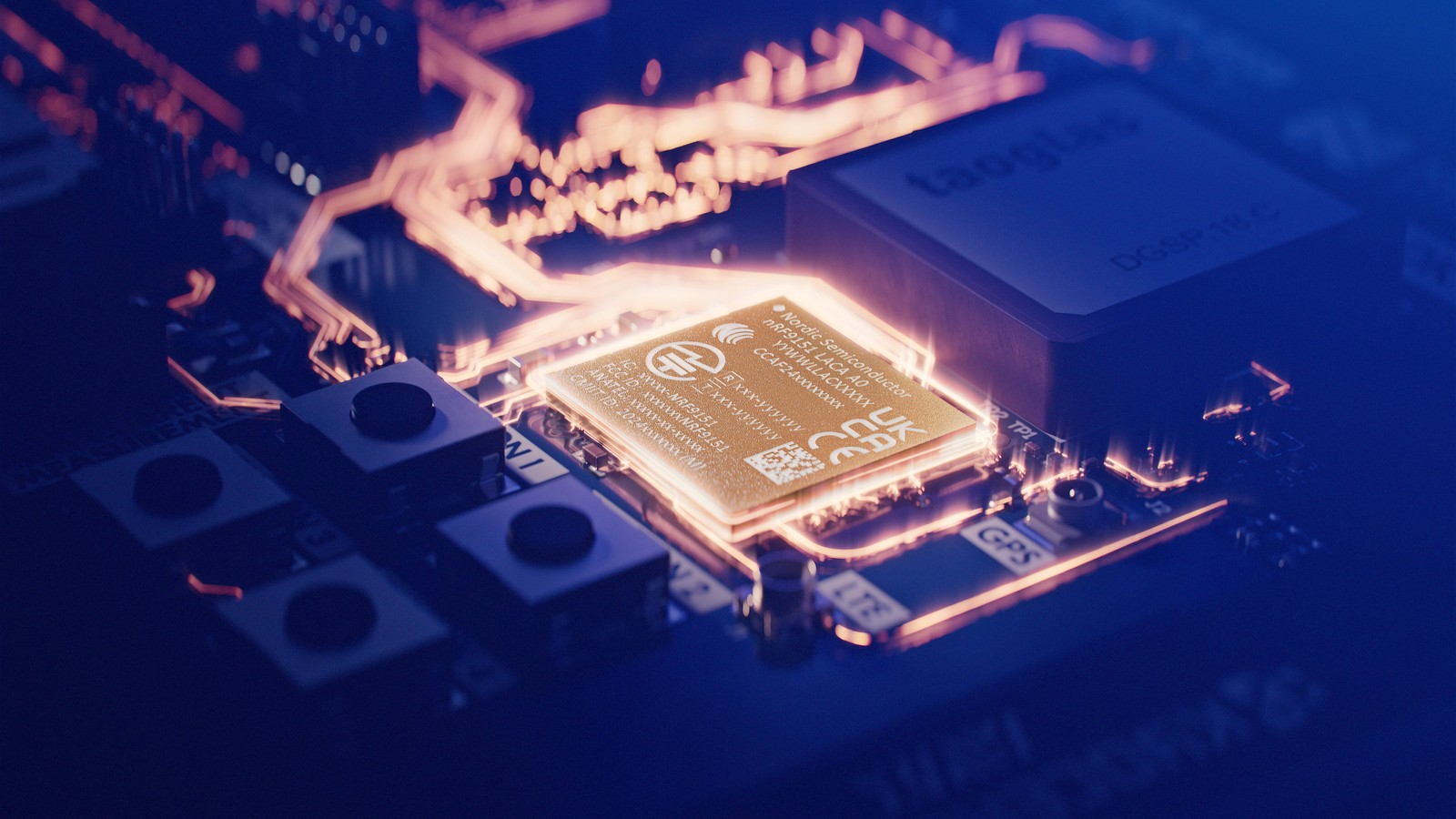
Nordic Semiconductor moved the nRF9151 system-in-package and its development kit into commercial availability on September 5, 2024. The production milestone turned a promising compact cellular device into hardware developers could order through distribution and design into LTE-M, NB-IoT, and DECT NR+ products.
The nRF9151 integrates a cellular modem, a GNSS receiver (Global Navigation Satellite System, the broader term for GPS-style satellite positioning), an RF (radio-frequency) front end, power management, and a 64MHz Arm Cortex-M33 application processor with 1MB of flash and 256KB of RAM. It can run a complete application or operate as a stand-alone modem controlled by another processor.
Nordic also said future modem firmware would add non-terrestrial network support. NTN allows compatible cellular devices to communicate through satellites, potentially extending coverage beyond terrestrial towers. The word future is essential: production hardware did not make satellite service automatically available on launch day.
Production availability changes the decision
An engineering sample can prove a concept, but a product team needs orderable parts, stable software, certification evidence, and a supply plan. By announcing production and distributor availability, Nordic moved the nRF9151 into that more practical stage.
The device retained the 20 percent footprint reduction announced earlier in 2024. It supported the standard 23dBm transmit class and a 20dBm class that Nordic said could reduce peak power consumption by 45 percent. Lower peaks can simplify battery and regulator selection when network conditions allow reduced transmit power.
The company also emphasized supply-chain resilience and a country of origin not subject to US tariffs at that time. Tariff status can change, so purchasing teams should verify current rules rather than treating an announcement as permanent commercial guidance.
The development kit lowers the cellular barrier
Cellular development has several moving pieces: hardware, SIM service (the subscriber identity module that registers a device on a carrier's network), carrier coverage, modem firmware, certificates, cloud endpoints, and power management. The nRF9151 DK packages the modem, antennas, debugger, connectors, and power measurement access into a known platform.
Nordic shipped kits with SIM options from Onomondo and Wireless Logic that included introductory data. It also pre-flashed the Serial LTE Modem application. That firmware exposes modem functions through AT commands, a text command set widely used for modems.
AT-command operation lets an existing host microcontroller use the nRF9151 as a communications module. Alternatively, developers can replace that firmware and run application code directly on the Cortex-M33. The first model can speed integration with an established product; the second reduces the number of processors in a new design.
Neither mode is universally better. A host-plus-modem architecture separates responsibilities and may preserve a mature application platform. A single-chip application can reduce cost, board area, and idle power, but must fit within the nRF9151's memory and processing budget.
Cellular, private radio, and location share one platform
LTE-M supports mobility and moderate IoT data rates, while NB-IoT emphasizes small messages and deep coverage. DECT NR+ serves private, large-scale networks in supported regions. The combination gives product makers several deployment models without changing the central SiP.
GNSS provides outdoor positioning, and nRF Cloud can assist or supplement location. Nordic listed assisted and predictive GNSS, cellular location, and Wi-Fi SSID location (matching nearby network names, or Service Set Identifiers, against a location database) among its services. These methods trade accuracy, energy, response time, and cloud dependence differently.
An asset tracker might use low-energy cellular location for routine reports, request GNSS when movement or theft is detected, and fall back to the last known position indoors. The best strategy is a power policy, not a single positioning technology.
Cloud integration can accelerate development, but teams should define data ownership, regional availability, pricing, retention, and an exit path. A field device may live for ten years, longer than a typical web-service plan.
Satellite support promises wider coverage
Non-terrestrial networks connect cellular-standard devices through satellites or airborne platforms. For sensors on farms, ships, remote infrastructure, or freight routes, NTN can fill gaps where towers are unavailable.
Satellite links impose constraints. Signals travel farther, visibility to the sky matters, data capacity may be limited, and a device may wait for a satellite opportunity. Energy per successful message can rise if firmware retries aggressively.
Hardware support is only one piece. A working service also requires compatible modem firmware, an approved network, a subscription, regional authorization, and suitable antennas. Developers planning around NTN should track each dependency and avoid promising coverage before field trials.
The advantage of a firmware roadmap is that a product may use terrestrial cellular first and add satellite operation later without replacing the main package. Whether that works in a finished product depends on antenna design and the exact released feature set.
Power measurements must include the network
The nRF9151 is described as low power, but cellular energy use varies dramatically. Strong coverage can produce quick registration and short transmissions. Weak coverage can trigger higher output power, repetitions, longer searches, and reconnection attempts.
Measure current with realistic SIMs and deployed networks. Include cold boot, network search, data transfer, positioning, firmware update, and sleep. Test low temperature if the battery will be outdoors because cell voltage and pulse capability change.
Averaging current over a short bench session can hide rare but important peaks. Use a power analyzer or suitable shunt setup that captures fast events, and check that the regulator and battery do not brown out during transmission.
A platform rather than only a modem
Nordic positioned the nRF9151 as an end-to-end cellular IoT platform spanning silicon, modem firmware, the nRF Connect SDK (Nordic's software development kit of drivers, libraries, and sample code), development tools, certifications, and cloud services. That vertical integration can reduce finger-pointing when hardware and software interact.
It can also create ecosystem dependence. Teams should pin SDK and modem versions, archive production tools, document cloud APIs, and test update recovery. Long-lived devices need a maintenance plan before they leave the lab.
Production monitoring should record modem and application firmware separately. When field performance changes, knowing the network, firmware pair, and power history is often the difference between a reproducible fault and a mystery. The development kit can help establish that diagnostic format before custom hardware ships.
The production announcement is therefore more important than another specification reveal. It gives developers a compact, purchasable starting point for wide-area sensors and trackers, plus a credible path toward satellite-connected products. The next step for any real deployment remains the same: verify coverage, energy, antennas, service cost, and lifecycle in the places where the device will actually work.
I'd test power with a real SIM in the real location. Cellular energy use swings widely with signal strength, and the bench rarely shows it.
Sources and image credits
- nRF9151 product page, Nordic Semiconductor.
- Nordic Semiconductor news, Nordic Semiconductor.
- Official image from Nordic Semiconductor.
- Square and vertical crops are edited from the same source image.


