
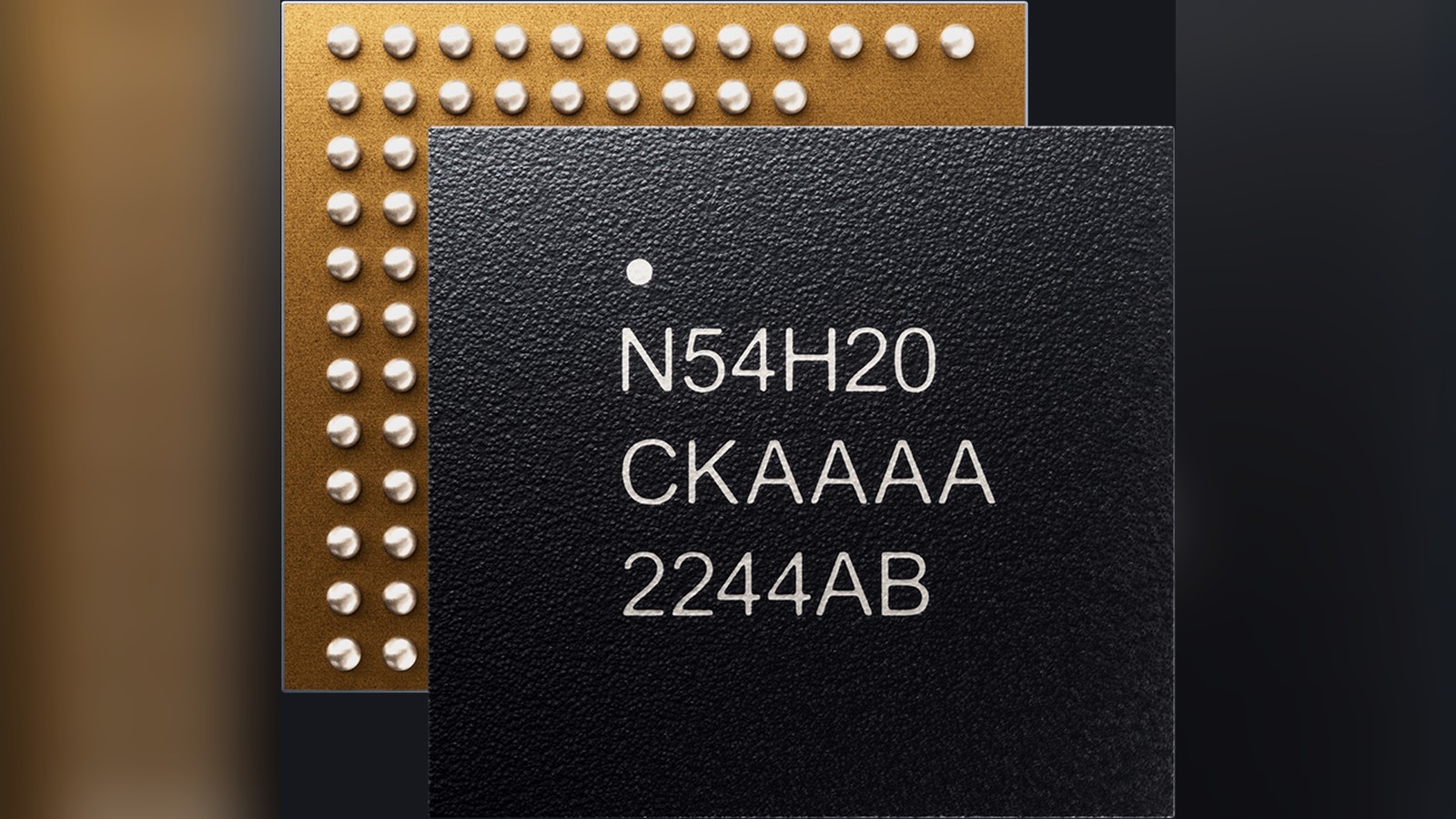
Nordic Semiconductor announced the nRF54H20 on April 12, 2023, opening a new generation of low-power wireless chips after the familiar nRF51, nRF52, and nRF53 families. The company presented it as a fourth-generation architecture rather than a small update, with multiple processors, substantially more memory, faster interfaces, a new radio, and security designed for demanding connected products.
The headline specifications explain why. Processing reaches 320MHz, the chip combines multiple Arm Cortex-M33 processors with multiple RISC-V coprocessors, and integrated memory includes 2MB of nonvolatile storage and 1MB of RAM. Nordic also added high-speed USB, CAN FD, I3C, an external memory interface, and a 14-bit analog-to-digital converter.
At launch, the nRF54H20 was sampling to selected customers. Treat that availability detail as a caveat. It was a technology announcement and roadmap marker, not an invitation to immediately redesign every nRF52 project.
A wireless chip with application-processor ambitions
A system-on-chip, or SoC, combines a processor, memory, peripherals, and radio functions in one package. Nordic's earlier Bluetooth devices already fit that description, but the nRF54H20 moves the concept closer to a complete application platform.
Nordic said the dedicated application processor delivered twice the CoreMark performance of the application processor in its nRF5340 flagship. CoreMark is a synthetic embedded benchmark, so it does not predict every workload. It does indicate that this part targets applications that would previously have needed a separate application microcontroller beside the wireless chip.
That integration can simplify wearables, medical devices, smart-home products, LE Audio equipment, and edge machine-learning systems. A single device may be able to manage the radio stack, sensor fusion, user interface, storage, and application logic. Fewer major chips can mean a smaller board and a shorter bill of materials.
There is a tradeoff. A multicore design requires deliberate ownership of peripherals, memory, and timing. Firmware teams need to decide which processor handles the application, radio-related work, background jobs, and low-power tasks. More compute is useful only when the software architecture can control its complexity.
Arm and RISC-V share the package
The nRF54H20 mixes Arm Cortex-M33 cores with RISC-V coprocessors. RISC-V is an open instruction-set architecture, while Cortex-M33 is a licensed Arm processor core widely used in secure microcontrollers.
For most developers, the important point is not choosing one instruction set over the other. The coprocessors let Nordic assign specialized or low-level jobs to efficient execution engines while keeping familiar Arm development for the main application. The precise programming model depends on Nordic's software and documentation, so the presence of RISC-V does not necessarily mean every coprocessor behaves like a general-purpose user-programmable CPU.
The memory sizes are equally significant. One megabyte of RAM gives room for network buffers, audio data, sensor pipelines, and machine-learning working memory. Two megabytes of nonvolatile storage can hold a substantial application plus secure update images, although actual space depends on protocol stacks and boot requirements.
The interface list expands the possible products
High-speed USB at 480Mbps is a major step beyond the low-speed interfaces common on small wireless controllers. It makes the chip more credible for audio, rapid data transfer, and devices that need a fast wired path for configuration or streaming.
CAN FD adds a dependable vehicle and industrial network interface built to shrug off electrical noise. FD stands for flexible data-rate: CAN FD extends the classic Controller Area Network (CAN) standard with larger frames and faster data phases. Its presence does not turn the nRF54H20 into an automotive-qualified controller by itself, but it reduces the need for a separate CAN controller in appropriate industrial and mobility designs.
Two I3C peripherals provide a modern successor path to I2C (Inter-Integrated Circuit, the common two-wire bus used to connect sensors and small chips), adding higher speeds and better error handling to that same job. The external memory interface, rated by Nordic at 400MBps, gives demanding applications a route beyond the on-chip storage. Each feature broadens the chip's reach beyond a simple beacon or environmental sensor.
A new radio sets the link budget
Nordic specified receiver sensitivity of minus 100dBm for a 1Mbps Bluetooth LE signal and transmit power up to 10dBm. Receiver sensitivity describes the weakest signal a receiver can decode under defined conditions. Combined with transmit power, it contributes to link budget, which is the allowance for path loss between two radios.
Better link budget can improve range or reliability, but antennas, enclosure materials, orientation, interference, and regional radio limits remain decisive. A strong data-sheet number cannot compensate for a poorly placed antenna.
Nordic also claimed receive current as low as 2.0mA at 3V with its DC-to-DC converter. Battery life still depends on the complete duty cycle. A radio that listens continuously uses far more energy than one that wakes briefly, exchanges a packet, and sleeps.
Protocol support included Bluetooth 5.4, LE Audio, Bluetooth Mesh, Thread, and Matter, with room for future Bluetooth specifications. Thread provides an IPv6 mesh network, while Matter defines an interoperable smart-home application layer that can run over Thread or Wi-Fi. Developers must still budget flash and RAM for the chosen stack and certification requirements.
Security is part of the architecture
Nordic designed the nRF54H20 toward PSA Certified Level 3 (a security benchmark from the Platform Security Architecture framework), including secure boot, secure firmware update, secure storage, hardened cryptographic accelerators, and tamper sensors. PSA certification uses defined assurance levels for platform security. A target level is meaningful, but the final product remains responsible for keys, update policy, cloud security, and safe application code.
Hardened accelerators are intended to resist side-channel attacks that infer secrets from timing, power use, or electromagnetic behavior. Tamper sensors can help detect physical attacks. These capabilities matter for locks, medical products, payments, and long-lived infrastructure where a wireless device may be physically accessible.
What developers should take from the launch
The nRF54H20 is not positioned as the cheapest replacement for every nRF52840. It is the high-performance branch of a wider family. Existing nRF52 designs with mature firmware and modest requirements remain sensible, especially when cost and immediate availability matter more than peak capability.
New projects should compare workload, memory, interfaces, power modes, package, software maturity, and production status. Begin with a development kit and representative radio tests. Exercise secure updates, worst-case RAM use, and sleep transitions early. Multicore bugs and power leaks become expensive after the board is fixed.
The main significance of the announcement is architectural. Nordic has taken a low-power Bluetooth platform and added the compute, memory, interfaces, and security expected of a much broader embedded controller. The nRF54H20 shows where advanced wireless products are heading, even as the rest of the nRF54 family has yet to be announced.
I'd treat the nRF54H20 as a look at where wireless chips are heading, not a replacement for every nRF52 project. Match the chip to the job.
Sources and image credits
- nRF54H20 product page, Nordic Semiconductor.
- Nordic Semiconductor news, Nordic Semiconductor.
- Official nRF54H20 product image from Nordic Semiconductor.
- Square and vertical crops are edited from the same source image.


