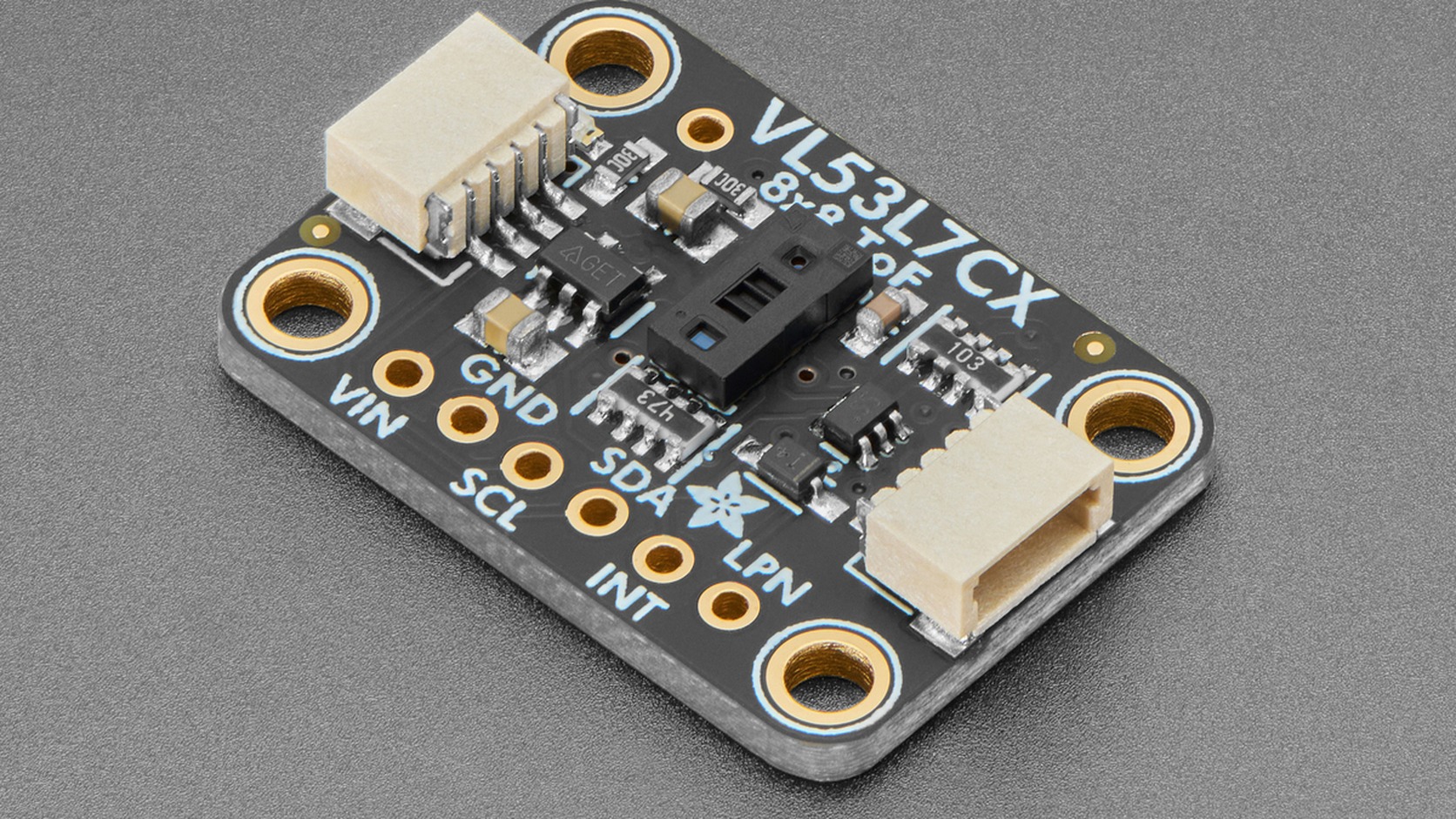
Adafruit has listed a VL53L7CX Time-of-Flight Distance 8x8 Pixel Camera breakout with STEMMA QT and Qwiic connectors, marked "Coming soon" on its product page in the week of November 21. The board carries STMicroelectronics' VL53L7CX, an 8x8-zone laser ranging sensor with a wider field of view than the VL53L5CX that Adafruit already sells at $19.95. The listing shows no price and no ship date.
Adafruit describes the sensor as more of a low-resolution depth camera than a distance sensor. It projects an invisible 940nm laser pattern, divides the view into 64 zones, and reports a distance for each one. ST's product page adds a 4x4 mode, a frame rate of up to 60Hz, multi-target detection in each zone, and an autonomous low-power mode that wakes the host when a distance threshold is crossed.
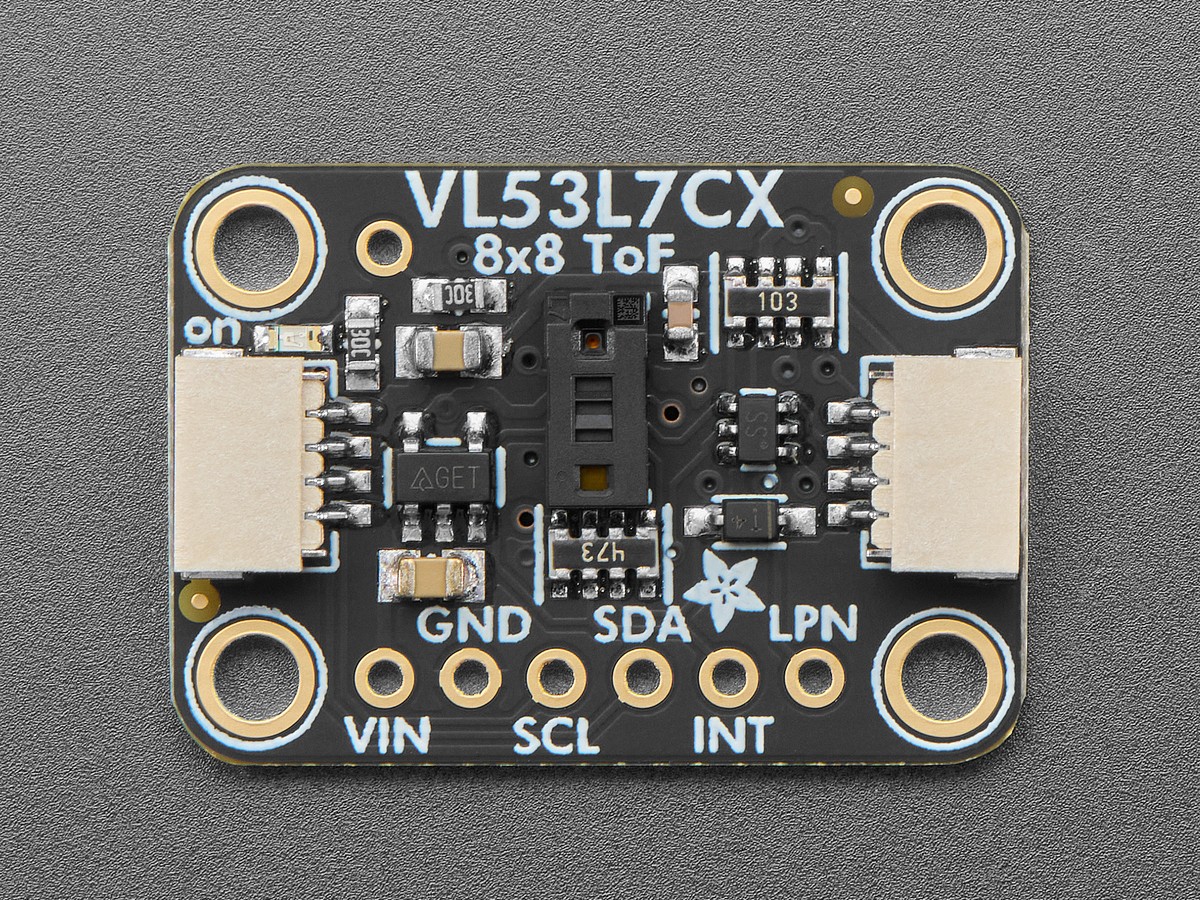
Image: Adafruit. The silkscreen reads 8x8 ToF and lists the pins.
The VL53L7CX trades range for a wider view
Adafruit's page puts the two sensors side by side: the VL53L7CX reaches 3.5 meters with a 60-degree by 60-degree field of view, while the VL53L5CX reaches 4 meters with 45 degrees by 45 degrees. ST's pages agree on the range figures (350cm and 400cm) and call the L7CX view 90 degrees diagonal, against 65 degrees diagonal for the L5CX. ST says the two parts share pinouts and drivers, so moving a project from one to the other is meant to be a swap.
The wider view changes what each zone covers. Using simple geometry, a 60-degree square view spans about 1,155mm across at 1 meter, or roughly 144mm per zone on an 8-zone row. A 45-degree view spans about 828mm at the same distance, or about 104mm per zone. The L7CX therefore covers close to twice the area at 1 meter, but each of its zones is about 40 percent wider, which blurs small objects into fewer pixels. At the 3.5-meter limit, the L7CX sees a patch about 4 meters wide.
The geometry also raises a question about ST's headline number. A flat 60-degree by 60-degree square works out to about 78 degrees along its diagonal, not 90. ST does not say how it measures the diagonal figure, so the 60 by 60 values are the safer ones to design around.
The product page contradicts itself
Adafruit's listing was copied in part from the L5CX page. The description gives 3.5 meters for the L7CX, and the board's silkscreen reads "Max Range 3.5m." The specification list further down says "Up to 400cm ranging" and "Optical Sensor 157.480" (4m)," both L5CX numbers. The same list says "90° diagonal square FoV," which matches ST's L7CX wording, and one sentence refers to the "VL53L4CX," a different part. ST's own page lists 350cm for the L7CX.
For a project that places the sensor facing a wall or doorway, the difference is 50cm of usable range. The board's silkscreen and ST's page agree with each other, so 3.5 meters is the figure that two independent sources support.
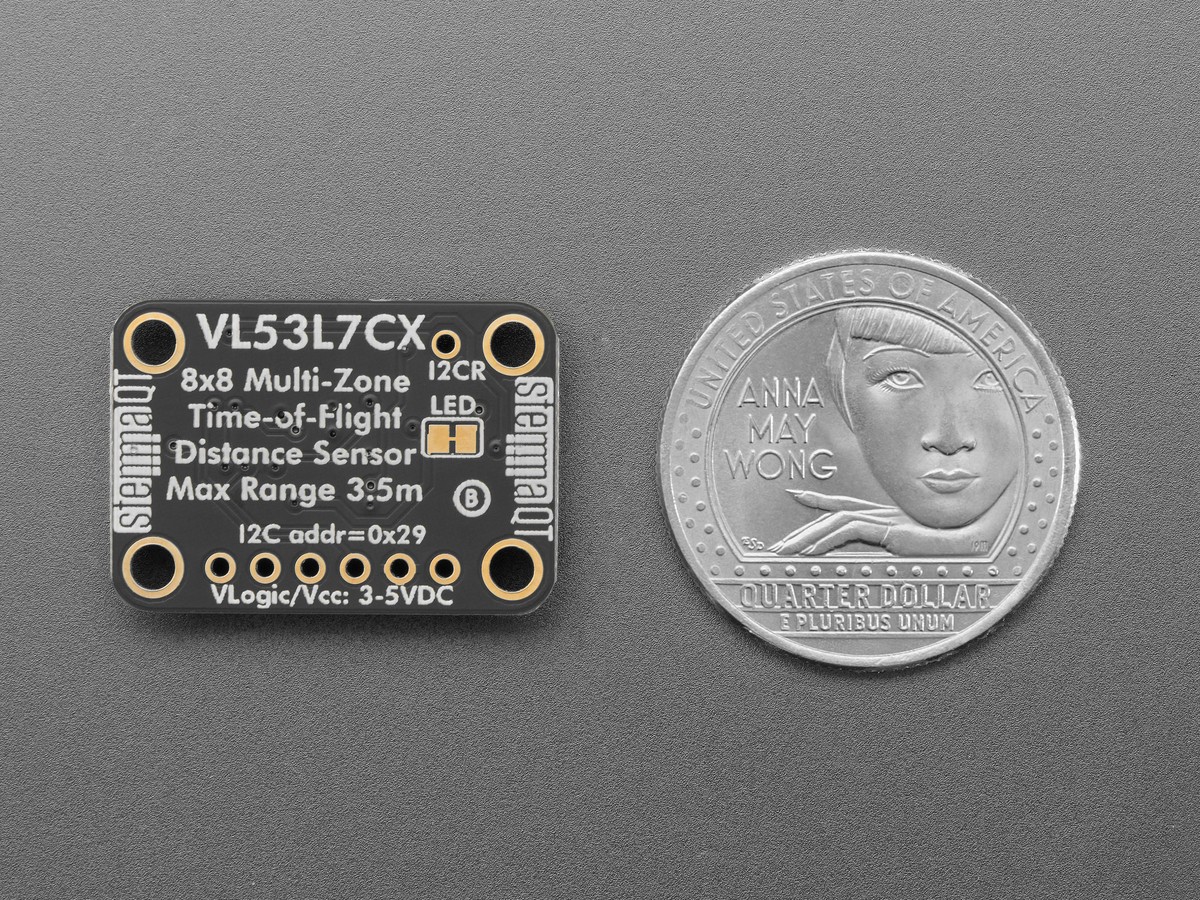
Image: Adafruit. The board labels its range as 3.5m and its I2C address as 0x29.
Memory and boot time limit which boards can run it
The sensor loads its firmware at start-up, and Adafruit lists the consequences. It says the board cannot run on small-memory boards such as the ATmega328, and that the host needs more than 128KB of flash and more than 16KB of SRAM. Boards such as the SAMD21, SAMD51, and ESP32 families fit that description. Adafruit also says a cold boot takes about 3 seconds while the firmware loads, which matters for battery projects that power the sensor down between readings.
On the electrical side, the sensor needs 3.3V power and logic. Adafruit's board adds a regulator and level shifting, and the page says it works with 3V to 5V microcontrollers, including a 3.3V Feather and a 5V Arduino Mega. STEMMA QT connectors carry the I2C bus without soldering, although the cable is sold separately. Adafruit lists two Arduino libraries for the VL53L5 family, one built on ST's driver package and one written without it. The listing does not say whether the same pair covers the L7CX.
ST lists gesture recognition, robot mapping, and low-power presence detection as target uses, and notes that the sensor records only distance with no image capture, so it keeps working in the dark. Adafruit's board measures 25.5mm by 17.8mm by 4.7mm and weighs 1.7 grams. ST lists the bare sensor at 6.4mm by 3.0mm by 1.6mm and says it is Class 1 eye safe, with cover-glass crosstalk immunity beyond 60cm, which applies to anyone planning to mount the sensor behind a window or enclosure panel.
The VL53L5CX breakout is in stock at $19.95. Adafruit's page for the VL53L7CX lists no price.
Sources and image credits
- Adafruit: VL53L7CX Time-of-Flight Distance 8x8 Pixel Camera (product 6574), opened November 23, 2026
- Adafruit: VL53L5CX Time-of-Flight Distance 8x8 Pixel Camera (product 6503) and Adafruit New Products
- STMicroelectronics: VL53L7CX and VL53L5CX, opened November 23, 2026
- Images: Adafruit Industries product photos.