
FIRST, the youth robotics nonprofit, announced on November 18 that its next generation of K-8 robotics programs will run on a hardware platform built on the Arduino UNO Q. Qualcomm Technologies is the lead technology partner, Walt Disney Imagineering will help design the games and challenges, and REV Robotics will make the mechanical build system. Arduino published its own account on November 20. FIRST says the new programs replace FIRST LEGO League, which concludes in 2027.
According to FIRST's press release, the organization reached more than 850,000 participants in the 2025-2026 season and more than 4 million since its 1989 founding. Spread evenly, 4 million participants over 37 years is about 108,000 a year, so the latest season ran at roughly eight times the long-run average. A hardware decision for a program that size reaches more students than most maker-board launches do.
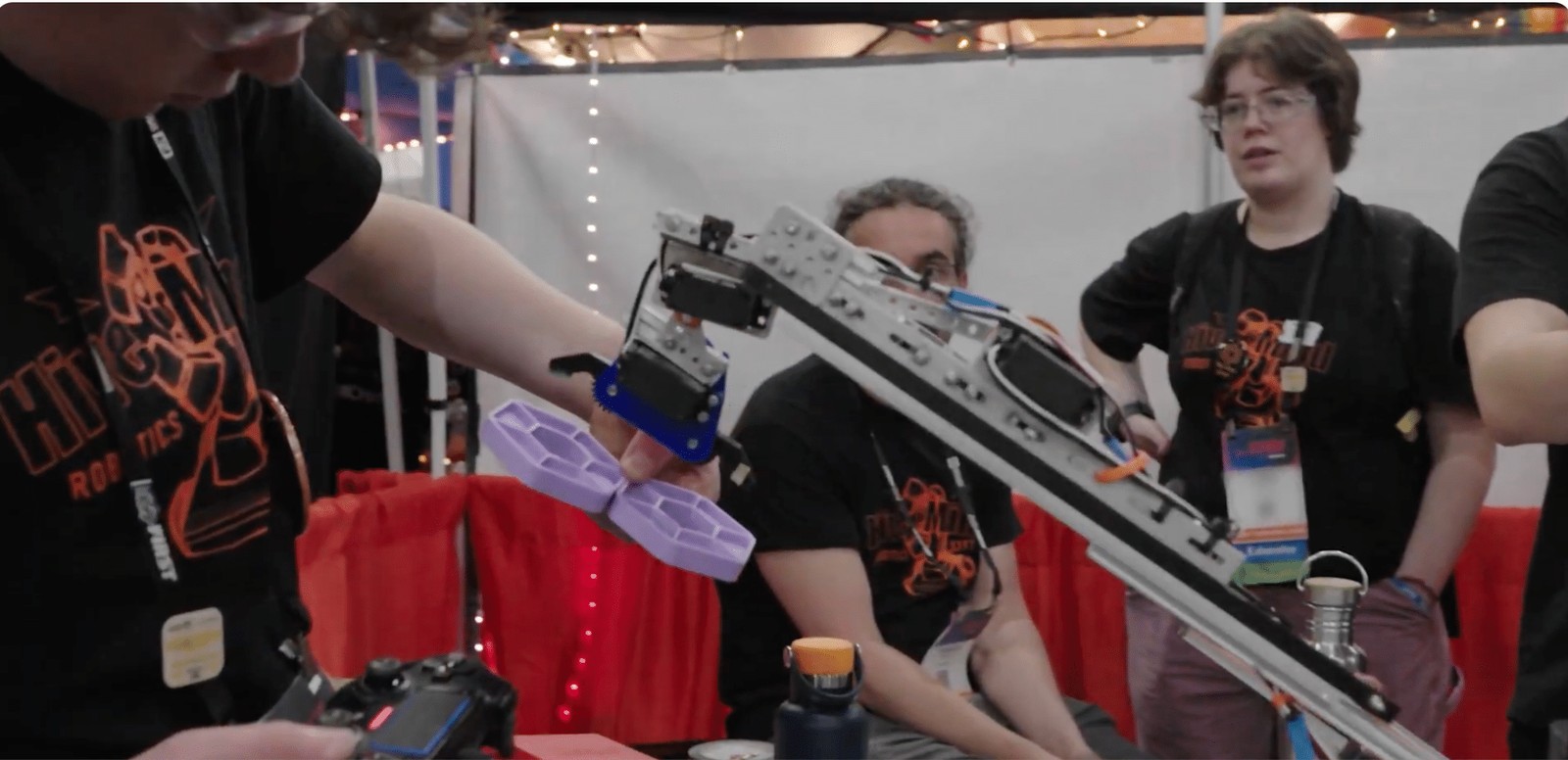
Image: Arduino and FIRST.
The UNO Q platform for grades 3 to 8
FIRST's K-8 FAQ, updated November 18, describes two program experiences: one for ages 5 to 7 (grades K-2) and one for ages 8 to 14 (grades 3-8). Grades 3 to 8 teams will use either LEGO Education's SPIKE Prime or a new platform built on the UNO Q, paired with a mechanical build system developed with Qualcomm, Arduino, and REV. In the 2027-2028 season, teams on the new hardware will play the same autonomous game as SPIKE teams on a single 4-by-8-foot field. The K-2 experience will use SPIKE Essential or new hardware introduced from that season on.
Arduino's blog post says the grades 3 to 8 hardware options are built on the UNO Q, while the press release speaks only of "Arduino technologies" and never names the board. The FAQ and the Arduino post are the two places the UNO Q appears. FIRST's other programs continue unchanged: FIRST Tech Challenge serves grades 7 to 12 and FIRST Robotics Competition serves grades 9 to 12, so the new K-8 platform overlaps FIRST Tech Challenge at grades 7 and 8.
None of the documents lists a price, the program names, the game, or whether the classroom hardware is a stock UNO Q or a modified board. FIRST says program names, the technology platform, the game experience, and participation details will be announced ahead of the 2027-2028 season.
Dates and compatibility that do not line up
The sources differ on timing. The press release and Arduino both say the new programs launch in spring 2027, while the FAQ refers to a 2027-2028 season. The most likely reading is that spring 2027 is the public launch and 2027-2028 is the first competition season, but none of the three documents says so directly.
The FAQ also gives two end dates for LEGO hardware. One answer says SPIKE Essential and SPIKE Prime sets will remain compatible with 2027-2028 K-8 season offerings. Another says FIRST plans to maintain compatibility through the 2028-2029 season. A school that already owns SPIKE kits therefore has one source with two possible cutoffs. FIRST adds that the new K-8 programs are not sponsored, endorsed, or affiliated with LEGO Education or the LEGO Group.
Qualcomm's role has a second layer. The press release's boilerplate describes Arduino S.r.l. as a subsidiary of Qualcomm Technologies, so the lead technology partner and the maker of the board are the same corporate family. FIRST says Qualcomm will help create a cost-effective, approachable technology experience, and Arduino frames its own role as making first builds approachable while leaving room for more advanced coding, sensing, and prototyping.
What the UNO Q brings to a classroom robot
Arduino's UNO Q documentation describes a Qualcomm QRB2210 microprocessor running a Debian-based Linux environment alongside an STMicroelectronics STM32U585 microcontroller, a 32-bit Arm Cortex-M33, in the standard UNO form factor. The store page says the board keeps 3.3V and 5V compatibility with most existing UNO shields, runs full Python 3 on the Linux side, and ships with Arduino App Lab, which combines Python apps and Arduino sketches in one workflow. The microcontroller side can still be programmed from the Arduino IDE.
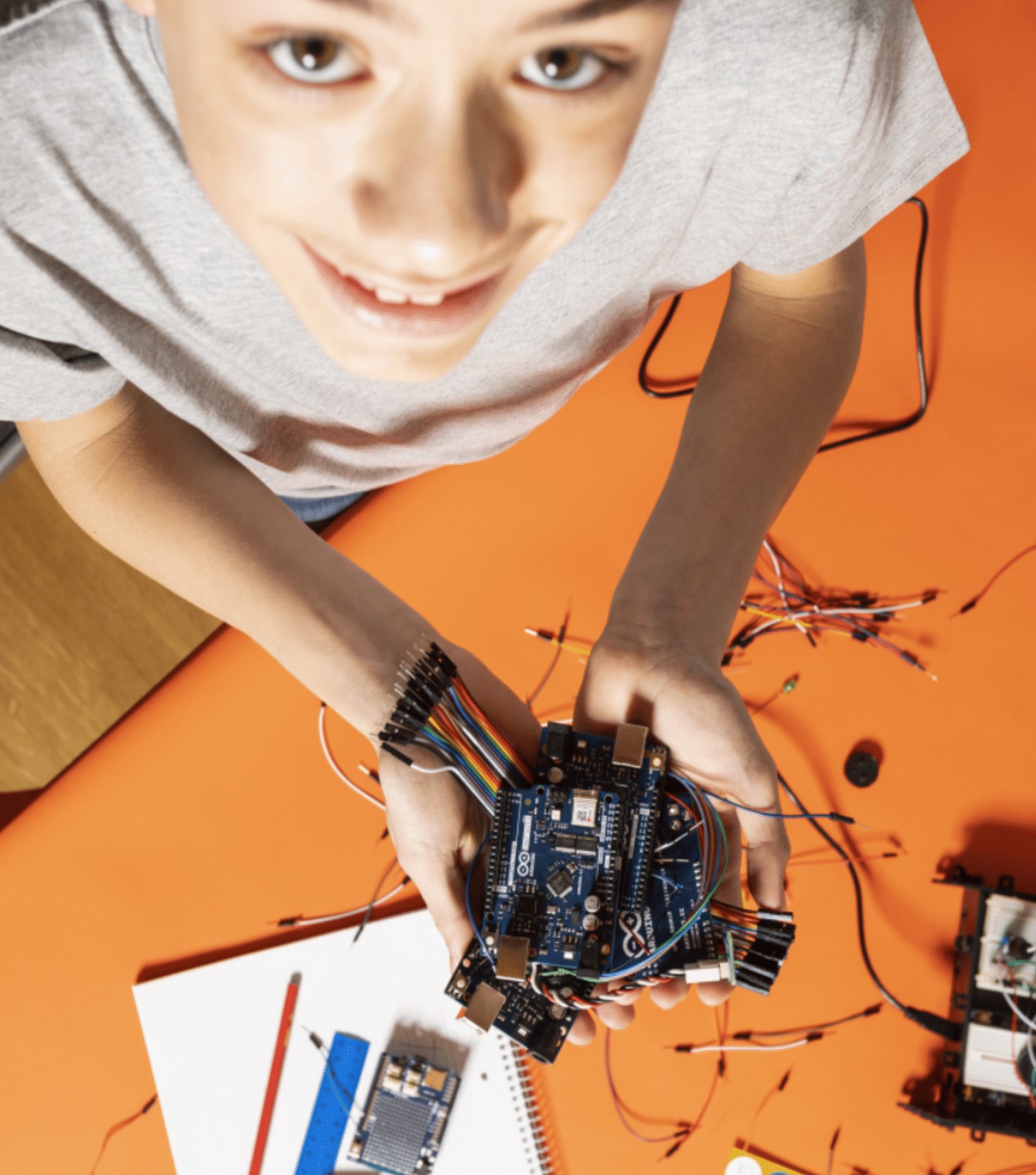
Image: Arduino and FIRST.
That split matters for a classroom. The same board can run a sensing or vision script in Python on Linux and a timing-critical motor loop as an Arduino sketch, so a team can start with block-level tasks and move toward text code without changing hardware. Arduino says UNO Q schematics and gerbers are published under CC-BY-SA 4.0 and that the software stack, including App Lab and the Debian image, is open source. Neither FIRST nor Arduino says whether the K-8 variant carries the same terms.
Arduino's boilerplate in the FIRST release puts the ecosystem at an estimated 33 million active users. FIRST asks interested schools and teams to sign up for updates on its K-8 page, with program details due before the 2027-2028 season.
Sources and image credits
- FIRST: FIRST and Qualcomm Technologies, Inc. Launch Next Generation of K-8 Robotics Education (November 18, 2026)
- FIRST: K-8 Programs, 2027 and Beyond FAQ
- Arduino Blog: Qualcomm and Arduino partner with Walt Disney Imagineering and REV Robotics (November 20, 2026)
- Arduino documentation: UNO Q and Arduino Store: UNO Q
- Images: Arduino and FIRST.