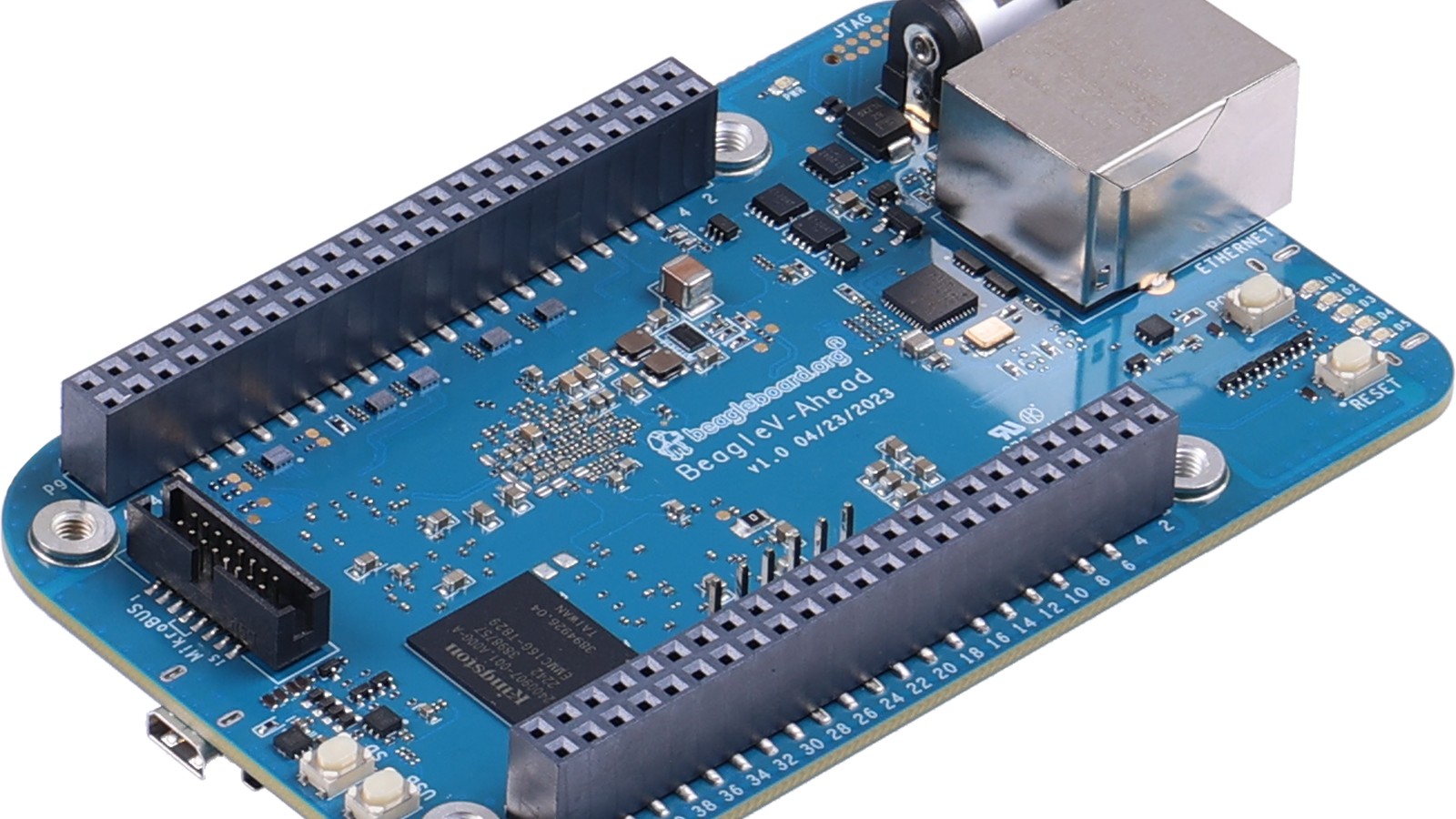
BeagleBoard.org expanded its open-hardware lineup into high-performance RISC-V computing on July 12, 2023, with BeagleV-Ahead. Priced below $150 at launch, the compact single-board computer combined four 64-bit RISC-V application cores with graphics, multimedia processors, and a neural-processing unit rated for as much as 4 TOPS.
RISC-V is an open instruction set architecture, or ISA. An ISA defines the machine instructions software uses to communicate with a processor. An open ISA lets organizations design compatible processors without licensing a proprietary instruction set, but it does not automatically make every chip design or software component open.
BeagleV-Ahead paired that architecture with BeagleBoard's open-hardware approach, making it useful both as a Linux computer and as a platform for studying a rapidly developing processor ecosystem.
The TH1520 contains several kinds of processor
The board is built around T-Head's TH1520 system-on-chip. Its main processor cluster contains four 64-bit Xuantie C910 RISC-V cores implementing the RV64GC profile (the standard general-purpose 64-bit RISC-V instruction set that most Linux-capable RISC-V chips build on). In plain terms, these are the cores that run the Linux operating system and normal applications.
The chip also includes a Xuantie C906 processor for audio-related work and a low-power E902 RISC-V core. A graphics processor is rated at 50 GFLOPS (billions of floating-point operations per second, a common yardstick for graphics and general compute throughput), while the neural-processing unit, or NPU, is rated at up to 4 TOPS.
An NPU accelerates the matrix operations used by many neural networks. The peak rating does not describe complete application speed. A model must be supported by the available compiler and runtime, and the system still has to capture, prepare, and interpret its data.
This combination makes the board a heterogeneous computer. Different processors handle different types of work, potentially improving efficiency. It also increases software complexity because developers need suitable drivers and tools for each block.
Memory, storage, and networking make it a complete SBC
BeagleV-Ahead launched with 4GB of LPDDR4 memory (low-power DDR4, the mobile-oriented RAM standard used in most modern single-board computers), 16GB of onboard eMMC storage (embedded MultiMediaCard flash, a persistent storage chip built into the board), and a microSD slot. It includes dual-band 2.4GHz and 5GHz Wi-Fi, Bluetooth 5.2, and Gigabit Ethernet.
For displays and peripherals, the board provides micro-HDMI, a 5Gbps USB 3 micro-AB connection that can operate as host or device, and a serial debug interface. Camera and display expansion includes two CSI (Camera Serial Interface, a high-speed standard for camera sensors) interfaces and DSI (Display Serial Interface, its counterpart for driving screens) for a display.
The board also carries a 92-pin header compatible with the BeagleBone cape form factor and a mikroBUS Shuttle interface. The expansion options help because architecture experiments become more interesting when they can interact with cameras, sensors, motors, and real networks.
As always, physical compatibility does not prove complete cape compatibility. Pin functions, voltages, drivers, and mechanical clearances must be checked for the individual add-on.
Open hardware and an open ISA are different layers
The board's open design gives users access to hardware information needed to study or adapt it. RISC-V makes the processor's instruction set openly specified. Those are complementary forms of openness, but neither guarantees that every internal accelerator has an open implementation or a fully upstream software stack.
Buyers should keep this distinction in view. A board can be excellent for learning RISC-V Linux while still relying on vendor kernels, firmware, or binary components for some hardware. Developers who require mainline Linux support should inspect the current status of graphics, video, NPU, wireless, and boot components separately.
At launch, BeagleBoard said the board shipped with Yocto, with Ubuntu and Fedora prototypes also working. Yocto is a project for building customized embedded Linux distributions. It is not itself one fixed distribution image. It provides metadata and tools that produce a system tailored to a product.
What can developers do with 4 TOPS?
Supported computer-vision models can perform classification, object detection, or image segmentation near the sensor instead of sending every frame to a cloud service. Local processing can reduce latency, bandwidth use, and exposure of raw data.
The NPU is only one part of that pipeline. Camera support, memory bandwidth, image resizing, model conversion, and runtime compatibility determine whether a project is practical. A developer should begin with the vendor's supported models and record actual end-to-end latency rather than extrapolate from TOPS.
Robotics and Internet of Things gateways are natural targets. Linux can handle networking and application logic while the NPU analyzes images or signals. The additional RISC-V cores may serve media or control functions, depending on available software.
Projects that do not use AI still benefit from a quad-core RISC-V Linux platform with familiar storage and connectivity. Compiler developers, distribution maintainers, educators, and operating-system researchers can use the board to test software on physical RV64 hardware.
The software ecosystem is the real test
A mature single-board computer depends on more than a capable chip. Boot firmware, kernel support, graphics drivers, media frameworks, debugging, documentation, and repeatable images decide how much of the silicon developers can use.
RISC-V Linux support is already substantial in 2023, but individual system-on-chip features remain vendor-specific. Buyers need to distinguish architecture support from board support. A compiler knowing RISC-V instructions does not mean the kernel can automatically operate a particular camera receiver or NPU.
For a new project, verify the current image, kernel branch, boot process, and known limitations before committing hardware. Keep a recovery microSD card and a serial console available. Serial output is often the only clear evidence when boot firmware fails before networking or graphics starts.
Why BeagleV-Ahead matters
BeagleV-Ahead arrives when affordable RISC-V hardware is moving from small microcontrollers toward Linux-capable systems. It offers a combination that is still unusual: four 64-bit application cores, edge-AI hardware, wireless networking, onboard storage, familiar expansion, and an open board design.
It is not simply a drop-in substitute for an established Arm SBC. Early adopters will need to accept a younger software stack and learn which accelerators are genuinely usable. That work can contribute to the ecosystem by exposing missing drivers, documentation gaps, and portability assumptions.
For makers, the board provides a path into RISC-V that extends beyond blinking an LED. For professionals and researchers, it offers a documented target for Linux, AI, and custom hardware experiments. What stands out is that it puts the open instruction set inside a complete, expandable computer rather than treating RISC-V as an abstract specification.
If you're curious about RISC-V, this is a fun board to explore, but I'd check the current software support for the parts you need before you commit.
Sources and image credits
- BeagleV-Ahead board page, BeagleBoard.org.
- BeagleBoard documentation: Boards, BeagleBoard.org.
- Official product image from BeagleBoard.org.
- Square and vertical crops are edited from the same source image.