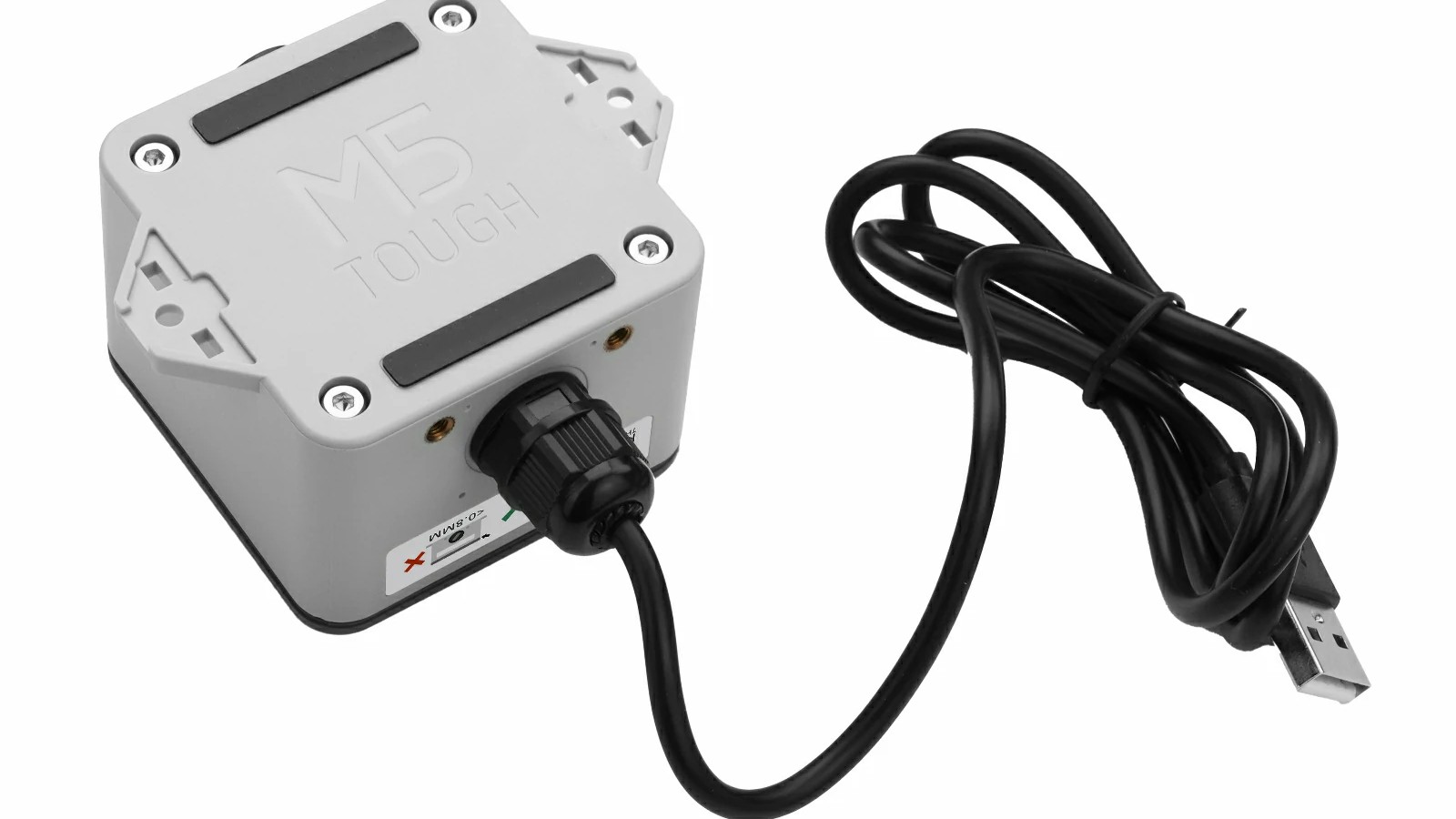
M5Stack has released the ToughC5, an outdoor IoT controller built around an ESP32-C5 with a 2-inch touchscreen and a weather-resistant housing. The M5Stack documentation page lists dual-band Wi-Fi 6, Bluetooth 5 LE, and an IEEE 802.15.4 radio for Zigbee and Thread, along with power input over RS485. The page gives no price.
The controller uses the ESP32-C5HR8 core module, a 32-bit single-core processor running at up to 240 MHz with 16 MB of flash and 8 MB of PSRAM. M5Stack describes the device as suited to outdoor edge data collection, smart buildings, and industrial gateways.
Weather resistance
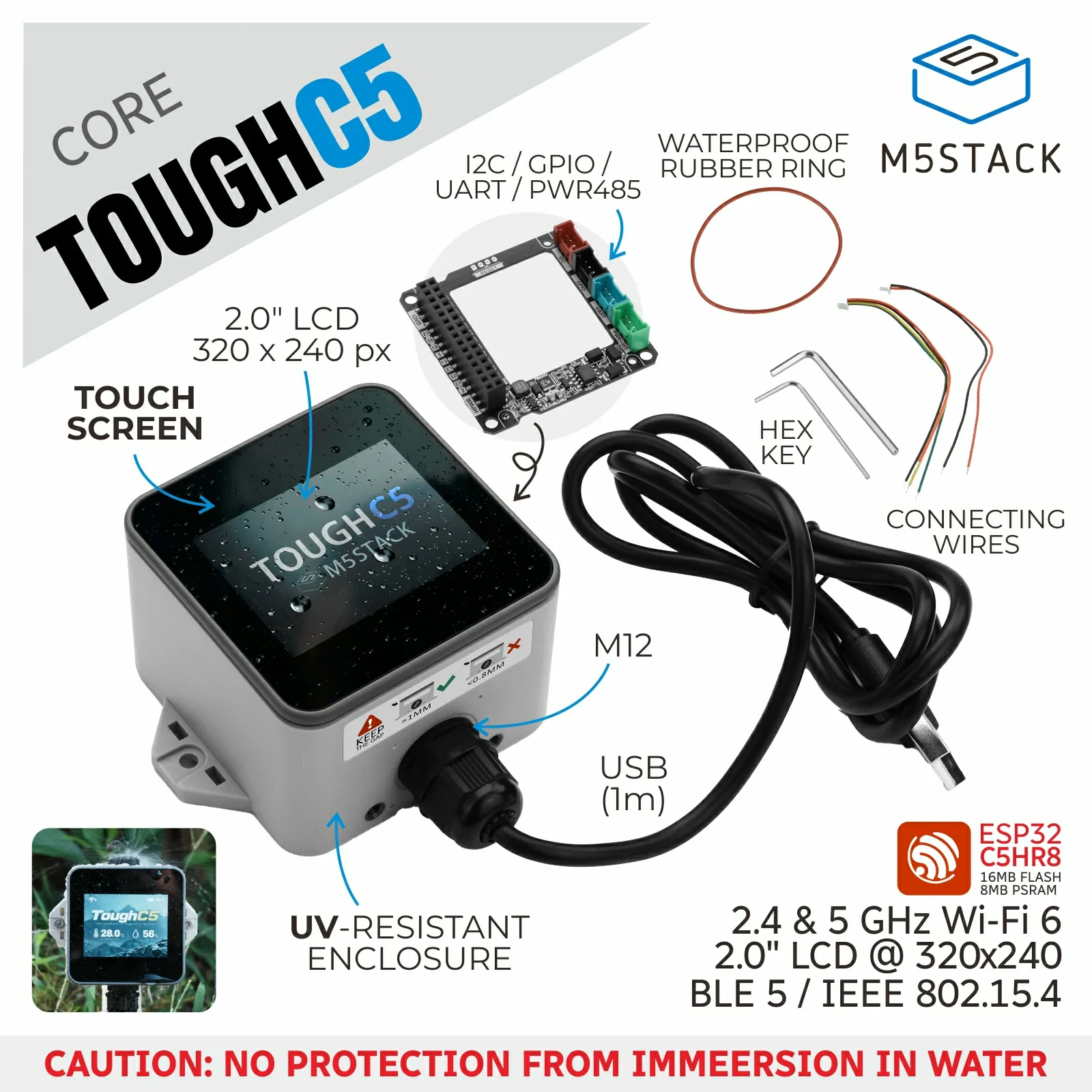
The housing is PC plus ABS with UV-resistant additives. M5Stack says the unit offers standard water and dust resistance and states that it is not designed for immersion. The product images repeat the warning, and the page does not give an IP rating. The practical reading is that rain and splashes are covered by design, and a puddle or a hose test is not. For a permanent roof or fence-post install, a rated enclosure or some overhead cover is the safer choice.
The ESP32-C5 is Espressif's first chip to combine dual-band Wi-Fi 6 with the 802.15.4 radio used by Zigbee and Thread. In a sealed outdoor unit that matters because 5 GHz is often less crowded than 2.4 GHz, and the 802.15.4 radio lets the controller join mesh networks of low-power sensors. M5Stack lists outdoor environment gateway monitoring among the intended uses.
Power, connections, and features
Three power sources are listed: USB at 5 V and 500 mA, a 3.7 V battery connector, and an RS485 interface input that accepts 6 to 24 V DC at 1 A. RS485 is a long-distance serial standard common in building automation and factory sensors, so a single weatherproof cable can bring both power and data. The housing has two M12 cable routing holes, and an internal expansion board provides four HY2.0-4P ports covering RS485, I2C, GPIO, and UART. M5Stack's M5PM1 and M5IOE1 chips handle multi-level power management and low-power wake-up.
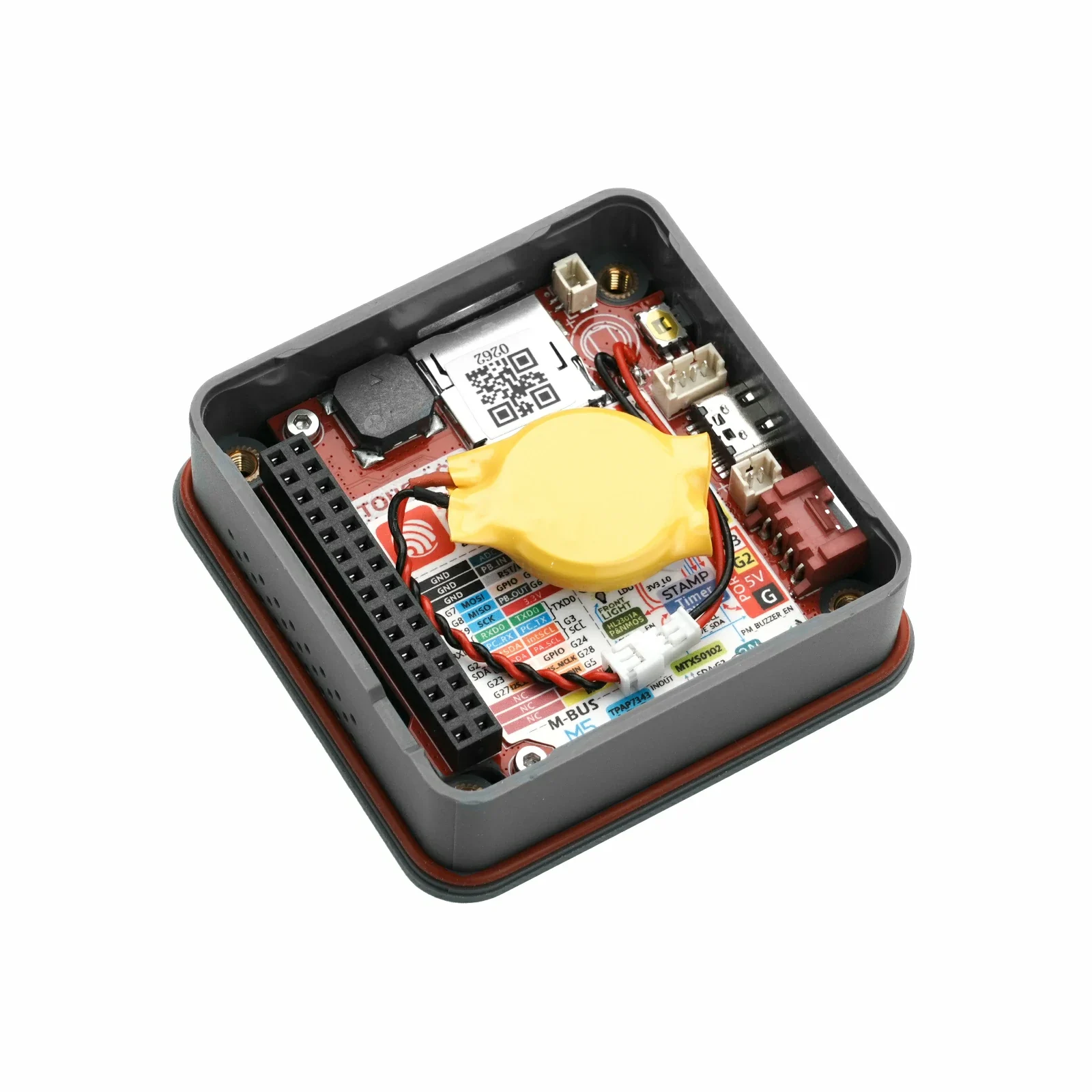
The display is a 2.0-inch IPS panel at 320 by 240 resolution with capacitive touch, rated at up to 853 nits of brightness. The board also carries a passive buzzer, a microSD slot, and an RX8130CE real-time clock backed by a CR2032 coin cell, which keeps timestamps correct when main power drops. Magnetic mounting lets the unit stick to metal surfaces.
M5Stack's power figures show the range the design covers: 10.41 microamps in the shutdown state and 320 mA at full load, both measured at 4.2 V. The box includes two hex keys, 1.5 mm and 2.5 mm, for the housing's M2 and M3 screws, and a waterproof O-ring.
RS485 is the physical layer behind Modbus RTU, the protocol many industrial sensors and meters speak, so the ToughC5 can sit on an existing sensor bus and take its power from the same cable. The HY2.0-4P ports inside the housing match the connector used on M5Stack's Unit sensor modules, which opens the existing Unit catalog to the controller once the cables are routed through the M12 entries.
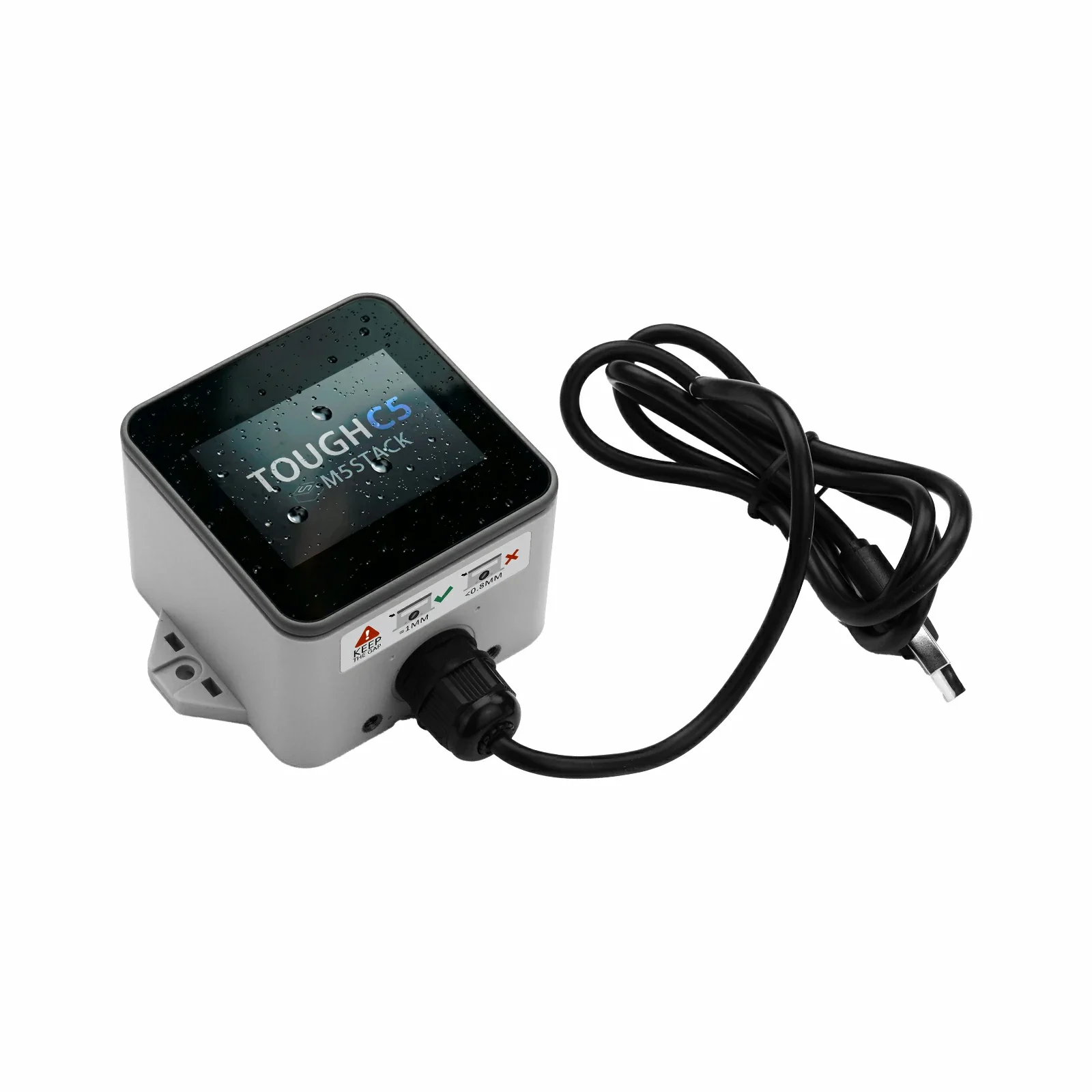
On the software side, M5Stack says the ToughC5 programs through the Arduino IDE with its M5Unified and M5GFX libraries, and that UiFlow2, its visual programming tool, is also supported. The ESP32-C5 is among the newer ESP32 variants, so Arduino users will need board support that covers it.
The ToughC5 follows M5Stack's earlier Tough controller, and the C5 version moves to a dual-band, Zigbee and Thread-capable chip. That makes it an alternative to mounting a general-purpose ESP32 board in a project box of your own. The documentation page lists no price and no independent test data for the weather resistance or battery life.
The shutdown figure is small enough to matter in battery designs. At 10.41 microamps, a 1,000 mAh lithium cell would take on the order of a decade to drain through shutdown current alone, though any real deployment will draw far more while the controller is awake and transmitting.
M5Stack's listed uses are outdoor environment gateway monitoring, outdoor edge data collection, smart buildings, and industrial gateways. In those jobs the controller reads sensors, shows status on its 2-inch screen, and passes data over Wi-Fi, Zigbee, or Thread, with the real-time clock keeping logs timestamped through short power losses.
Sources and image credits
- M5Stack ToughC5 documentation page
- Images: M5Stack official documentation materials