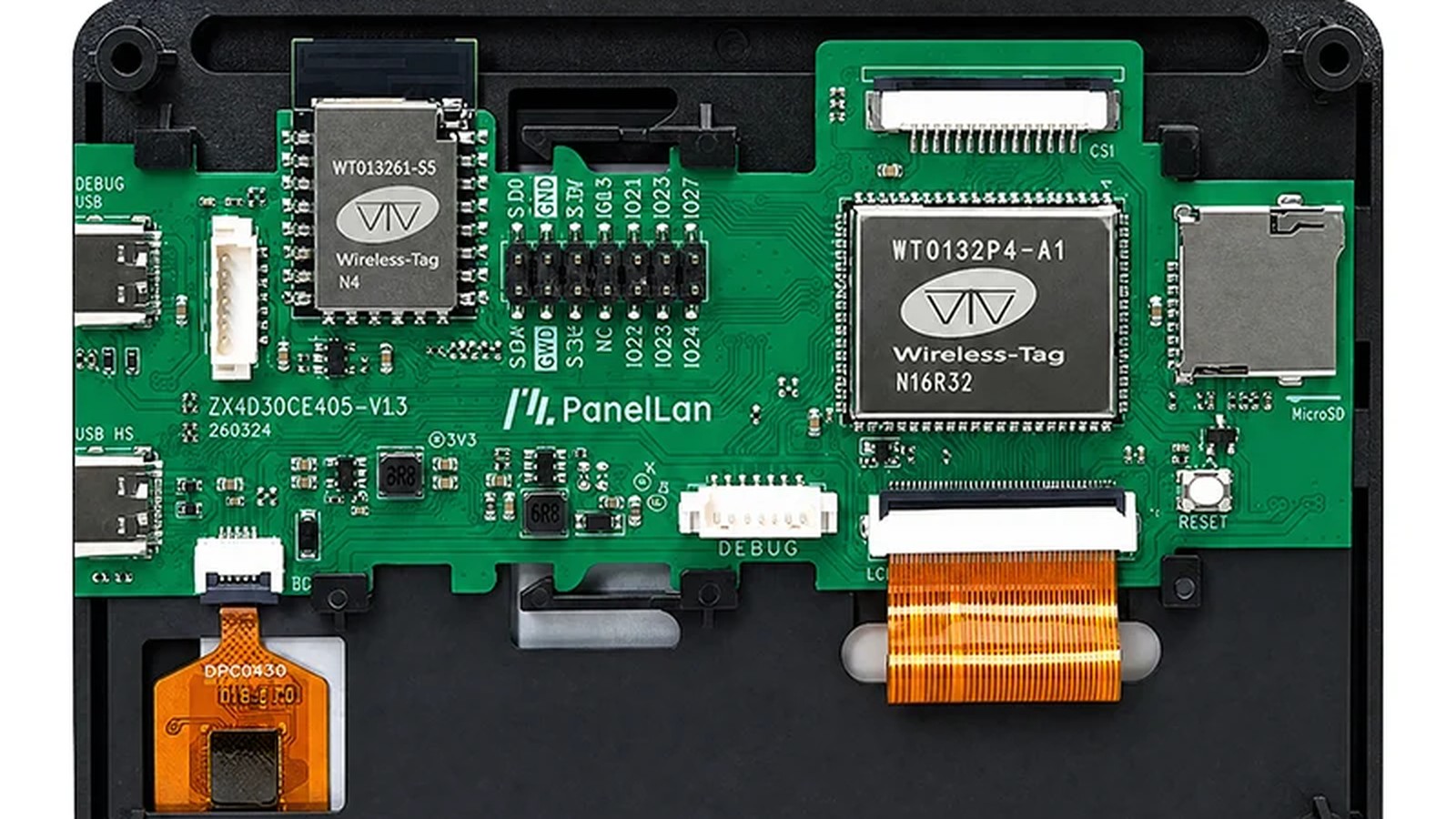
Wireless-Tag has opened pre-orders for the WT32P4C5-43S, a 4.3-inch touchscreen board that pairs an ESP32-P4 processor with a separate ESP32-C5 or ESP32-C61 wireless module. The store page lists it at $32, or $37 for a version bundled with a burning tool. Wireless-Tag says samples are in expedited production, so these are pre-orders and not stock.
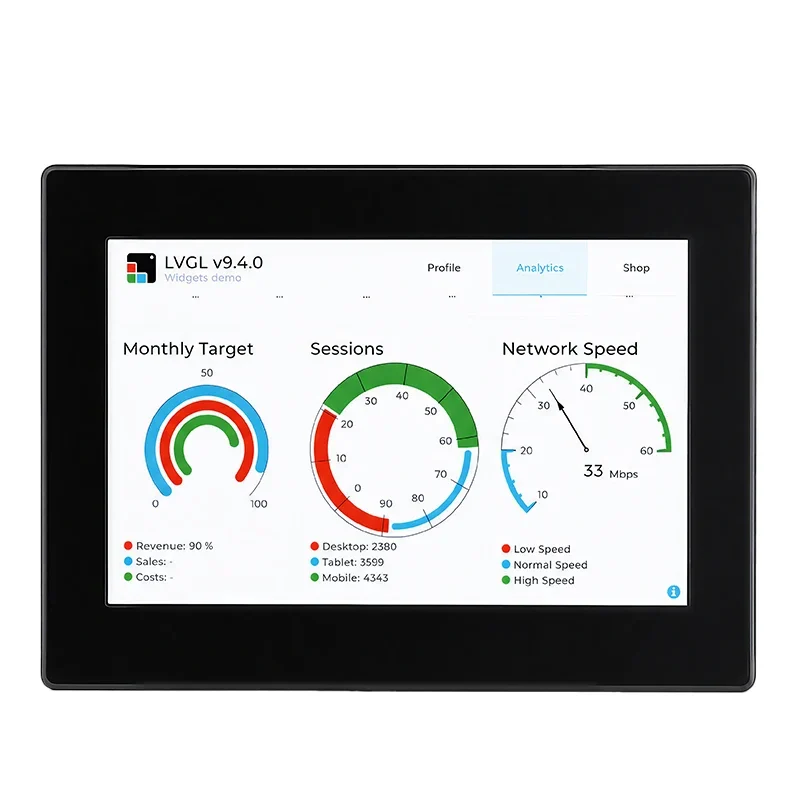
Wireless-Tag describes the board as an industrial HMI display, meaning a screen and touch interface for operating a machine or a control system. The panel is a 4.3-inch, 800 by 480 TFT color display with touch.
Two ESP32 chips
The ESP32-P4 is Espressif's high-performance chip for graphics and interfaces, and it has no built-in Wi-Fi or Bluetooth. Wireless-Tag handles that by adding a second chip. The ESP32-C5 provides dual-band Wi-Fi 6 on 2.4 and 5 GHz, Bluetooth LE, and an 802.15.4 radio for Zigbee and Thread. The ESP32-C61 option is, as Espressif's lineup stands, a Wi-Fi 6 part limited to 2.4 GHz, so buyers who want 5 GHz should confirm they are ordering the C5 configuration.
The split has a software cost. Developers manage two firmware images, one for the P4 and one for the wireless module, and debugging spans two chips. That is more work than a single-chip board, in exchange for a processor with more graphics capability than the wireless-oriented ESP32 parts. In a typical setup, ESP-IDF projects target the P4, while the wireless chip runs Espressif-supplied firmware that exposes its radios to the P4, so most of the application code lives on one side.
Espressif specifies the ESP32-P4 with a dual-core RISC-V processor running at up to 400 MHz, MIPI camera and display interfaces, a 2D graphics accelerator, and H.264 video encoding. The ESP32-C5 is a 240 MHz RISC-V chip and the first ESP32 to combine dual-band Wi-Fi 6 with an 802.15.4 radio. Espressif's own ESP32-P4 Function EV board pairs the P4 with an ESP32-C6 for wireless, so using a C5 or C61 here follows the same two-chip pattern with a different radio.
Other hardware
According to the store listing, the board includes a CSI camera interface for image sensors, a microSD card slot, and a standard expansion header that exposes GPIOs and other peripherals. There are two USB ports. One is a Debug USB port for firmware download and debugging, and the other is a USB 2.0 High-Speed port for application development. Wireless-Tag lists industrial automation, human-machine interfaces, smart device control, IoT terminals, and embedded graphical display applications as the intended uses.
The listing does not spell out what the extra $5 buys beyond the "burning tool" label, which in maker usage means a programming and debugging accessory for writing firmware to the chip. It also does not name a shipping date or link software documentation. The ESP32-P4 is supported by Espressif's ESP-IDF framework, and LVGL is a common choice for on-screen graphics, but the store page does not say which examples Wireless-Tag supplies.
On the display side, 800 by 480 pixels on a 4.3-inch diagonal works out to about 217 pixels per inch, which is sharp enough for text and gauges at arm's length. The $37 bundle with the burning tool costs about 16 percent more than the base board.
In Espressif's own P4 reference designs, a companion chip connects through the ESP-Hosted software, so the P4 treats the companion's Wi-Fi and Bluetooth as if they were built in. The store page does not say how Wireless-Tag links its two chips, which matters for software support. The camera port is the other feature with real depth behind it. The P4 can capture camera input and encode H.264 video in hardware, and Wireless-Tag lists the CSI interface for image sensors used in machine vision.
The Zigbee and Thread radio on the C5 option makes the board a candidate for a wall-mounted smart-home panel or a small gateway, and the CSI camera port leaves room for a vision project such as a doorbell or a machine monitor. Those are applications the hardware allows. Wireless-Tag's page does not show finished examples of any of them.
The appeal is a built-in display at $32, which removes the wiring step that separate P4 or C5 boards and screens require. The caveat is the pre-order status. Documentation, schematics, and community examples will decide how usable it is, and the store page does not yet provide them.
Sources and image credits
- Wireless-Tag store page for the WT32P4C5-43S
- Images: Wireless-Tag official store materials