USB can make a small embedded project feel simple from the outside. One cable carries data, supplies power, and may even update the firmware. Inside the device, however, USB demands accurate timing, a protocol stack, connector decisions, and a safe way to handle power.
Microchip launched the AVR DU family on April 9, 2024, to place more of that work inside an 8-bit microcontroller. The family combines USB 2.0 Full Speed connectivity with support for as much as 15 watts of power at 5 volts and 3 amps, plus features intended to protect firmware and support field updates.
This is not the same as integrating a complete USB Power Delivery controller. USB Power Delivery, often shortened to USB PD, is the negotiation system that lets compatible devices request several voltage and power levels. AVR DU's launch specification focuses on 5-volt operation up to 3 amps through USB-C. The surrounding product still needs a correctly designed Type-C power path and connector circuitry.
What does native USB change?
Many older microcontroller projects add USB through a separate bridge chip. The main processor talks through a universal asynchronous receiver-transmitter, or UART, while the bridge translates that stream into USB. A UART is a simple serial interface that sends bits one after another without a shared clock wire.
That arrangement works well for a programming port, but the bridge adds cost, space, and another component to source. It also limits the device to whatever USB functions the bridge provides.
With a native USB peripheral, the AVR DU microcontroller participates directly in USB communication. Firmware can present the device as a keyboard, serial port, custom instrument, or another supported USB class. A USB class is a standard device category with agreed behavior. Human Interface Device, or HID, covers keyboards, mice, and similar controls. Communications Device Class, or CDC, commonly creates a virtual serial port.
Direct USB opens more options, but developers still need a software stack. A stack is the group of software layers that implements a communication protocol. Microchip provides USB components through MPLAB Code Configurator Melody so a project can start from configured code rather than a blank implementation of the USB specification.
Why does crystal-less USB matter?
USB timing must remain within tight tolerances. Microcontrollers have traditionally used an external crystal because a crystal oscillator provides a stable clock reference. The crystal and its capacitors take board space, add parts, and create another layout-sensitive circuit.
AVR DU includes USB clock recovery, which uses timing information from the USB connection to keep its internal clock aligned. That allows supported designs to operate USB without an external crystal.
Removing the crystal can reduce the bill of materials, commonly shortened to BOM. The BOM is the complete list of components required to manufacture a product. It can also simplify a compact printed-circuit board.
Crystal-less does not mean clock quality no longer matters. The design must follow Microchip's operating conditions and reference material. Applications that need accurate timing while disconnected from USB may still require another clock strategy.
How does the 15-watt power feature work?
Power is voltage multiplied by current. At 5 volts and 3 amps, the maximum is 15 watts. That is enough for devices such as rechargeable toys, small instruments, controllers, and portable accessories.
The microcontroller helps manage the USB-C connection, but it does not turn its normal input/output pins into a 3-amp power switch. High current must travel through connectors, copper traces, protection components, and switches rated for the load. A narrow trace or underrated connector can heat up even when the firmware is correct.
USB-C also uses Configuration Channel pins, called CC pins, to establish cable orientation and advertise or detect current capability. A product designer must implement the required resistors or controller functions rather than assuming the reversible connector handles negotiation by itself.
The most important gotcha is language. A design that accepts 3 amps at 5 volts is not automatically a universal USB PD source or sink. If a project needs 9, 15, or 20 volts, review the requirement for a dedicated Power Delivery controller and the relevant USB specifications.
How does AVR DU protect firmware?
AVR DU includes Microchip's Program and Debug Interface Disable feature, known as PDID. The programming and debugging interface is the connection used to load code, inspect memory, and control the processor during development. Those abilities are invaluable on a workbench, but an exposed interface can also let an attacker read or replace firmware.
When PDID is enabled, the device is designed to block unauthorized attempts to read, modify, or erase code through that interface. This can help protect intellectual property and make simple physical attacks more difficult.
Security configuration deserves care. Permanently disabling a development path before the update and recovery process has been tested can turn a correctable firmware problem into discarded hardware. Prototype the full manufacturing, update, and failure-recovery sequence before locking a device.
No single lock bit makes a product secure. Firmware must still validate inputs, protect secrets, control update authorization, and avoid exposing dangerous commands through USB. Physical access, supply glitches, and software bugs remain part of the threat model. A threat model is a structured description of what is being protected, who might attack it, and how.
How can it support firmware updates?
The family includes Read-While-Write flash memory. Flash is the nonvolatile memory that stores the program. Read-While-Write means one region can continue being read while another region is erased or programmed, subject to the device's memory organization.
Combined with a secure bootloader, this supports firmware updates over USB. A bootloader is a small program that runs before the main application and can install new firmware. A secure bootloader verifies that an update is authorized and intact before executing it.
The launch announcement described updates that could patch bugs, address security issues, and add features in the field. The phrase secure update should not be accepted without examining the implementation. Developers need a signing process, protected verification keys, version checks, power-failure handling, and a recovery path if installation is interrupted.
For a maker prototype, a simple USB bootloader may be enough. For a commercial connected device, the update system becomes part of the product's long-term security boundary.
What development hardware is available?
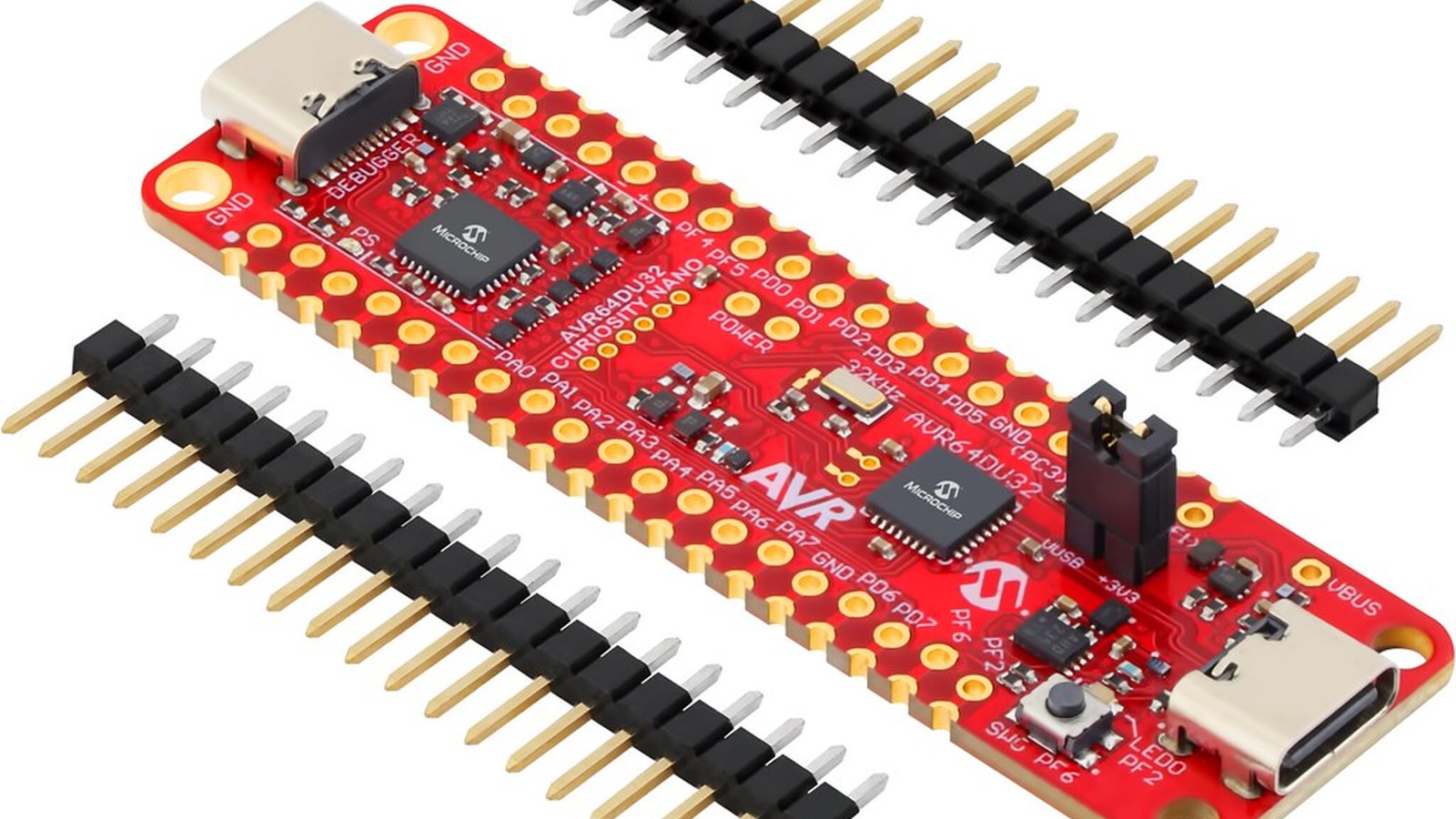
Microchip paired the family with the AVR64DU32 Curiosity Nano board. It exposes the microcontroller's pins, includes onboard programming and debugging, and provides USB-C connections for experimenting with the device and its USB functions.
The naming reflects a device with 64 KB of flash in a 32-pin package. Capacity and package options vary across the family, so a custom design should be based on the exact part number rather than the family headline.
AVR DU is supported by MPLAB X, the MPLAB XC8 compiler, and MCC Melody. A compiler translates human-readable C code into machine instructions for the microcontroller. MCC can configure the USB module and generate a starting software stack, which saves considerable protocol setup.
Test with more than the development board. USB problems often come from cables, hubs, host operating systems, electrostatic-discharge protection, or printed-circuit-board layout. Try several computers and cable types. Check current draw, connector temperature, and behavior during repeated unplugging.
Why this AVR family matters
AVR DU shows how an 8-bit microcontroller can remain useful without competing on raw processing speed. USB protocol hardware, clock recovery, protected programming, and specialized memory behavior solve tasks that would otherwise require more components or much more firmware.
The device is best suited to products whose main job remains modest but whose connection to the outside world needs to be modern. A keypad, instrument, rechargeable controller, or custom USB peripheral may not need a 32-bit processor. It does need reliable USB, safe power design, and an update plan.
For makers, the family also creates a route beyond older USB-capable AVRs such as the ATmega32U4. The key is to treat USB-C as an electrical and protocol system, not merely a connector swap. AVR DU supplies several important building blocks. A successful product still depends on how carefully those blocks are connected.
If AVR DU has caught your eye, I'd start with the Curiosity Nano board and prove the USB behavior on a few different computers and cables before designing a custom board around it.
Sources and image credits
- Microchip announcement: AVR DU USB microcontrollers
- Microchip AVR DU product family
- Official AVR64DU32 Curiosity Nano image supplied by Microchip Technology with explicit permission to publish.
- Square and vertical crops are edited from the same source image.