Security on a connected microcontroller becomes difficult when every part of the firmware shares the same privileges. A bug in a network parser should not automatically give an attacker access to device credentials, signing keys, or every byte of protected storage. Yet that is the risk when trusted secrets and ordinary application code live in one undivided software environment.
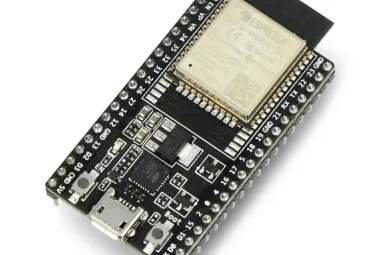
Espressif addressed that problem on February 18, 2025, with the ESP-TEE framework for the ESP32-C6. TEE means trusted execution environment: an isolated part of a system reserved for sensitive code and data. ESP-TEE separates security services from the main ESP-IDF application by using privilege levels built into the ESP32-C6's RISC-V processor and the chip's security peripherals.
The immediate benefit is not that application code becomes bug-free. It is that a flaw in less-trusted code has a harder time reaching the most valuable assets.
How ESP-TEE divides the chip
The ESP32-C6 supports two RISC-V privilege levels. Machine mode, usually shortened to M-mode, is the more privileged level. User mode, or U-mode, has fewer rights. ESP-TEE places its trusted firmware in Machine mode while the normal application, ESP-IDF, and FreeRTOS run in User mode as the rich execution environment.
The rich execution environment is where product features normally live. It may handle sensors, a user interface, Matter logic, wireless messages, and business rules. When that application needs a protected service, it communicates with the TEE through a defined secure interface rather than reading the secret directly.
This is a familiar security pattern on larger computers, adapted to a resource-constrained microcontroller. A cryptographic key can remain inside the trusted side while the application asks it to sign or decrypt data. The application receives the result without gaining unrestricted access to the key itself.
Hardware-enforced isolation is the important phrase. A normal C module can hide a variable behind an API, but a memory-corruption bug may still cross that software boundary. Privilege controls and security peripherals create a stronger boundary that the processor enforces.
What ESP-TEE is designed to protect
Espressif identified secure storage, sensitive cryptographic operations, secure over-the-air updates, and attestation as central uses. An over-the-air update, usually called OTA, replaces device firmware through a network connection. Secure OTA verifies that an update is authentic before installing it. Attestation lets a device provide evidence about its identity or software state to another system.
Consider a smart-home controller. It may keep credentials for joining a network, keys for authenticating accessories, and certificates used to prove its identity. Ordinary application code still needs to request secure operations, but it does not need raw access to every credential. If a parser in the untrusted side is compromised, the isolation layer is intended to keep the keys and protected operations on the trusted side.
ESP-TEE also gives developers a cleaner way to decide which code deserves the highest privilege. The secure part should remain small and focused. That reduces the amount of code that must be reviewed as part of the trusted computing base, the collection of hardware and software that the security model depends upon.
What ESP-TEE does not guarantee
A trusted execution environment is a security boundary, not a magic shield. Developers still need secure boot, signed updates, sensible key provisioning, protected debug settings, careful input validation, and a process for shipping fixes. A badly designed trusted service can expose too much through its own interface. A product can also leak secrets through logs, external components, or operational mistakes outside the TEE.
Isolation therefore changes the consequences of a bug rather than removing the possibility of bugs. Its value comes from defense in depth, which means using several independent protections so one failure does not expose the whole system.
The February announcement also described a roadmap, not universal support across every ESP32. Espressif said ESP-TEE would officially become part of ESP-IDF 5.5 for the ESP32-C6, with more RISC-V-based Espressif chips planned later. Teams evaluating it now should check the supported chip and framework version rather than assume the same design works on older Xtensa-based parts.
Why the ESP32-C6 is a logical starting point
The ESP32-C6 combines a RISC-V processor with Wi-Fi 6, Bluetooth Low Energy, and IEEE 802.15.4 radios. IEEE 802.15.4 is the low-power radio foundation used by Thread and Zigbee. That makes the chip attractive for connected products that may handle several trust relationships at once: the local network, a commissioning phone, a cloud service, and nearby smart-home devices.
Those products are increasingly expected to stay in service for years. Their credentials and update mechanisms become long-lived targets. Separating security services from application features can make maintenance safer because the boundary remains in place as product code evolves.
The same architecture can also help teams divide responsibility. A platform group can maintain the trusted services while application developers work against a narrow interface. That does not eliminate security review, but it can make the review scope more understandable.
What developers should do first
The sensible starting point is not moving an entire application into the TEE. It is making an inventory of the assets that would cause the greatest harm if exposed. Device identity keys, update verification keys, encrypted configuration, and signing operations are common candidates.
Next, define the smallest useful interface between the application and those assets. Prefer requests such as "sign this digest" over calls that return a private key. Validate every argument crossing the boundary, because the rich execution environment must be treated as potentially hostile within this model.
Finally, test failure cases. Interrupt updates, pass malformed requests, exhaust buffers, and confirm that debug builds do not accidentally expose secrets. Security architecture only earns trust when its assumptions survive testing.
ESP-TEE is significant because it brings a recognizable isolation model to an inexpensive, highly connected microcontroller. For makers, it is a chance to learn security architecture on accessible hardware. For product teams, it offers a practical way to keep credentials and sensitive operations away from the rapidly changing application layer. Either way, the most useful lesson is simple: code does not need access to a secret merely because it runs on the same chip.
The habit I'd borrow even if you never use ESP-TEE is simple: keep your keys behind a narrow interface, and ask for results rather than raw secrets.
Sources and image credits
- Espressif Developer Portal: Announcing ESP-TEE
- Official Developer Portal image supplied by Espressif Systems.
- Square and vertical crops are edited from the same source image.