how electronics work

A voltmeter dial above three symbol panels for circuit common, chassis ground and protective earth, beside the title How Electronics Work, Part 10, How Electrical Ground Works
How Electrical Ground Works: Mastering Fundamental Electronics Part 10
Learn how electrical ground works: circuit reference, signal ground, chassis, protective earth, ground faults and ground loops, and why ground is not always zero volts.
A kilowatt-hour meter, a stopwatch and a battery linked by glowing wires, beside the title How Electronics Work, Part 9, How Electrical Energy Works
How Electrical Energy Works: Mastering Fundamental Electronics Part 09
Learn how electrical energy works: joules, watt-hours, kilowatt-hours, amp-hours versus energy, and why not every stored watt-hour reaches your load.
A wattmeter dial with glowing wires linking a voltmeter, an ammeter and a lamp, beside the title How Electronics Work, Part 8, How Electrical Power Works
How Electrical Power Works: Mastering Fundamental Electronics Part 08
Learn how electrical power works: watts as a rate, P = VI, resistor heating, source and load signs, efficiency, and a worked LED resistor example.
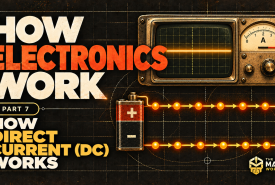
A vintage oscilloscope with a flat trace and a battery driving glowing charges around a loop, beside the title How Electronics Work, Part 7, How Direct Current (DC) Works
How Direct Current (DC) Works: Mastering Fundamental Electronics Part 07
Learn how direct current works: polarity, the complete path, steady versus rippled DC, common sources, and why a real battery sags under load.
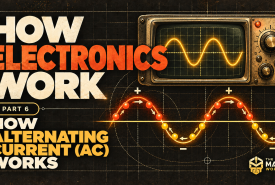
A vintage oscilloscope showing a sine wave with reversing charges, beside the title How Electronics Work, Part 6, How Alternating Current (AC) Works
How Alternating Current (AC) Works: Mastering Fundamental Electronics Part 06
Learn how alternating current works: what alternates, how to read a sine wave, frequency, period, phase, and why a 120V RMS supply peaks near 170V.
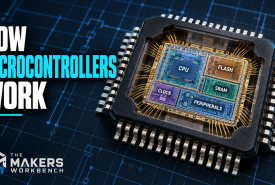
How Microcontrollers Work card (horizontal)
How Microcontrollers Work
Learn how a microcontroller works: the CPU, flash, SRAM, clock, GPIO pins, and peripherals packed into one chip, and how your code turns into a lit LED.
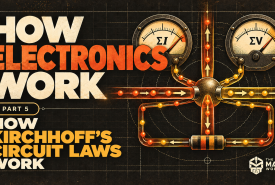
Two vintage dials marked sigma I and sigma V above a glowing junction where currents split and recombine around a resistor loop, beside the title How Electronics Work, How Kirchhoff's Circuit Laws Work
How Kirchhoff's Circuit Laws Work: Mastering Fundamental Electronics Part 05
Learn how Kirchhoff's circuit laws work: the current law at a node, the voltage law around a loop, sign conventions, and a fully solved two-loop circuit you can check against a simulator or a breadboard.