
The board on the bench can wait. The model picker changes the bill. On June 9, 2026, Anthropic launched Claude Fable 5, a Mythos-class model it says is safe enough for general use, and Claude Mythos 5, which it says is the same underlying model with some safeguards lifted.
Mythos-class, in Anthropic's footnote, means a tier above the Opus line. The first of that tier, Claude Mythos Preview, went out in April through Project Glasswing, a limited program for cyber defenders and infrastructure providers. Fable 5 is the copy a general customer can call. On the API, the application programming interface developers use, the model id is claude-fable-5. The price is $10 per million input tokens and $50 per million output tokens. A token is a small slice of text the meter counts, often a word or a piece of a word. Anthropic says that rate is less than half the price of Mythos Preview.
Pro, Max, Team, and seat-based Enterprise plans, priced per person, include Fable 5 through June 22. The API, and consumption-based Enterprise plans that bill for tokens rather than a fee per seat, can call it today. I would spend the included window on a long session in Claude Code, Anthropic's tool that reads a project, edits files, and runs commands. Ordinary questions stay on Claude Opus 4.8. The new meter is steep, and some requests leave Fable on purpose.
What actually changed?
A safeguard is a check that keeps the strong model from answering a covered topic. Anthropic says those checks are what split the two names. Fable 5 is the general door, with the checks on. Mythos 5 lifts some of them. At launch it is only for partners who already have Mythos Preview inside Project Glasswing. Wider access is a later plan. It is not an open signup today.
The check you will feel is the fallback. On some cybersecurity, biology, and chemistry requests, and on some bulk attempts to copy the model's answers so another system can be trained on them, Fable does not write the reply. Opus 4.8 does. Anthropic says the product tells you when that handoff happens. That handoff is the fallback. The launch post says the checks fire in less than 5 percent of sessions on average, so more than 95 percent of Fable sessions never leave Fable. The Verge, reporting the same day, put the testing figure at 95 percent of sessions with no fallback.
How does the new piece work?
You send a prompt, which is the text of the request. Classifiers look first. A classifier here is a separate checker, not the main model. If it stays quiet, Fable answers. If it trips, Opus 4.8 answers and you are told. Anthropic says the checks are tuned cautious, so a harmless question can trip them. The company would rather over-trigger at launch than miss a risky request.
I am not going to repeat the life-sciences procedures in the post. On the bench, the fallback is what changes the session. A chemical-sensor question or a request about attacking a bootloader is the kind of prompt the checker is built to move. Mythos 5 is the Glasswing copy with some cyber checks lifted. A biology program for a few researchers is described as later, with cyber checks still on. Anthropic points to a system card for the long write-up. If the on-screen notice names Opus 4.8, grade the reply as Opus 4.8.
What does this look like on a real project?
The job I would buy Fable for is the long one. Say the board is a motor controller and a DMA transfer is failing. DMA means direct memory access, hardware that copies bytes without the processor touching each one. It runs for twenty minutes, then drops a sample. The useful work is the driver, the datasheet chapter, the logic-analyzer notes, and a failing test. Anthropic says Fable's lead over its other models grows as the task gets longer. That is the claim I would be paying for.
I would open Claude Code on the repo, name the symptom, point at the driver and the test, and say not to flash the board. Anthropic says Fable can hold a long task and use its own notes on later steps, so I would let it keep a notes file. Then I would read the diff myself. I have not run Fable 5. This is the session I would set up.
Ordinary edits stay on Opus 4.8, and so do prompts the checker is built to catch. Anthropic says Stripe used Fable on a 50-million-line codebase and finished, in a day, a migration a team would have spent more than two months on by hand. That is Anthropic's report of Stripe's run. I would still review every line on the motor controller.
How does it compare with the previous version?
Opus 4.8 is the previous general model. Mythos Preview is the previous model in the Mythos tier. Anthropic says Fable exceeds any model it has made generally available, with the largest gap on long work, and that it uses fewer tokens than earlier Claude models. Fewer tokens help the bill only if the drop outruns the higher price. On a short prompt, I would not expect that.
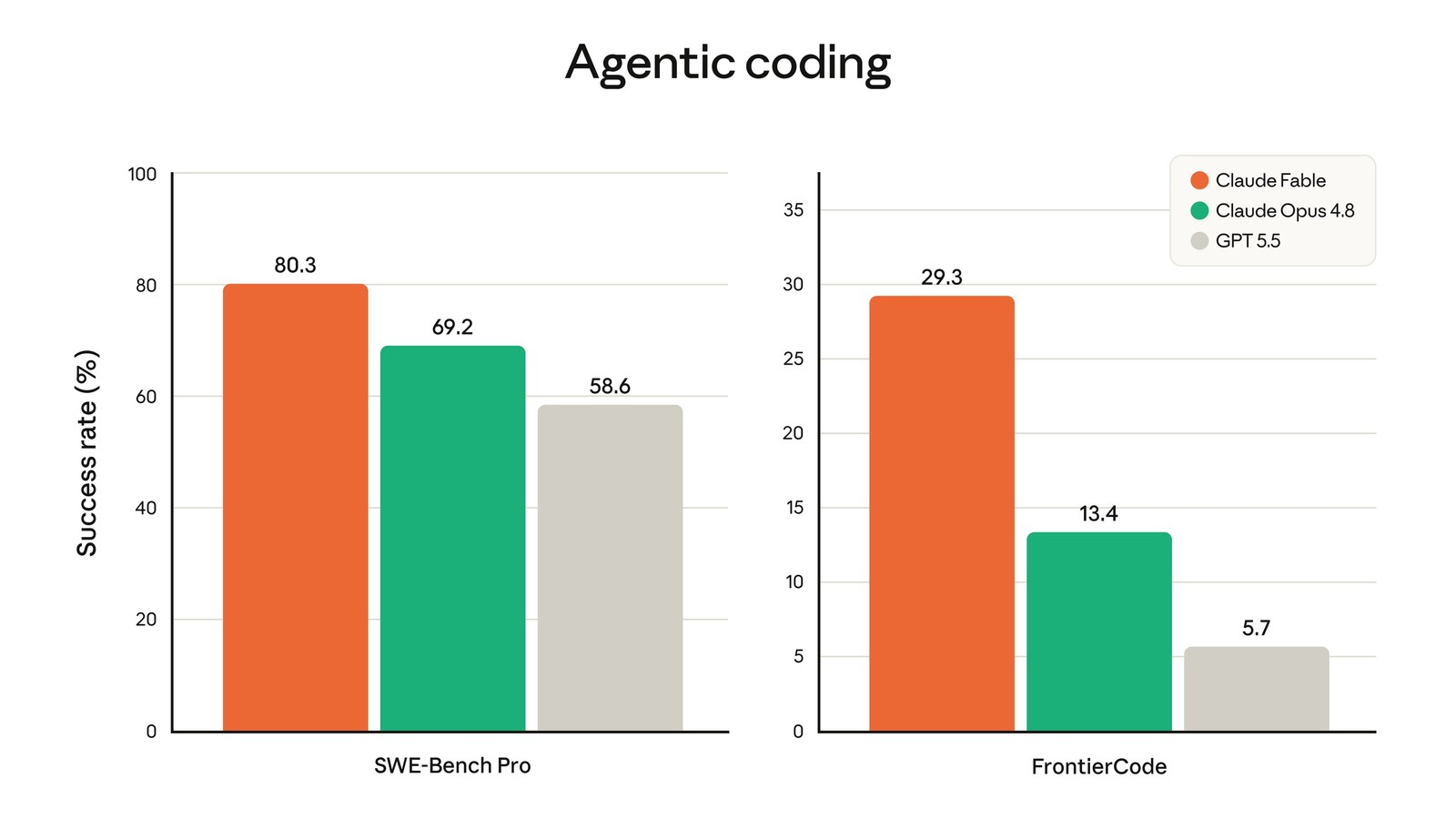
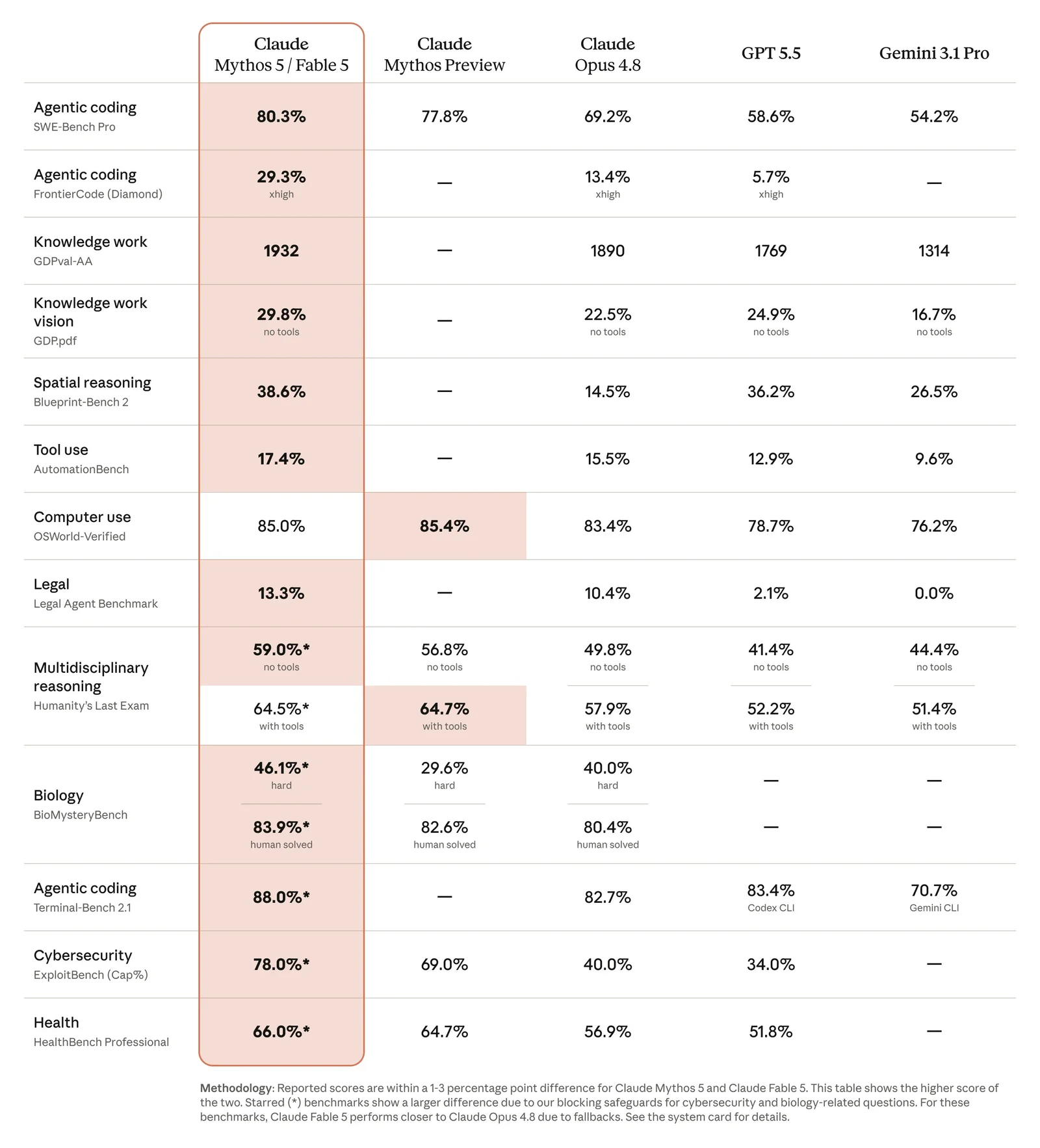
Anthropic's bar chart labels Fable at 80.3 percent on SWE-Bench Pro, a software-repair test, against 69.2 percent for Opus 4.8. On FrontierCode, Cognition's harder coding test, it labels Fable at 29.3 percent and Opus 4.8 at 13.4 percent. A footnote says many rows show the higher of Fable and Mythos 5. On the cybersecurity and biology rows, Anthropic says Fable lands closer to Opus 4.8 because of the fallback. Do not read those rows as what a general account receives. The prose also says Fable leads FrontierCode at medium effort, while the table marks 29.3 percent as extra-high. Those are not the same point.
Where does it sit next to other tools a maker already uses?
Fable sits inside Claude Code and on the API. It does not replace the editor, the scope, or the programmer. Opus 4.8 stays in the picker because Anthropic made it the fallback, and because it is the right start when you already know the request is ordinary or sensitive. GPT-5.5 is still the other coding model a lot of us pay for, and Anthropic's chart, which Anthropic ran, puts Fable ahead on those coding rows. Mythos 5 is not a third tab unless you are already a Glasswing partner.
What does this cost, and who can use it today?
Both models are $10 per million input tokens and $50 per million output tokens. Anthropic's own comparison is with Mythos Preview: less than half. Wired, on June 9, described the new rate as twice what Anthropic charges for its publicly available models. The Fable post does not print an Opus 4.8 price, and I will not invent one. I would keep Fable on the long job. Short questions belong on the model you already use.
Access is staged. API calls to claude-fable-5, and consumption-based Enterprise, start today. Through June 22, Pro, Max, Team, and seat-based Enterprise include Fable at no extra cost. On June 23, Anthropic says it removes that include. Afterward, Fable draws usage credits, which are extra balance on a paid plan. The company says it may extend that window if capacity allows. Mythos 5 stays with Glasswing partners. A missing menu entry on night one can be the staged rollout. Anthropic says demand will be hard to predict.
What is still unproven?
I have not run Fable 5, and this is not a bench review. The coding bars, the Stripe story, and the long-task claim are Anthropic's reports, plus early customers as Anthropic tells them. The "more than 95 percent" line is early internal data. The Verge's 95 percent figure is the same claim, repeated the same day.
Anthropic already says benign requests will sometimes fall back, because the checks were tuned conservative on purpose. Count those notices on your own prompts before you move a repo. The included window ends June 23 unless it is extended. I would spend it on one long Claude Code job I know how to grade, and leave ordinary work on Opus 4.8.
Disclosure: The author is a paying subscriber to ChatGPT Plus, Claude Pro, and SuperGrok and uses all three services on a daily basis. The Makers Workbench is not affiliated with OpenAI, Anthropic, xAI, Google, or any of the other major AI companies covered in our reporting. No company receives favorable editorial treatment based on the author's personal subscriptions.
Sources and image credits
- Anthropic announcement (www.anthropic.com)
- Images: published by Anthropic with the announcement.