
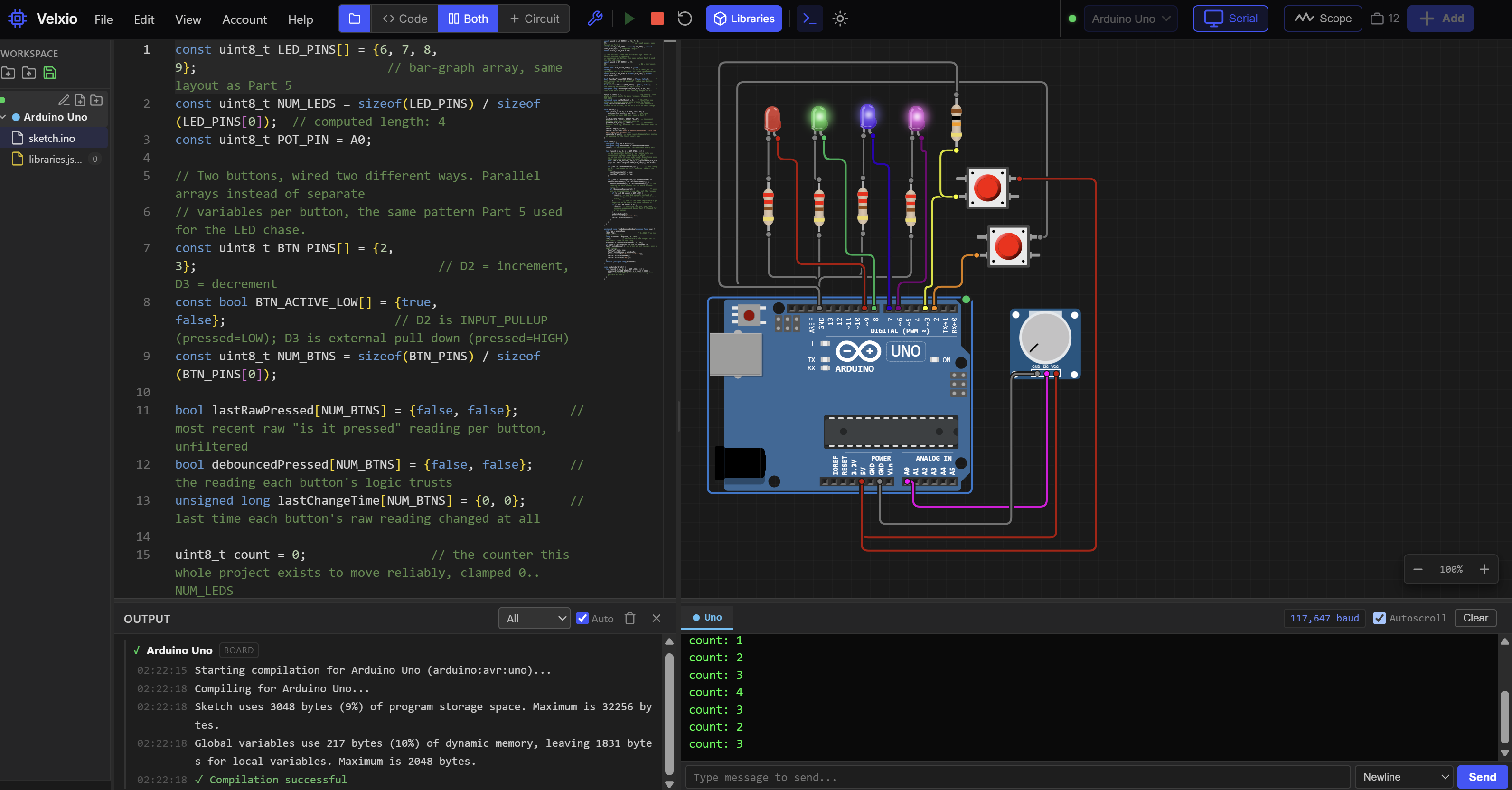

After an overnight soak test I have a serial log, a stale README, and a firmware fix I would like to leave running. On September 22, 2026, OpenAI put GPT-6 Sol and GPT-6 Luna on that work. Plus, Pro, Business, Enterprise, and Edu users get both in ChatGPT Work and in Codex. Free and Go users get Luna in the desktop app. OpenAI says neither model is in Chat yet, the regular conversation view, as distinct from Work and Codex.
A token is a chunk of text the model reads or writes, often only part of a word. Prices are per million tokens. The table moves GPT-5.6 Sol from $4 input and $20 output to GPT-6 Sol at $2 and $10, and GPT-5.6 Luna from $0.20 and $1.20 to GPT-6 Luna at $0.10 and $0.50. OpenAI labels each row 50 percent cheaper than the GPT-5.6 promotional pricing.
GPT-6 Astra arrived earlier in September. OpenAI calls it the most intelligent and aligned model in the world, and says Sol and Luna were trained with similar methods so that more of that work fits a smaller bill. Astra stays the top model. Luna is for bulk documentation and test logs. Sol is for the coding session. Astra is for a job that is genuinely hard. I would not leave Astra selected for the log.
What actually changed?
The number I watch is the output price on a coding agent I forgot to stop. An agent here is a model loop that can read files, call tools, and keep going while I do something else at the bench. On Sol, output is the expensive line: $10 is five times the $2 input price.
On Sol, $4 to $2 and $20 to $10 are each exactly half. One million input tokens plus one million output tokens cost $24 on the old Sol promotional rates and $12 on GPT-6 Sol. On Luna, input is exactly half, $0.20 to $0.10. Output on that same row goes from $1.20 to $0.50, and OpenAI still labels the row 50 percent cheaper. The matching pair falls from $1.40 to $0.60. That is the 50 percent reduction the table shows, measured against the promotional GPT-5.6 column.
OpenAI also says GPT-6 prompt caching improved, with a 90 percent discount on cached input-token reads. A cache is a saved prefix of the prompt. If the next call starts with the same prefix, those tokens can be reread at the discount. Ninety percent off Sol's $2 input is $0.20 per million cached tokens. Ninety percent off Luna's $0.10 input is $0.01 per million. Those two figures are arithmetic on the discount OpenAI stated. The September 22 table does not print them as their own row.
How does the new piece work?
Picture Codex still walking a firmware tree while the iron heats. The API names are gpt-6-sol and gpt-6-luna. Sol is the edit. Luna is the long, repetitive read.
OpenAI says you can change reasoning effort, how long the model thinks, without discarding the cached prefix. Paste today's log at the top of the prompt and you pay full input price. Leave the repo at the front and later turns can hit the cache.
OpenAI says daily token use inside the company, valued at API prices, has passed $600 for the median researcher and $7,000 at the 90th percentile. I am not that shop. The same card is what a solo developer pays. Halving Sol's input and output is what lets me start a coding session and check it after the iron work. Luna at $0.50 per million output tokens is cheap enough for the log and the docs.
What does this look like on a real project?
This is the assignment I would use on the soak-test morning. I did not run it on publication day.
The log and the stale README go to Luna. I ask for the failed checks, the timestamps, and a documentation patch that matches the firmware on the board. Logs and bulk docs burn output tokens. At $0.10 in and $0.50 out, I leave that job running while I check that the hub is still powered.
The coding session goes to Sol in Codex. The input is Luna's summary plus the firmware tree. The bug is concrete: after suspend, the device stops answering on the bus. Sol's new rates are half the old promotional input and half the old output, so I leave the session selected while I am on the scope.
Astra enters only if Sol misses the same check twice and the miss is in a corner of the protocol I do not already understand. OpenAI says the demanding projects still need Astra, and that Astra remains the best model across the board. If Work or Codex does not show the names yet, OpenAI says the launch-day rollout is gradual and to try again later.
How does it compare with the previous version?
The previous column is GPT-5.6 Sol and Luna at the promotional rates. The scores below are OpenAI's, from their research setup or API, with competitor numbers taken from public reports.
On DeepSWE v1.1, long software tasks in real codebases, OpenAI says Sol at maximum effort scores 68.8 percent. That is 1.1 percentage points under Claude Fable 5's highest score on that evaluation, 69.9 percent at extra-high effort, at about 80 percent lower cost per task. Luna at maximum effort scores 66.6 percent, which OpenAI calls comparable to medium-effort Opus 5 and Fable 5, at 93 percent less per task than Opus 5 and 96 percent less than Fable 5.
On a factuality set of chats where someone had already flagged a mistake, OpenAI says Sol makes about half as many mistakes as its predecessor. Those prompts are not typical use.
Where does it sit next to other tools a maker already uses?
The other paid window on my bench is usually Claude. Inside OpenAI's picker, the question is which tier stays selected when I stand up to solder.
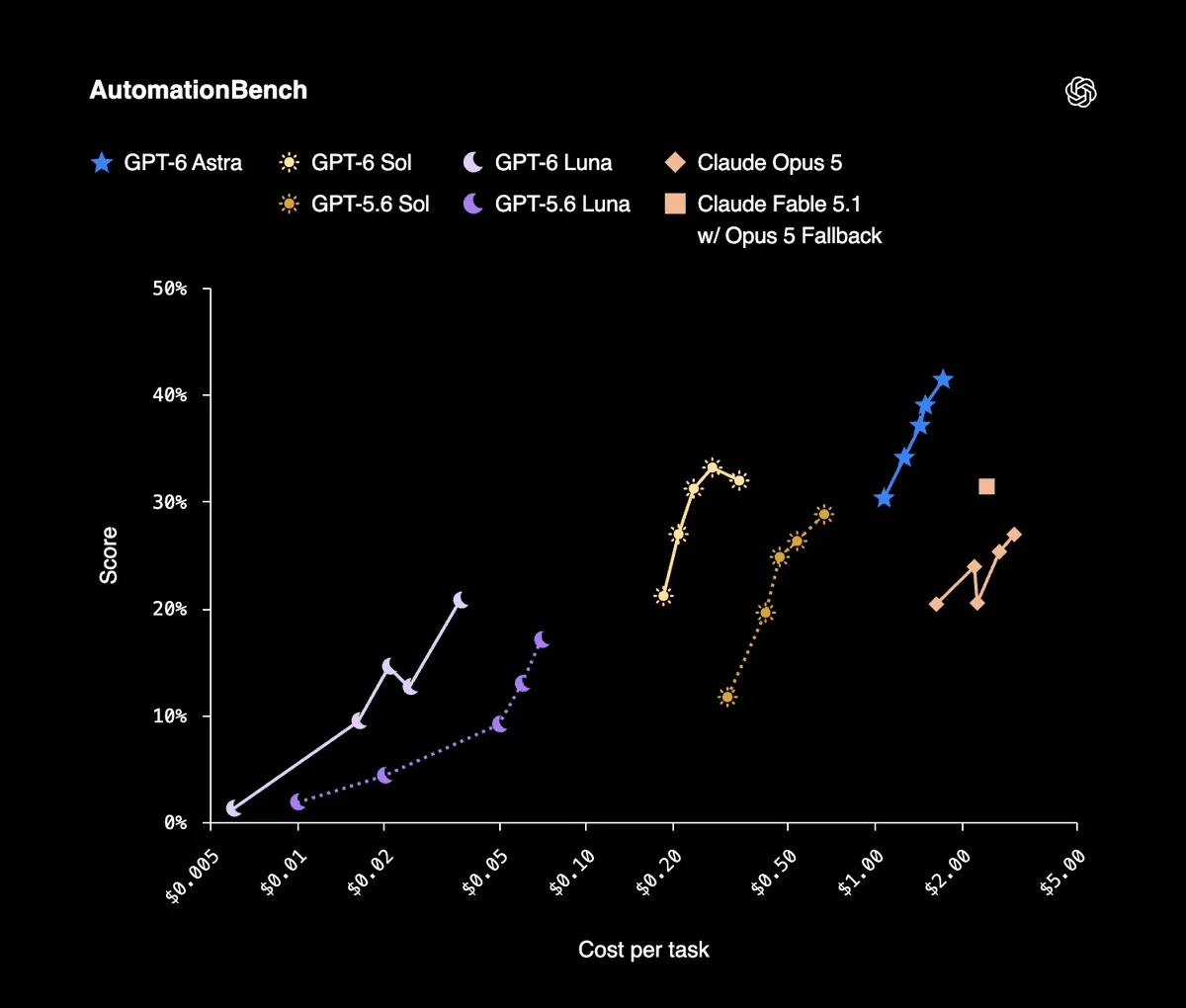
On AutomationBench, a 47-tool workflow test, OpenAI says extra-high Sol scores 33.2 percent at $0.27 per task, beating maximum-effort Opus 5 (26.9 percent) at 9 percent of the cost, or 11.1 times Sol's cost. Low-effort Astra scores 30.3 percent at 3.9 times that cost. Fable 5.1 with an Opus 5 fallback scores 31.4 percent at more than 8.9 times, with fallback cost omitted. OpenAI says those fallbacks hit about 40 percent of tasks. High-effort Luna gains 5.4 points on its predecessor at 58 percent lower cost per task.
On OSWorld 2.0 offline, partial reward, extra-high Sol scores 60.5 percent against medium-effort Opus 5 at 60.3 percent, at about 80 percent lower cost. OpenAI still calls Astra its best computer-use model. The rank order is theirs until another harness is public.
What does it cost, and who can use it today?
GPT-6 Sol is $2 per million input tokens and $10 per million output tokens, as gpt-6-sol. GPT-6 Luna is $0.10 and $0.50, as gpt-6-luna. Both are in the API, and in ChatGPT Work and Codex for Plus, Pro, Business, Enterprise, and Edu. Luna is also in the desktop app for Free and Go users. Neither model is in Chat yet. The Work and Codex rollout is gradual on launch day.
Cached reads keep the 90 percent discount only if the prefix holds still. Astra stays for the hard job. This post does not restate Astra's dollar prices in the Sol and Luna table.
What is still unproven?
I have not run Sol or Luna for this article. The benchmark figures are OpenAI's account, and the factuality prompts were chosen because an earlier model had already failed. Cache savings depend on keeping the repo prefix still.
The rate is the part I can audit. Sol at $2 and $10. Luna at $0.10 and $0.50. OpenAI's 50 percent label against the promotional column. That changes which jobs a solo developer leaves running. It does not make Astra the model for the log.
Disclosure
Disclosure: The author is a paying subscriber to ChatGPT Plus, Claude Pro, and SuperGrok and uses all three services on a daily basis. The Makers Workbench is not affiliated with OpenAI, Anthropic, xAI, Google, or any of the other major AI companies covered in our reporting. No company receives favorable editorial treatment based on the author's personal subscriptions.
Sources and image credits
- OpenAI announcement (openai.com)
- Images: published by OpenAI with the announcement.


