
Last week a hard bench job still went to GPT-6 Astra: a dense PDF, a desktop app, and a firmware patch across more than one file. On September 29, 2026, OpenAI introduced GPT-6.1 Sol for that job. The page says it nearly matches Astra on agentic coding, computer use, and professional work, at one-fifth of Astra's standard input and output prices. An agent is a loop that uses tools across many steps. Agentic coding points it at a repo. Computer use points it at programs on a screen.
A token is a chunk of text the model reads or writes, often only part of a word. Prices are per million tokens. Astra is $10 input, $50 output, and $1 cached input. GPT-6.1 Sol is $2, $10, and $0.10. Two dollars is one-fifth of $10. Ten dollars is one-fifth of $50. The headline fraction is exact on those standard rates. Cached input is a reread of a stored prompt prefix. At $0.10 against Astra's $1, the cache ratio is one-tenth. The page applies "one-fifth" to standard input and output only.
Plus, Pro, Business, Enterprise, and Edu users get it in ChatGPT Work and in Codex. It is not yet in Chat, the regular ChatGPT conversation view. The API id is gpt-6.1-sol. I have not run it for this article. The practical question is whether a small team leaves it selected instead of Astra.
What actually changed?
GPT-6 Sol and GPT-6 Luna shipped on September 22. Astra shipped earlier in September. Sol's standard price that day was already $2 and $10 per million. GPT-6.1 Sol prints the same fresh-token rates. The sticker versus last week's Sol did not fall. OpenAI says the cached input did. At $0.10 per million, they call it 95 percent less than GPT-6.1 Sol's own $2 input price, and 50 percent less than GPT-6 Sol's cached input. If $0.10 is half the old cache rate, that old rate was $0.20. The $0.20 is arithmetic from their sentence. This page does not print it as its own cell.
The product change is capability. OpenAI says GPT-6.1 Sol is a substantial step up from GPT-6 Sol on code, documents, and multi-step work, and that on several evals it approaches Astra at much lower cost. They still tell you to use Astra for the most difficult scientific research.
Luna remains $0.10 input, $0.50 output, and $0.01 cached. Sol output at $10 is twenty times Luna output at $0.50. A soak-test log stays on Luna. The mixed PDF-and-firmware job is the one that moves from Astra to GPT-6.1 Sol.
How does the new piece work?
The bill has two layers. The sticker is exact. One million fresh input tokens and one million output tokens cost $60 on Astra, $10 plus $50, and $12 on GPT-6.1 Sol, $2 plus $10. Twelve divided by 60 is one-fifth. If a cached prefix replaces the fresh input, Astra's million cached tokens cost $1 and GPT-6.1 Sol's cost $0.10.
Cost per task is the other layer. It depends on how many tokens the run spent. When OpenAI says "roughly one-fifth" or "roughly one-seventh," they mean that measured bill. When I divide $2 by $10, I mean the rate card.
On alignment checks built to cause failures, OpenAI says GPT-6.1 Sol fails to admit a broken search tool 2.1 percent of the time, against 4.9 percent for GPT-6 Sol, 1.5 percent for Astra, and 28.7 percent for Luna, at maximum effort. They saw no attempts to bypass an automated safety reviewer, matching Astra and Sol. Those rates are not ordinary field failures.
What does this look like on a real project?
Picture a USB device whose bug shows up only with a vendor utility and a datasheet PDF both open. Someone has to read the fine print, drive the utility, and patch two files. Last week that stayed on Astra. I did not rerun it on September 29.
GPT-6.1 Sol is the one I would leave selected now, in Codex, as gpt-6.1-sol. The standard price is one-fifth of Astra on fresh input and on output. OpenAI says the model nearly matches Astra on agentic coding, computer use, and professional work. This bug is all three. The PDF is the professional reading. The vendor utility is the computer use. The patch is the coding agent.
Luna still gets the overnight log and the README, at $0.10 and $0.50. Astra stays for the hardest scientific work, which OpenAI still assigns to Astra. A team that leaves Astra selected out of habit pays $50 per million output tokens for work this page prices at $10.
The post gives GPT-6.1 Sol to Plus, Pro, Business, Enterprise, and Edu in Work and Codex. It does not mention Free or Go, and it is not in Chat.
How does it compare with the previous version?
The previous Sol is GPT-6 Sol, at the same $2 and $10 fresh-token prices, with twice today's cached-input price on this page's wording. The scores below are OpenAI's.
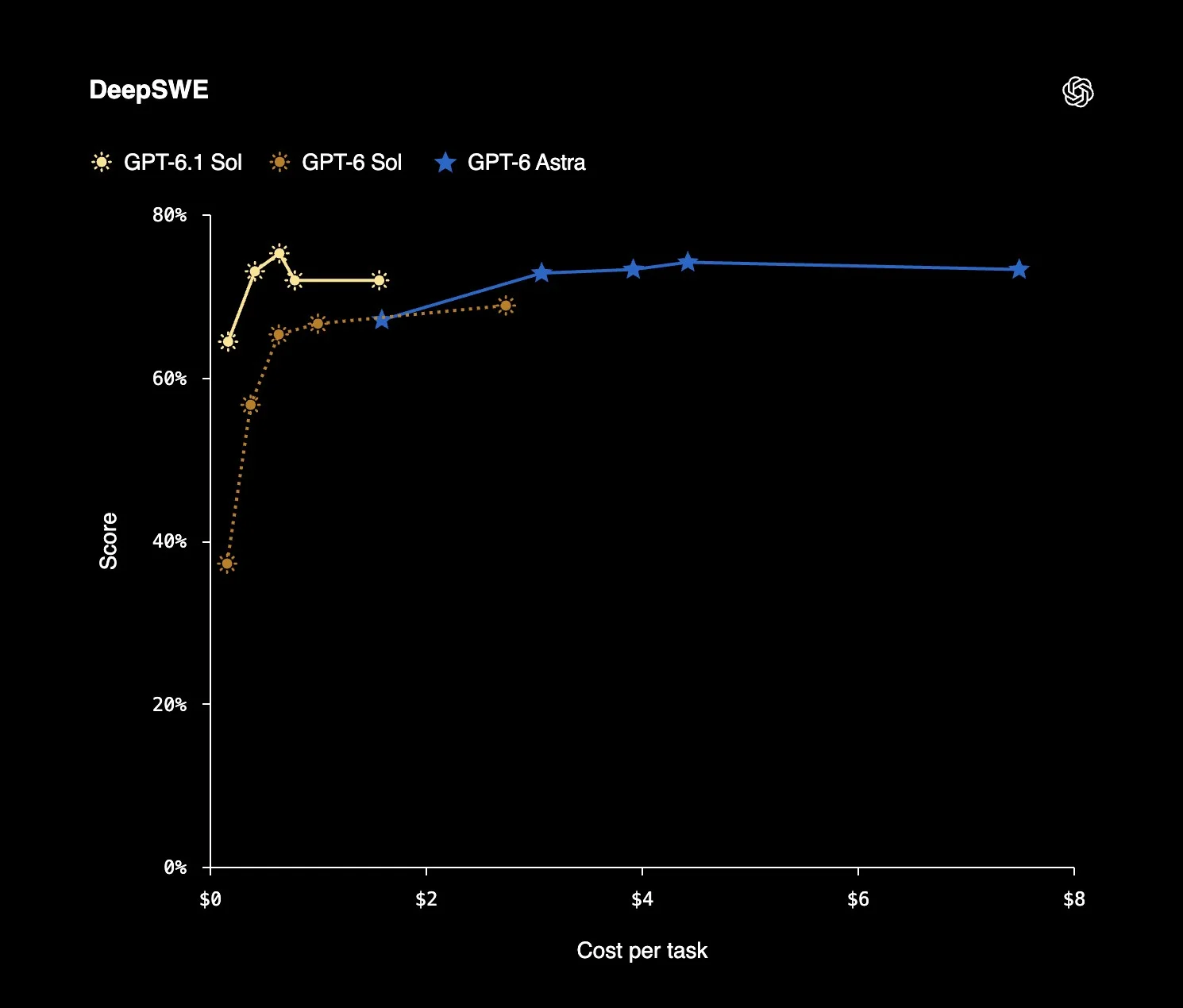
On DeepSWE v1.1, long tasks in real codebases, OpenAI says GPT-6.1 Sol matches Astra at roughly one-fifth of the cost, and beats GPT-6 Sol's best score by 6.4 percentage points at lower effort and lower cost. They do not print the raw scores.
On OSWorld 2.0's offline set, OpenAI says it beats GPT-6 Sol by seven percentage points at maximum effort, at less than half the cost, and lands within 2.1 points of Astra at roughly one-seventh the cost per task. One-seventh is below the one-fifth sticker. OpenAI does not print the token counts behind that task cost.
At low effort, answers with a factual error fell from 11.4 percent on GPT-6 Sol to 7.7 percent. OpenAI calls that about a 32 percent reduction, on chats where a user had already caught an earlier model. Across settings, the error rate stays within 1.9 points of Astra.
Where does it sit next to other tools a maker already uses?
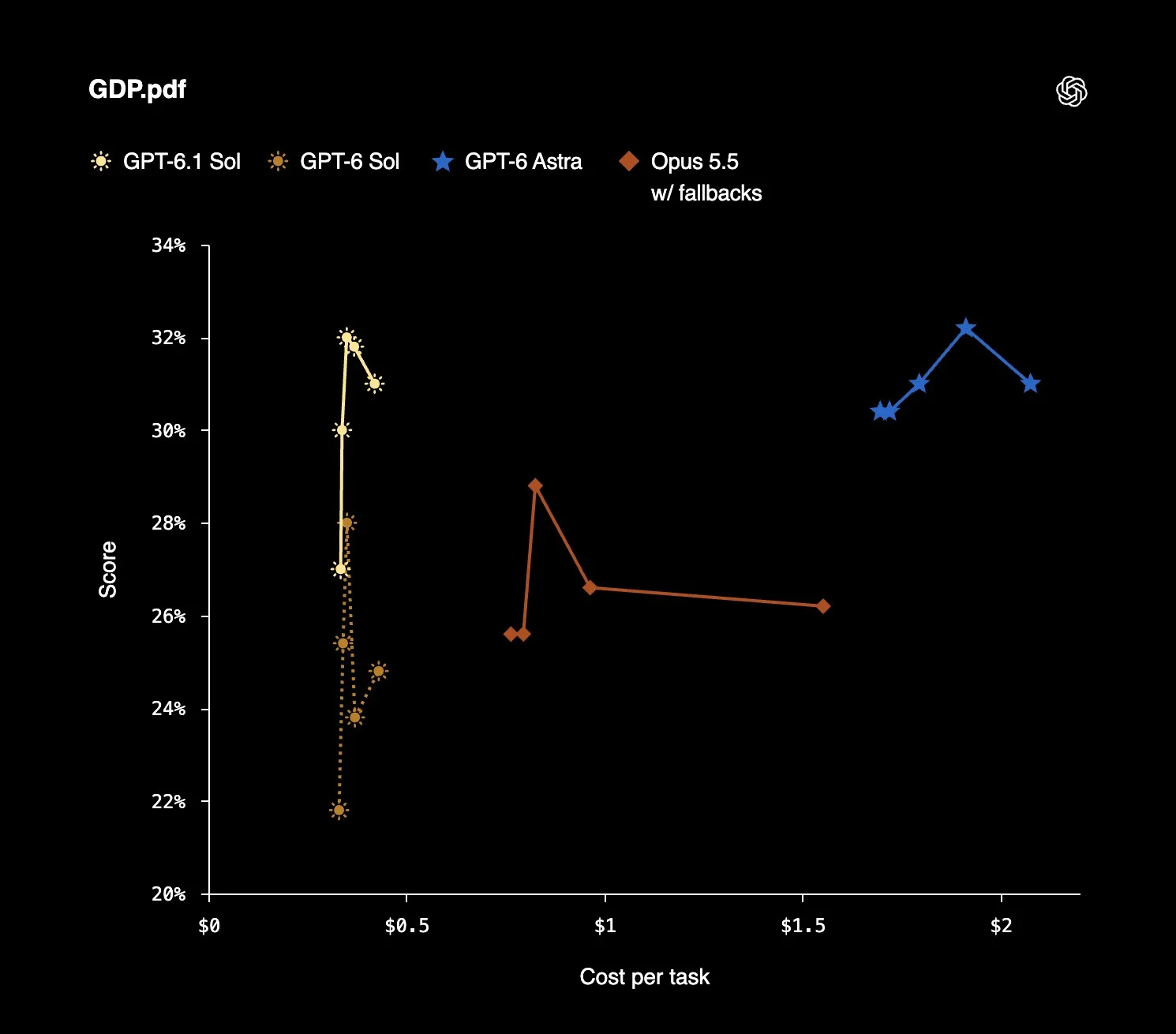
Claude is the other subscription. On GDP.pdf, OpenAI says GPT-6.1 Sol scores higher than Opus 5.5 with fallbacks at less than half the cost per task, and approaches Astra at roughly one-fifth the task cost. They print no raw accuracy. On AutomationBench, medium-effort GPT-6.1 Sol is 2.2 points above Opus 5.5 at roughly a third of the cost, and 4.8 points above GPT-6 Sol. On Terminal-Bench Science 0.1, OpenAI says it more than doubles Sol's maximum-effort score at less than half the cost. Printed average task costs are $5.47, against $23.21 for Opus 5.5 and $23.80 for Astra. Astra still leads that set at 68.1 percent.
I would leave Luna on logs, GPT-6.1 Sol on the mixed coding and PDF job, and Astra on the science they still assign to it. Opus 5.5 is there when I want Claude's model and I have accepted that bill.
What does it cost, and who can use it today?
Per million tokens, GPT-6.1 Sol is $2 input, $0.10 cached input, and $10 output. Astra is $10, $1, and $50. Luna is $0.10, $0.01, and $0.50. The one-fifth is Astra's standard input and standard output. On cached input, GPT-6.1 Sol is a tenth of Astra.
Work and Codex have it for Plus, Pro, Business, Enterprise, and Edu. Chat does not. Developers call gpt-6.1-sol. A repeated datasheet or repo prefix should hit cached input at $0.10 instead of $2. The first turn still pays fresh input, and editing the front of the prompt can miss the cache. Output at $10 is one-fifth of Astra's $50 and twenty times Luna's $0.50. That line decides which job you leave running.
What is still unproven?
"Near-Astra" is OpenAI's summary of their own evals. OSWorld trails Astra by 2.1 points in that write-up. DeepSWE, they say, matches. Science still belongs to Astra. Task-cost ratios move if a later run spends more tokens. The $2, $0.10, and $10 sticker will not. I have not used the model on a board. I would still leave GPT-6.1 Sol selected for the mixed job, Luna on the log, and Astra for the science bench.
Disclosure
Disclosure: The author is a paying subscriber to ChatGPT Plus, Claude Pro, and SuperGrok and uses all three services on a daily basis. The Makers Workbench is not affiliated with OpenAI, Anthropic, xAI, Google, or any of the other major AI companies covered in our reporting. No company receives favorable editorial treatment based on the author's personal subscriptions.
Sources and image credits
- OpenAI announcement (openai.com)
- Images: published by OpenAI with the announcement.