
On May 28, 2026, Anthropic released Claude Opus 4.8 and said it is available everywhere that day. Regular pricing matches Opus 4.7: $5 per million input tokens and $25 per million output tokens. A token is a small chunk of text used for billing. Fast mode, a quicker setting of the same model, is $10 per million input tokens and $50 per million output tokens. Anthropic says fast mode runs at 2.5 times the speed and is three times cheaper than fast mode was on previous models.
Effort control arrives with it on claude.ai and in Cowork. Effort is how long and how deeply the model thinks before it answers. In Claude Code, a research preview called dynamic workflows lets Claude plan a large job, run hundreds of subagents in parallel, and check the result. A subagent is a helper assigned one slice of the work. Anthropic's example is a migration across a whole codebase.
On a shop PC that already hosts a large machine program, the list price did not move. The new choices are how hard the model thinks, and whether a migration may split into workers that still have to pass your tests.
What actually changed?
Opus 4.8 follows Opus 4.7. Anthropic says the new version improves on benchmarks and is a more effective collaborator. They also call the step modest, and say it is one you can feel. I am keeping both descriptions.
Higher effort means more thinking. Lower effort answers faster and spends the rate limit more slowly. The control is on every claude.ai plan, and Anthropic lists Cowork too. Dynamic workflows are the Claude Code feature for a job that will not fit in one pass. Fast mode is the separate speed product at the $10 and $50 rates.
Developers get one API change that is easy to miss. The Messages API now accepts system entries inside the messages array, so instructions can be updated mid-task. Anthropic says this does not break the prompt cache, the saved front of a request you would otherwise resend and pay for again. A harness can use that entry to change permissions, a token budget, or environment context while an agent is running. The model id to call is claude-opus-4-8.
How does the new piece work?
Effort is on every claude.ai plan, and the default is high. On coding tasks, Anthropic says high effort spends about as many tokens as Opus 4.7's default and performs better. Extra, called xhigh in Claude Code, and max, spend more tokens. Anthropic recommends extra for hard jobs and for long runs you are not watching line by line. They raised Claude Code rate limits to fit that use. A lower setting answers faster and burns the cap more slowly.
Fast mode is a separate switch: $10 and $50 per million tokens, against $5 and $25, at 2.5 times the speed. "Three times cheaper" compares this fast mode with fast mode on earlier models. The old price is not printed, so I will not derive it.
Dynamic workflows, still a research preview, have Claude plan the work, run hundreds of parallel subagents, and verify before reporting. Anthropic says Opus 4.8 lets those agents run longer. The example is a migration of hundreds of thousands of lines, judged by the tests you already have. Enterprise, Team, and Max get it in Claude Code.
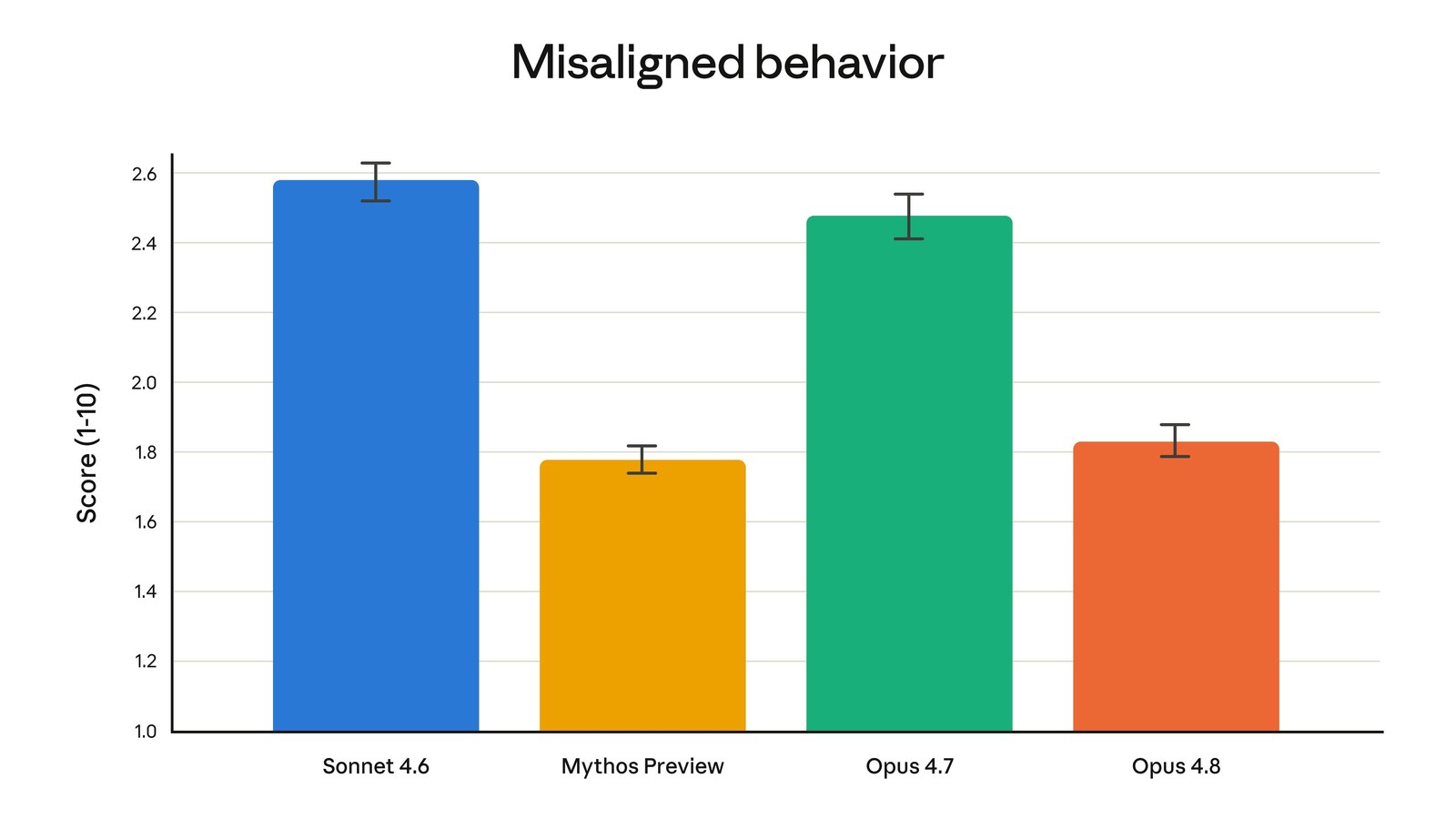
On honesty, Anthropic's evaluations say Opus 4.8 is around four times less likely than Opus 4.7 to let flaws in its own code pass without remark. The Alignment team wrote that it "reaches new highs on our measures of prosocial traits like supporting user autonomy and acting in the user's best interest." They also report less misaligned behavior than Opus 4.7, including deception and cooperation with misuse.

What does this look like on a real project?
Picture a host program that talks to a small CNC interface over a serial port. You are swapping serial libraries. The tests you trust already run on every change. The failure mode is a helper that also rewrites motion math you never named.
I would use Claude Code on a seat that includes dynamic workflows, so Enterprise, Team, or Max, and I would set effort to extra. The instruction names both libraries and the test command. It also says motion math, feed rates, and the emergency-stop path are out of scope.
Claude plans, subagents take modules in parallel, and the existing suite is the check before a merge. A passing suite with a surprise edit on the stop path is still a rejected diff.
String replacements can stay at the high default, which Anthropic ties to 4.7's token spend. The file that parses status bits gets extra. Fast mode is for when the wait is the problem and the higher token price is acceptable. I would keep reading diffs. If this shop runs its own harness, a system entry mid-task is how you cut a directory out of scope, or tighten the token budget, without throwing away the cached standing prompt.
How does it compare with the previous version?
Opus 4.7 is the previous version, and regular pricing is unchanged. Fast mode is the line that moved: $10 and $50 per million, called three times cheaper than the old fast mode, at 2.5 times the speed. If you never turned fast mode on, the billable list price is the one you already know.
Effort is the new control on claude.ai. High is the default. Extra and max buy more thinking. Lower effort stretches the rate limit. Anthropic says Claude Code's limits went up, and does not print the new numbers.
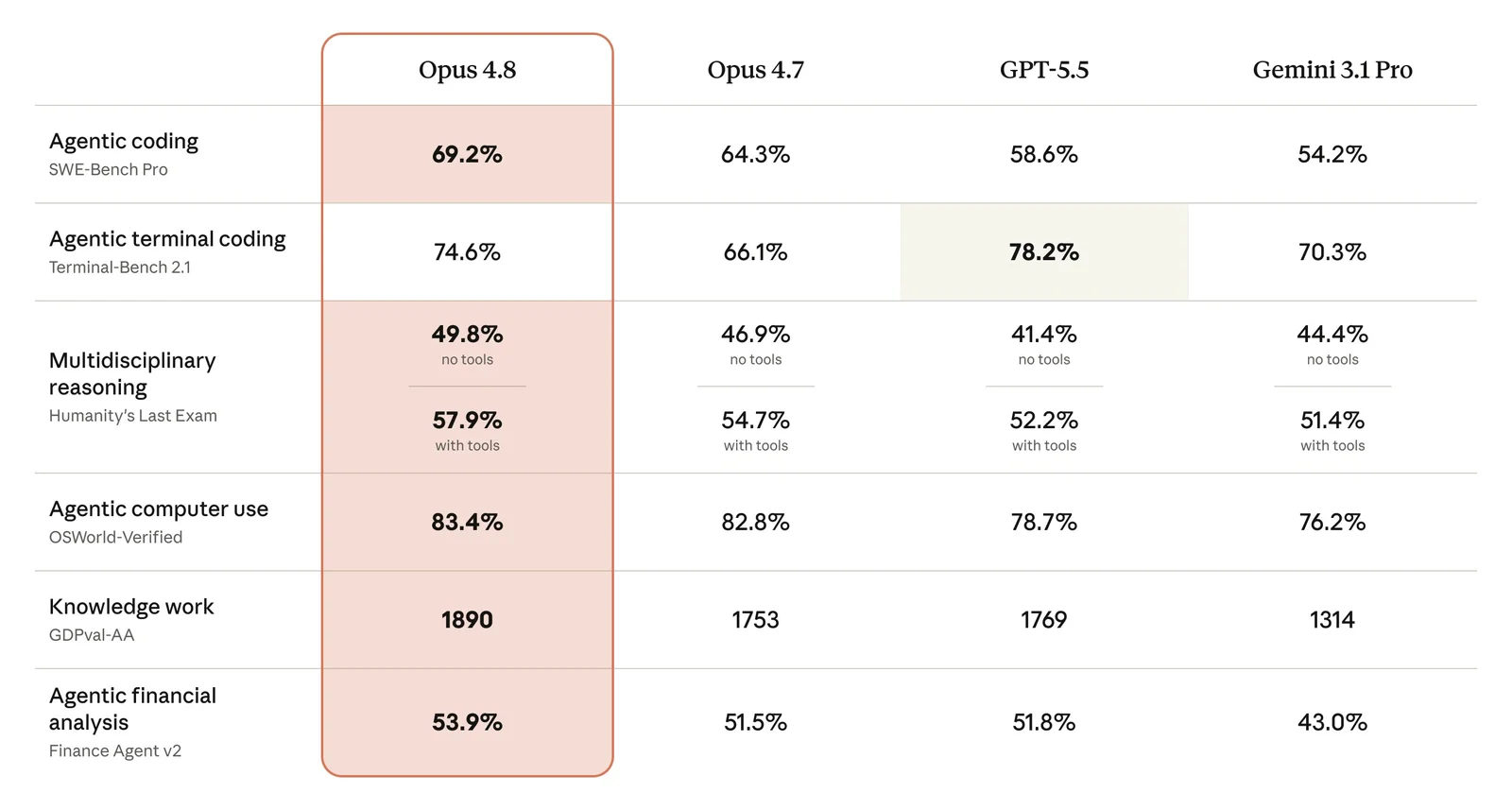
The comparison chart includes Opus 4.7, GPT-5.5, and Gemini 3.1 Pro. It is an image, and I will not type a percentage the sentences leave unspoken. A tester writing about Devin said Opus 4.8 improves on Opus 4.6 and eases the verbose comments and tool-calling trouble they saw on Opus 4.7. Another reported 84 percent on Online-Mind2Web and called it higher than Opus 4.7 and GPT-5.5 on that setup. Footnotes warn that harnesses differ: Terminal-Bench 2.1 in this comparison uses the Terminus-2 harness, while GPT-5.5's 83.4 percent is the Codex CLI harness, and the Opus 4.7 OSWorld-Verified score was reset to 82.3 percent after a method change.
Where does it sit next to other tools a maker already uses?
You meet Opus 4.8 in claude.ai, in Claude Code, in Cowork's effort control, and on the API as claude-opus-4-8. The subagent preview is Claude Code for Enterprise, Team, and Max only. A Databricks tester, writing about the Genie agent, reported Opus 4.7-level quality at a token cost 61 percent lower. The list price did not drop. Gemini 3.5 Flash has been generally available since May 19, so a shop can draft on a fast default and keep Opus for a tested migration. Anthropic also says Claude Mythos Preview, under Project Glasswing, is in limited cybersecurity use and is not this release. Stronger safeguards come before any general offer.
What does it cost, and who can use it today?
Regular tokens are $5 per million in and $25 per million out, the same as Opus 4.7. Fast mode is $10 and $50, which Anthropic calls three times cheaper than prior fast mode, at 2.5 times the speed.
Anthropic says the model is available everywhere today. Effort defaults to high on all claude.ai plans and in Cowork. Dynamic workflows stay a research preview on Enterprise, Team, and Max. The 61 percent Genie figure is a customer's usage report, not a lower list price.
What is still unproven?
I did not run Opus 4.8 for this article. The chart, the honesty multiple, and the customer quotes are Anthropic's. The 84 percent browser score is a tester's figure. Dynamic workflows are a preview, and the big migration is an example. The stop-path file still needs a person. The old fast-mode price is not printed, so the "three times cheaper" line cannot be checked from this page. Opus 4.8 is the general release at the old regular price. It is not an independent run of your tests.
Disclosure
Disclosure: The author is a paying subscriber to ChatGPT Plus, Claude Pro, and SuperGrok and uses all three services on a daily basis. The Makers Workbench is not affiliated with OpenAI, Anthropic, xAI, Google, or any of the other major AI companies covered in our reporting. No company receives favorable editorial treatment based on the author's personal subscriptions.
Sources and image credits
- Anthropic announcement (www.anthropic.com)
- Images: published by Anthropic with the announcement.


