
Open Claude on a Free or Pro plan and the name may not register until the job gets long. On June 30, 2026, Anthropic released Claude Sonnet 5 and made it the default on Free and Pro. Max, Team, and Enterprise can select it too. The API id, the name you pass through the application programming interface, is claude-sonnet-5. The announced price is $2 per million input tokens and $10 per million output tokens. A token is a small slice of text the meter counts, often a word or a piece of a word.
Anthropic calls Sonnet 5 its most agentic Sonnet. Agentic, in the company's words, means the model can make a plan, use tools such as a browser or a terminal, and keep going on its own. The post says that kind of stamina, a few months ago, asked for a larger and more expensive model. The same post lists Claude Opus 4.8 at $5 per million input tokens and $25 per million output tokens. If the claim holds, firmware sessions I used to push up to Opus can stay on the default. Opus stays in the menu for whatever gap the chart still shows.
What actually changed?
The change on the bench is the default. Free and Pro now open on Sonnet 5. The technical claim is a step up from Sonnet 4.6, the predecessor in the comparison, on reasoning, tool use, coding, and knowledge work. Anthropic also says the model sits close to Opus 4.8 on some of that work, at the lower price.
Anthropic says its tests found fewer undesirable behaviors than on Sonnet 4.6, and weaker cybersecurity skill than the current Opus models. A system card, the long test write-up, is linked from the post. Cyber safeguards are on by default. Anthropic says they match the checks on Opus 4.7 and Opus 4.8, and that they are less strict than the safeguards launched with Fable 5, because it judged the risk from Sonnet 5 to be lower.
A footnote changes the bill in a way the sticker hides. Sonnet 5 uses an updated tokenizer, the step that chops text into tokens, similar to the change on Opus 4.7. The same file can count as more tokens than before, roughly 1.0 to 1.35 times, depending on the content. I would re-bill one real prompt before I trusted a spreadsheet that still uses the old token count.
How does the new piece work?
You give a goal. The model plans, calls a tool, reads the result, and takes another step instead of waiting for you to type "keep going." A browser tool can open a page. A terminal tool can run a build. That loop is the agentic part.

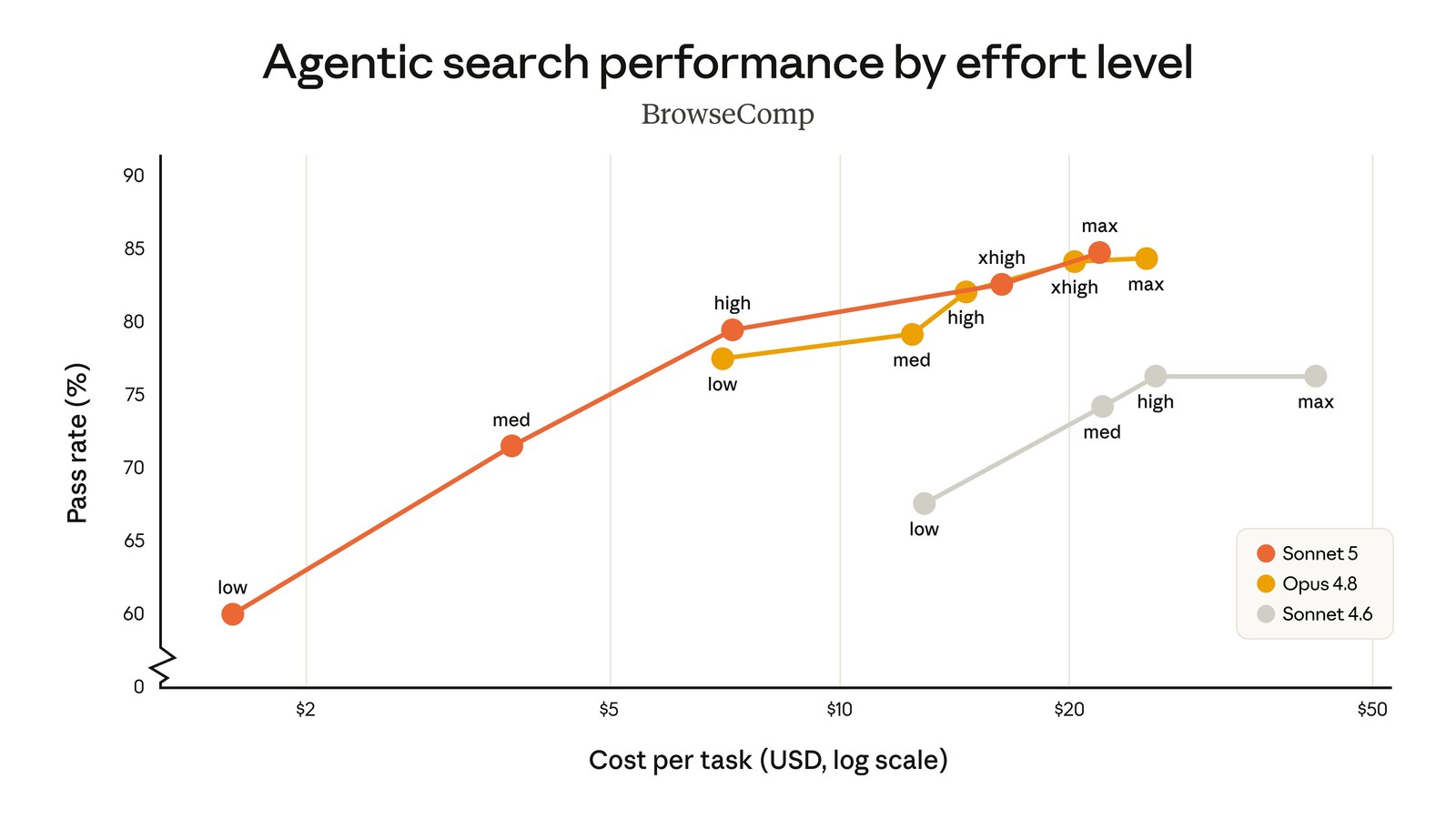
Effort is the knob for how much computation you are willing to buy. Anthropic's charts plot low, medium, high, extra-high, and max. Higher effort uses more tokens and, on those curves, raises the score. The post says medium effort is where the cost advantage shows most clearly, and that higher effort can match Opus 4.8 on some tasks. A one-line register note does not need max. A flaky bring-up might.
Anthropic says it did not train Sonnet 5 for cybersecurity tasks. On a Firefox test developed with Mozilla, Sonnet 5 produced no full working exploit, while Opus 4.8 and Mythos 5 scored much higher. The company recommends Opus 4.8 when the work needs reduced guardrails. I am not going to describe that test past the result.
What does this look like on a real project?
The job I would run is a sensor that works on the desk and fails once the cable is longer. The link is I2C, a two-wire bus for short on-board connections. I would open Claude Code with Sonnet 5 at medium effort, hand it the driver and the logic-analyzer capture, and ask for a hypothesis, a code change, and a unit test. Anthropic says early testers saw it finish work where earlier Sonnet models stopped. I have not run Sonnet 5. I would grade the diff on the bench.
If medium effort stalls, I would raise effort before I changed models. If the question turns into how someone would break the bootloader, I would move to Opus 4.8, which is the model Anthropic recommends when the guardrails need to come down. I would also resend one prompt I already measured on Sonnet 4.6. A tokenizer bump toward 1.35 times is enough to stop quoting yesterday's bill as today's.
How does it compare with the previous version?
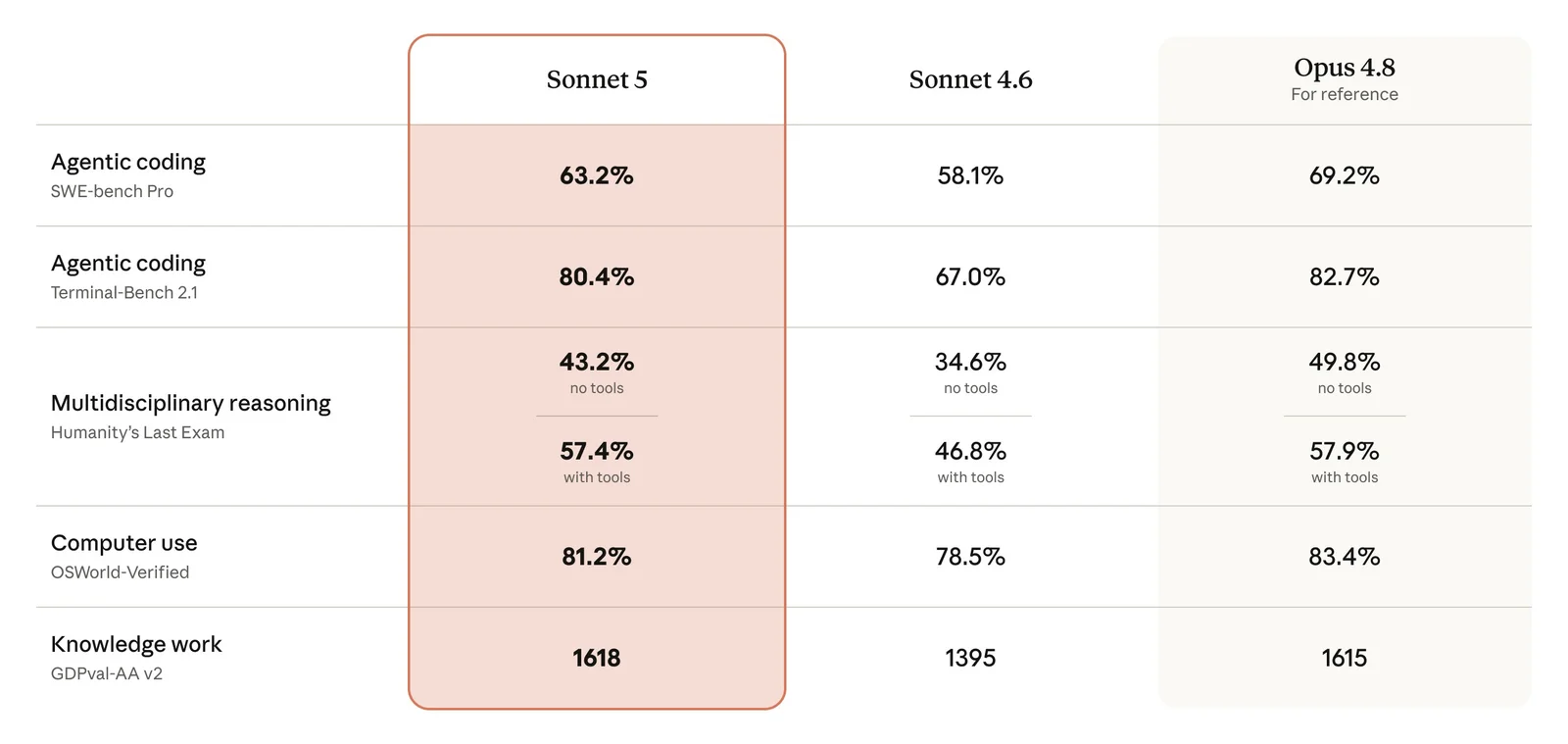
Sonnet 4.6 is the model this one replaces. Opus 4.8 is the reference column. On Anthropic's table, SWE-bench Pro, a software-repair test, is 63.2 percent for Sonnet 5, 58.1 for Sonnet 4.6, and 69.2 for Opus 4.8. Terminal-Bench 2.1, a command-line test, is 80.4, 67.0, and 82.7 percent. GDPval-AA v2, a knowledge-work score, is 1618, 1395, and 1615. Repair work still trails Opus. The knowledge-work score does not. Anthropic says some Sonnet 4.6 numbers were revised from that model's own launch post because the test setup changed. Use this table, not the older blog.
Anthropic says the cost curves beat Sonnet 4.6 across effort levels and can meet Opus at the high end on some tasks. The caption draws those curves at $3 and $15 per million tokens and calls that existing standard pricing. The sentences that set the price say $2 and $10. Budget the announced rate. Anthropic also replaced the BrowseComp search chart on launch day, because the first draft used a simpler method and understated Sonnet 5.
Where does it sit next to other tools a maker already uses?
Sonnet 5 is now the everyday model in the chat app, in Claude Code, and on the API. Opus 4.8 remains the pick when the table still gives the job to Opus, and when the work is a security review that needs the looser guardrail Anthropic points at Opus. The editor, the programmer, and the scope stay put. The model does not flash a part. It does not see a glitch on the wire unless you paste the capture.
This post mentions Fable 5 only to say Sonnet's cyber checks are less strict than Fable's. I would use Sonnet 5 for the driver and Opus 4.8 for the security review. Anthropic also raised rate limits on Chat, Cowork, Claude Code, and the platform so higher effort has room to spend tokens. A higher cap is not a lower bill.
What does this cost, and who can use it today?
The announcement sets $2 per million input tokens and $10 per million output tokens on the surfaces it lists. Opus 4.8, on the same page, is $5 and $25. Output tokens are the expensive direction. A long session that writes a lot of code is where Sonnet's output price does the work.
Anthropic says every Claude plan can use it today. It is the default on Free and Pro. Max, Team, and Enterprise can select it. Developers call claude-sonnet-5. Low effort is still there for a small job. The tokenizer can count the same file as high as about 1.35 times the old token total, and higher effort spends more output on top of that. On the output sticker, $10 against Opus at $25 is less than half. One usage line will show whether your repo eats the gap.
What is still unproven?
I have not run Sonnet 5 on a board. The table, the curves, and the partner lines are Anthropic's choices. The system card is where the broader tests live.
A lower cyber score than Opus is a reason to keep Opus for a security review, which is what Anthropic recommends. The safeguards are on because Sonnet 5 is somewhat stronger than Sonnet 4.6. The price chart is the other soft spot: the launch text says $2 and $10, and the caption discusses $3 and $15. For the sensor driver I would still start here. It is the default, and the price fits ordinary work.
Disclosure: The author is a paying subscriber to ChatGPT Plus, Claude Pro, and SuperGrok and uses all three services on a daily basis. The Makers Workbench is not affiliated with OpenAI, Anthropic, xAI, Google, or any of the other major AI companies covered in our reporting. No company receives favorable editorial treatment based on the author's personal subscriptions.
Sources and image credits
- Anthropic announcement (www.anthropic.com)
- Images: published by Anthropic with the announcement.


