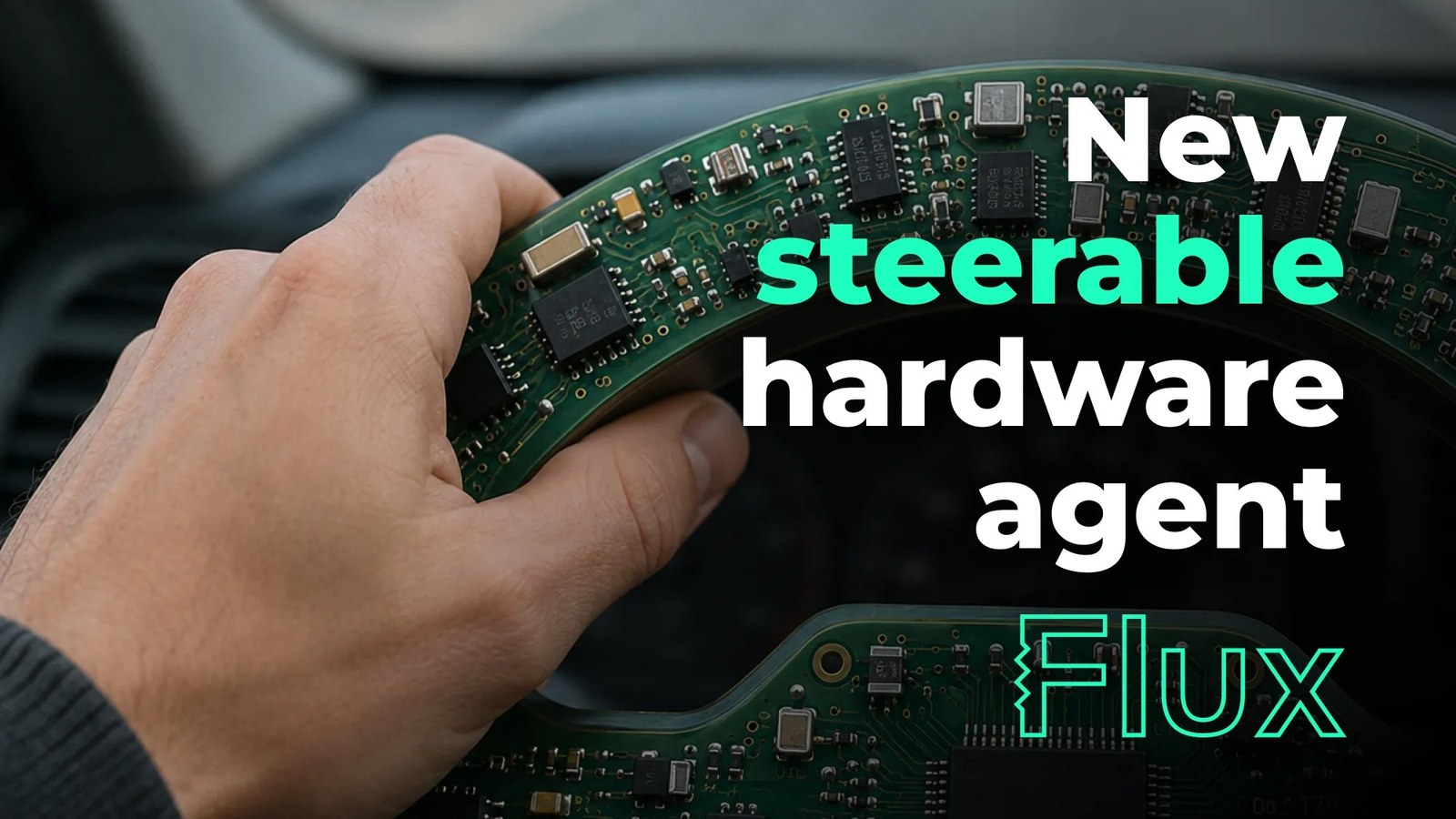
I have lost an afternoon because a connector landed on the wrong edge. The usual fix is to abandon the run and start the drawing over. On May 14, 2026, I am reading Dirk Stoop's Flux post, dated May 2026. Flux here is the board-design platform at flux.ai. It is not an image generator that happens to share the name.
Stoop says the hardware agent is more steerable, more adaptive, and faster. An agent, in this post, takes a hardware goal and makes a string of design choices. The page states no price change. What matters on the bench is that you can interrupt a run, add a fact, and continue from the current design, or stop if you said stop.
What actually changed?
A part disappears, or a cable has to leave the other face of the box. Stoop says that bend is where projects stall. The upgrade is meant to take the new fact without a restart.
Steerable means it can change course when you add information. Adaptive means it can find new information and change its own approach. You can jump in mid-run. It continues from the design it has, or it stops when told.
The examples are the feature. "Put the connector on the other side." "Add a power switch and ESD protection." ESD is electrostatic discharge, a static zap from a finger or a cable. "Make sure the output ripple is acceptable." Ripple is the wiggle left on a voltage that should be steady. "I prefer an ADI LDO." An LDO is a low-dropout regulator: it makes a lower, calmer supply from a higher one, and it can do that when the two voltages are close. ADI means Analog Devices.
Flux also says the agent can notice trouble on its own. A battery connector may need reverse-polarity protection, so a backward plug does not kill the board. Enable pins may be floating, unconnected, so noise can chatter a chip on and off. A datasheet may specify decoupling capacitors, the small parts at a power pin that swallow brief current spikes. You might add a TVS diode for hot-plugging. A TVS diode clamps a short spike. Hot-plugging means connecting the cable while power is already on. You might ask for one microcontroller when the extra chips cost too much, or for a certified radio module.
Status lines should be clearer and grouped. The closing summary should be shorter. Faster is claimed. No stopwatch number is published.
How does the new piece work?
A PCB, a printed circuit board, is the fiberglass, the copper, and the parts. A schematic is the pin-to-pin drawing before the outline is frozen. Stoop's point is that a lot of choices sit between a sentence and a board. Flux makes many of them, and this upgrade lets your next sentence join a run already in motion. You do not need the whole spec on line one.
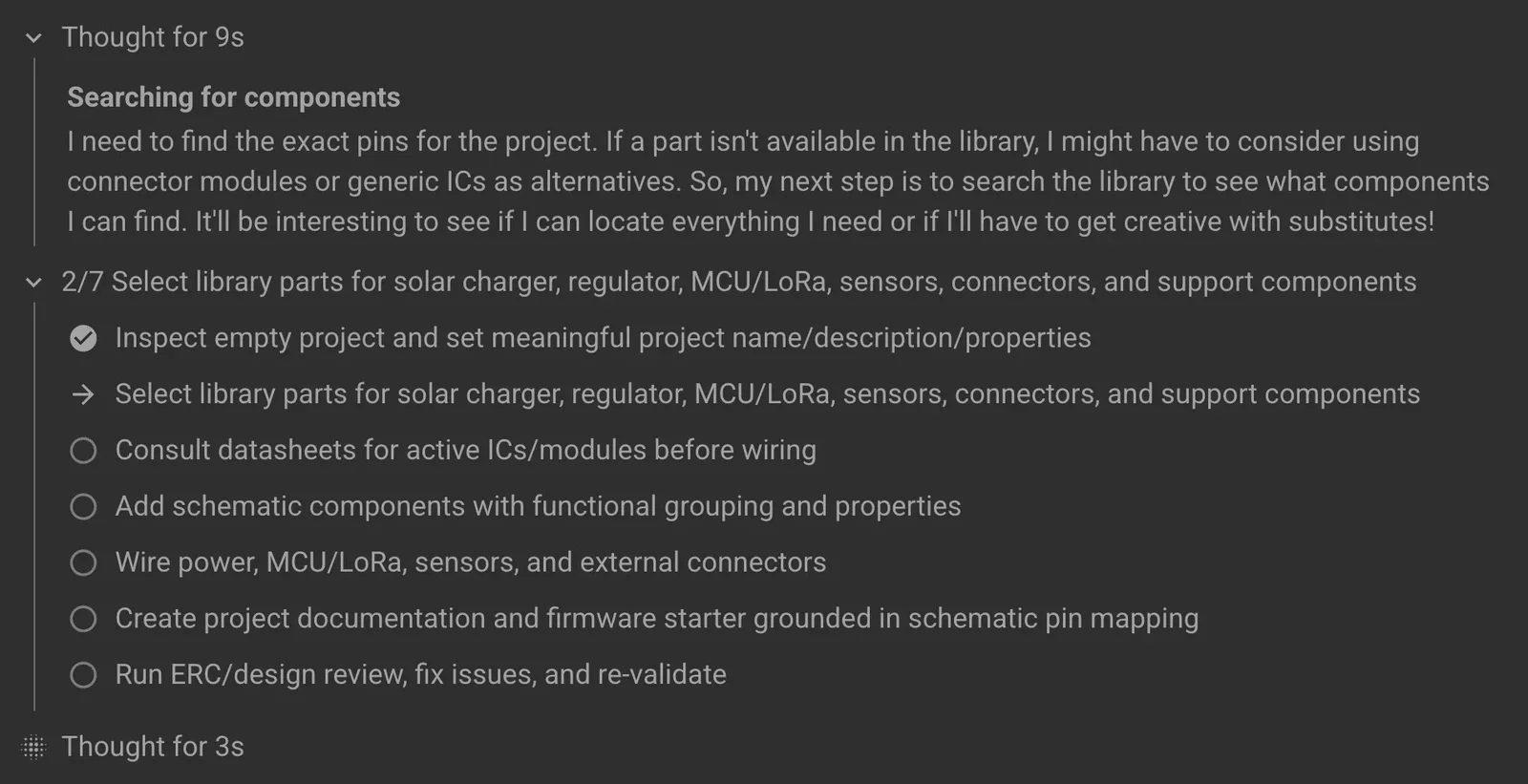
From a short prompt, Flux says the agent picks the architecture, meaning what talks to what, plus the major parts and the schematic. It records the important decisions and summarizes. Finding a datasheet note you did not type, then changing approach, is the adaptive claim. Your correction landing on that same drawing is the steerable claim. Stop means stop. Continue means keep the current design. Stoop's loop is to guide, inspect, and continue. A single giant prompt, followed by a full restart, is the habit this upgrade is there to retire.
I would read the status text while it runs. The summary helps only if your decisions are in it.
What does this look like on a real project?
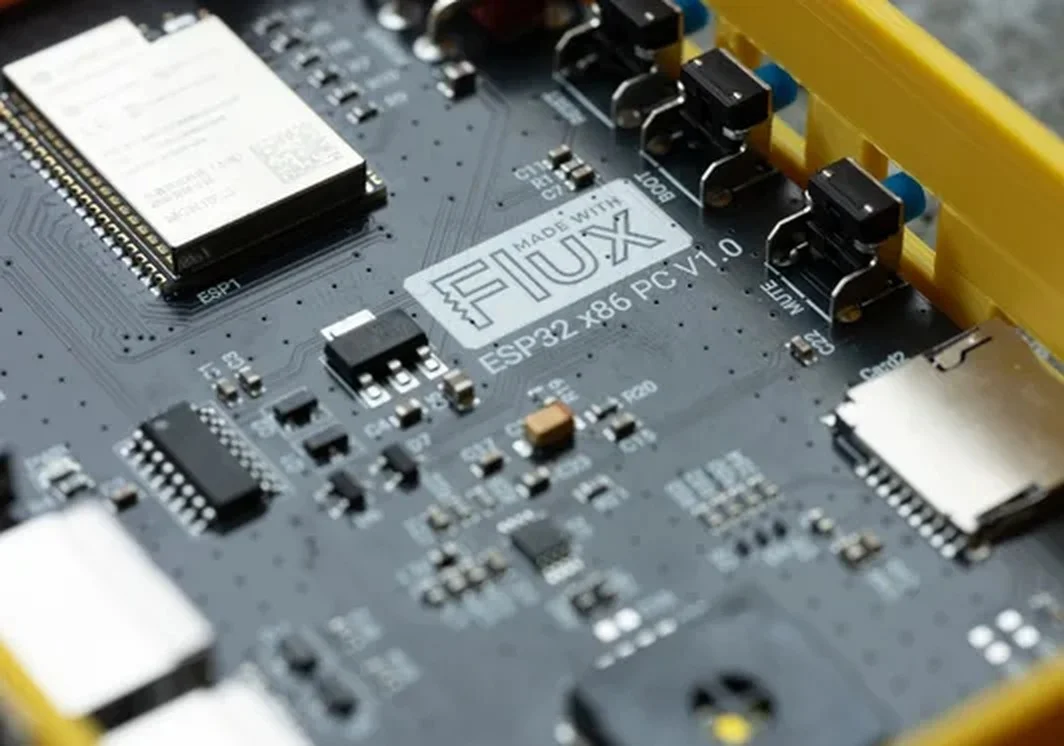
Flux's own example is the prompt I would type: "Build me a USB-C powered ESP32 dev board with an SHT40 temperature and humidity sensor over I2C."
USB-C is the oval Universal Serial Bus plug the board would take power from. An ESP32 is a small microcontroller module used here as the computer on a dev board you can probe. The SHT40 reports temperature and humidity. I2C, Inter-Integrated Circuit, is a two-wire link: data and clock. Flux says the agent then picks architecture, major parts, and the schematic, records the decisions, and summarizes.
I have not built that board on this upgrade. Once a power path showed up, the route from the plug through protection and a regulator to both chips, I would interrupt with their lines: move the connector, add a power switch and ESD protection, require acceptable ripple, prefer an ADI LDO, and add a TVS diode if the cable will be hot-plugged.
Then I stop and check three things myself.
Pinout is which pin carries which signal. I match the SHT40, including the I2C pair, to its datasheet, then to the ESP32 pins on the sheet. Floating enable pins are on Flux's list of things it can notice. A warning still has to be a wire.
Decoupling is the capacitor check. I open the datasheet and see whether its values landed on its pins. This post prints no capacitor value, so I will not invent one.
The power path is USB-C, switch, LDO, then both chips, at a voltage the sensor datasheet allows, with the ADI regulator I asked for. This prompt is USB-C powered. A battery, and the reverse-polarity part that protects one, should appear only if I asked. Ripple on a built board is a scope measurement. The post does not say the agent measured a supply.
The post does not call the result factory-ready, and it does not claim a clean DRC. DRC is a design-rule check: copper spacing, missing ties, and the rest of a fabrication house's rules. I would run it. Steering does not replace it.
How does it compare with the previous version?
This is an upgrade to the Flux agent, not a new product name. The pain Stoop describes is a run that had to restart when the spec moved. Mid-run steering is the change he is proudest of. Clearer status and a shorter summary are the visible session changes. Speed is asserted without a published delta. Catches for reverse polarity, floating enables, and datasheet decoupling are claims about judgment, with no hit rate attached. Nothing here says the board is ready to fabricate or that DRC is clean. I am not borrowing features from Flux's other articles.
Where does it sit next to other tools a maker already uses?
The sensor datasheet is still the authority. Flux is where this schematic is being drawn. Firmware still gets written in an editor, and it still has to speak I2C to the SHT40 correctly. A meter and a scope still answer whether the LDO is alive and whether ripple is small. I would write down the steers I gave, connector side, switch, ESD, ADI part, no surprise battery, and search the sheet if the summary drops one. Stoop's advice is to start with a board you already know how to judge. That is the right first project.
What does it cost, and who can use it today?
No price change is stated, and no subscription number is printed. The post says to open Flux and try the workflow. A signup link on the page is marked as a free try. I will not treat that button as a full rate card. There is no waitlist in the text. If your account cannot interrupt a run yet, this post does not say whether the switch has reached you.
What is still unproven?
Faster is unmeasured, and I have not watched a session on this date. An adaptive run can still chase a fact you did not want, so steering only helps if you watch. The ESP32 and SHT40 prompt is an example, not a design I would send to a fab. Pinout, decoupling, and the power path stay datasheet work. A note about a floating pin is not a layout, and the post never claims a passed design-rule check.
Disclosure
Disclosure: The company covered in this article has not sponsored The Makers Workbench or paid for this coverage. Companies interested in having The Makers Workbench evaluate or cover an AI model, product, or service, or incorporate it into a future Makers Workbench project, may contact us for sponsorship rates and terms. Sponsored content and partnerships are disclosed as such.
Sources and image credits
- Flux announcement (www.flux.ai)
- Images: published by Flux with the announcement.