
On May 19, 2026, Google put Gemini 3.5 Flash into general use and shipped Antigravity 2.0 the same morning. Flash is the first model in the 3.5 series. Google says it is available in the Gemini app, in AI Mode in Search, in Google Antigravity, through the Gemini API in AI Studio and Android Studio, and in Gemini Enterprise. It is the default in the Gemini app and in AI Mode.
Antigravity 2.0 is a desktop app for running many agents at once. An agent is a software helper that plans a job and then uses tools to finish it. Google also shipped a command-line interface, or CLI, the text terminal, and a software development kit, or SDK, a library your own code can call. Managed Agents run in an isolated Linux environment through the Interactions API. The default model for that launch is 3.5 Flash.
On a bench, this pairing shows up when a fixture note and a parts list need a pass in one sitting. The same morning, Google also introduced Gemini Omni, a separate family whose first model generates video. That launch stands on its own.
What actually changed?
The model post, from Koray Kavukcuoglu, Jeff Dean, Oriol Vinyals, and Noam Shazeer, calls 3.5 Flash their strongest agentic and coding model yet. They say it beats Gemini 3.1 Pro on four tests named in the prose. Google reports 76.2 percent on Terminal-Bench 2.1, a test of real jobs inside a computer terminal. GDPval-AA is given as 1656 Elo. Elo is a head-to-head rating, the style used in chess, and Google cites GDPval-AA for economically valuable work. MCP Atlas is 83.6 percent. MCP is the Model Context Protocol, a standard way for an assistant to call tools and read project context, and Google groups that test with its coding and agent scores. CharXiv Reasoning is 84.2 percent, the figure they attach to multimodal understanding: more than one kind of input, including charts.
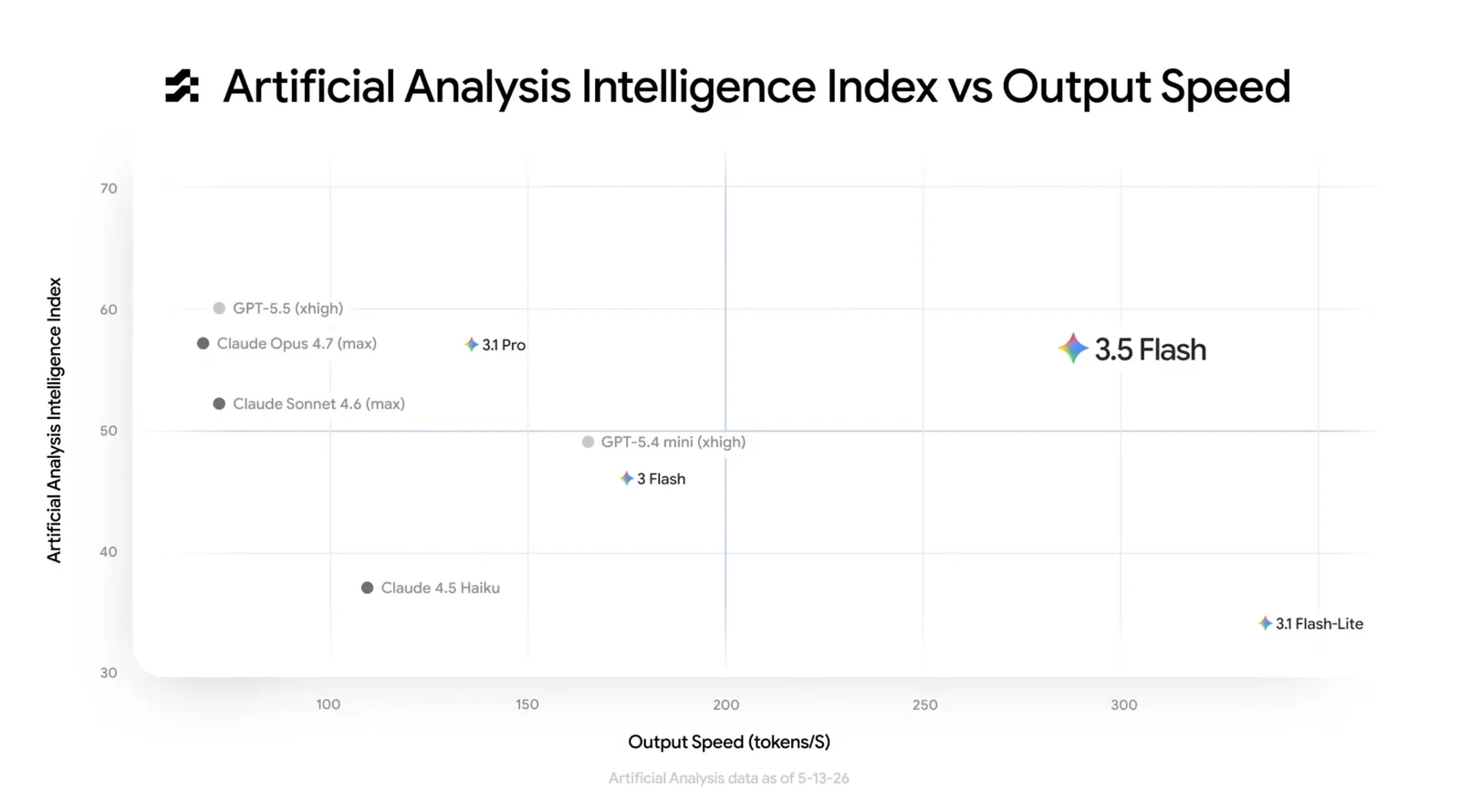
Google says that, in output tokens per second, 3.5 Flash is four times faster than other frontier models. A token is a small chunk of text the model reads or writes. Sundar Pichai's keynote note the same day repeats the four-times claim. He also says Antigravity can serve a further optimized Flash that Google rates at twelve times faster than other frontier models, and that users can try it starting today. Gemini 3.5 Pro did not ship. Google says Pro is in internal use and that they hope to roll it out next month.
How does the new piece work?
Varun Mohan and Logan Kilpatrick describe Antigravity 2.0 as a desktop base where you run several agents in parallel. Dynamic subagents are the smaller agents that take a slice of the job at the same time. Scheduled tasks keep going in the background. Google lists connections to AI Studio, Android, and Firebase.
Google tells current Gemini CLI users to migrate to the Antigravity CLI. The SDK exposes the same agent harness, the control layer around the model, so you can define behavior and host it on computers you choose. Managed Agents are the hosted form. One call to the Interactions API starts an agent that can reason, use tools, and run code in an isolated Linux environment. I would call that box a sandbox: the job is not supposed to touch the rest of the machine. Google says you can resume the environment later, files and state included. Custom instructions and skills live in markdown files. For this launch, the model under the harness is 3.5 Flash.
What does this look like on a real project?
Say the bench holds a limit-switch fixture: a pile of unlabeled photos, a text bill of materials, and one paragraph that names the switch pin. You want a project page another builder can follow. You do not want the pin rewritten as a guess.
I would open the folder in Antigravity 2.0 on 3.5 Flash and split the work. One agent proposes photo filenames, and I approve them before a rename. Google's demo is that kind of sort. A second agent drafts the setup page with the pin written out for a meter check. AI Studio's examples include turning a plain description into an interactive hardware view. A third pass copies the bill of materials and marks gaps instead of guessing parts.
Google's heavier demos, including a six-hour game built by two agents, are demonstrations. The fixture page is the small version of that split. I would not publish until the wiring sentence matches the machine. Google says 3.5 sits under its Frontier Safety Framework, with stronger safeguards on cyber requests and on CBRN topics. CBRN means chemical, biological, radiological, and nuclear material. Those safeguards do not probe a pin.
How does it compare with the previous version?
On the four prose scores, 3.5 Flash is ahead of Gemini 3.1 Pro, and Google presents Flash as the fast model. Pichai says it is better across almost all benchmarks than 3.1 Pro. "Almost all" is his phrase. I am not going to turn it into every row of the chart.
Google's speed chart, labeled with Artificial Analysis data as of May 13, 2026, puts 3.5 Flash upper right of Gemini 3.1 Pro, GPT-5.5, and Claude Opus 4.7. The dot has no tokens-per-second label in the prose, so the number I will repeat is the written one: four times other frontier models. Twelve times is only the Antigravity variant. Both posts say Flash often costs under half what other frontier models cost, and neither shows a price table. Pro is still internal. Gemini CLI users are told to move to the new Antigravity CLI.
Where does it sit next to other tools a maker already uses?
If the Gemini app is already on your phone, 3.5 Flash is the default there and in AI Mode. Pichai puts AI Mode past 1 billion monthly users and the Gemini app past 900 million. A default change reaches people who never open a model picker.
Android Studio carries the Gemini API. AI Studio can start an Android app from a prompt, with a path toward the Play Console test track, and a one-click export is supposed to move that project into local Antigravity. Claude and ChatGPT can stay on the bench. The speed chart places 3.5 Flash next to Claude Opus 4.7 and GPT-5.5. I would still want a second read on a wiring note. Gemini Spark, a personal agent on 3.5 Flash, is testers first, with a U.S. Ultra beta planned for next week.
What does it cost, and who can use it today?
These posts do not print a per-token price for 3.5 Flash. They print a "less than half the cost" comparison, plus one scenario from Pichai. He says companies processing about 1 trillion tokens a day could save over $1 billion a year if 80 percent of that work moved to 3.5 Flash. That is his illustration, not an invoice.
The number you can budget is the subscription around Antigravity. Google AI Ultra now starts at $100 a month, with a usage limit inside Antigravity five times the Google AI Pro limit. For a limited time, new and existing Ultra subscribers can claim $100 in bonus Antigravity credits after they hit the quota. Google says the offer expires May 25, 2026. Everyone can use 3.5 Flash in the Gemini app and in AI Mode without Ultra. Developers also get Antigravity, the API in AI Studio and Android Studio, and Managed Agents. Enterprises get Gemini Enterprise and the Gemini Enterprise Agent Platform.
What is still unproven?
The four headline scores are Google's. The speed chart is an outside index, dated May 13 on the graphic Google published. I did not run those four tests, and I did not open a 3.5 Flash session for this piece.
Named partners, including Shopify, Macquarie, Salesforce, Ramp, Xero, and Databricks, are company anecdotes, not procedures. The twelve-times figure is an Antigravity taste. Pro is not on sale. Spark is a tester program. A six-hour game is a demo.
Disclosure
Disclosure: The author is a paying subscriber to ChatGPT Plus, Claude Pro, and SuperGrok and uses all three services on a daily basis. The Makers Workbench is not affiliated with OpenAI, Anthropic, xAI, Google, or any of the other major AI companies covered in our reporting. No company receives favorable editorial treatment based on the author's personal subscriptions.
Sources and image credits
- Google announcement (blog.google)
- Images: published by Google with the announcement.


