
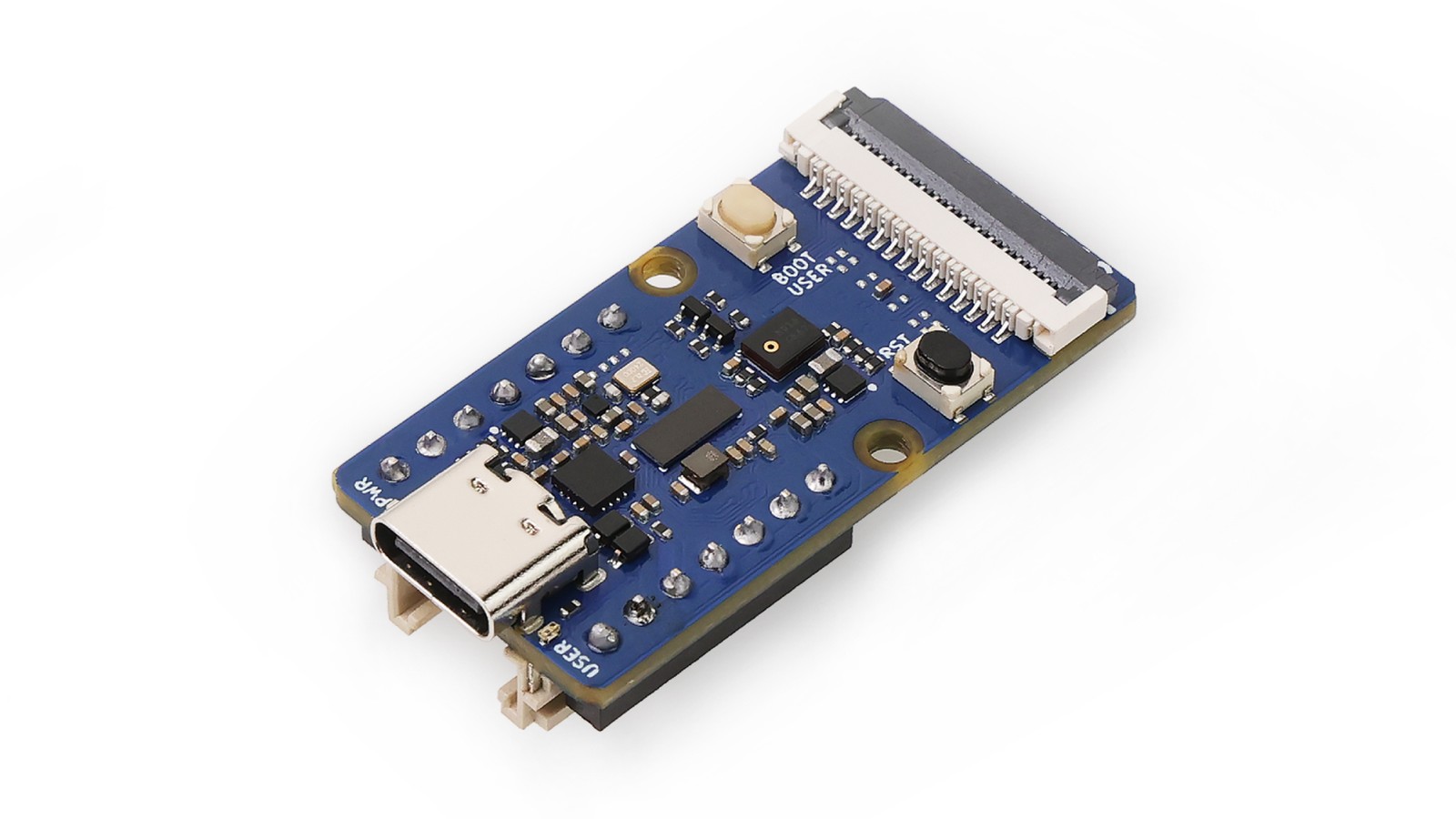
Seeed Studio introduced the Grove Vision AI V2, a compact computer-vision module built around Himax's WiseEye2 HX6538 processor. The chip combines an Arm Cortex-M55 CPU with an Ethos-U55 neural processing unit, or NPU, bringing dedicated machine-learning acceleration to a microcontroller-class device.
The module was designed to run image inference locally at low power, then provide useful results to another controller or automation system. It supported Seeed's SenseCraft AI workflow as well as model development from common machine-learning frameworks.
That combination made the board approachable without hiding the important constraint: this is embedded vision, not a miniature desktop computer. It works best with focused models, controlled inputs, and carefully measured memory use.
Cortex-M55 is built for modern signal processing
The Cortex-M55 is an Arm microcontroller processor that includes Helium vector extensions. Vector instructions apply one operation to several data elements at once, accelerating workloads such as filtering, feature extraction, and neural-network layers.
Ordinary application code still runs on the CPU. It handles camera control, peripherals, data movement, communications, and model operations that are not assigned to the accelerator. The value of the M55 is that it remains a flexible microcontroller while executing supported math more efficiently than a purely scalar core.
The WiseEye2 platform pairs that CPU with memory and image-related hardware suitable for always-on sensing. Exact performance depends on model size, input resolution, clock settings, and which operations can use acceleration.
Ethos-U55 accelerates neural networks
The Ethos-U55 is a micro neural processing unit. It executes supported neural-network operators with better energy efficiency than running every layer on the CPU.
An NPU does not accept any model without preparation. The network normally needs supported layer types, tensor shapes, and numerical formats. Conversion tools analyze the model, optimize it, and divide work between the accelerator and CPU.
If an unsupported operator falls back to software, latency can increase sharply. Developers should inspect conversion reports instead of assuming the entire network runs on the NPU. A slightly simpler architecture with complete accelerator support may outperform a theoretically smaller model with awkward fallback layers.
Quantization is usually part of the process. It converts model weights and activations from large floating-point representations to compact integers. This reduces memory and makes the arithmetic better suited to the accelerator. Accuracy must be tested after quantization with representative data.
Local vision changes the privacy and bandwidth equation
A Grove Vision AI V2 can evaluate frames near the camera and report a class, count, or event instead of streaming images continuously. A smart-home system might receive “person detected” or “package present.” A factory controller might receive a defect flag and confidence score.
This approach reduces network bandwidth and can keep ordinary images off a server. It also lowers response latency because an internet round trip is unnecessary.
Local inference does not automatically guarantee privacy. Firmware may still save frames, logs may reveal behavior, and a connected host could transmit data. Product documentation should state whether images leave the module and provide clear control over storage and uploads.
SenseCraft AI lowers the first barrier
Seeed's SenseCraft AI platform provides a guided route to select or train a model and deploy it to supported hardware. A managed workflow can help beginners avoid manual conversion, compiler flags, and board flashing during the first experiment.
Convenience has limits. Developers should record the dataset, model version, input processing, labels, confidence thresholds, and generated firmware. A model that works today must remain reproducible after the web tool or underlying library changes.
More advanced users can work with TensorFlow or PyTorch models and the Himax software development kit. These paths provide greater control but require understanding the supported compiler pipeline and memory layout.
The best workflow often starts with the managed tool to validate the use case, then moves to lower-level tools only when the application needs custom operators, tighter performance, or deeper integration.
Camera data consumes memory quickly
Even a modest 320-by-240 RGB image contains 230,400 color values. Larger frames and intermediate neural-network feature maps can exceed microcontroller memory rapidly. Embedded vision systems therefore resize, crop, convert color, and reuse buffers aggressively.
Input resolution should match the object scale. A model looking for a large occupancy state may work with a small image. Reading tiny printed codes or distant defects requires more detail and may exceed the module's practical range.
Frame rate is another budget. Many applications do not need 30 inferences per second. A plant monitor might run once per minute, while gesture control needs faster response. Lower rates save energy and give the CPU time for communication and housekeeping.
Developers should measure peak memory, not only model-file size. The camera buffer, tensor arena, firmware, stack, and communications all coexist. Leave margin for updates and worst-case execution.
Lighting and optics matter as much as the model
A model only sees what the camera captures. Backlighting, glare, motion blur, lens contamination, and an object that occupies too few pixels can defeat excellent training.
Fix the camera position when possible. Add controlled illumination for inspection tasks. Use an enclosure that does not cast unexpected reflections across the lens. If outdoor use is required, collect examples across daylight, weather, and seasons.
Training data should come from the intended camera and viewpoint. Internet images may help an early experiment, but they often differ in lens distortion, resolution, background, and exposure. Include negative examples that resemble the target without actually containing it.
Confidence thresholds need validation. A high threshold reduces false positives but may miss weak examples. A low threshold catches more candidates but can trigger unnecessary actions. Evaluate the consequences of each error type rather than choosing a number because it looks precise.
Integration is designed to be modular
The Grove ecosystem uses standardized cables and connectors for rapid sensor prototyping. The Vision AI V2 can act as a smart peripheral that sends inference results to an Arduino-compatible board, XIAO, Raspberry Pi, or home-automation gateway.
This separation is useful when the host handles networking or actuators and the vision module handles images. Define a simple message protocol with result type, confidence, timestamp, and error state. The host should know when the camera is initializing or the model has failed.
Seeed also documented Home Assistant integration, microSD use, PDM microphones, and development with the Himax SDK. Those options broaden the module beyond a fixed object detector, but each extra function competes for power and software attention.
Where this class of module fits
The board suits occupancy sensing, simple counting, gesture interfaces, package detection, wildlife triggers, machine-state recognition, and controlled quality checks. It is especially attractive when the output is a small decision rather than an image archive.
It is not the right tool for large language-and-vision models, high-resolution multi-camera tracking, or complex open-world recognition. A Linux edge computer provides more memory and software flexibility for those jobs, at a higher cost and power draw.
The Grove Vision AI V2 made dedicated NPU acceleration available in a tiny, modular format. Its significance lies in efficient local interpretation: a camera can become a sensor that reports meaning rather than a stream of pixels. Used with realistic models, controlled optics, and careful validation, that can make computer vision practical in projects where a full edge computer would be excessive.
I'd start with the SenseCraft AI tool to check that the idea works, and then move to your own model only when you need to.
Sources and image credits
- Official Seeed Studio blog post, Seeed Studio, January 1, 2024.
- Official product image from Seeed Studio: Grove Vision AI Module V2.
- Square and vertical crops are edited from the same source image.


