The llama.cpp project released v1.0.0 of both llama.cpp and its ggml tensor library on November 13, and said that from now on any change that breaks its public C API or ABI will be marked by a major version bump. The announcement on Hugging Face, written by the project's team at Hugging Face, says the change reflects how many downstream applications now depend on the libraries. The matching GitHub release lists what the first stable version removes and adds.
The project says it has grown over 3.5 years from a single-model experiment into an engine that runs multimodal models on hardware from consumer machines to servers. It states support for more than 150 architecture variants and all mainstream speculative decoding methods, and says its continuous integration now runs on self-hosted runners with hardware support from NVIDIA, AMD, Qualcomm, Arm, IBM, and Intel.
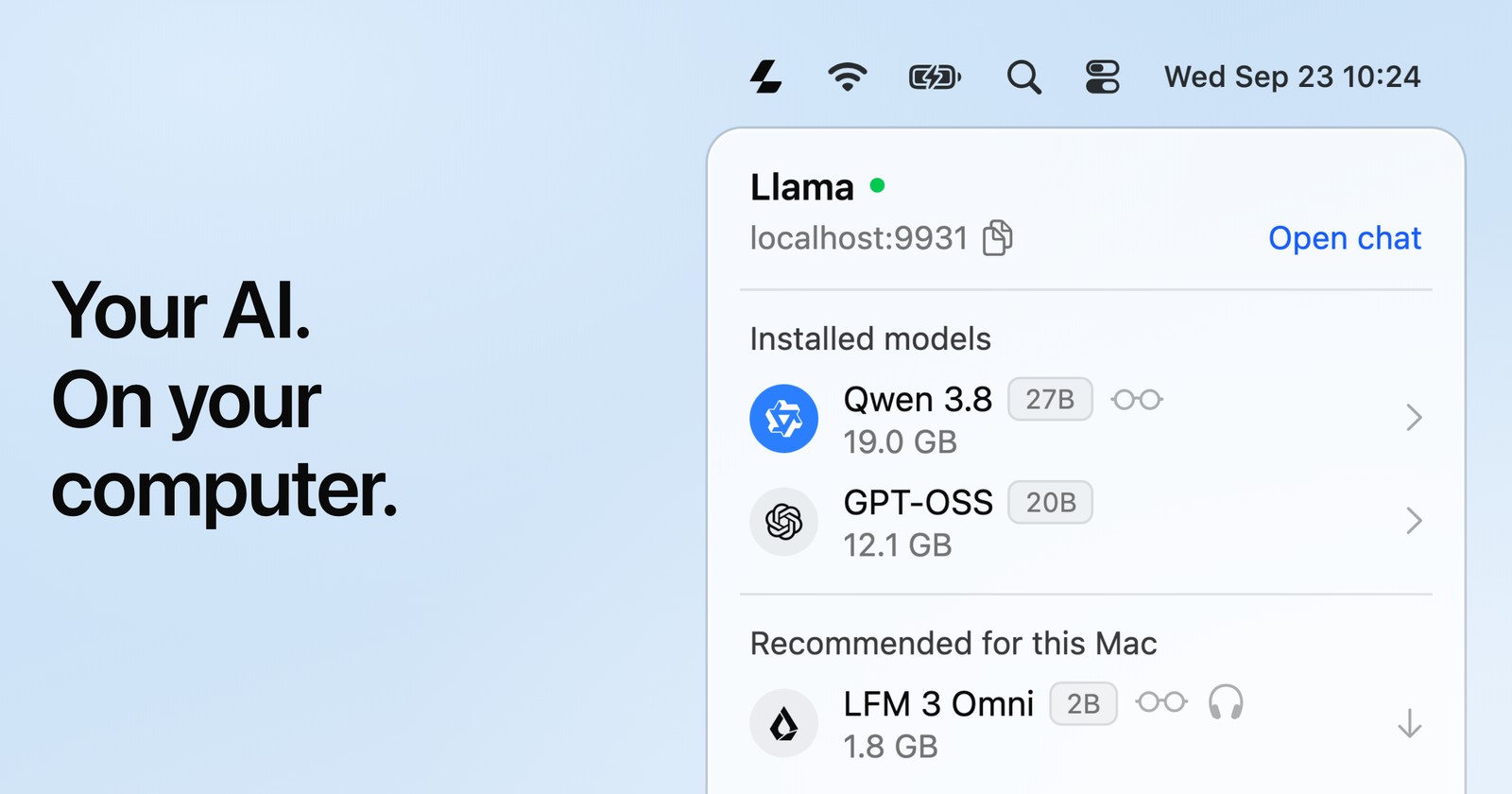
Image: Llama (llama.app). The desktop app is shipped by the llama.cpp team and is a separate product from the libraries.
Major versions now signal breaking C API changes
The project published its versioning rules in the announcement. A major bump means a breaking change to the public C API in the include directory. A minor bump covers backward-compatible features, backend updates, model support, or API additions, and a patch bump covers bug fixes with no API change. The rules apply to all ggml-org projects that use semantic versioning, and libllama and libggml each carry v1.0.0.
Distribution is listed in the same post: pre-release artifacts for Linux, macOS, Windows, Android, and iOS, plus Docker, Debian, Homebrew, conda-forge, MacPorts, Winget, and an XCFramework for Apple platforms.
The repository shows that the versioning change does not cover the binaries most users download. The v1.0.0 release carries a single asset, a seven-byte file named nightly-tag.txt. The build-numbered tags continue alongside it: tag b12648 was published on November 23 and is flagged as a pre-release. A user who downloads prebuilt binaries still follows the b-number stream, while a developer who links the libraries follows the v1.0.0 line.
What v1.0.0 removes
The release notes put the breaking changes under "API changes." In llama.h, the project removed llama_set_warmup, 35 deprecated functions, and the defrag_thold parameter along with its --defrag-thold command-line flag. It also moved the NextN speculative API from llama-ext.h into llama.h and renamed llama_set_embd_state_src to llama_set_ctx_state_src. In the multimodal code, clip.h is gone and its infrastructure is folded into mtmd.
On the ggml side, the release prunes the deprecated public API, removes the legacy DIAG_MASK_INF and DIAG_MASK_ZERO ops, and bumps the RPC protocol to version 9. The notes say the new protocol rejects incompatible peers, so machines that share a model over RPC need matching builds on every node.
The ggml v1.0.0 notes add that its scheduler now skips uploading inputs that are not read. They list performance work across backends: few-row quantized matrix multiplications and mixture-of-experts fusion on CUDA and Metal, a Vulkan prefill FlashAttention path, a device-side expert scheduler on SYCL, decomposed Adreno FlashAttention in OpenCL, new WebGPU kernels, and broader Hexagon operation coverage. The RPC protocol bump also brings faster loading and a graceful failure when an endpoint is unreachable or a handshake fails.
For anyone with code that links libllama, the practical task is to rebuild against v1.0.0 and replace any of the 35 removed functions. The notes list the pull requests for each change, which makes the migration traceable.
New features and one measured trade-off
The release adds FP8 key-value caches, selected with the -ctk and -ctv flags set to f8_e4m3, and a host-memory cache for mixture-of-experts models with new moe_cache_size and moe_cache_cpu_share context parameters. It also loads external per-layer embedding shards from separate GGUF files, and adds Windows unbuffered model loading that mirrors the Linux DirectIO path. New architectures include Kimi-K3.1-Pro, Ripple-65B-Preview, and xing4_0, plus drama-3 text-to-speech.
The llama-server component gets security hardening against server-side request forgery (SSRF), cross-origin (CORS) misuse, and DNS rebinding, along with MCP tool cancellation and an OpenAI-compatible /v1/audio/speech endpoint. The web interface was redesigned with chat groups and a markdown editor.
A separate Hugging Face post on streaming mixture-of-experts models, published November 18, measured the area the new cache targets. On a 24GB A10G with Qwen3.6-35B-A3B, it recorded 63 to 64 tokens per second for llama.cpp at Q8_0 with --fit on, against 82 to 88 for the Strata engine. The post also says llama.cpp's GPU expert cache fragments the compute graph and loses about 10 percent even when every expert fits in memory. That is a third-party measurement of one setup, and it predates broad use of v1.0.0.
The announcement does not say when a v2 might arrive or which functions would be next to go.
Sources and image credits
- Hugging Face blog: llama.cpp v1.0.0, A stronger foundation for the local AI ecosystem (November 13, 2026)
- GitHub: llama.cpp v1.0.0 release notes and ggml v1.0.0 release notes, opened November 23, 2026
- GitHub: llama.cpp releases, tag b12648 checked November 23, 2026
- Hugging Face blog: 180B Parameters, 32GB of RAM: Pushing MoE Inference to the Limit with Transformers (November 18, 2026)
- Images: ggml-org and Hugging Face (hero card); Llama, llama.app (body).