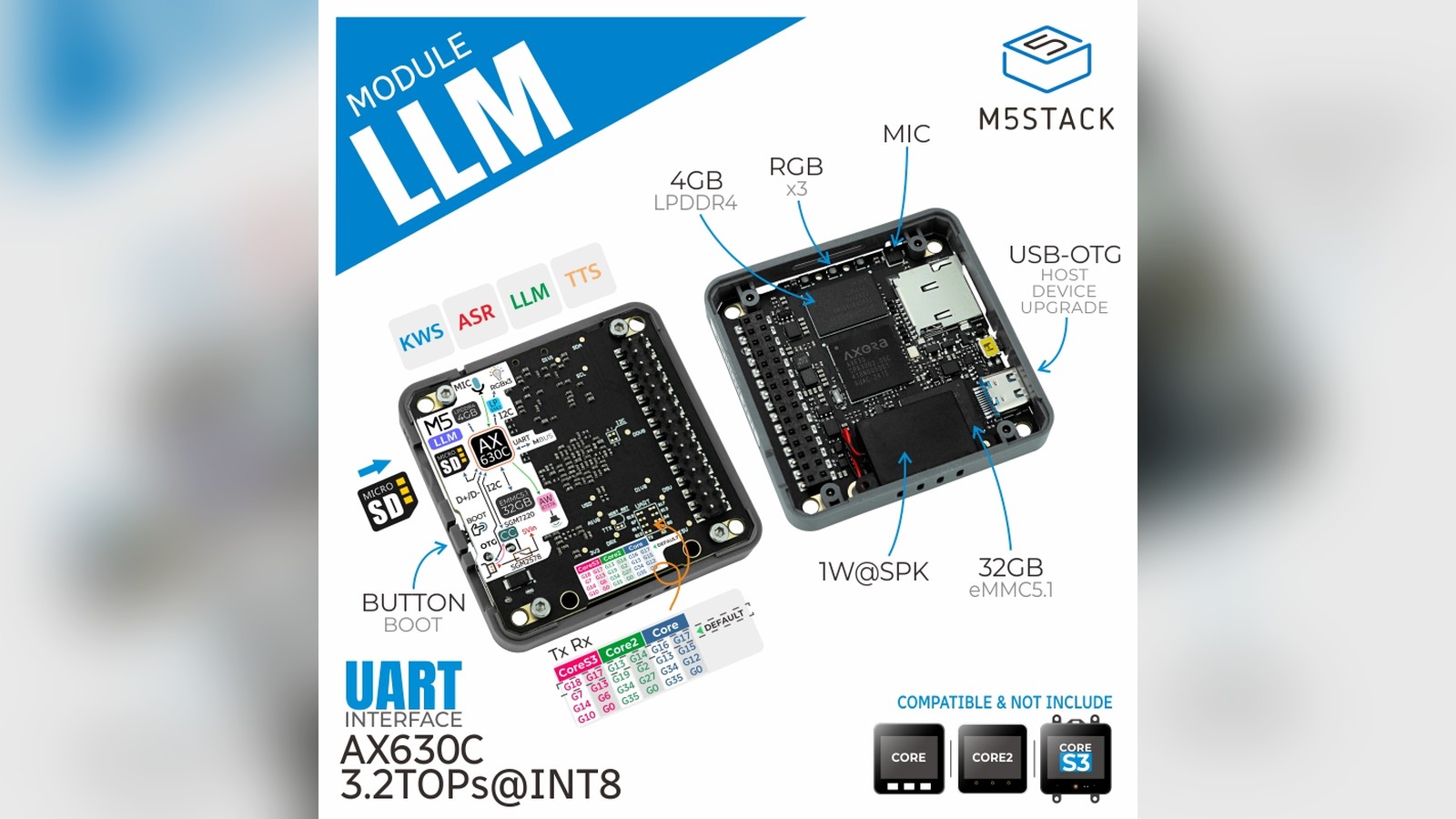
M5Stack's Module LLM brought local generative AI and voice processing into the company's modular hardware ecosystem in 2024. The module combines an Axera AX630C processor with a 3.2-TOPS neural processing unit, 4GB of LPDDR4 memory (a low-power type of RAM built for mobile and embedded devices), and 32GB of eMMC storage (embedded MultiMediaCard, a small onboard flash chip similar to what's inside an SD card, soldered directly to the board). M5Stack's StackFlow software exposes keyword spotting, speech recognition, language-model inference, text-to-speech, audio, and vision-language functions to a separate host.
The architecture is the interesting part. An ordinary M5Stack controller does not have to run a large model itself. It can ask the AI module to perform a task, receive the result, and use that result to control a screen, speaker, sensor, or machine.
A coprocessor separates AI from control
Microcontrollers such as the ESP32 are excellent at reading sensors, updating displays, and controlling outputs. Their memory and compute limits make modern speech and language models difficult or impossible to run at useful sizes.
Module LLM adds a dedicated Linux-capable AI system beneath or beside the host. Its neural processing unit, or NPU, accelerates the matrix arithmetic common in machine-learning inference. M5Stack rates it at 3.2 trillion operations per second for supported workloads.
TOPS, short for trillion operations per second, is not a direct measure of application speed. Model architecture, numerical precision, memory bandwidth, software support, and input length all affect performance. A supported compact model can run well while an unsupported or memory-heavy model may not run at all.
The host-and-coprocessor split has practical benefits. The user interface can remain responsive while inference runs. The host firmware can focus on buttons, sensors, and application state. The module can manage models and pipelines using its own operating environment.
It also creates a boundary that must be designed. The two sides need a communications protocol, error handling, version compatibility, and a recovery plan. An application should never assume that an AI request will succeed instantly.
StackFlow turns models into services
StackFlow organizes AI functions as separate services. Instead of embedding every model runtime into the host program, software can create and connect components for keyword spotting, automatic speech recognition, a language model, text-to-speech, audio input and output, or vision-language processing.
Keyword spotting listens for a short trigger phrase. Automatic speech recognition, or ASR, converts speech to text. A large language model produces a textual response or structured instruction. Text-to-speech, or TTS, turns text back into audio. Linking them creates a local voice assistant.
This service approach makes the AI module resemble a powerful peripheral. The host sends configuration and data, then receives events or results. The underlying work is more complicated than reading a temperature sensor, but the mental model helps embedded developers reason about the system.
Independent services also support different pipelines. A device may need speech recognition without a language model, or a vision-language model without speech. Loading only the required components can conserve memory and reduce startup time.
Versioning deserves care. A host application should record the StackFlow, model, and firmware versions used during testing. Changes in tokenization, output format, or service behavior can otherwise produce difficult field failures.
Offline processing changes privacy and reliability
Running locally means microphone recordings, images, prompts, and responses do not have to be sent to a cloud service for inference. That can reduce latency, protect sensitive data, and keep core functions available when internet access disappears.
Local does not automatically mean private. The device may still log data, expose a network service, or upload telemetry. Developers must inspect the full data path and communicate it clearly. Stored audio, transcripts, and conversation history need retention and access policies.
Offline operation also moves maintenance onto the owner. Cloud providers update models and infrastructure centrally. A local product must distribute security fixes, model updates, licenses, and configuration changes. Storage should be verified, and interrupted updates must not leave the device unusable.
For a workshop voice controller or private note interface, the trade can be worthwhile. A command can remain within the room, and the system can operate on an isolated network. A cloud model may still be preferable when the task requires broader knowledge, very large models, or centralized fleet management.
A voice pipeline is more than an LLM
A useful assistant begins before the language model. The microphone signal must have enough level without clipping. Noise reduction and echo control may be needed. Keyword spotting must balance missed triggers against accidental activations.
ASR performance depends on accent, distance, room acoustics, vocabulary, and background noise. A transcript should be treated as uncertain input. Commands that affect locks, machinery, purchases, or safety need explicit confirmation and deterministic validation.
The language model can interpret a flexible request, but application code should convert its response into a restricted schema. For example, a workshop assistant might accept only a device identifier, an action from a short allowed list, and a value within a safe range. Free-form generated text should not be passed directly to a shell or actuator.
TTS completes the interaction by confirming what the system understood. A screen can show the transcript and pending action, giving users another way to catch mistakes. Physical buttons should remain available for canceling or muting the microphone.
Latency accumulates across every stage. Measure wake-word delay, transcription time, model response, speech generation, and playback. A smaller model with a quick, predictable answer can feel more useful than a larger model that pauses unpredictably.
Vision-language processing adds another input
M5Stack also documents vision-language model functions in the StackFlow ecosystem. A vision-language model connects image information with text, allowing queries about a frame rather than only classification into a fixed label set.
The feature can support scene descriptions, equipment checks, document assistance, or interactive camera projects. It should not be treated as a precise measurement system. Models can miss objects, invent details, and respond differently to lighting or framing.
Applications should constrain the question and preserve the original image for review. If a task can be solved with a deterministic sensor or traditional computer-vision algorithm, that may be safer and faster. Generative vision is most useful when flexible interpretation is valuable and occasional error is acceptable.
Camera privacy needs the same care as audio. Include a clear indicator when capture is active, minimize retained images, and provide a physical way to disable the sensor where appropriate.
Building a dependable local assistant
Start with one service. Verify microphone input and keyword spotting before loading speech recognition. Then test ASR with a small set of expected phrases in the real room. Save failed examples and measure recognition accuracy rather than relying on demonstrations.
Add the language model only after transcripts are visible and trustworthy enough for the task. Use a narrow system prompt and request structured output. Validate every field on the host, reject unknown actions, and require confirmation for consequential commands.
Add TTS last and keep spoken responses short. Log timing and service errors without retaining sensitive content unnecessarily. Test the module with network access removed to confirm which functions are genuinely local.
Power-cycle the host and module in different orders. Disconnect communications during inference. Fill storage, load an unavailable model, and send an oversized request. The interface should report a clear failure and recover without leaving outputs in an unsafe state.
Thermal and power testing are worth doing during sustained inference. An NPU module can draw and dissipate much more energy than an idle microcontroller. Measure enclosure temperature and supply stability during repeated ASR, LLM, and TTS cycles.
Why Module LLM matters
Module LLM makes local AI an add-on within a familiar embedded system rather than requiring every project to begin with a separate AI computer. A CoreS3 or another host can remain responsible for the physical interface while StackFlow handles supported inference tasks.
The 3.2-TOPS platform has clear model and performance limits, but those limits can be productive. It encourages compact, task-focused assistants that operate without sending every interaction to the internet.
More importantly, M5Stack presents speech, language, audio, and vision as composable embedded services. That connects modern AI with buttons, screens, sensors, and actuators in a form makers can prototype. The result is not merely a small chatbot. It is a route for adding local interpretation to physical devices, provided developers treat model output as uncertain and design the surrounding system accordingly.
I'd test the voice pipeline one stage at a time, keyword first and then speech recognition, and keep the language model's output restricted to a short list of allowed actions.
Sources and image credits
- M5Stack Module LLM documentation, M5Stack, 2024.
- M5Stack StackFlow LLM API guide, M5Stack, 2024.
- Official M5Stack documentation image of Module LLM, M5Stack official documentation image.
- Square and vertical crops are edited from the same source image.