
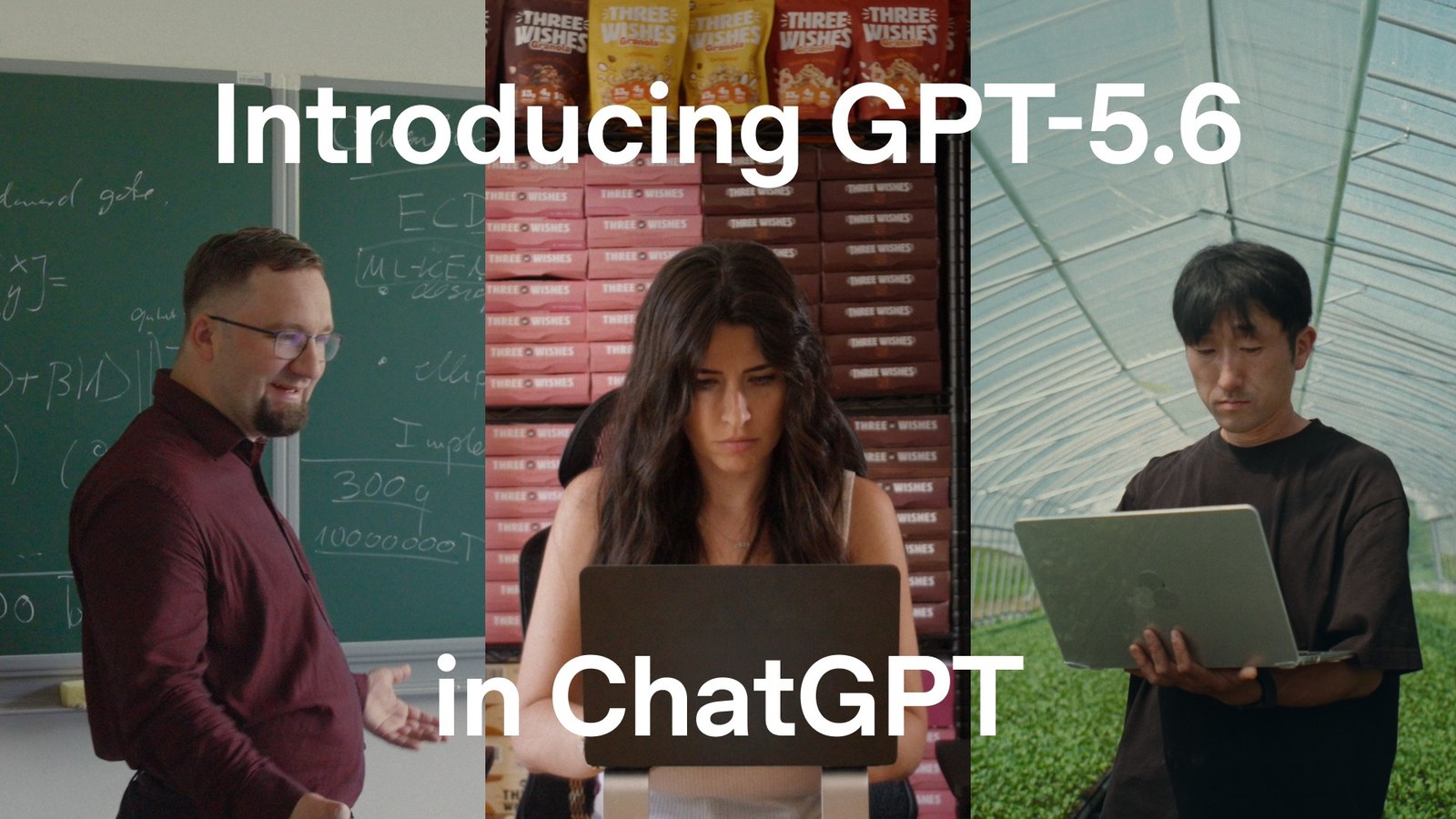
On July 9, 2026, OpenAI made the GPT-5.6 family generally available: Sol, Terra, and Luna. Sol is the flagship. Terra is the balanced model for everyday work. Luna is the cost-efficient one, which OpenAI also calls the fastest in the family. The rollout covers ChatGPT, Codex, and the API, and OpenAI says full availability takes about 24 hours. The API is the application programming interface, the programmer's door. Codex is OpenAI's coding agent for a repository.
The prices in the body of that post, per million tokens, are $5 input and $30 output for Sol, $2.50 and $15 for Terra, and $1 and $6 for Luna. A token is a small slice of text the meter counts, often a word or a piece of a word.
Luna or Terra is the pick for a driver I already understand. Sol is the one I would call for the bug that has already eaten a day.
What actually changed?
GPT-5.5 was the previous general model. GPT-5.6 splits that job into three tiers. OpenAI says Sol sets its new mark on coding, knowledge work, cybersecurity, and science, in fewer tokens than the models it compares itself with. Those comparisons are OpenAI's, including when the other name is an outside index.
Effort is how much time and compute the model spends before it answers. The post names medium and higher settings, then extra-high, then max, which it says gives still more time to revise. ultra runs four agents in parallel by default. An agent here is a worker that can use tools and carry part of the job. More tokens, OpenAI says, and a faster finish on a hard task. A multi-agent API mode is in beta. Developers also get programmatic tool calling: the model writes a short program that calls tools and keeps only the useful intermediate data. OpenAI says that path can run with zero data retention.
How does the new piece work?
Luna is for repetitive work. Terra is the everyday board. Sol is for the failure that has stopped making sense. OpenAI says Terra is competitive with GPT-5.5 at a lower price. The long scoreboard paragraphs are about Sol.
On a short prompt I would leave effort at medium. max buys a longer look. ultra buys the four-way split, which I would save for a bug that already survived one Sol pass. OpenAI's charts for that setting include a browsing test and a pair of coding tests.
OpenAI says the safeguards are stricter, and that Sol's cyber checks block about ten times more potentially harmful activity than the previous generation. A blocked prompt can be retried on a weaker model. The company says the family does not cross its Critical threshold in biology or cybersecurity. I will not describe those tests. Defensive security work can go through a trusted-access program, and OpenAI says those users need hardware-backed account security by September 1 to keep the higher access.
What does this look like on a real project?
I would not put Sol on a UART driver. A UART is a serial port, the slow text link between a board and a laptop. The work is an init table, a ring buffer, and a loopback test. On an API key I pay myself, Luna at $1 and $6 is the bill I can defend for that repetition. Terra at $2.50 and $15 is the pick for a new peripheral and a datasheet timing diagram. Who can select which model is in the price section below.
The hard debug is a different purchase. Say a DMA interrupt corrupts a buffer only after the board has been up for an hour. DMA is direct memory access, a block that copies bytes in the background. I would switch to Sol, set effort to max, and paste the driver, the map file, and the note. I would ask for a hypothesis and a test, and I would say not to flash anything. If that pass is still lost, and I am in Codex on Plus or above, ultra is the expensive parallel setting. In ChatGPT Work, the work chat named in the post, ultra is for Pro and Enterprise. In ordinary chat, Plus and above reach Sol from medium effort up, and Sol Pro, a higher-quality option, is for Pro and Enterprise. I have not run GPT-5.6. The patch gets read before it touches a programmer.
On the API, cache writes cost 1.25 times the input rate and cache reads are 90 percent off, for at least 30 minutes. A script that changes the whole prompt every call should not assume the discount.
How does it compare with the previous version?
Against GPT-5.5, OpenAI's table generally moves up. SWE-Bench Pro, a software-repair test, is 64.6 percent for Sol and 59.4 percent for GPT-5.5, with Terra and Luna in between at 63.4 and 62.7. Terminal-Bench 2.1 puts Terra a bit above GPT-5.5 and Luna a hair below it.
The cross-checks do not all point the same way. On OpenAI's Coding Agent Index, Sol is 80 and Claude Fable 5 is 77.2. On SWE-Bench Pro in the same post, Fable 5 is 80 percent and Claude Mythos 5 is 80.3 percent, above Sol's 64.6. OpenAI calls Sol its best coding model and also prints a repair score where those Claude models lead. A firmware patch looks more like the repair test than like the blended index. One more snag: the prose says Sol scores 53.6 on Agents' Last Exam, a long professional-work test, and the table says 52.7 percent. Both numbers are OpenAI's. They do not match.
Where does it sit next to other tools a maker already uses?
Chat on Plus, Pro, Business, and Enterprise reaches Sol at medium effort and up. Free and Go get Terra in ChatGPT Work and Codex. Codex is where I would spend a firmware week, because the model can see the repo. A script on the API can call Luna all night and Sol once.
Fable 5 and Opus 4.8 stay useful as a second read on a repair task, because OpenAI's own SWE-Bench row has Claude ahead. I would not pay Sol's $30 output price for a UART init Luna can draft. I would pay it when the DMA failure is still unexplained. The logic analyzer and the programmer still decide whether a patch is real.
What does this cost, and who can use it today?
Launch prices per million tokens, from the July 9 post, are Sol at $5 and $30, Terra at $2.50 and $15, and Luna at $1 and $6. Cache writes are 1.25 times input. Cache reads are 90 percent off.
The rollout started July 9 and may take about 24 hours, so a missing model tonight can be the delay. In chat, Plus, Pro, Business, and Enterprise reach Sol at medium effort and up. Pro and Enterprise can also select Sol Pro. In ChatGPT Work and Codex, Free and Go get Terra, and Plus and above can choose any of the three. ultra in Work is Pro and Enterprise. ultra in Codex is Plus and higher. The API serves all three.
A solo engineer on Plus can put Luna or Terra on firmware in Codex and Sol on the hard debug. On Free, the post gives Terra there. On your own API key, the output prices are six dollars, fifteen, and thirty.
What is still unproven?
I have not run GPT-5.6. The scores are OpenAI's, and the prose and the table already disagree on Agents' Last Exam. Customer lines are the ones OpenAI chose to print.
It is still unproven that Terra holds GPT-5.5 quality on your drivers, and that Sol's extra dollars fix the DMA bug. Ultra spends more on purpose. Leave it off for ordinary firmware. The cyber filters are aggressive enough that OpenAI offers a retry on a weaker model, so measure that on your own prompts before a script depends on a clean pass. Sol is for the debug that earned it. Luna and Terra are for the rest of the board.
Disclosure: The author is a paying subscriber to ChatGPT Plus, Claude Pro, and SuperGrok and uses all three services on a daily basis. The Makers Workbench is not affiliated with OpenAI, Anthropic, xAI, Google, or any of the other major AI companies covered in our reporting. No company receives favorable editorial treatment based on the author's personal subscriptions.
Sources and image credits
- OpenAI announcement (openai.com)
- Images: published by OpenAI with the announcement.


