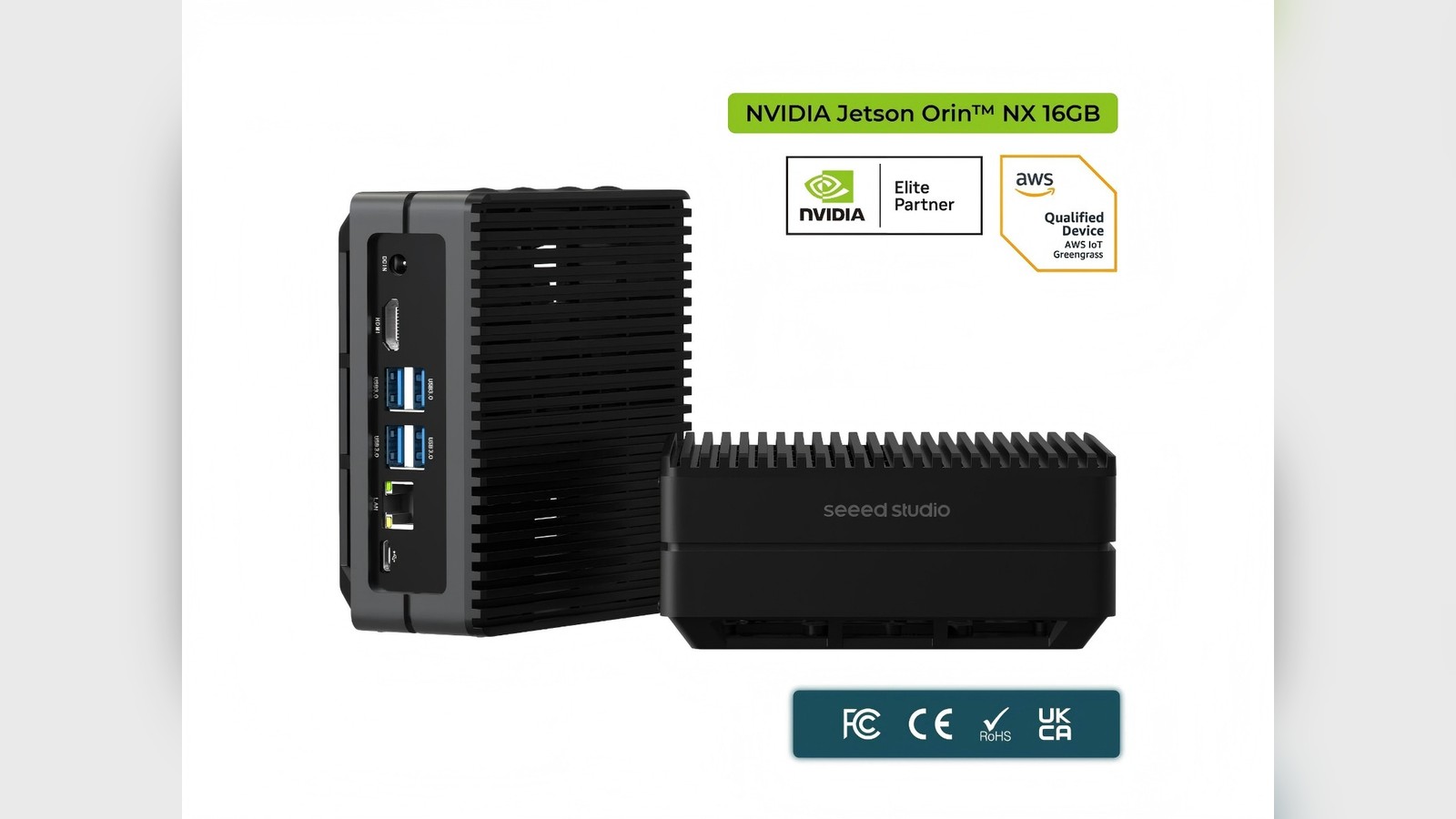
Seeed Studio introduced the reComputer J4012 on January 6, 2023, as a hand-sized edge AI computer built around NVIDIA's Jetson Orin NX 16GB module. The complete system delivered up to 100 TOPS of claimed AI performance and arrived with a 128GB NVMe solid-state drive, cooling, an aluminum enclosure, and JetPack 5.1 preinstalled.
TOPS means trillions of operations per second. It is a useful headline for specialized neural-network arithmetic, but it is not a universal speed rating. Model architecture, numerical precision, memory movement, camera decoding, preprocessing, and software optimization determine how quickly a real application runs.
The more practical story was integration. Instead of buying a compute module, designing a carrier board, selecting storage, and solving thermal management separately, developers could start with a finished Linux computer that exposed four USB 3.2 ports, Gigabit Ethernet, HDMI, CAN, a 40-pin GPIO header, and M.2 expansion.
Jetson Orin NX moves serious inference to the edge
Edge AI runs machine-learning inference near the sensors that produce the data. A warehouse camera can detect people or pallets locally instead of sending every frame to a cloud service. A robot can interpret cameras with less network delay. A production line can continue operating when an internet connection is unavailable.
The Jetson Orin NX uses NVIDIA's Ampere GPU architecture and includes dedicated acceleration for AI workloads. The 16GB of shared memory gives developers room for larger models or several simultaneous pipelines. Seeed highlighted the ability to run multiple neural networks and process feeds from several high-resolution sensors.
Local processing can reduce upstream bandwidth and improve privacy, but it does not eliminate system design. Applications still need data-retention rules, access controls, model updates, and monitoring. A locally processed camera can remain privacy-sensitive even when video never reaches a public cloud.
The complete computer changes the starting line
Jetson modules are compact computing engines intended to sit on a carrier board. The carrier supplies power, connectors, storage, and the electrical paths to cameras and peripherals. Designing one is reasonable for a high-volume product, but it adds time and signal-integrity risk during early development.
The J4012 turns that module into a deployable development system. Its four USB 3.2 ports can host cameras, depth sensors, storage, or accelerators. The M.2 Key M slot supports fast NVMe storage, while the Key E slot can accommodate suitable wireless modules. Gigabit Ethernet provides a predictable network link, and HDMI simplifies setup and diagnostics.
CAN, or Controller Area Network, is a serial communication protocol originally developed for automobiles that lets multiple controllers and sensors share a single pair of wires and keep talking reliably even in electrically noisy environments. It is valuable in robotics, vehicles, and industrial equipment for exactly that reason. The 40-pin header gives makers familiar access to lower-speed interfaces and general-purpose pins. Those interfaces make the J4012 more than a sealed inference appliance.
Developers still need to check voltage levels and pin assignments before connecting accessories. A Raspberry Pi-style header shape does not guarantee identical electrical behavior or software support. High-current loads should use their own power path rather than drawing blindly from the header.
Storage and software arrive ready to use
Seeed specified a 128GB NVMe SSD and JetPack 5.1. JetPack is NVIDIA's software platform for Jetson, combining the Linux operating system, CUDA computing tools, TensorRT inference optimization, multimedia libraries, and hardware support.
Preinstallation removes a tedious first step, but production teams should treat the factory image as a starting point. Record the exact JetPack release, apply appropriate security updates, and verify that camera drivers and models work before upgrading components independently.
TensorRT can optimize trained models for Jetson hardware by selecting efficient kernels and numerical formats. Quantization may reduce a model from 32-bit floating point to 16-bit or 8-bit calculations, improving throughput and lowering memory use. Accuracy must be measured after conversion because some models tolerate reduced precision better than others.
Seeed cited a demonstration running custom YOLOv5 object detection above 100 frames per second. That figure is workload-specific. Input resolution, model size, precision, number of streams, and preprocessing all change the result. A useful benchmark should match the cameras and detection targets planned for deployment.
Cooling is part of AI performance
The enclosure includes a fan because sustained GPU work produces heat. A benchmark that runs briefly on an open bench may not predict performance inside a cabinet on a hot factory floor. When the module reaches a thermal limit, clock speeds can fall to protect the hardware.
Measure temperature and inference rate over hours, not minutes. Test blocked airflow, dust accumulation, and the maximum expected ambient temperature. Fan noise and service life may matter in kiosks, laboratories, or quiet rooms. A fan failure should produce an alert before it becomes intermittent application behavior.
Power budgeting deserves similar care. The computer, cameras, USB peripherals, SSD, and wireless modules all draw from the supply. Startup and peak GPU loads can expose a marginal adapter even when average power looks comfortable. Use the supported power modes and measure the complete configuration.
What 100 TOPS does and does not promise
The 100 TOPS figure describes the upper capability of particular accelerated operations under supported conditions. It cannot be compared directly with a desktop CPU clock rate, and two accelerators with the same TOPS may perform differently on the same model.
Memory bandwidth can become the limit when a network moves large feature maps. Video decoding or image resizing can limit a multi-camera pipeline before the neural engine is full. Application code that copies frames unnecessarily can erase gains from fast inference.
Developers should profile the whole pipeline: capture, decode, resize, inference, postprocessing, tracking, logging, and network output. NVIDIA's tools can show GPU and memory utilization, while application timestamps reveal latency and dropped frames. Optimize the bottleneck that measurements identify.
A practical route from prototype to deployment
Begin with one supported camera and an NVIDIA or Seeed example. Confirm capture and hardware-accelerated decoding before adding a custom model. Export the model to ONNX (Open Neural Network Exchange, a shared file format that lets a model trained in one framework move into a different tool for optimization), build a TensorRT engine for the installed software version, and validate results against known images.
Next, add realistic concurrency. If the final system uses four cameras, test four streams with the intended resolution and frame rate. Include the database, user interface, alerts, and networking that will run beside inference. Measure worst-case latency, not only average frames per second.
Finally, plan field maintenance. Remote systems need secure updates, logs, health checks, storage management, and a recovery image. AI models change alongside application software, so version the model, labels, thresholds, and inference engine together.
The reComputer J4012 stands out because it makes the new Orin NX performance available as a complete, compact computer. Its value is not merely 100 TOPS. The enclosure, storage, cooling, connectors, and preinstalled software let developers spend their first weeks validating an application instead of designing the machine that runs it.
I'd test with the cameras and the load you actually plan to run, and watch temperature over hours. A short benchmark can look much better than a day in a cabinet.
Sources and image credits
- Official Seeed Studio blog post, Seeed Studio, January 6, 2023.
- Official product image from Seeed Studio: reComputer J4012.
- Square and vertical crops are edited from the same source image.


