
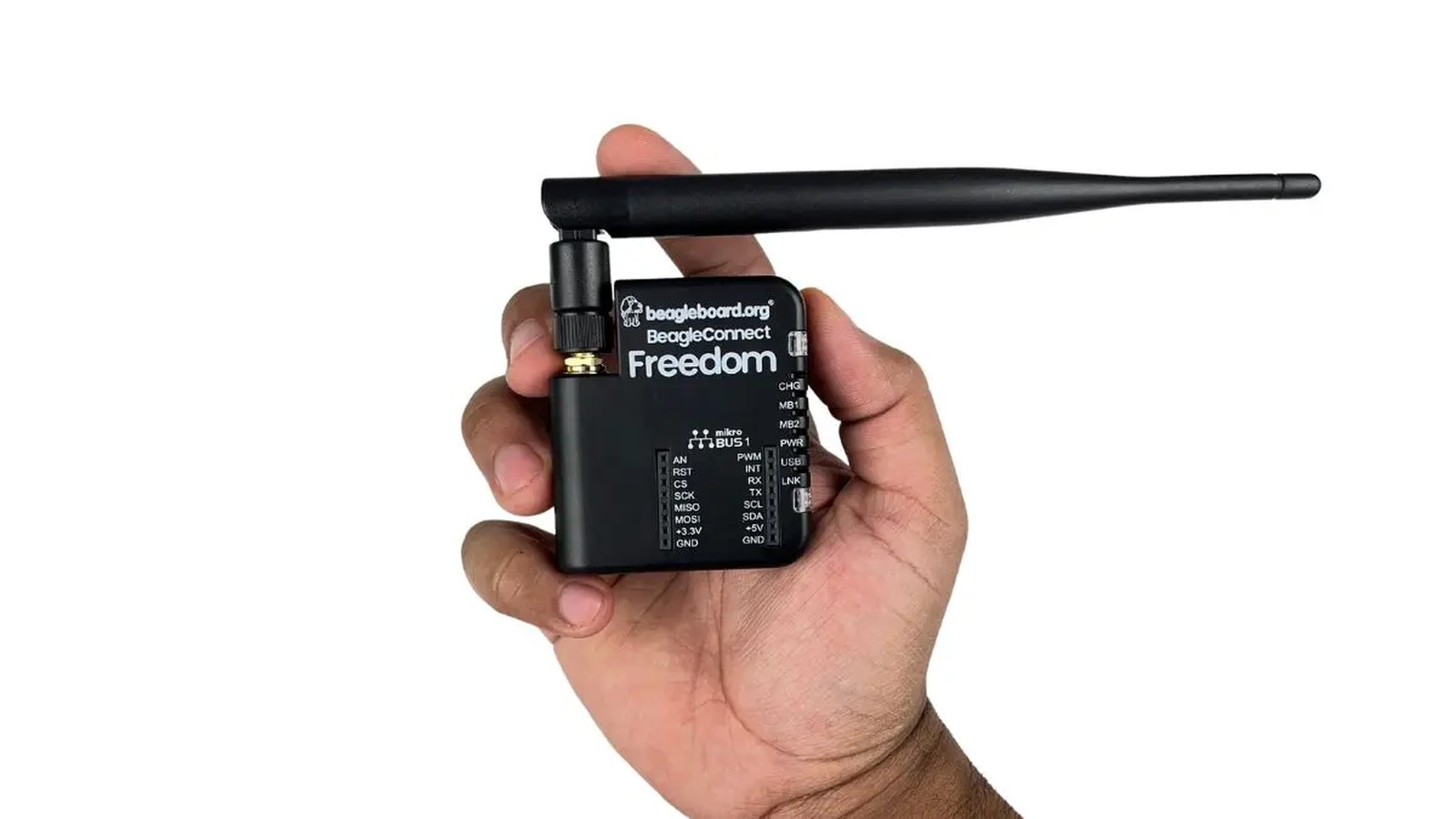
BeagleConnect Freedom became generally available on March 8, 2023, as a different kind of BeagleBoard product. Rather than another Linux single-board computer, it is a wireless microcontroller platform designed to place sensors and actuators away from the main computer, then expose them through an open software stack.
The board uses Texas Instruments' CC1352P7 wireless microcontroller, supports both 2.4GHz and sub-GHz radio operation, and provides two mikroBUS sockets for modular hardware. It ships in an enclosure with an antenna, battery charging, and a USB connection for programming and serial access.
Its most interesting idea is bigger than the hardware. BeagleConnect aims to make remote embedded devices feel more like extensions of a Linux system, reducing the amount of one-off gateway software required for every sensor project.
One microcontroller covers two radio ranges
The CC1352P7 contains an Arm Cortex-M4F application processor and a radio subsystem. Its 2.4GHz support can serve technologies such as Bluetooth Low Energy and IEEE 802.15.4, while its sub-GHz radio targets longer-range, lower-rate communication.
Lower frequencies generally travel farther and pass through obstacles more effectively than 2.4GHz signals under comparable conditions. Actual range depends on frequency rules, antenna design, transmit power, data rate, terrain, interference, and protocol. "Sub-GHz" is a radio category, not a guaranteed distance.
That flexibility makes Freedom suitable for distributed environmental sensing, agriculture, buildings, equipment monitoring, and education. A node might read a temperature or soil sensor, then report to a BeaglePlay gateway positioned inside a building.
The board's two mikroBUS sockets accept Click boards and compatible modules. mikroBUS provides standard positions for SPI (Serial Peripheral Interface, a fast synchronous link for chips that sit close together), I2C (Inter-Integrated Circuit, a simple two-wire bus that lets several low-speed devices share one pair of lines), UART (Universal Asynchronous Receiver-Transmitter, the classic point-to-point serial connection used for consoles and simple sensors), analog, PWM (Pulse-Width Modulation, a way to approximate an analog output by rapidly switching a digital pin on and off), interrupt, reset, power, and ground signals. Developers can add sensors or interfaces without designing a carrier board for each experiment.
Zephyr provides the embedded foundation
BeagleConnect development centers on Zephyr, an open-source real-time operating system for microcontrollers. A real-time operating system, or RTOS, provides scheduling, drivers, communication stacks, and synchronization while allowing tasks to meet defined timing constraints.
Zephyr supports the CC1352P7 and includes networking technologies relevant to BeagleConnect. It also provides a structured device model, configuration system, and update mechanisms that are more scalable than an ad hoc loop once firmware grows.
Freedom also shipped with MicroPython-based firmware. MicroPython is a compact implementation of Python designed for microcontrollers. Its interactive prompt makes initial hardware experiments accessible, while Zephyr remains underneath much of the platform work.
Developers should distinguish the language interface from the operating environment. A MicroPython prompt can simplify experimentation, but radio routing, device discovery, and remote I/O still depend on the firmware version and enabled services.
Why the USB bridge is on the board
The CC1352P7 does not include native USB. BeagleConnect Freedom therefore uses an MSP430F5503 microcontroller as a USB-to-UART bridge. That connection gives a computer a serial console and a route for reflashing the main wireless microcontroller.
BeagleBoard also discussed WPANUSB, a Zephyr application and Linux driver arrangement that exports an IEEE 802.15.4 radio over USB. IEEE 802.15.4 defines a low-rate wireless link used beneath protocols such as Thread, Zigbee, and 6LoWPAN.
This detail prevents a common misunderstanding. The USB bridge is not the long-range connection between two deployed nodes. It is a local interface that makes the radio microcontroller accessible to a host. Once deployed, Freedom communicates over its wireless link.
Greybus connects remote hardware to Linux
The ambitious part of BeagleConnect is its use of Greybus. Greybus was created to describe hardware interfaces across a communication link. In this context, it can let a Linux host discover and control peripherals attached to a remote Freedom node.
BeagleBoard's implementation used a combination of a Greybus server on the microcontroller, a userspace component called GBridge on Linux, and kernel support. BeaglePlay shipped with gateway functionality intended to make that arrangement easier.
The goal is powerful: a sensor connected to a remote mikroBUS socket can appear through normal Linux interfaces instead of requiring a unique application protocol for every project. Existing Linux drivers can then do more of the work.
At launch, the stack was still evolving. Forum discussion documented limitations around firmware choices, discovery, routing, and how MicroPython interacted with Greybus-controlled peripherals. Makers should treat those details as version-specific and follow current documentation rather than assume every early demonstration is automatic.
The network is not automatically a mesh
BeagleBoard explained that its Greybus transport used bare 6LoWPAN over IEEE 802.15.4g. 6LoWPAN adapts Internet Protocol version 6 to small, low-power wireless frames. In the described setup, nodes used BeaglePlay as a sensor aggregator.
That arrangement was point-to-point rather than a self-forming mesh. Other protocols can provide mesh routing, but they require additional firmware and design work. Keep that in mind when planning coverage. A long-range radio does not automatically relay messages through neighboring devices.
Security also needs explicit planning. Remote control of GPIO and buses is convenient, but it creates a path into physical equipment. Authentication, encryption, key provisioning, update signing, and safe behavior during lost communication should be part of the design.
A practical starting project
A sensible first project uses one Freedom board, one supported mikroBUS sensor, and a nearby Linux host over USB. Confirm sensor access and learn the firmware update process before adding radio complexity. Then move to a BeaglePlay gateway and measure packet delivery, latency, power use, and recovery after outages.
Battery projects should record current in active, receive, transmit, and sleep states. The radio can dominate average consumption if firmware wakes too often. Antenna placement counts too. Keep metal, cables, and noisy electronics away from the antenna where possible.
Finally, document the complete software combination: Zephyr version, board firmware, Linux kernel, GBridge version, and protocol settings. Distributed systems become difficult to reproduce when only the application source is recorded.
BeagleConnect Freedom is notable because it treats wireless sensor hardware as part of an open Linux ecosystem rather than an isolated microcontroller project. The board provides useful radios and expansion, but the more important idea is remote, discoverable hardware backed by shared drivers. That approach could turn a collection of sensor nodes into a system that is easier to inspect, extend, and maintain.
I'd begin with one board and one sensor over USB before adding radios, then test range with the antenna in its final position.
Sources and image credits
- BeagleConnect Freedom board page, BeagleBoard.org.
- BeagleBoard documentation: Boards, BeagleBoard.org.
- Official product image from BeagleBoard.org.
- Square and vertical crops are edited from the same source image.


