Update (January 5, 2026): The acquisition described below has since been completed. At CES 2026, Qualcomm announced the completion of its edge IoT expansion and counted Arduino among the companies it has acquired, alongside Augentix, Edge Impulse, Focus.AI, and Foundries.io. Arduino’s own website now states that Qualcomm Technologies, Inc. has acquired Arduino, and that Arduino will continue to operate with its own brand, tools, and mission. The article below is preserved as originally written on October 7, 2025, when the transaction was still pending.
Qualcomm announced an agreement to acquire Arduino on October 7, 2025, pairing one of the best-known names in maker hardware with a major supplier of mobile and embedded processors. On the same day, Arduino introduced the UNO Q, a board built around a Qualcomm Dragonwing processor and a separate real-time microcontroller.
Those announcements belong together. The acquisition was not presented as a simple transfer of ownership, and the UNO Q was not just another member of the UNO family. Together they outlined a plan to make Linux computing, artificial intelligence, and real-time electronics easier to combine inside one Arduino workflow.
When this was first published, the transaction was still proposed. Qualcomm said completion remained subject to regulatory approval and customary closing conditions, so Arduino had not yet become part of Qualcomm and continued operating independently while the deal moved toward closing.
What Qualcomm said it was buying
Arduino brought far more than a catalog of development boards. Qualcomm's announcement cited a community of more than 33 million active users, along with Arduino's software tools, education presence, documentation, hardware partners, and recognizable approach to embedded development.
For a chip company, that community is a direct path to developers. Semiconductor platforms can be technically capable yet difficult to adopt if the first project requires unfamiliar build systems, board support packages, and low-level configuration. Arduino's central promise has always been that a user can connect a board, open an example, and make a physical result happen quickly.
Qualcomm brought a different scale of technology. Its processors and software are used in phones, robots, industrial systems, cameras, vehicles, and connected devices. In 2025 the company was also assembling a broader edge-computing portfolio. Edge computing means processing data near the device that produces it instead of sending everything to a remote cloud service.
Qualcomm had already added Edge Impulse, a platform for building and deploying machine-learning models to edge hardware, and Foundries.io, which develops tools for maintaining Linux devices. Arduino fit that strategy at the point where developers learn, prototype, and turn ideas into working hardware.
Why the UNO Q makes the strategy concrete
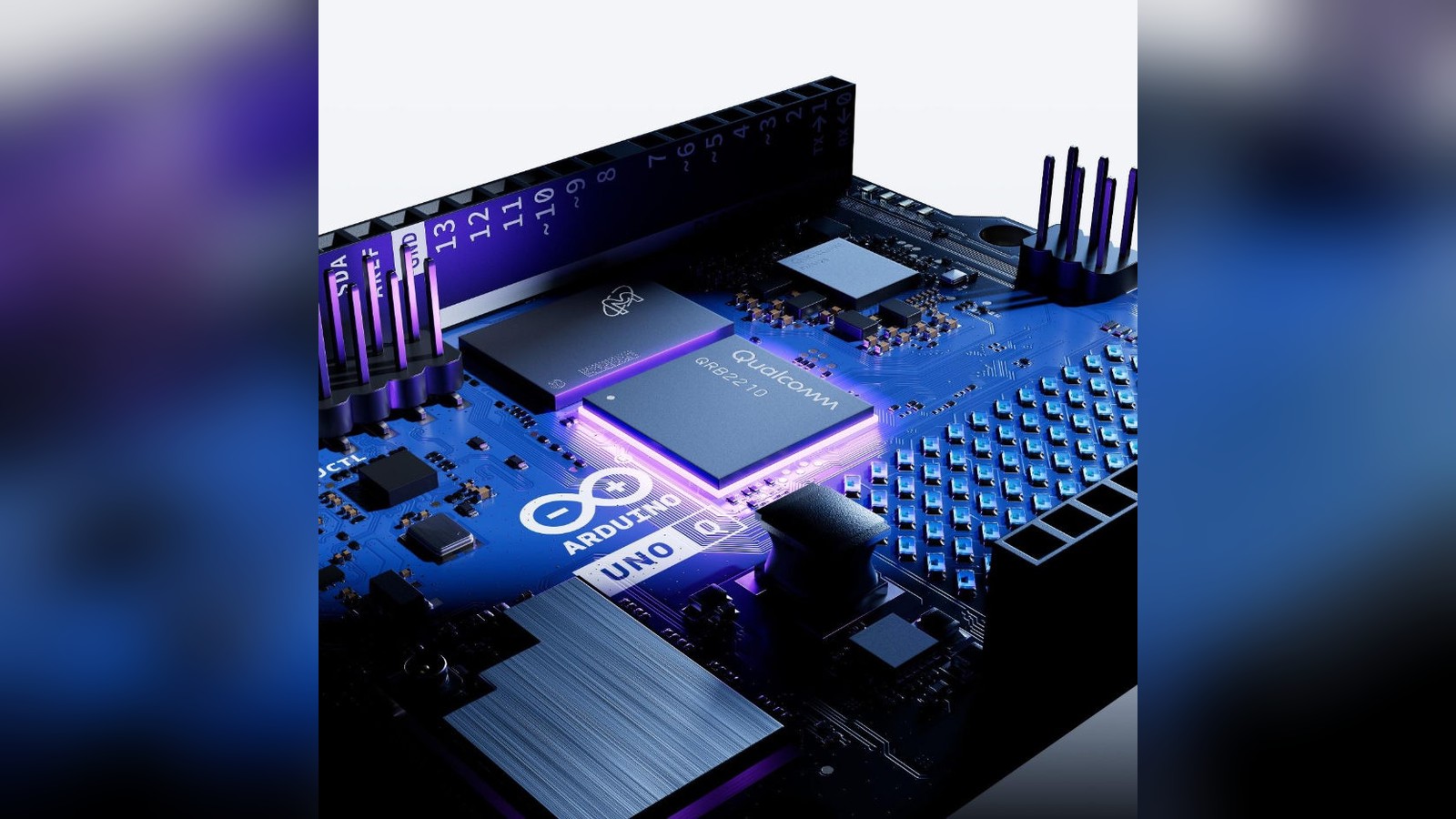
The UNO Q shows what the combined direction can look like as a product. It pairs a Qualcomm Dragonwing QRB2210 processor capable of running Debian Linux with an STMicroelectronics STM32U585 microcontroller for real-time control. Linux handles applications, networking, files, cameras, and higher-level AI software. The microcontroller handles precisely timed interaction with pins, sensors, and actuators.
This arrangement is often described as a dual-brain design. That is helpful shorthand, but the two processors do not work independently by accident. The board's software must define how messages, data, and control move between them. Arduino's App Lab development environment is introduced alongside it to make that relationship accessible through Arduino sketches, Python programs, reusable software components, and AI models.
The UNO Q therefore serves as more than launch-day decoration for the deal. It demonstrates a product category Qualcomm and Arduino could develop together: hardware with enough compute for Linux and local AI, plus a microcontroller that preserves the direct, predictable hardware control makers expect.
What Arduino promised would remain independent
Acquisitions make communities ask what will disappear. Arduino and Qualcomm addressed that concern directly. Their October statements said Arduino would retain its brand, tools, and mission, and that its products would continue supporting processors from multiple semiconductor companies.
That multi-vendor point was essential. Arduino boards and software have supported hardware from Microchip, Renesas, STMicroelectronics, Espressif, Nordic Semiconductor, NXP, Raspberry Pi, and others. If Arduino became only a path into Qualcomm hardware, it would lose much of the openness that made the platform valuable.
The companies also said Arduino would continue its open approach. Open source allows people to inspect, modify, and redistribute designs or software under the terms of a license. Arduino's ecosystem mixes open-source hardware and software with proprietary components and commercial services, so the practical question is not whether every piece is open. It is whether the company continues publishing the source, design files, and documentation that let the community understand and extend the platform.
Promises made during an acquisition deserve to be recorded, then evaluated against later releases. They are commitments, not automatic guarantees. The UNO Q's public documentation and computer-aided design files offer early evidence, while the long-term test will be the treatment of non-Qualcomm boards, core development tools, and community contributions.
What the agreement could change for makers
The most immediate opportunity is access. Qualcomm platforms have not traditionally been as approachable to hobbyists as classic Arduino microcontrollers. Better documentation, affordable boards, integrated tools, and familiar examples could put capable Linux and AI hardware in front of people who might never start with a conventional embedded Linux development kit.
AI is the most visible theme, but local computing has benefits even when a project does not use a neural network. A board like the UNO Q can run a web interface, process camera frames, manage a local database, or coordinate several network services. Keeping those tasks on the device can reduce latency, bandwidth use, and dependence on an internet connection.
There are also legitimate concerns. A dual-processor platform is more complex than an 8-bit UNO. Linux introduces operating-system updates, storage management, security maintenance, and software dependencies. AI tools can make demos easier without making model quality, privacy, bias, or power consumption disappear. An integrated environment must simplify those responsibilities without hiding them so completely that users cannot troubleshoot their systems.
Pricing and availability will count too. Arduino's reach comes partly from accessible hardware and a large clone-compatible ecosystem. Qualcomm's technology could expand what Arduino boards can do, but the result will need to remain practical for classrooms, small teams, and independent makers.
How to read the launch-day announcement
On October 7, the safest interpretation is neither that Arduino has already changed owners nor that nothing will change. The signed agreement establishes the direction. The UNO Q and App Lab provide the first concrete implementation. Regulatory review and closing still have to happen, while the longer consequences will unfold through future hardware and software decisions.
For existing Arduino projects, there is no reason to rewrite working code or abandon familiar boards. The announcement adds a new high-compute path rather than replacing microcontroller-only development. A simple sensor, light controller, or motor driver still does not need Linux or AI.
For developers who have been stitching a single-board computer to a microcontroller, however, the UNO Q is immediately relevant. It promises one supported platform for the application side and the real-time side. Qualcomm's acquisition plan suggests that more resources could be directed at making that bridge reliable and repeatable.
The most important story is access. Qualcomm wants its edge technologies to reach Arduino's enormous developer base, and Arduino wants to make more advanced computing feel as approachable as its earlier boards. Whether that combination preserves the platform's openness can only be judged over time. At the time, the UNO Q gave the community something specific to examine while it waited for the deal to close.
I'd treat the UNO Q as the interesting part of this story. Acquisition headlines fade, but a board that pairs Linux with a real-time microcontroller is something you can actually test on your own bench.
Sources and image credits
- Qualcomm announcement: Qualcomm to acquire Arduino
- Arduino announcement: A new chapter for Arduino
- Official UNO Q press image supplied by Qualcomm Technologies and approved by the site owner for editorial use.
- Square and vertical crops are edited from the same source image.