Arduino announced on October 31, 2025, that its acquisition by Qualcomm Technologies was complete. The closing came only 24 days after the companies disclosed their agreement and introduced the Arduino UNO Q, a dual-processor board built around Qualcomm and STMicroelectronics silicon.
Completion changed the legal and corporate fact: Arduino was now part of the Qualcomm family. It did not mean that every Arduino board, software tool, or community program changed overnight. The companies repeated their commitments to Arduino's brand, open-source approach, and support for chips from multiple vendors.
Those commitments are central to understanding the deal. Arduino's value does not come from one processor. It comes from a development model used across a wide range of hardware, a large body of open code and documentation, and a community that expects to understand and modify the tools it uses. Qualcomm acquired that ecosystem, not merely a board design.
What changed when the deal closed?
Before October 31, Qualcomm and Arduino had signed an acquisition agreement that still depended on regulatory approval and closing conditions. After the closing announcement, Arduino officially operated within Qualcomm. The companies could begin coordinating product plans, engineering resources, and market strategy as one corporate group.
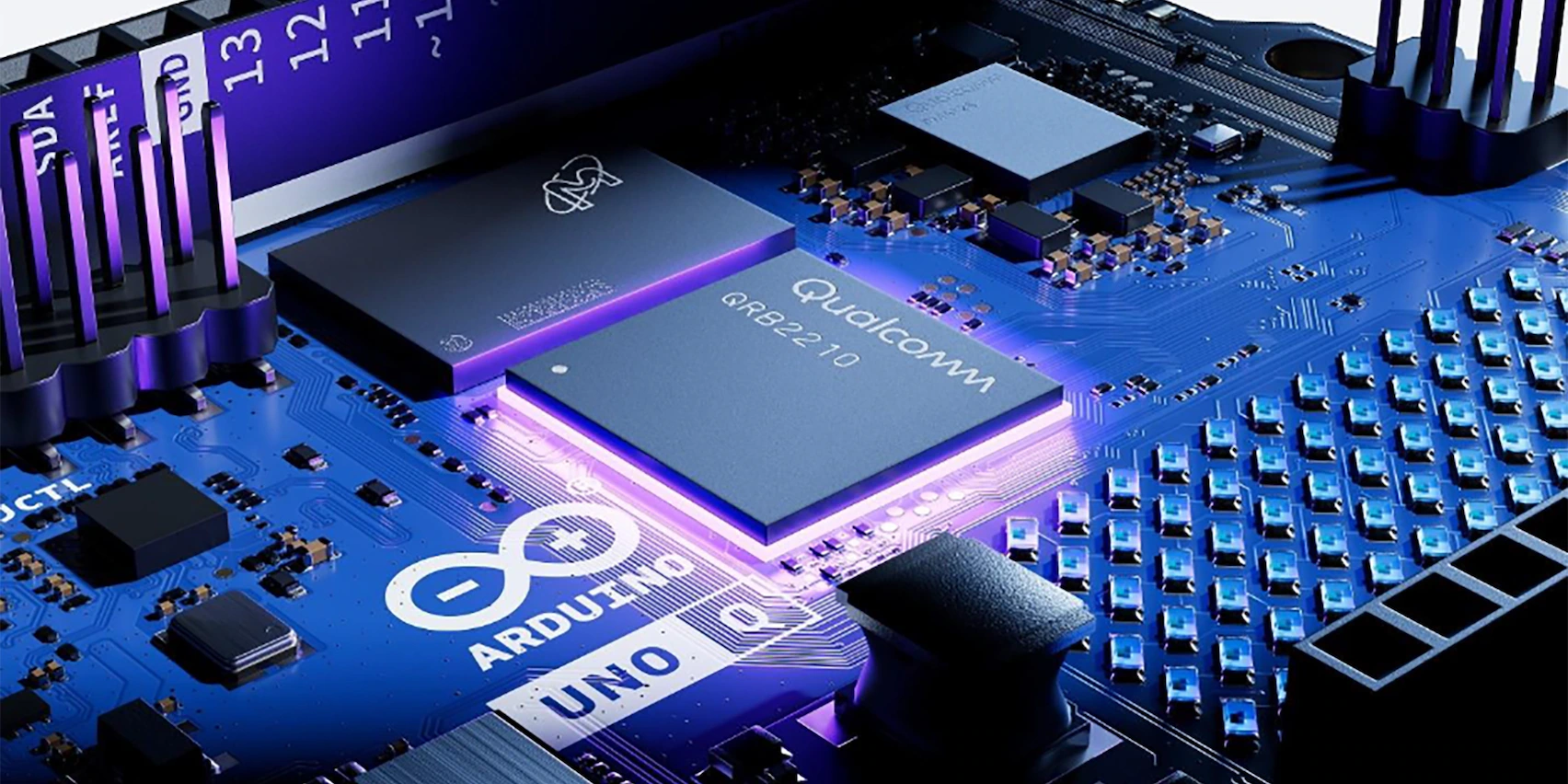
The immediate product example was the UNO Q. Its Qualcomm Dragonwing QRB2210 runs Debian Linux, while an STM32U585 microcontroller handles real-time tasks. Arduino App Lab gives developers one environment for Python, Arduino sketches, Linux services, and AI components.
This combination points to Qualcomm's reason for the acquisition. The company develops powerful processors and connectivity platforms, but reaching millions of makers and embedded developers requires approachable hardware, examples, software, and education. Arduino had that route. Arduino, in turn, gained access to Qualcomm's computing, graphics, connectivity, and edge-AI technology.
What did Arduino say would stay the same?
Arduino said it would keep its identity and mission while continuing to support multiple semiconductor vendors. Multi-vendor support means the Arduino platform is not limited to chips from its owner. That matters because the ecosystem includes boards and software based on processors from Renesas, Microchip, Espressif, Nordic Semiconductor, STMicroelectronics, Raspberry Pi, NXP, and others.
The company also promised to retain its open-source spirit. Open source is not a ceremonial phrase for Arduino users. Published board designs, cores, libraries, tools, and documentation allow the community to inspect how products work, repair problems, contribute changes, and create compatible hardware.
An acquisition announcement cannot prove what a company will do for years. The evidence has to come from releases and repository activity after closing. Arduino offered an early, concrete signal by making UNO Q computer-aided design files publicly available. CAD files describe a product's physical or electronic design and can help developers build enclosures, carriers, and compatible hardware.
Why the architecture diagram matters
The UNO Q architecture is a useful picture of the business strategy. The board combines an application processor, memory, and storage for Linux with a microcontroller for predictable hardware control. It also needs software that lets the two sides communicate and development tools that make the complete system understandable.
Qualcomm had already acquired Edge Impulse, which helps developers create and deploy machine-learning models, and Foundries.io, which focuses on maintaining Linux devices. Arduino adds the accessible hardware and developer workflow at the front of that stack.
In a possible end-to-end project, a maker could prototype on Arduino hardware, build an edge model with integrated tools, run it under Linux, and maintain the deployed system through a supported device platform. That is attractive to Qualcomm because it creates a path from an experiment to a commercial connected product.
It can also benefit makers if the individual layers remain usable on their own. A user should not need a cloud account to blink an LED. A library should not become needlessly tied to one chip family. A local project should remain understandable without a proprietary service sitting between the developer and the hardware.
What are the opportunities?
The clearest opportunity is bringing Qualcomm-class processors into a workflow that is easier to enter. Traditional embedded Linux boards can demand substantial setup before a developer reaches the actual project. Arduino's examples, libraries, board definitions, and education materials can reduce that friction.
Local AI and computer vision are likely to receive the most attention. Running inference on a device can lower network latency and avoid uploading continuous streams of sensor data. Inference is the use of a trained model to analyze new input. It still requires careful measurement of accuracy, memory, processing time, power, and heat.
Robotics, industrial prototypes, interactive installations, and smart instruments can also benefit from the dual-processor approach. Linux handles networking and complex applications. A microcontroller handles motors, sensors, and timing. One supported board and one project structure can replace a hand-built connection between separate computers.
Qualcomm's resources could improve long-term software maintenance as well. Development boards are easy to announce and harder to support for years. Reliable operating-system images, security updates, current packages, and maintained documentation are what make Linux hardware usable beyond a launch demo.
What should the community watch?
The first question is whether Arduino continues treating non-Qualcomm platforms as first-class targets. New board packages, library fixes, documentation, and tool support will show whether multi-vendor language becomes daily engineering practice.
The second is which parts of future products remain open. A board can publish its mechanical CAD while keeping important software or hardware interfaces closed. Each release should be evaluated component by component: schematics, board files, boot software, operating-system changes, development tools, and cloud services may have different licenses.
The third is account and cloud dependence. Optional services can make connected development easier. Mandatory accounts, proprietary deployment paths, or features that stop working without a vendor server can make a project harder to own and maintain. Arduino's strongest tools have historically let people begin locally and add online services when useful.
Cost and accessibility also matter. The Arduino community includes schools, independent makers, artists, researchers, and small companies. Advanced processors will naturally cost more than simple microcontrollers, but the broader platform needs affordable entry points. The acquisition should expand the ladder of capability rather than remove its lowest rungs.
Finally, users should watch the practical quality of App Lab and the UNO Q software stack. Combining Linux and a real-time microcontroller is powerful, but debugging two processors can be difficult. Clear logs, documented message formats, reproducible environments, and recovery tools will determine whether the integrated experience holds up outside curated examples.
What the completion means for existing projects
For a project already built on an UNO R4, Nano, MKR board, or third-party Arduino-compatible controller, the closing announcement required no immediate action. Existing code and hardware did not become obsolete on October 31. Makers should continue maintaining projects according to their actual dependencies and support requirements.
For teams evaluating new high-compute designs, the acquisition makes Arduino's direction clearer. The company intends to offer a path from conventional sketches into Linux applications and edge AI, with Qualcomm technology as an important foundation. That path is additive when it preserves simpler tools and competing hardware options.
The acquisition's success will not be measured by how often the words AI and edge appear in product launches. It will be measured by whether makers can build more capable devices without losing transparency, choice, or control. Qualcomm completed the purchase in October 2025. The community's evaluation begins today.
Sources and image credits
- Arduino announcement: Arduino and Qualcomm Technologies join forces
- Arduino UNO Q hardware documentation
- Architecture diagram from Arduino's open documentation repository, credited to Arduino documentation contributors under CC BY-SA 4.0.
- Square and vertical card artwork generated with OpenAI's built-in image generation tool.