BeagleBoard.org pushed the BeagleBone family into a different performance class on June 14, 2022, with the broad availability of BeagleBone AI-64. The board retained the expansion approach associated with BeagleBone while adding a 64-bit application processor, dedicated vision hardware, several real-time cores, and an accelerator rated for as much as 8 trillion operations per second.
That last figure is normally written as 8 TOPS. It describes the peak number of small integer operations the matrix accelerator can perform each second. TOPS is useful for comparing a class of neural-network hardware, but it is not a promise that every model will run at that rate. Software support, memory movement, model structure, and input processing all affect real performance.
The larger story is that AI-64 combines several kinds of computing on one open-hardware board. Linux can manage files, networking, and applications while specialized cores handle vision, inference, signal processing, or deterministic control.
The TDA4VM is more than a fast Linux processor
At the center of the board is Texas Instruments' TDA4VM system-on-chip. Its main Linux subsystem contains two 64-bit Arm Cortex-A72 cores running at up to 2GHz. Those cores provide the familiar general-purpose environment where Debian, development tools, Python, and ordinary applications run.
The chip also includes a C7x vector digital signal processor, two C66x floating-point digital signal processors, vision-processing accelerators, depth and motion hardware, and a deep-learning matrix-multiply accelerator rated at up to 8 TOPS with 8-bit data. A digital signal processor, or DSP, is optimized for repeated mathematical work such as filters, transforms, and media processing.
Six Arm Cortex-R5F microcontroller cores add real-time capability. Real-time in this context means code can respond within predictable timing limits, which matters for motors, safety monitoring, and tightly scheduled I/O. Linux is powerful, but its normal scheduler is not designed to guarantee every response deadline.
This heterogeneous architecture lets a project place each task on suitable hardware. The application cores can run a user interface and network services. Accelerators can process camera data and neural networks. Real-time cores can supervise machinery without waiting for Linux.
Memory and storage support serious applications
BeagleBone AI-64 shipped with 4GB of LPDDR4 memory and 16GB of onboard eMMC flash, plus a microSD slot. LPDDR4 is low-power system memory, while eMMC is persistent flash storage managed through an integrated controller.
Four gigabytes is modest beside a desktop computer, but substantial for an embedded controller. It provides room for Linux, development libraries, camera buffers, and machine-learning models. The onboard eMMC also offers a more appliance-like boot device than relying only on a removable microSD card.
Developers still need to budget memory carefully. Video frames consume space quickly, and several accelerator runtimes may allocate their own buffers. A model that fits in storage may still demand too much working memory. Measuring the complete pipeline is more useful than looking only at the model file.
High-speed I/O expands the possible projects
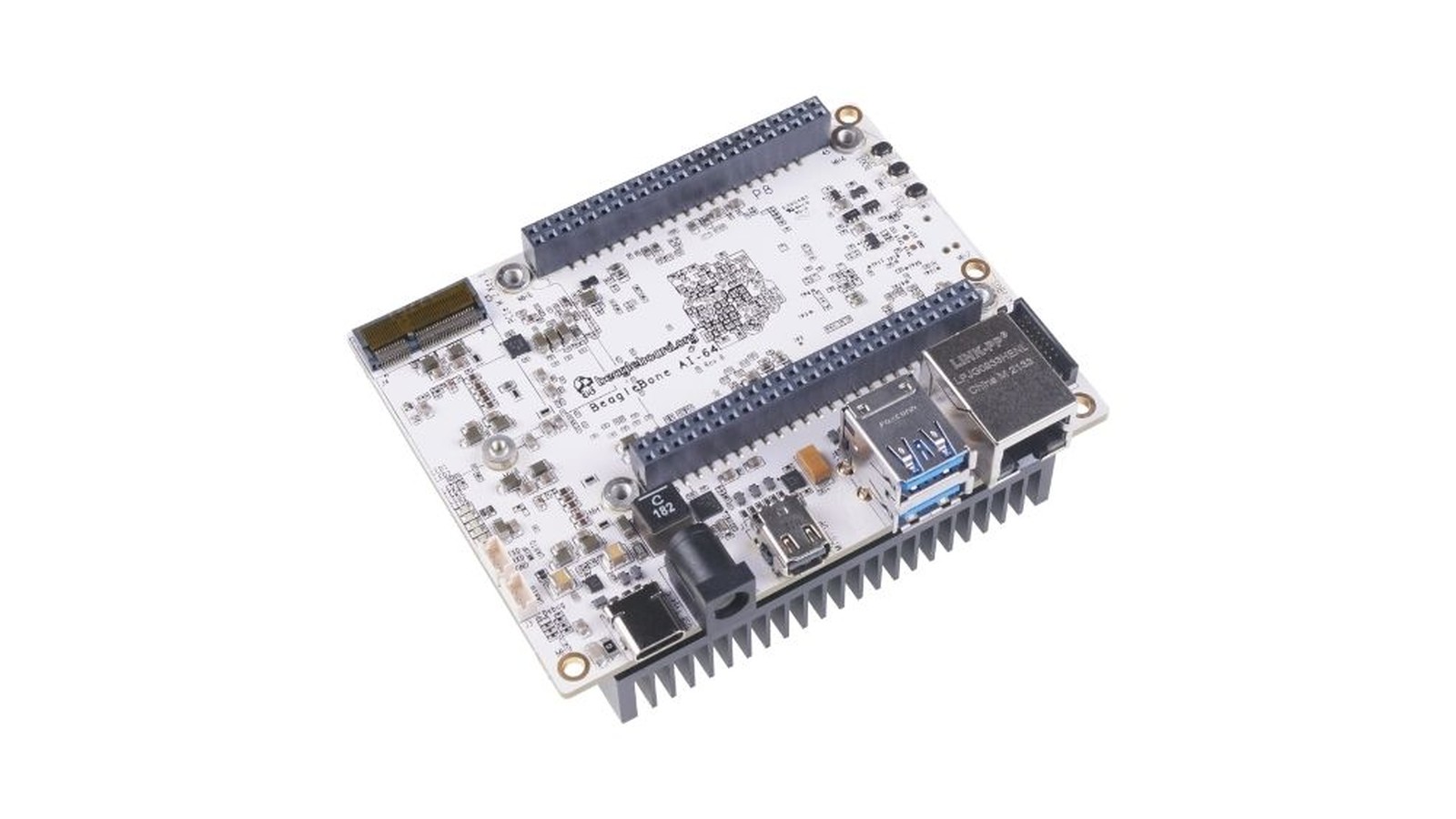
The board provides Gigabit Ethernet, two USB 3.0 Type-A ports, and a USB Type-C SuperSpeed interface used for data and power. An M.2 E-key connector can accept suitable Wi-Fi and Bluetooth adapters. Two four-lane CSI (Camera Serial Interface, a high-speed standard built for connecting camera sensors) connectors support cameras, while a four-lane DSI (Display Serial Interface, its counterpart for driving screens) connector serves displays. Mini DisplayPort provides another display route.
Those interfaces explain the focus on vision and automation. A developer can connect multiple cameras, high-speed storage or peripherals, a network, and a display without building every interface onto a custom carrier board first.
The physical board remains compatible with the familiar BeagleBone cape headers. A cape is an add-on board that plugs into the expansion headers, much like a shield in the Arduino ecosystem. BeagleBoard also included a mikroBUS Shuttle header, a standardized socket for Click boards and other modular sensor and actuator add-ons.
Compatibility needs to be checked electrically and mechanically, not assumed from connector shape. AI-64 is more power-hungry and complex than classic BeagleBone boards, and individual capes may depend on pin assignments or software support that differ.
Open hardware remains central
BeagleBoard described AI-64 as a fully open-hardware reference. That means design files and technical documentation are available for inspection and adaptation, subject to their licenses. The value goes beyond curiosity. Engineers can study the power system, trace interfaces, design a derivative, or validate how signals reach the processor.
Open hardware does not automatically make every component inside the system open. The TDA4VM contains proprietary intellectual property, and accelerator toolchains may have device-specific pieces. The board-level openness still reduces barriers between evaluation and a custom product.
That distinction is one reason BeagleBoard hardware often appeals to professional embedded developers as well as hobbyists. The board is not merely a small desktop. It is a documented reference platform for building embedded systems.
What the 8-TOPS rating means in practice
The accelerator is suited to quantized neural networks, where weights and activations use small integer formats such as 8-bit values. Quantization can reduce memory use and increase throughput, but a model must be converted and checked for acceptable accuracy.
A useful workflow starts with a supported model, measures preprocessing and inference together, and checks whether every operation maps to the accelerator. Unsupported layers may fall back to a general-purpose core and reduce performance sharply. Camera capture, resizing, color conversion, and post-processing can also become bottlenecks.
Projects that fit the hardware include object detection, machine inspection, occupancy analysis, autonomous robots, video analytics, and intelligent gateways. The board can also serve as a media or building-automation controller even when the AI accelerator is not the main attraction.
Cooling and power deserve planning. High compute loads create heat, and the official product image shows a substantial heat sink. A stable supply and airflow can be the difference between a benchmark and a system that runs continuously.
Why AI-64 Is a Major BeagleBone Release
Earlier BeagleBone boards have earned loyalty through accessible Linux, real-time programmable units, cape expansion, and unusually open documentation. AI-64 preserves those priorities while adding the kind of compute architecture normally associated with automotive vision and industrial processors.
It is not the simplest beginner board, and using every accelerator requires more work than installing a Python package on a desktop. That complexity is also its strength. Developers can learn how modern edge systems divide work between application processors, DSPs, dedicated accelerators, and real-time controllers.
BeagleBone AI-64 therefore deserves attention less as a raw TOPS headline than as a complete platform. It puts Linux, deterministic control, camera interfaces, high-speed I/O, and substantial edge-AI hardware on a documented board that can grow from experiments into serious automation designs.
I'd start with the supported vision examples and measure the whole pipeline, not just the model. The 8 TOPS figure is a ceiling, not a promise.
Sources and image credits
- BeagleBone AI-64 board page, BeagleBoard.org.
- BeagleBoard documentation: Boards, BeagleBoard.org.
- Official product image from BeagleBoard.org.
- Square and vertical crops are edited from the same source image.